Selecionar segmento
Estude com questões de diferentes segmentos
Atenção: Isso limpará todos os campos já preenchidos no filtro!
Foram encontradas 9.629 questões
Resolva questões gratuitamente!
Junte-se a mais de 4 milhões de concurseiros!


Ano: 2026
Banca:
FCC
Órgão:
SEFAZ-SP
Prova:
FCC - 2026 - SEFAZ-SP - Auditor Fiscal da Receita Estadual - AFRE - Gestão Tributária - Conhecimentos Básicos (P2) |
Q3955837
Direito Constitucional
Suponha que lei estadual institua região metropolitana, constituída por agrupamento de municípios limítrofes, para integrar a
organização, o planejamento e a execução de funções públicas de interesse comum, prevendo: (1) a criação de conselho de
caráter deliberativo e normativo, assegurada neste a participação paritária do conjunto dos Municípios, com relação ao Estado; e
(2) que o planejamento do transporte coletivo de caráter regional será realizado pelo Estado, em conjunto com os Municípios
integrantes da região. Considerados esses elementos à luz da Constituição Federal e da Constituição do Estado de São Paulo,
referida lei será
Ano: 2026
Banca:
FCC
Órgão:
SEFAZ-SP
Prova:
FCC - 2026 - SEFAZ-SP - Auditor Fiscal da Receita Estadual - AFRE - Gestão Tributária - Conhecimentos Básicos (P2) |
Q3955833
Direito Constitucional
Projeto de lei de iniciativa do Governador de determinado Estado visava a instituir gratificação para professores das escolas
estaduais que exercessem atribuições na educação especial. Por meio de emendas parlamentares ao projeto, referida gratificação foi estendida a todos os servidores que atuassem na educação especial, sem estimativa prévia de impacto orçamentário e
financeiro, ademais de ter sido concedida anistia para faltas dos servidores da área que tivessem participado de movimento
grevista pleiteando a extensão do benefício. Aprovado nesses termos pela Assembleia Legislativa, o projeto da lei foi encaminhado para sanção do Governador, que, no entanto, vetou ambas as previsões resultantes das emendas parlamentares, por
motivo de inconstitucionalidade. Nessa hipótese, em conformidade com a Constituição Federal e a jurisprudência do Supremo
Tribunal Federal, o veto governamental é
Ano: 2026
Banca:
FCC
Órgão:
SEFAZ-SP
Prova:
FCC - 2026 - SEFAZ-SP - Auditor Fiscal da Receita Estadual - AFRE - Gestão Tributária - Conhecimentos Gerais (P1) |
Q3954882
Economia
Ao analisar a estrutura do Balanço de Pagamentos brasileiro, segundo as regras vigentes do Banco Central, tem-se que
Ano: 2026
Banca:
FCC
Órgão:
SEFAZ-SP
Prova:
FCC - 2026 - SEFAZ-SP - Auditor Fiscal da Receita Estadual - AFRE - Gestão Tributária - Conhecimentos Gerais (P1) |
Q3954881
Economia
A tabela abaixo apresenta em sua coluna da esquerda quatro diferentes índices de preços utilizados no Brasil e, na coluna da
direita, as características relacionadas a esses diferentes índices.
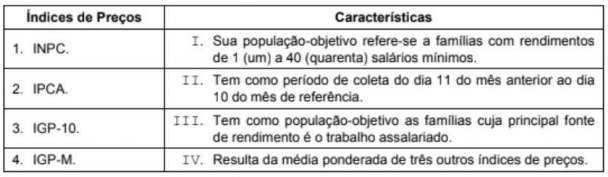
A alternativa que relaciona corretamente cada um dos índices de preços à sua característica é
A alternativa que relaciona corretamente cada um dos índices de preços à sua característica é
Ano: 2026
Banca:
FCC
Órgão:
SEFAZ-SP
Prova:
FCC - 2026 - SEFAZ-SP - Auditor Fiscal da Receita Estadual - AFRE - Gestão Tributária - Conhecimentos Gerais (P1) |
Q3954880
Economia
Em uma economia hipotética, uma crise inicialmente localizada na esfera imobiliária transforma-se em crise financeira, com
implicações macroeconômicas globais. Ao analisar seu impacto, em suas diferentes fases, sobre o equilíbrio macroeconômico
desse país, a partir da observação dos movimentos das curvas IS e LM em análise de curto prazo, tem-se que:
Ano: 2026
Banca:
FCC
Órgão:
SEFAZ-SP
Prova:
FCC - 2026 - SEFAZ-SP - Auditor Fiscal da Receita Estadual - AFRE - Gestão Tributária - Conhecimentos Gerais (P1) |
Q3954879
Economia
Considere um conjunto orçamentário hipotético que relaciona as quantidades dos bens A (eixo das abcissas) e B (eixo das
ordenadas). O estabelecimento de um imposto ou a concessão de um subsídio, sejam sobre a quantidade, sobre o valor, ou sobre
um montante fixo do bem A, mantido tudo mais constante, trazem alterações no conjunto orçamentário desse consumidor
hipotético.
Observa-se que um
Observa-se que um
Ano: 2026
Banca:
FCC
Órgão:
SEFAZ-SP
Prova:
FCC - 2026 - SEFAZ-SP - Auditor Fiscal da Receita Estadual - AFRE - Gestão Tributária - Conhecimentos Gerais (P1) |
Q3954878
Economia
O efeito multiplicador keynesiano refere-se à noção de que um aumento nos gastos governamentais leva a um aumento mais do
que proporcional na renda total da economia. Em uma situação hipotética na qual a Propensão Marginal ao Consumo Agregada
(PMgC) é de 90%, o multiplicador dos gastos governamentais tem o valor de
Ano: 2026
Banca:
FCC
Órgão:
SEFAZ-SP
Prova:
FCC - 2026 - SEFAZ-SP - Auditor Fiscal da Receita Estadual - AFRE - Gestão Tributária - Conhecimentos Gerais (P1) |
Q3954877
Economia
A respeito da teoria pigouviana do bem-estar econômico desenvolvida no começo do século passado em obras como Wealth
andWelfare (1912) e The Economics of Welfare (1920), fundamental para a compreensão da eficiência de mercado, considere:
I. contempla uma preocupação com a questão da ação pública com vistas a alcançar maior eficiência econômica.
II. introduz a questão das "falhas de mercado" como elementos que afetam o equilíbrio do mercado.
III. fortalece a posição contrária à tributação dos mais ricos, como ferramenta distributiva, com base no princípio da utilidade marginal decrescente.
IV. apresenta como pressuposto a igualdade entre produto marginal líquido privado e produto marginal líquido social, afastando a noção de falhas de mercado.
V. traz importantes elementos para o desenvolvimento posterior do que chamamos de Economia do Meio Ambiente.
Está correto o que se afirma APENAS em
I. contempla uma preocupação com a questão da ação pública com vistas a alcançar maior eficiência econômica.
II. introduz a questão das "falhas de mercado" como elementos que afetam o equilíbrio do mercado.
III. fortalece a posição contrária à tributação dos mais ricos, como ferramenta distributiva, com base no princípio da utilidade marginal decrescente.
IV. apresenta como pressuposto a igualdade entre produto marginal líquido privado e produto marginal líquido social, afastando a noção de falhas de mercado.
V. traz importantes elementos para o desenvolvimento posterior do que chamamos de Economia do Meio Ambiente.
Está correto o que se afirma APENAS em
Ano: 2026
Banca:
FCC
Órgão:
SEFAZ-SP
Prova:
FCC - 2026 - SEFAZ-SP - Auditor Fiscal da Receita Estadual - AFRE - Gestão Tributária - Conhecimentos Gerais (P1) |
Q3954875
Economia
Na análise microeconômica, dentre as várias ferramentas existentes, o mapa de isoquantas permite
Ano: 2026
Banca:
FCC
Órgão:
SEFAZ-SP
Prova:
FCC - 2026 - SEFAZ-SP - Auditor Fiscal da Receita Estadual - AFRE - Gestão Tributária - Conhecimentos Gerais (P1) |
Q3954874
Economia
Ao analisar o comportamento de um mercado competitivo em equilíbrio, considerando constantes outros fatores, a imposição de
uma redução do preço acarreta
Ano: 2026
Banca:
FCC
Órgão:
SEFAZ-SP
Prova:
FCC - 2026 - SEFAZ-SP - Auditor Fiscal da Receita Estadual - AFRE - Gestão Tributária - Conhecimentos Gerais (P1) |
Q3954873
Economia
Do cotejo entre as abordagens de Pigou (impostos e subsídios de Pigou) e de Coase (Teorema de Coase) sabe-se que:
Ano: 2026
Banca:
FCC
Órgão:
SEFAZ-SP
Prova:
FCC - 2026 - SEFAZ-SP - Auditor Fiscal da Receita Estadual - AFRE - Gestão Tributária - Conhecimentos Gerais (P1) |
Q3954872
Economia
Na busca de aperfeiçoamentos em uma estrutura tributária em um ambiente federativo, deve-se considerar que uma hipótese no
modelo de Tiebout é que
Ano: 2026
Banca:
FCC
Órgão:
SEFAZ-SP
Prova:
FCC - 2026 - SEFAZ-SP - Auditor Fiscal da Receita Estadual - AFRE - Gestão Tributária - Conhecimentos Gerais (P1) |
Q3954868
Economia
Ao analisar o comportamento da relação entre preço e consumo, tem-se que
Ano: 2026
Banca:
FCC
Órgão:
SEFAZ-SP
Prova:
FCC - 2026 - SEFAZ-SP - Auditor Fiscal da Receita Estadual - AFRE - Gestão Tributária - Conhecimentos Gerais (P1) |
Q3954867
Direito Administrativo
Considere que a Administração pretenda celebrar instrumento de parceria com o terceiro setor para realização de atividades
culturais no centro de São Paulo. De acordo com a legislação de regência, poderá firmar
Ano: 2026
Banca:
FCC
Órgão:
SEFAZ-SP
Prova:
FCC - 2026 - SEFAZ-SP - Auditor Fiscal da Receita Estadual - AFRE - Gestão Tributária - Conhecimentos Gerais (P1) |
Q3954863
Administração Pública
A Teoria da Mudança (Theory of Change) é amplamente utilizada no planejamento e na avaliação de políticas públicas e
programas sociais. Um de seus elementos distintivos em relação a outros instrumentos de planejamento consiste na
Ano: 2026
Banca:
FCC
Órgão:
SEFAZ-SP
Prova:
FCC - 2026 - SEFAZ-SP - Auditor Fiscal da Receita Estadual - AFRE - Gestão Tributária - Conhecimentos Gerais (P1) |
Q3954861
Auditoria
O COSO (The Commitee of Sponsoring Organizations), criado em 1985, é uma entidade privada sem fins lucrativos e com
objetivo de aperfeiçoar a qualidade de relatórios financeiros, em especial quanto à ocorrência de fraudes. Com a obra de 2004
Enterprise Risk Management- Integrated Framework, o COSO realizou um trabalho voltado para o gerenciamento de riscos
corporativos e, nesse contexto, a representação gráfica então apresentada consiste
Ano: 2026
Banca:
FCC
Órgão:
SEFAZ-SP
Prova:
FCC - 2026 - SEFAZ-SP - Auditor Fiscal da Receita Estadual - AFRE - Gestão Tributária - Conhecimentos Gerais (P1) |
Q3954855
Gestão de Pessoas
Suponha que determinado gestor pretenda avaliar o desempenho de sua equipe utilizando ferramentas e metodologias
consagradas de avaliação de desempenho. Nesse contexto, pretende aplicar a Avaliação 360°, também denominada Avaliação
Circular, o que significa que
Ano: 2026
Banca:
FCC
Órgão:
SEFAZ-SP
Prova:
FCC - 2026 - SEFAZ-SP - Auditor Fiscal da Receita Estadual - AFRE - Gestão Tributária - Conhecimentos Gerais (P1) |
Q3954852
Inglês
Texto associado
Atenção: Considere o texto abaixo para responder à questão.
Why Audits Fail: A Story of Missteps and Lessons Learned
24 January 2025
Let's look at three common reasons why audits fall apart and see what we can learn from them.
1. ______[subtítulo]_____
Picture an auditor walking into a company with a checklist and a laptop, ready to make sense of the chaos. But instead of finding
clarity, they're handed a series of false assumptions. Maybe management paints an overly rosy picture of their processes. Or
worse, the evidence provided is incomplete or outright fabricated. Imagine the frustration of trying to solve a puzzle when pieces
are deliberately hidden or swapped out.
Sometimes it's not malicious -management might not even realize their statements are misleading. But the result is the same:
the auditor can't do their job, and critical issues go unnoticed.
2. ALack of Skilled Resources
Now imagine the audit team itself. Maybe they're new, overwhelmed, or simply don't have the expertise needed to navigate the
complexities of this organization. Instead of spotting red flags, they miss them - or worse, don't even know where to look.
Auditing isn't easy. It takes specialized knowledge to dig into systems, spot gaps in controls, and interpret what the data is really
saying. Without skilled resources, even the most thorough audit plan can fall apart.
3. No Support from the Organization
Finally, imagine the company itself. The audit team asks for access to critical systems but gets stuck waiting for approval.
Employees avoid answering questions because they're either too busy or worried about saying the wrong thing. The systems in place are outdated, making it impossible to track down reliable data. At this point, it's like the auditor is running a race with their
shoelaces tied together.
Auditors can't succeed without support. They need access to systems, cooperation from employees, and tools that make their job
easier -not harder. When the organization doesn't provide this support, even the most well-intentioned audit is doomed.
How to Avoid a Failed Audit
So, how can we change the ending to this story? It comes down to preparation and collaboration. Here are a few things every
organization can do:
- Be Transparent: Don't hide problems. Audits are there to help, not punish.
- Invest in Skills: Train your audit team and give them the tools they need to succeed.
- Foster a Supportive Culture: Make sure ure employees see audits as opportunities for growth, not something to fear.
(Adapted from https://www.linkedin.com/pulse/why-audits-fail-story-missteps-lessons-learned-morfa-itil-cobit-5-1rghe/)
Um subtítulo adequado para a primeira circunstância que pode impedir uma boa auditoria é
Ano: 2026
Banca:
FCC
Órgão:
SEFAZ-SP
Prova:
FCC - 2026 - SEFAZ-SP - Auditor Fiscal da Receita Estadual - AFRE - Gestão Tributária - Conhecimentos Gerais (P1) |
Q3954851
Inglês
Texto associado
Atenção: Considere o texto abaixo para responder à questão.
Why Audits Fail: A Story of Missteps and Lessons Learned
24 January 2025
Let's look at three common reasons why audits fall apart and see what we can learn from them.
1. ______[subtítulo]_____
Picture an auditor walking into a company with a checklist and a laptop, ready to make sense of the chaos. But instead of finding
clarity, they're handed a series of false assumptions. Maybe management paints an overly rosy picture of their processes. Or
worse, the evidence provided is incomplete or outright fabricated. Imagine the frustration of trying to solve a puzzle when pieces
are deliberately hidden or swapped out.
Sometimes it's not malicious -management might not even realize their statements are misleading. But the result is the same:
the auditor can't do their job, and critical issues go unnoticed.
2. ALack of Skilled Resources
Now imagine the audit team itself. Maybe they're new, overwhelmed, or simply don't have the expertise needed to navigate the
complexities of this organization. Instead of spotting red flags, they miss them - or worse, don't even know where to look.
Auditing isn't easy. It takes specialized knowledge to dig into systems, spot gaps in controls, and interpret what the data is really
saying. Without skilled resources, even the most thorough audit plan can fall apart.
3. No Support from the Organization
Finally, imagine the company itself. The audit team asks for access to critical systems but gets stuck waiting for approval.
Employees avoid answering questions because they're either too busy or worried about saying the wrong thing. The systems in place are outdated, making it impossible to track down reliable data. At this point, it's like the auditor is running a race with their
shoelaces tied together.
Auditors can't succeed without support. They need access to systems, cooperation from employees, and tools that make their job
easier -not harder. When the organization doesn't provide this support, even the most well-intentioned audit is doomed.
How to Avoid a Failed Audit
So, how can we change the ending to this story? It comes down to preparation and collaboration. Here are a few things every
organization can do:
- Be Transparent: Don't hide problems. Audits are there to help, not punish.
- Invest in Skills: Train your audit team and give them the tools they need to succeed.
- Foster a Supportive Culture: Make sure ure employees see audits as opportunities for growth, not something to fear.
(Adapted from https://www.linkedin.com/pulse/why-audits-fail-story-missteps-lessons-learned-morfa-itil-cobit-5-1rghe/)
Segundo o texto,
Ano: 2026
Banca:
FCC
Órgão:
SEFAZ-SP
Prova:
FCC - 2026 - SEFAZ-SP - Auditor Fiscal da Receita Estadual - AFRE - Gestão Tributária - Conhecimentos Gerais (P1) |
Q3954850
Inglês
Texto associado
Atenção: Considere o texto abaixo para responder à questão.
Big Techs
When tax bills are in the millions or even billions, some individuals will go to any lengths to avoid paying up
RS, HMRC, FTS or CRA: whatever you like to call him, there's no hiding from the taxman. No individual or institution is immune from
the annual tax deadline, although many aim to reduce what they pay as much as possible through regulatory loopholes and profit
redistribution schemes.
When that tips over into illegal territory, though, it becomes a major problem. The International Monetary Fund (IMF) estimates that
over $600bn is lost every year due to tax avoidance, with the US, China and Japan named as the greatest culprits.
Multinational technology companies including Google, Apple and Amazon have been slapped with multiple allegations in recent years
regarding non-payment of taxes in Europe. In 2016, Apple was ordered to pay $15.4bn in back taxes to Ireland after it was revealed
that the company paid just one percent tax on its European profits in 2003, down to 0.005 percent in 2014. That same year Google was
accused of using two regulatory loopholes, nicknamed the 'double Irish', allowing it to pay just six percent corporation tax rather than
the required 19.3 percent.
The Double Irish arrangement was a base erosion and profit shifting (BEPS) corporate tax avoidance tool used mainly by United States
multinationals since the late 1980s to avoid corporate taxation on non-US profits. (The US was one of a small number of countries that
did not usea "territorial" tax system, and taxed corporations on all profits, no matter whether the profit was made outside the US or not,
in contrast to "territorial" tax systems which tax only profits made within that country.) It was the largest tax avoidance tool in history. By
2010, it was shielding US$100 billion annually in US multinational foreign profits from taxation, and was the main tool by which US
multinationals built up untaxed offshore reserves of US$1 trillion from 2004 to 2018.
Despite US knowledge of the Double Irish fora decade, it was the European Commission that in October 2014 forced Ireland to close
the scheme, starting in January 2015. However, users of existing schemes, such as Apple, Google, Facebook and Pfizer, were given
until January 2020 to close them.
At the announcement of the closure, it was known that multinationals had replacement BEPS tools in Ireland, the Single Malt (2014).
and Capital Allowances for Intangible Assets (CAIA) (2009):
-
Single malt is almost identical to the Double Irish, and was identified with Microsoft (Linkedin), and Allergan in 2017;
- CAIA can provide up to twice the tax shield of Single Malt, or Double Irish, and was identified with Apple in the 2015 leprechaun
economics affair, i.e., a huge statistical distortion in Ireland's GDP caused by Apple's tax restructuring. The company transferred
intangible assets to its Irish subsidiary, which artificially inflated the country's GDP by more than 26.3% in a single year (later
revised to 24.6%), an absurd leap for a relatively small economy. This growth did not reflect real production, but rather Apple's tax
inversion of about US$ 300 billion of its intangible assets (mainly intellectual property) to Ireland.
(Adapted from https://www.worldfinance.com/wealth-management/top-5-tax-scandals)
De acordo com o texto,
 Conheça nossos planos