Questões de Concurso
Para professor - letras
Foram encontradas 2.711 questões
Resolva questões gratuitamente!
Junte-se a mais de 4 milhões de concurseiros!


Ano: 2026
Banca:
IF-MT
Órgão:
IF-MT
Prova:
IF-MT - 2026 - IF-MT - Professor EBTT - Área: Português/Espanhol |
Q4275673
Noções de Informática
Uma equipe de professores de um curso técnico precisa elaborar o plano pedagógico do curso (PPC) de forma colaborativa, utilizando um documento on-line compartilhado no Google Docs. Todos os integrantes devem
poder editar o documento simultaneamente, com registro das alterações realizadas. O coordenador do curso,
responsável pela revisão final, necessita identificar quem realizou cada modificação, quando ela ocorreu e quais
alterações foram feitas ao longo do tempo. Qual recurso do Google Docs permite atender integralmente a esse
requisito de rastreamento e auditoria das edições?
Ano: 2026
Banca:
IF-MT
Órgão:
IF-MT
Prova:
IF-MT - 2026 - IF-MT - Professor EBTT - Área: Português/Espanhol |
Q4275672
Pedagogia
Um professor de História, utilizando o ambiente virtual de aprendizagem Moodle (versão 5), deseja configurar o
fluxo pedagógico de sua disciplina de forma condicional e automatizada. Ele pretende: i) disponibilizar o conteúdo
da unidade “Idade Média” apenas após a conclusão de atividades prévias; ii) exibir a nota de um questionário somente quando o aluno atingir um critério mínimo de desempenho (≥ 70%). Considerando os mecanismos nativos
de controle condicional e avaliação no Moodle, qual configuração atende integralmente a esses requisitos?
Ano: 2026
Banca:
IF-MT
Órgão:
IF-MT
Prova:
IF-MT - 2026 - IF-MT - Professor EBTT - Área: Português/Espanhol |
Q4275671
Pedagogia
Uma professora de Artes precisa criar um roteiro de vídeo para uma aula on-line sobre o movimento artístico
Expressionismo Alemão, com duração de 5 a 7 minutos. O roteiro deve incluir: i) introdução contextualizada; ii)
apresentação de 3 a 4 artistas com exemplos visuais; iii) conclusão reflexiva. Ela decide utilizar uma ferramenta
de IA generativa. Considerando-se boas práticas documentadas de engenharia de prompt — incluindo uso de
persona, contextualização, estruturação da saída e uso de exemplos (few-shot prompting), qual alternativa atende
integralmente a esses critérios?
Ano: 2026
Banca:
IF-MT
Órgão:
IF-MT
Prova:
IF-MT - 2026 - IF-MT - Professor EBTT - Área: Português/Espanhol |
Q4275670
Pedagogia
Um professor de Física utiliza o Google Sala de Aula para gerenciar sua disciplina. Ele deseja estruturar o conteúdo do curso de forma organizada e progressiva, garantindo que: i) as atividades sejam agrupadas por unidade
temática; ii) os materiais de apoio fiquem associados a cada unidade; iii) os alunos visualizem, de forma clara e
sequencial, os conteúdos e as tarefas. Considerando-se os recursos nativos da plataforma para organização pedagógica do conteúdo, qual alternativa atende integralmente a esses requisitos?
Ano: 2026
Banca:
IF-MT
Órgão:
IF-MT
Prova:
IF-MT - 2026 - IF-MT - Professor EBTT - Área: Português/Espanhol |
Q4275669
Pedagogia
A um professor de Língua Portuguesa foi solicitado criar um plano de aula de 50 minutos sobre a obra “Memórias
Póstumas de Brás Cubas”, de Machado de Assis, para uma turma do 3º ano do ensino médio. O plano deve ser
detalhado, incluindo objetivos de aprendizagem, metodologia, recursos didáticos e uma atividade de avaliação.
Para otimizar o tempo, ele decide utilizar uma ferramenta de IA generativa (como ChatGPT, Gemini ou Claude).
De acordo com boas práticas documentadas de engenharia de prompt — como fornecer instruções claras, contexto suficiente e especificar explicitamente a estrutura da saída, qual alternativa atende integralmente a essas
diretrizes para o objetivo proposto?
Ano: 2026
Banca:
IF-MT
Órgão:
IF-MT
Prova:
IF-MT - 2026 - IF-MT - Professor EBTT - Área: Português/Espanhol |
Q4275668
Noções de Informática
Um professor deseja calcular a média ponderada das notas de seus alunos em uma planilha, utilizando softwares
como Microsoft Excel ou LibreOffice Calc. As notas estão nas colunas B (Prova 1), C (Prova 2) e D (Trabalho), e os
respectivos pesos (4, 3 e 3) estão armazenados nas células F1, G1 e H1. Ao copiar a fórmula para as demais linhas,
os valores dos pesos devem permanecer fixos, enquanto as referências das notas devem ser ajustadas automaticamente. Considerando-se o uso correto de referências absolutas exclusivamente nas células de pesos, qual
fórmula atende integralmente a esse requisito?
Ano: 2026
Banca:
IF-MT
Órgão:
IF-MT
Prova:
IF-MT - 2026 - IF-MT - Professor EBTT - Área: Português/Espanhol |
Q4275667
Noções de Informática
Uma professora deseja padronizar visualmente todos os slides de sua apresentação, garantindo que títulos, fontes, cores e elementos gráficos sigam um mesmo estilo automaticamente, sem necessidade de formatação manual em cada slide. Qual recurso do Microsoft PowerPoint, LibreOffice Impress ou Google Apresentações permite
definir e aplicar esse padrão global de layout e formatação de forma centralizada?
Ano: 2026
Banca:
IF-MT
Órgão:
IF-MT
Prova:
IF-MT - 2026 - IF-MT - Professor EBTT - Área: Português/Espanhol |
Q4275666
Noções de Informática
Um professor de Química está elaborando uma prova com dez questões, sendo que a última, sobre balanceamento de equações químicas, exige a inserção de fórmulas e símbolos específicos, como subscritos (H₂O) e
sobrescritos (C⁶⁺). Para garantir que a representação visual da fórmula química fique correta, padronizada e
editável diretamente no documento, qual recurso de formatação de fonte, disponível em editores de texto como
Microsoft Word, LibreOffice Writer e Google Docs, é o mais apropriado para essa finalidade?
Ano: 2026
Banca:
IF-MT
Órgão:
IF-MT
Prova:
IF-MT - 2026 - IF-MT - Professor EBTT - Área: Português/Espanhol |
Q4275664
Pedagogia
Durante a elaboração de seu plano de expansão, o Instituto Federal Beta destacou a necessidade de alinhar suas
metas institucionais ao Plano Nacional de Educação – PNE (Lei Federal 15.388, de 2026). No que se refere à educação profissional, o Objetivo 12 do PNE busca:
Fonte: BRASIL. Lei nº 15.388, de 14 de abril de 2026. Aprova o Plano Nacional de Educação (PNE). Diário Oficial da União: seção 1, Brasília, DF, 15 abr. 2026. Disponível em: https://www.planalto.gov.br/ccivil_03/_ato2023-2026/2026/lei/l15388.htm. Acesso em: 24 abr. 2026.
Fonte: BRASIL. Lei nº 15.388, de 14 de abril de 2026. Aprova o Plano Nacional de Educação (PNE). Diário Oficial da União: seção 1, Brasília, DF, 15 abr. 2026. Disponível em: https://www.planalto.gov.br/ccivil_03/_ato2023-2026/2026/lei/l15388.htm. Acesso em: 24 abr. 2026.
Ano: 2026
Banca:
IF-MT
Órgão:
IF-MT
Prova:
IF-MT - 2026 - IF-MT - Professor EBTT - Área: Português/Espanhol |
Q4275662
Legislação Federal
De acordo com a nova redação da Lei 12.772, de 2012, dada pela Lei 15.141, de 2025, a partir de 1º de janeiro de
2025, o ingresso na Carreira de Magistério do Ensino Básico, Técnico e Tecnológico passou a ocorrer:
Fonte: BRASIL. Lei nº 12.772, de 28 de dezembro de 2012. Dispõe sobre a estruturação do Plano de Carreiras e Cargos de Magistério do Ensino Básico, Técnico e Tecnológico, e dá outras providências. Diário Oficial da União: seção 1, Brasília, DF, 31 dez. 2012. Disponível em: https://www.planalto.gov.br/ccivil_03/_ato2011-2014/2012/lei/l12772compilado.htm. Acesso em: 24 abr. 2026.
Fonte: BRASIL. Lei nº 12.772, de 28 de dezembro de 2012. Dispõe sobre a estruturação do Plano de Carreiras e Cargos de Magistério do Ensino Básico, Técnico e Tecnológico, e dá outras providências. Diário Oficial da União: seção 1, Brasília, DF, 31 dez. 2012. Disponível em: https://www.planalto.gov.br/ccivil_03/_ato2011-2014/2012/lei/l12772compilado.htm. Acesso em: 24 abr. 2026.
Ano: 2026
Banca:
IF-MT
Órgão:
IF-MT
Prova:
IF-MT - 2026 - IF-MT - Professor EBTT - Área: Português/Espanhol |
Q4275661
Pedagogia
Um estudante do curso técnico integrado de nível médio do IFMT, ao final do semestre, não atingiu a média mínima para aprovação em um componente curricular. Diante disso, o professor deste componente curricular explicou ao estudante que haveria a possibilidade de realizar atividades específicas para recuperar a aprendizagem,
nos termos do Regulamento Didático da Instituição. Para tanto, segundo a Resolução CONSUP/IFMT 81, de 2020,
os estudos de recuperação processual deverão ocorrer:
Fonte: INSTITUTO FEDERAL DE EDUCAÇÃO, CIÊNCIA E TECNOLOGIA DE MATO GROSSO. Conselho Superior. Resolução CONSUP/IFMT nº 81, de 26 de novembro de 2020. Aprova o Regulamento Didático do Instituto Federal de Educação, Ciência e Tecnologia de Mato Grosso. Cuiabá: IFMT, 2020. Disponível em: https://drive.google.com/file/d/17ETcl0UM4w_0YCxezYifQ_N7w-sFdyhX/view. Acesso em: 24 abr. 2026.
Fonte: INSTITUTO FEDERAL DE EDUCAÇÃO, CIÊNCIA E TECNOLOGIA DE MATO GROSSO. Conselho Superior. Resolução CONSUP/IFMT nº 81, de 26 de novembro de 2020. Aprova o Regulamento Didático do Instituto Federal de Educação, Ciência e Tecnologia de Mato Grosso. Cuiabá: IFMT, 2020. Disponível em: https://drive.google.com/file/d/17ETcl0UM4w_0YCxezYifQ_N7w-sFdyhX/view. Acesso em: 24 abr. 2026.
Ano: 2026
Banca:
IF-MT
Órgão:
IF-MT
Prova:
IF-MT - 2026 - IF-MT - Professor EBTT - Área: Português/Espanhol |
Q4275660
Pedagogia
Durante o acompanhamento de uma turma de licenciatura, a coordenação percebeu que alguns estudantes
estavam ultrapassando o limite de faltas permitido. Ao orientar os docentes, destacou-se a exigência mínima de
frequência prevista no Regulamento Didático do IFMT. Nesse sentido, de acordo com a Resolução CONSUP/IFMT
81, de 2020, a frequência mínima exigida para a aprovação no referido curso de graduação corresponde a:
Fonte: INSTITUTO FEDERAL DE EDUCAÇÃO, CIÊNCIA E TECNOLOGIA DE MATO GROSSO. Conselho Superior. Resolução CONSUP/IFMT nº 81, de 26 de novembro de 2020. Aprova o Regulamento Didático do Instituto Federal de Educação, Ciência e Tecnologia de Mato Grosso. Cuiabá: IFMT, 2020. Disponível em: https://drive.google.com/file/d/17ETcl0UM4w_0YCxezYifQ_N7w-sFdyhX/view. Acesso em: 24 abr. 2026.
Fonte: INSTITUTO FEDERAL DE EDUCAÇÃO, CIÊNCIA E TECNOLOGIA DE MATO GROSSO. Conselho Superior. Resolução CONSUP/IFMT nº 81, de 26 de novembro de 2020. Aprova o Regulamento Didático do Instituto Federal de Educação, Ciência e Tecnologia de Mato Grosso. Cuiabá: IFMT, 2020. Disponível em: https://drive.google.com/file/d/17ETcl0UM4w_0YCxezYifQ_N7w-sFdyhX/view. Acesso em: 24 abr. 2026.
Ano: 2026
Banca:
IF-MT
Órgão:
IF-MT
Prova:
IF-MT - 2026 - IF-MT - Professor EBTT - Área: Português/Espanhol |
Q4275659
Pedagogia
O Instituto Federal Alfa está estruturando um novo curso técnico na área de energias renováveis. Durante as
reuniões de planejamento, sua equipe pedagógica discute como organizar o itinerário formativo, destacando que
este deve ir além da simples seleção de conteúdos disciplinares, buscando configurar uma trajetória formativa
consistente, alinhada às demandas do mundo do trabalho e aos fundamentos científicos e tecnológicos da área.
Com base nesta situação hipotética, e segundo as disposições das Diretrizes Curriculares Nacionais Gerais para a Educação Profissional e Tecnológica (Resolução CNE/CP 1, de 2021), o itinerário formativo deve contemplar a articulação de cursos e programas, configurando trajetória educacional consistente e programada, a partir de:
Fonte: BRASIL. Ministério da Educação. Conselho Nacional de Educação. Resolução CNE/CP nº 1, de 5 de janeiro de 2021. Define as Diretrizes Curriculares Nacionais Gerais para a Educação Profissional e Tecnológica. Diário Oficial da União: seção 1, Brasília, DF, 6 jan. 2021. Disponível em: https://www.gov.br/mec/pt-br/cne/resolucoes/resolucoes-cp-2021. Acesso em: 24 abr. 2026.
Com base nesta situação hipotética, e segundo as disposições das Diretrizes Curriculares Nacionais Gerais para a Educação Profissional e Tecnológica (Resolução CNE/CP 1, de 2021), o itinerário formativo deve contemplar a articulação de cursos e programas, configurando trajetória educacional consistente e programada, a partir de:
Fonte: BRASIL. Ministério da Educação. Conselho Nacional de Educação. Resolução CNE/CP nº 1, de 5 de janeiro de 2021. Define as Diretrizes Curriculares Nacionais Gerais para a Educação Profissional e Tecnológica. Diário Oficial da União: seção 1, Brasília, DF, 6 jan. 2021. Disponível em: https://www.gov.br/mec/pt-br/cne/resolucoes/resolucoes-cp-2021. Acesso em: 24 abr. 2026.
Ano: 2026
Banca:
IF-MT
Órgão:
IF-MT
Prova:
IF-MT - 2026 - IF-MT - Professor EBTT - Área: Português/Espanhol |
Q4275658
Meteorologia
Leia o trecho de notícia:
COM MAIS DE 40°C, CUIABÁ É A CIDADE MAIS QUENTE DO PAÍS NESTA SEMANA, APONTA INMET
No domingo e na segunda-feira, Cuiabá bateu dois recordes consecutivos de calor no ano, na medição manual de temperatura feita pelo Inmet.
Cuiabá tem enfrentado uma onda de calor intensa nos últimos dias e registrou as temperaturas mais altas do país nesta semana, chegando a mais de 40°C, segundo Instituto Nacional de Meteorologia (Inmet) (veja abaixo). Nesta quarta-feira (21), a capital de Mato Grosso deve seguir liderando o ranking das cidades mais quentes do Brasil, com previsão de temperatura máxima de 39°C durante a tarde.
Confira as temperaturas registradas em Cuiabá nesta semana:
• Domingo (17): 40°C • Segunda-feira (18): 40,2°C
• Terça-feira (19): 39,0°C
• Quarta-feira (20): 39,8°C
A capital mato-grossense é uma das cidades mais afetadas por um fenômeno climático que provoca elevação atípica das temperaturas durante o inverno. A umidade relativa do ar nesta semana segue abaixo dos 30%, o que acende um alerta de risco à saúde [...].
Disponível em: https://g1.globo.com/mt/mato-grosso/noticia/2025/08/21/com-mais-de-40c-cuiaba-e-a-cidade-mais-quente-do-pais- -nesta-semana-aponta-inmet.ghtml (adaptado). Acesso em: 23 ago. 2025.
O fenômeno climático noticiado no texto é conhecido como:
COM MAIS DE 40°C, CUIABÁ É A CIDADE MAIS QUENTE DO PAÍS NESTA SEMANA, APONTA INMET
No domingo e na segunda-feira, Cuiabá bateu dois recordes consecutivos de calor no ano, na medição manual de temperatura feita pelo Inmet.
Cuiabá tem enfrentado uma onda de calor intensa nos últimos dias e registrou as temperaturas mais altas do país nesta semana, chegando a mais de 40°C, segundo Instituto Nacional de Meteorologia (Inmet) (veja abaixo). Nesta quarta-feira (21), a capital de Mato Grosso deve seguir liderando o ranking das cidades mais quentes do Brasil, com previsão de temperatura máxima de 39°C durante a tarde.
Confira as temperaturas registradas em Cuiabá nesta semana:
• Domingo (17): 40°C • Segunda-feira (18): 40,2°C
• Terça-feira (19): 39,0°C
• Quarta-feira (20): 39,8°C
A capital mato-grossense é uma das cidades mais afetadas por um fenômeno climático que provoca elevação atípica das temperaturas durante o inverno. A umidade relativa do ar nesta semana segue abaixo dos 30%, o que acende um alerta de risco à saúde [...].
Disponível em: https://g1.globo.com/mt/mato-grosso/noticia/2025/08/21/com-mais-de-40c-cuiaba-e-a-cidade-mais-quente-do-pais- -nesta-semana-aponta-inmet.ghtml (adaptado). Acesso em: 23 ago. 2025.
O fenômeno climático noticiado no texto é conhecido como:
Ano: 2026
Banca:
IF-MT
Órgão:
IF-MT
Prova:
IF-MT - 2026 - IF-MT - Professor EBTT - Área: Português/Espanhol |
Q4275657
História e Geografia de Estados e Municípios
Segundo dados do Instituto Brasileiro de Geografia e Estatística (IBGE, 2024), o estado de Mato Grosso possui
uma área territorial de 903.804,362 km², sendo o terceiro mais extenso do país, superado apenas por Pará e Amazonas. Dentro do estado, o maior (27.960,237 km²) e o menor (344,330 km²) município, em extensão territorial,
são, respectivamente:
Ano: 2026
Banca:
IF-MT
Órgão:
IF-MT
Prova:
IF-MT - 2026 - IF-MT - Professor EBTT - Área: Português/Espanhol |
Q4275656
Geografia
Leia o trecho de notícia:
IBAMA COMBATE GARIMPO ILEGAL E DESARTICULA INFRAESTRUTURA CRIMINOSA EM MATO GROSSO
Operação Xapiri faz parte da força-tarefa de desintrusão da Terra Indígena Sararé, onde mais de 400 acampamentos utilizados por garimpeiros foram destruídos
Brasília/DF (25/08/2025) – Desde o início do mês, o Instituto Brasileiro do Meio Ambiente e dos Recursos Naturais Renováveis (Ibama) tem conduzido a Operação Xapiri-Sararé para combater o garimpo ilegal na Terra Indígena (TI) Sararé, em Mato Grosso. A ação já resultou na destruição de uma vasta infraestrutura utilizada pelos garimpeiros.
As equipes de fiscalização inutilizaram, até o momento, 100 escavadeiras hidráulicas, 317 motores estacionários, 431 acampamentos, 61 mil litros de combustível (diesel e gasolina), 43 motocicletas, 9 caminhonetes, 12 caminhões, além de outros equipamentos usados na extração ilegal de ouro.
A Operação Xapiri-Sararé conta com a parceria das seguintes instituições: Ministério dos Povos Indígenas (MPI), Fundação Nacional dos Povos Indígenas (Funai), Polícia Rodoviária Federal (PRF), Polícia Federal (PF), Força Nacional de Segurança Pública (FNSP), Centro Gestor e Operacional do Sistema de Proteção da Amazônia (Censipam) e Agência Brasileira de Inteligência (ABIN), além do apoio da Polícia Civil de Goiás (CORE/ GT3) [...].
Disponível em: https://www.gov.br/ibama/pt-br/assuntos/noticias/2025/ibama-combate-garimpo-ilegal-e-desarticula-infraestrutura- -criminosa-em-mato-grosso (adaptado). Acesso em: 28 ago. 2025.
A Terra Indígena mencionada no texto é o lar do povo:
IBAMA COMBATE GARIMPO ILEGAL E DESARTICULA INFRAESTRUTURA CRIMINOSA EM MATO GROSSO
Operação Xapiri faz parte da força-tarefa de desintrusão da Terra Indígena Sararé, onde mais de 400 acampamentos utilizados por garimpeiros foram destruídos
Brasília/DF (25/08/2025) – Desde o início do mês, o Instituto Brasileiro do Meio Ambiente e dos Recursos Naturais Renováveis (Ibama) tem conduzido a Operação Xapiri-Sararé para combater o garimpo ilegal na Terra Indígena (TI) Sararé, em Mato Grosso. A ação já resultou na destruição de uma vasta infraestrutura utilizada pelos garimpeiros.
As equipes de fiscalização inutilizaram, até o momento, 100 escavadeiras hidráulicas, 317 motores estacionários, 431 acampamentos, 61 mil litros de combustível (diesel e gasolina), 43 motocicletas, 9 caminhonetes, 12 caminhões, além de outros equipamentos usados na extração ilegal de ouro.
A Operação Xapiri-Sararé conta com a parceria das seguintes instituições: Ministério dos Povos Indígenas (MPI), Fundação Nacional dos Povos Indígenas (Funai), Polícia Rodoviária Federal (PRF), Polícia Federal (PF), Força Nacional de Segurança Pública (FNSP), Centro Gestor e Operacional do Sistema de Proteção da Amazônia (Censipam) e Agência Brasileira de Inteligência (ABIN), além do apoio da Polícia Civil de Goiás (CORE/ GT3) [...].
Disponível em: https://www.gov.br/ibama/pt-br/assuntos/noticias/2025/ibama-combate-garimpo-ilegal-e-desarticula-infraestrutura- -criminosa-em-mato-grosso (adaptado). Acesso em: 28 ago. 2025.
A Terra Indígena mencionada no texto é o lar do povo:
Ano: 2026
Banca:
FUNDATEC
Órgão:
Prefeitura de Água Doce - SC
Prova:
FUNDATEC - 2026 - Prefeitura de Água Doce - SC - Professor, com atuação de 6ª a 9ª séries do Ensino Fundamental Português/Inglês - Edital nº 3 PSS |
Q4237504
Português
Texto associado
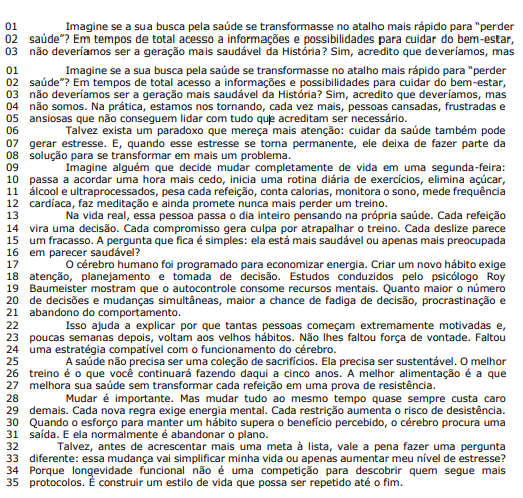
Quando a busca pela saúde passa a fazer mal
Por Marcio Atalla
(Disponível em: https://oglobo.globo.com/saude/marcio-atalla/post/2026/07/quando-a-busca-pela-saudepassa-a-fazer-mal.ghtml – texto adaptado especialmente para esta prova).
Analise as assertivas a seguir considerando o trecho abaixo, retirado do texto:
“Na vida real, essa pessoa passa o dia inteiro pensando na própria saúde”.
I. O segmento “na vida real” é isolado por vírgula por se tratar de um adjunto adverbial deslocado.
II. A palavra “essa” é classificada morfologicamente como um pronome demonstrativo.
III. O segmento “na própria saúde” desempenha a função sintática de objeto direto do verbo “pensando”.
Quais estão corretas?
“Na vida real, essa pessoa passa o dia inteiro pensando na própria saúde”.
I. O segmento “na vida real” é isolado por vírgula por se tratar de um adjunto adverbial deslocado.
II. A palavra “essa” é classificada morfologicamente como um pronome demonstrativo.
III. O segmento “na própria saúde” desempenha a função sintática de objeto direto do verbo “pensando”.
Quais estão corretas?
Ano: 2026
Banca:
FUNDATEC
Órgão:
Prefeitura de Água Doce - SC
Prova:
FUNDATEC - 2026 - Prefeitura de Água Doce - SC - Professor, com atuação de 6ª a 9ª séries do Ensino Fundamental Português/Inglês - Edital nº 3 PSS |
Q4237503
Português
Texto associado
Quando a busca pela saúde passa a fazer mal
Por Marcio Atalla
(Disponível em: https://oglobo.globo.com/saude/marcio-atalla/post/2026/07/quando-a-busca-pela-saudepassa-a-fazer-mal.ghtml – texto adaptado especialmente para esta prova).
Com base no texto, é correto afirmar que:
Ano: 2026
Banca:
FUNDATEC
Órgão:
Prefeitura de Água Doce - SC
Prova:
FUNDATEC - 2026 - Prefeitura de Água Doce - SC - Professor, com atuação de 6ª a 9ª séries do Ensino Fundamental Português/Inglês - Edital nº 3 PSS |
Q4237502
Inglês
Texto associado
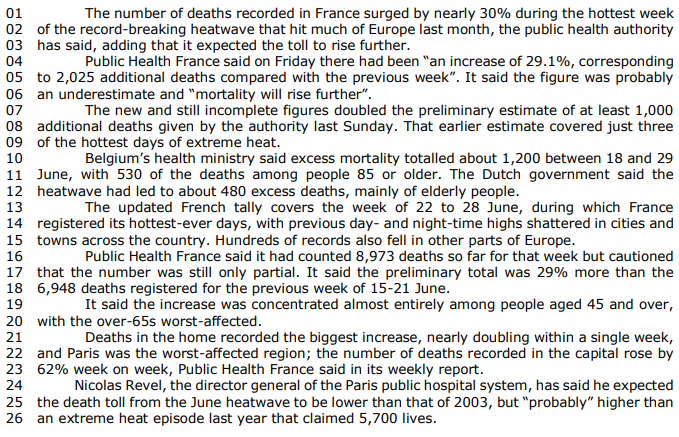
Deaths in France surged 30% during hottest week of record June heatwave
By Jon Henley
(Available at: https://www.theguardian.com/world/2026/jul/03/deaths-france-surged-hottest-week-recordheatwave-june – text specially adapted for this test).
In the sentence “It said the figure was probably an underestimate [...]” (l. 05-06),
the pronoun “It” refers to:
Ano: 2026
Banca:
FUNDATEC
Órgão:
Prefeitura de Água Doce - SC
Prova:
FUNDATEC - 2026 - Prefeitura de Água Doce - SC - Professor, com atuação de 6ª a 9ª séries do Ensino Fundamental Português/Inglês - Edital nº 3 PSS |
Q4237501
Inglês
Texto associado
Deaths in France surged 30% during hottest week of record June heatwave
By Jon Henley
(Available at: https://www.theguardian.com/world/2026/jul/03/deaths-france-surged-hottest-week-recordheatwave-june – text specially adapted for this test).
Mark the alternative in which the verb “hit” is used with the same meaning as in the
sentence “the record-breaking heatwave that hit much of Europe last month […]” (l. 02).

 Conheça nossos planos