Questões de Concurso
Para inep
Foram encontradas 2.648 questões
Resolva questões gratuitamente!
Junte-se a mais de 4 milhões de concurseiros!


Q4151675
Inglês
 Available at: https://www.instagram.com/.
Accessed on: June 17, 2024
Last week, when an English teacher got into her High School class, one of her students was showing the poem above to her friends. She said she had found it online and was curious about it because its structure was different from the ones she was used to reading. The teacher was pleased to hear that, and thought this would be an excellent opportunity to introduce her class into this non-canonical literature. She started presenting the author, Rupi Kaur, a contemporary Indian poet. Then, she read it aloud and asked them to work in pairs to figure out its main idea.
Considering the students’ ages, their school level and their critical thinking ability, the teacher anticipated they should be able to understand that
Q4151674
Pedagogia
A teacher has decided to focus on improving his students’ speaking skills through group discussions.
The teacher believes that language learning is best achieved when students actively use the language in
meaningful contexts. Therefore, he organizes activities that encourage interaction and communication
among students and provides them with real-life scenarios to discuss and work on together, promoting
the use of authentic language.
Which theoretical approach to language learning underlies this teacher’s decisions?
Which theoretical approach to language learning underlies this teacher’s decisions?
Q4151673
Pedagogia
October in Brazil. An English teacher and her students decide to celebrate Halloween at the end of the
month. The kids were very excited because it was their first cultural experience at Middle School. They
started talking frenetically, all at the same time. Despite being very pleased with that situation, the teacher
decided to interrupt the discussion in order to organize the class celebration.
Considering this scenario and adopting a cultural approach, what would be the teacher’s first step?
Considering this scenario and adopting a cultural approach, what would be the teacher’s first step?
Q4151672
Inglês
TEXT 1
After the students have repeated the dialogue several times, the teacher gives them a chance to adopt the role of Bill while she says Sally’s lines. Before the class actually says each line, the teacher models it. In effect, the class is experiencing a repetition drill where the students have to listen carefully and attempt to mimic the teacher’s model as accurately as possible.
LARSEN-FREEMAN, D.; ANDERSON, M. Techniques & principles in language teaching. Oxford: OUP, 2011 (adapted).
TEXT 2
The teacher greets the class and distributes a handout. There is writing on both sides. On one side is a copy of a sports column from a recent newspaper. The reporter is discussing the last World Cup competition. The teacher asks the students to read it and then to underline the predictions the reporter makes about the next World Cup. He gives them these directions in the target language. Then, he and the students discuss which predictions the reporter feels more certain about and which predictions he feels less certain about.
LARSEN-FREEMAN, D.; ANDERSON, M. Techniques & principles in language teaching. Oxford: OUP, 2011 (adapted).
Considering the concept of language learning methods and their characteristics, we can state about text 1 and text 2, respectively, that
Q4151671
Pedagogia
Available at: https://learningtogether2012.wordpress.com/. Accessed on: May 28, 2024.
Both Shakespeare and Jane Austen died centuries ago and their themes and characters are still contemporary. In order to find out how recurrent their themes are, select the alternative that presents the appropriate type of research.
Q4151670
Inglês
TEXT 1
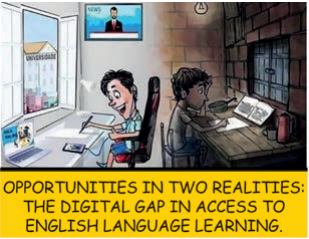 Available at: https://saladerecursos.com.br/. Accessed on: April 8, 2024 (adapted).
TEXT 2
 Available at: https://petletras.paginas.ufsc.br/.
Accessed on: April 8, 2024 (adapted).
From the analysis of the images above, nowadays, the use of digital technologies in English learning
Available at: https://saladerecursos.com.br/. Accessed on: April 8, 2024 (adapted).
TEXT 2
Available at: https://petletras.paginas.ufsc.br/.
Accessed on: April 8, 2024 (adapted).
From the analysis of the images above, nowadays, the use of digital technologies in English learning
Q4151669
Pedagogia
TEXT 1
The new High School English teacher has heard her colleagues use the following adjectives to characterize her students: noisy, challenging and disinterested. However, she knows that adolescence is a developmental stage influenced by biological, cognitive and affective factors and that necessary pedagogical adjustments are needed to meet the unique demands of this time. In any case, this reality poses a challenge for her, as she has the task of developing reading and writing skills in English. To meet these requirements, the teacher wishes to seek alternative assessment methods that encourage students to read and produce collaborative, critically reflective texts from which they can construct ideas and develop their argumentative and creative skills. She recognizes that her role should be that of a facilitator in the writing process.
TEXT 2
Due to the qualitative leap in intelligence during the adolescent stage of development, a more mechanical and traditional approach to teaching, learning and assessment that focuses solely on performance by the teacher and learning by the student, without encouraging genuine interaction between them, is more likely to lead to fatigue, discouragement and lack of engagement with the new language being learned. It also becomes clear that teaching based on an exclusionary methodology, ignoring the feelings and needs of these students and increasing their distance from the teacher, does not reach the world of adolescents. However, if they are guided by a meaningful approach to learning, encouraged to actively participate in the classroom and in decision-making processes, and feel that their thoughts and opinions are valued, the process of language learning, teaching and assessment can take a different direction that makes sense to them.
ROCHA, C. H.; BASSO, E. A. Ensinar e aprender língua estrangeira nas diferentes idades – reflexões para professores e formadores. São Carlos: Editora Claraluz, 2008 (adapted).
Based on the information presented, an assessment strategy that is consistent with the teacher’s aims and the characteristics of the developmental stage in question involves
Q4151668
Pedagogia
Considering the emerging need to reflect on how teenagers deal with their emotions, a 9th-grade English
teacher played the preview of the animation InsideOut, showing how emotions interact in the human
brain, and then, presented the following excerpt from the novel Things Fall Apart:
“Okonkwo never showed any emotion openly, unless it be the emotion of anger. To show affection was a sign of weakness; the only thing worth demonstrating was strength”.
ACHEBE, C. Things fall apart. London: Penguin Classics, 2006.
After that, the teacher provided information about Nigeria during the period the novel was set, pointing out the consequences of colonialism on indigenous culture. The students had a moment to analyze the excerpt critically, consider the plot, and establish connections with the animation preview. At the end of the class, the teacher proposed a digital storytelling project, so students could use multimedia elements to quote the novel.
By incorporating the animation preview and the excerpt from Things Fall Apart to talk about emotions, the teacher
Q4151667
Pedagogia
Any student, regardless of their varied skills, experiences, or identities, should have access to fair and
equitable educational opportunities, according to the inclusive education movement (UNESCO, 2019). The
ideas of inclusive education are expanded to the field of language acquisition within the context of English
Language Teaching (ELT). It places a focus on creating a welcoming environment for language instruction
where all students may actively participate and realize their full potential.
ANIS, M., KHAN, R. Integrating Multimodal Approaches in English Language Teaching for Inclusive Education: A Pedagogical Exploration. Universal Journal of Educational Research. (online), v.2, n.3, p. 2.960-3.722, jun./sept. 2023 (adapted).
Taking into consideration what UNESCO suggests about inclusive ELT, choose the alternative that brings an adequate source of intrinsic motivation to be observed by teachers when planning a lesson that is based on students’ learning styles, aiming at promoting students’ inclusion.
Q4151666
Pedagogia
Lesson plan
Objectives: To help students understand and apply pragmatic aspects of the English language in various contexts by using role-play and real-life scenarios.
Duration: 90 minutes.
Materials: Whiteboard and markers; printed role-play scenario cards; audio recordings of dialogues (optional); handouts with discussion prompts and reflection questions.
Assessment: Participation in role-play activities and class discussion.
Introduction (10 minutes): Explain that pragmatics involves understanding the context in which language is used and how meaning is constructed in different situations.
Warm-up activity (10 minutes):
Role-play activity (40 minutes):
Class discussion (15 minutes):
Audio analysis (optional) (10 minutes):
Reflection and homework (5 minutes):
The teacher has started planning the lesson. Taking into consideration this teacher’s lesson plan for a High School context, choose the alternative that fits the warm-up activity.
Q4151665
Inglês
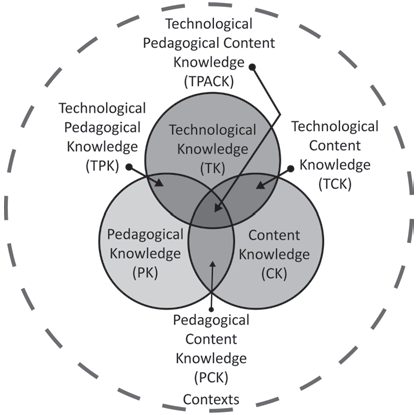
The Technological Pedagogical Content Knowledge (TPACK) is a model that seeks to identify the types of
knowledge a teacher needs to master to integrate Information and Communication Technologies (ICT) in
an effective way in the teaching process. Its main objective is the articulation of the three knowledges that
form its basis. The model can be viewed in the figure below.
 SILVA, J. B.; BILESSIMO, S. M. S.; MACHADO, L. R. Integration of technology in education:
proposal for a teacher training model inspired by TPACK.
Educação em revista, v. 27, 2021 (adapted).
After a two-week workshop on TPACK, a High School teacher prepared a class to be taught in a computer lab in which he had to focus on a coursebook unit entitled Fashion & English, and on the Base Nacional Comum Curricular (BNCC) skill EM13LP17, which covers the phenomenon of regional language variation in its pragmatic-discursive dimension and seeks to promote a students’ broader understanding of the living and dynamic nature of the English language.
Based on these informations, which of the following class ideas can he develop in order to meet the elements presented above?
SILVA, J. B.; BILESSIMO, S. M. S.; MACHADO, L. R. Integration of technology in education:
proposal for a teacher training model inspired by TPACK.
Educação em revista, v. 27, 2021 (adapted).
After a two-week workshop on TPACK, a High School teacher prepared a class to be taught in a computer lab in which he had to focus on a coursebook unit entitled Fashion & English, and on the Base Nacional Comum Curricular (BNCC) skill EM13LP17, which covers the phenomenon of regional language variation in its pragmatic-discursive dimension and seeks to promote a students’ broader understanding of the living and dynamic nature of the English language.
Based on these informations, which of the following class ideas can he develop in order to meet the elements presented above?
Q4151664
Inglês
Discussions around teaching in a culturally sustaining manner in the English language arts classroom,
specifically when teaching literary analysis, often address the need to incorporate multicultural literature
so that students are exposed to stories told from diverse perspectives. However, the reality in many schools
is that teachers do not have ownership over their curriculum in a way that allows them to choose which
texts they should read and study with students. In this context, culturally sustaining teaching presents a
difficult challenge. In this literature review, the author presents classroom strategies that apply a critical
literacy lens to analysis of canonical literature as a way to create a place for culturally sustaining teaching
within a prescribed curriculum.
ERVIN, J. Critically reading the canon: culturally sustaining approaches to a prescribed literary curriculum. Journal of adolescent & adult literacy, v. 65, n. 4, 2022 (adapted).
The abstract excerpt above points to a challenge faced by literature teachers in finding classroom procedures that ensure more culturally sustaining teaching considering limitations imposed by a prescribed curriculum.
In this context, which of the following examples of classes conducted in the scope of literary analysis would align with the approach advocated in the abstract?
Q4151663
Inglês
 AMOS, E.; CONDI, R. (Orgs.). Peacemakers: 6º Ano. 2 ed. São Paulo: Richmond, 2022.
Due to the spread of English in the 21st century to countries where it is neither a first nor an official language, its use is evident in various contexts, as illustrated in the textbook pictures above. A teacher could use this material to
Q4151662
Pedagogia
In a High School class, a group of students from different cultural backgrounds is learning English as an
additional language. Among these students are Black English speakers, a dialect with its own grammar and
vocabulary. The teacher recognizes the importance of working with linguistic diversity to promote inclusive
language learning. As part of a collaborative interdisciplinary project, students were asked to work in pairs
to do research about African Literature and texts with Black English expressions and idioms. After this,
they would present their findings and discuss their impressions.
GARCÍA, O., FLORES, N., E WOODLEY, H. Transgressing monolingualism and bilingual dualities: education. Bern: Peter Lang, 2012 (adapted).
Based on the approach presented in the case study, we can state that
GARCÍA, O., FLORES, N., E WOODLEY, H. Transgressing monolingualism and bilingual dualities: education. Bern: Peter Lang, 2012 (adapted).
Based on the approach presented in the case study, we can state that
Q4151661
Linguística
[Dialogue between students]
Paulo: Fernanda, look how I can speak in English: We are Carnaval / We are, we are folia / We are, we are the world of Carnaval / We are Bahia.
Fernanda: That’s not English, it does not make sense. Nobody would say: We are Carnival. An American would say: I like Carnival or I don’t like Carnival.
Paulo: Well, I am Brazilian and my English is Brazilian. I speak Brazilian English, my friend!
Considering this scenario, the English teacher decided to widen the debate and involve the rest of the class. She said that language is more than just a means of verbal communication: it is a social construct shaped by cultural, historical and social context. She emphasized that language reflects the norms, values and identities of a language community, which is constituted through the interactions between its members. In addition to grammatical skills, language also involves the interpretation and production of meaning in different social and cultural contexts and is subject to change both during its use and in its influence on us. Finally, echoing Leffa (2002), the teacher also said that, when learning a new language, we negotiate the code without denying who we are, because a Brazilian who speaks English is not an American, a British or an Australian who speaks English: s/he is a Brazilian who speaks English. She concluded by saying that the language you learn is not foreign; it is not from others — it can also belong to you and be part of your identity.
That situation shows that the teacher recognized the relationship between language and identity as
Q4151660
Inglês
Imagine a situation in which an English teacher has to deal with students’ diverse linguistic background
knowledge and make them recognize and value the different English dialects and varieties, promoting a
pluralistic view of English.
Considering this scenario, to foster an inclusive learning environment, the teacher should address the linguistic diversity and geopolitical aspects of English by
Considering this scenario, to foster an inclusive learning environment, the teacher should address the linguistic diversity and geopolitical aspects of English by
Q4151659
Pedagogia
In the post-colonial era, economic and political forces underlie discourse. [...] Individuals who spoke or
thought outside the dominant discourse were ignored. [...] On the other hand, the so-called ethnic and
cultural “minorities” exercise another type of power, discursive resistance, by taking over the language of
the dominant to question and talk about their problems.
PAULA, M. A. R. de; FERREIRA, G. D.; FELDMAN, A. K. T. Diversity and multiculturalism through English-language literature. In: PARANÁ, The challenges of public schools in Paraná from the perspective of the PDE teacher. Articles. v. 1, 2016.
Aligning with the ideas presented in the text, using non-canonical texts in English classes in Basic Education
Q4151658
Pedagogia
Assessment is not only central to the teaching and learning processes; it is, above all, the integrating element
between the two processes and, as such, should support them from the beginning and, therefore, should
not be treated as an independent final stage. Thinking about assessment from the start is fundamental to
define not only the end point or the aims to be achieved, but, above all, the starting point.
SCARAMUCCI, M. V. R. Avaliação: mecanismo propulsor de mudanças no ensino/aprendizagem de língua estrangeira. Revista Contexturas. São Paulo, APLIESP, p. 75- 81, 1999 (adapted).
What type of assessment aligns with the text?
SCARAMUCCI, M. V. R. Avaliação: mecanismo propulsor de mudanças no ensino/aprendizagem de língua estrangeira. Revista Contexturas. São Paulo, APLIESP, p. 75- 81, 1999 (adapted).
What type of assessment aligns with the text?
Q4151657
Pedagogia
A portfolio in the foreign language classroom is a collection of a learner’s work that displays the progress
that learner is making in connection with classroom goals. This assessment method is very learner-centered.
A portfolio can contain student work samples, optimally chosen by both the teacher and the learner, that
are based on the learning goals. Apart from being learner-centered and allowing ownership of learning,
portfolios offer opportunities for self-assessment and therefore critical thinking processes (Which work is
my best and why?) and for collaboration processes with peers, for example, when learners work together
on one task for the portfolio.
TSAGARI, D., et al. Handbook of Assessment for Language Teachers. 2018 (adapted).
According to the excerpt, reflective assessment tools such as portfolios
TSAGARI, D., et al. Handbook of Assessment for Language Teachers. 2018 (adapted).
According to the excerpt, reflective assessment tools such as portfolios
Q4151656
Pedagogia
Bennett (2009) endorses the idea that it is unhelpful, and simplistic, to equate assessment for learning with
formative assessment and assessment of learning with summative assessment. From a “more nuanced”
view, he suggests that assessments designed primarily to serve a summative function may also function
formatively, while those designed primarily to serve a formative function may also function summatively.
WILIAM, D. What is assessment for learning? Studies in Education Evaluation, v. 37, n. 1, 2011. p. 3-14 (adapted).
In a given school, each year, students of the third year of High School take a reading test which includes items taken from past Exame Nacional do Ensino Médio (ENEM) tests. These scores are not considered to their academic records. A group of English teachers meet together to review students’ performance on the test, and in particular, look at the facility (proportion correct) for different kinds of English reading items on the test. Where item facilities are lower than expected, they look at how the instruction on those which required reading skills was planned and delivered and they look at ways in which the instruction can be strengthened in the following year.
Considering the above scenario, the teacher’s decision is correctly described as assessment for learning, since

 Conheça nossos planos