Questões de Concurso
Para inep
Foram encontradas 2.648 questões
Resolva questões gratuitamente!
Junte-se a mais de 4 milhões de concurseiros!


Dudu gostava muito de brincar de ser, brincava todos os dias na escola. Aliás, acho que foi ele quem inventou essa brincadeira.
– Vamos brincar de ser?
– Vamos! Eu vou ser a princesa!
– Eu vou ser a fada!
Mariana e Lili falaram ao mesmo tempo. Elas adoravam essa brincadeira.
– Eu vou ser a bruxa!
– disse Dudu.
– Mas, Dudu, homens não podem ser bruxas! Você pode ser um mago...
Dudu não queria, ele gostava mesmo era de ser a bruxa. Os amigos da escola acabaram se acostumando.
MARTINS, G. da C. O menino que brincava de ser. 4. ed. São Paulo: DCL, 2000 (adaptado).
TEXTO 2
Os juízos de valor que constituem a literatura são historicamente variáveis e têm, eles próprios, uma estreita relação com as ideologias sociais. Eles se referem, em última análise, não apenas ao gosto particular, mas aos pressupostos pelos quais certos grupos sociais exercem e mantêm o poder sobre outros.
EAGLETON, T. Teoria da literatura: uma introdução. 6. ed. São Paulo: Martins Fontes, 2006 (adaptado).
Considerando-se os textos apresentados, é correto afirmar que os textos literários possibilitam discutir os papéis atribuídos aos gêneros feminino e masculino na sociedade porque
Redes sociais: varrendo o desrespeito para debaixo do tapete
“A gente se acostuma a abrir o jornal e a ler sobre a guerra. E, aceitando a guerra, aceita os mortos e que haja números para os mortos. E, aceitando os números, aceita não acreditar nas negociações de paz. E, não acreditando nas negociações de paz, aceita ler todo dia da guerra, dos números, da longa duração.” (Marina Colasanti).
Da mesma forma como Marina Colasanti, em sua crônica, nos faz refletir, estamos acostumados a ler ofensas, humilhações e falta de respeito nas redes sociais e, uma vez acostumados, passamos a achar tudo normal.
A má educação e o sentimento de “posso tudo” nas redes sociais estão cada vez mais nítidos e só refletem o que a própria sociedade vem vivendo: pessoas cada vez mais centradas nos seus problemas e nas suas opiniões. “O meu certo é o certo e o seu certo é o errado”.
Um cidadão entra para ofender uma empresa, uma marca, um político, uma figura pública, e não só achamos normal como, muitas vezes, até nos divertimos, achando tudo isso muito engraçado.
Não podemos nos acostumar com o errado e pensar que é normal ofender. Mesmo que a ofensa ou o desrespeito sejam direcionados a alguém de quem também não gostamos. Respeitar o próximo é uma premissa básica para a convivência humana.
Disponível em: https://www.linkedin.com/pulse/. Acesso em: 10 jun. 2024 (adaptado).
TEXTO 2
Disponível em: https://x.com/Karolconka/status/. Acesso em: 10 jun. 2024 (adaptado).
Considerando a relação entre as ideias expostas no Texto 1 e a postagem ilustrada no Texto 2, assinale a opção correta.
Conforme estudos interacionistas da linguagem, o processo de produção, recepção e circulação dos textos escritos deve levar em conta o contexto de produção, que corresponde ao conjunto de parâmetros que podem exercer influência sobre a forma como um texto é organizado. Assim, a produção de todo texto inscreve-se no quadro das atividades de uma formação social e, mais precisamente, no quadro de uma forma de interação comunicativa que implica o mundo social (normas, valores, regras etc.) e o mundo subjetivo (imagem que o agente dá de si ao agir).
BRONCKART, J. P. Atividade de linguagem, textos e discursos: por um interacionismo sócio-discursivo. São Paulo: EDUC, 1999 (adaptado).
TEXTO 2
O bêbado e as 10 garrafas
Eu tinha lá em casa dez garrafas de cachaça, da boa.
Mas tão boa que resolvi levar dez garrafas para casa, mas Dona Patroa obrigou-me a jogá-las fora.
Peguei a primeira garrafa, bebi um copo e joguei o resto na pia.
Peguei a segunda garrafa, bebi outro copo e joguei o resto na pia.
Peguei a terceira garrafa, bebi o resto e joguei o copo na pia.
Peguei a quarta garrafa, bebi na pia e joguei o resto no copo.
Peguei o quinto copo, joguei a rolha na pia e bebi a garrafa.
Peguei a sexta pia, bebi a garrafa e joguei o copo no resto.
A sétima garrafa eu peguei no resto e bebi a pia.
Peguei no copo, bebi no resto e joguei a pia na oitava garrafa.
Joguei a nona pia no copo, peguei na garrafa e bebi o resto.
O décimo copo, eu peguei a garrafa no resto e me joguei na pia.
Não me lembro do que eu fiz com a patroa.
Disponível em: http://www.fontedoriso.com.br/. Acesso em: 8 maio 2024 (adaptado).
Um aspecto fundamental para a produção do efeito de sentido de uma produção escrita é a consideração de parâmetros contextuais relativos a conhecimentos coletivos, seja da ordem do mundo social, seja do mundo subjetivo, conforme descrito no Texto 1.
Considerando-se o exposto, é correto afirmar que a condição de produção capaz de materializar de forma mais direta o efeito de sentido da embriaguez, posto em cena no Texto 2, é
SILVA, J. P. S. A poesia marginal e a perspectiva do pós-modernismo. Ibanceira: Revista de Letras da Universidade do Estado do Pará, p. 19-28, abr./jun. 2017 (adaptado).
Considerando as características dessa vertente poética, assinale a opção que apresenta um exemplo desse tipo de poesia.
Eu quero os manos, os manos, os manos, os manos, as minas, as minas, as minas, as minas levante as mãos e é só curtir, guerreiros e guerreiras curtem hip-hop, rap som do gueto firmo então pode vir. (x2)
É o som do gueto (hu, hu)/ Pode vir (hu, hu)/ Hip-hop (hu, hu)
Canto firme, sou black charme o rap, os mano e as mina que firmo (hey, hey)
Tô chegando na balada pra sentir, o clima é de festa, ver as mina olha sorrir, e os mano ver as minas aquele jeito pra curtir enfim o rap reina nas balada black black e black black.
NOVAMENTS. Manos e Minas. Disponível em: https://www.letras.mus.br/novaments/. Acesso em: 7 maio 2024.
Em uma aula cujo objetivo era combater o preconceito linguístico, uma professora da 2ª série do Ensino Médio apresentou aos seus alunos o rap intitulado Manos e Minas, apresentado acima. Por meio da canção, a docente ofereceu aos estudantes a possibilidade de discutirem sobre o “pretoguês”, termo criado pela professora e antropóloga Lélia Gonzalez, que o define como marca de africanização do português falado no Brasil.
Considerando essa situação, assinale a opção que apresenta uma ação pedagógica adequada à reflexão sociolinguística, no âmbito do combate ao racismo linguístico, conforme pretendido pela professora ao trabalhar essa canção.
Os clássicos não são lidos por dever ou por respeito, mas só por amor. Exceto na escola: a escola deve fazer com que você conheça bem ou mal um certo número de clássicos dentre os quais (ou em relação aos quais) você poderá depois reconhecer os “seus” clássicos. A escola é obrigada a dar-lhe instrumentos para efetuar uma opção: mas as escolhas que contam são aquelas que ocorrem fora e depois de cada escola.
CALVINO, l. Por que ler os clássicos. Tradução: Nilson Moulin. São Paulo: Companhia das Letras, 1993 (adaptado).
O excerto provocou grande debate sobre o que é sugerido como leitura na escola, em contraposição às obras que os adolescentes realmente gostam de ler. Nessa conversa, os alunos mencionaram livros que leram por indicação da escola e outros que conheceram fora dela, com os quais se identificavam mais. Uma aluna, então, trouxe à tona textos que havia lido a partir das redes sociais, como o Instagram, e acrescentou um novo ponto à discussão: a instapoesia.
Aproveitando a introdução desse novo tópico, a professora refletiu sobre a instapoesia como uma produção contemporânea. Em sala, a docente leu instapoemas de autoras populares no Instagram, como Rupi Kaur e Ryane Leão, poetas feministas indiano-canadense e brasileira, respectivamente. Contudo, em meio à discussão, um aluno questionou se tais produções seriam mesmo literatura. Como encaminhamento, a professora sugeriu que os estudantes fizessem uma pesquisa sobre instapoesia e informou que, nas aulas seguintes, retomaria as reflexões sobre o que se lê na escola, bem como sobre o que é literatura clássica e o que é arte marginal.
Nessa situação, na retomada das reflexões sobre esse tema, seria adequado a professora
“Entregue-o aos barcos”. De acordo com o livro A Vida de Artaxerxes, escrito pelo biógrafo grego e filósofo platônico Plutarco de Queroneia, essa frase seria atribuída a um suposto tipo de sentença de morte criada pelo Império Persa no século V a.C. para punir, da pior maneira possível, aquele que cometesse crimes bárbaros, como assassinato ou traição. O método chamado de “escafismo”, mais conhecido como “os barcos”, começava com o criminoso tendo suas mãos e pernas amarradas. O carrasco fazia a pessoa beber uma mistura de mel e leite até que ela não aguentasse mais, depois a encharcava com o líquido antes de forçá-la a se deitar em um pequeno barco que ficaria à deriva em um pântano.
ARAÚJO, J. C. Escafismo: o suposto método de tortura dos persas. Disponível em: https://www.megacurioso.com.br/artes-cultura/. Acesso em: 13 maio 2024 (adaptado).
A partir de uma análise do excerto apresentado, percebe-se a predominância de características da tipologia expositiva, pois o texto
Available at: https://journals.sagepub.com/. Accessed on: August 27, 2024 (adapted).
According to the text, it is correct to state that
When planning a reading test for her 9th grade class, a teacher inserted sentences in the text that did not initially belong there, but discussed the same topic. She then asked students to locate these sentences.
In this case, what reading strategy is this test assessing?
 Available at: https://cheezburger.com/. Accessed on: May 27, 2024.
A High School English teacher plans to use this meme on an assessment activity because it matches one of her class themes: introduction to English literature. The focus of the unit is its canonic masterpieces and their authors, from Old English to Contemporary English(es).
In this context, what is the relationship between the meme and the unit?
T: Hello, class!
Ss: Hi, teacher.
T: Today, I am going to introduce a new verb tense to you: the simple past. The simple past tense is used to describe actions or events that happened in the past. For example, If I say, “I walked to school yesterday,” what tense am I using?
(The teacher writes the sentences on the blackboard)
Ss: It is easy. It is simple past.
T: Ok, very good. What happened to the verb in the sentence?
Ss: You added “-ed.”
(The teacher underlines “-ed” in a different color)
T: Great. So, to change from the present tense to the past tense, with regular verbs, we simply add “-ed” to the verb. If the verb ends in “-y” preceded by a consonant, we drop the “-e” and add “-ied”, ok? Now let’s practice. Change the verbs below from present to past tense.
Scenario II: An English teacher (T) introduces the simple past tense to a group of 7th-grade students (Ss, S1, S2).
T: Hello, class!
Ss: Hello, teacher.
T: What day is today?
Ss: It is Monday.
T: Excellent. So, can you tell me what you did yesterday?
S1: I watch a movie on TV.
T: You watched a movie on TV, how nice.
S2: I played soccer with my friends.
T: Great. Now let’s practice. Sit in pairs and talk to your friend about things you did last week.
(The teacher observes their performances and assists them when required).
We can state about scenario I and scenario II, respectively, that
MACHADO, L. de P.; SILVA, A. S.; COSTA, R. F. da; FARIA, I. G. Metodologias ativas aplicadas em dois cursos técnicos pelos docentes no IFTO, Câmpus Palmas. Educação: Teoria e Prática, [S. l.], v. 32, n. 65, 2022 (adapted).
In light of the previous information, one activity that aligns with the assumptions of active methodologies is the use of
During the English class, the teacher presented the cartoon below to explain the grammar topic Present Perfect Tense. First, to explore the visual information brought by the cartoon, the teacher asked students if they frequently use online dictionaries. After that, the teacher explored the grammatical properties of the structure has been laid off presented in the cartoon and the unfamiliar vocabulary. At the end of class, some practice using fill-in-the-blank activities was proposed, as an opportunity to develop the students’ writing skills. Her initial goal was to promote critical thinking, reflect on the technology’s impacts on society and develop the students’ reading and writing skills.
TEXT 2
 Available at: https://larrycuban.wordpress.com/. Accessed on: April 17, 2024.
Considering the teacher’s initial goal and what she actually did, it is possible to conclude that
An English teacher analyzes the written work of her class of basic level students and notices that some errors are recurrent, related to orthographic and/or phonological similarities to the mother tongue (L1), such as: (1) the transit in São Paulo is bad; (2) when she was a child, she studied at a public college; (3) I want to study a stranger language. The challenge for the teacher is to find strategies to facilitate the understanding and correction of these errors in order to help her students develop greater autonomy and awareness of them, as well as to promote more effective learning.
TEXT 2
Errors, once considered obstacles in behaviorist theory, are now recognized as an essential part of learning. This requires a pedagogical approach that values them as teaching tools and encourages students to learn from them and become autonomous in their correction and learning. If we want our students to become good fishermen, we need to use a correction method that teaches them how to fish without giving them the fish.
FIGUEIREDO, F. J. Q. Aprendendo com os erros – uma perspectiva comunicativa do ensino de línguas. 4ª edição: São Paulo: Parábola, 2023 (adapted).
In view of the information provided, the teacher should
Based on this scenario, the approach that best fosters critical reflection and promotes understanding of English as a lingua franca should require the teacher to
KUMARAVADIVELU, B. Understanding language teaching: from method to postmethod. New Jersey: Lawrence Erlbaum Associates, 2006 (adapted).
Considering the ideas contained in the text, a successful lesson plan should include activities that
HERRERO, C. Integrating Screen Media into the Language Curriculum. In: HERRERO, C.; SUAREZ, M. F. Teaching Languages with Screen Media: pedagogical reflections. London: Bloomsbury Academy, 2023 (adapted).
Taking into consideration the importance of helping students develop transmedia skills, what would be an appropriate activity to be assigned by a High School teacher?
In this context, the language concept that supported this lesson is
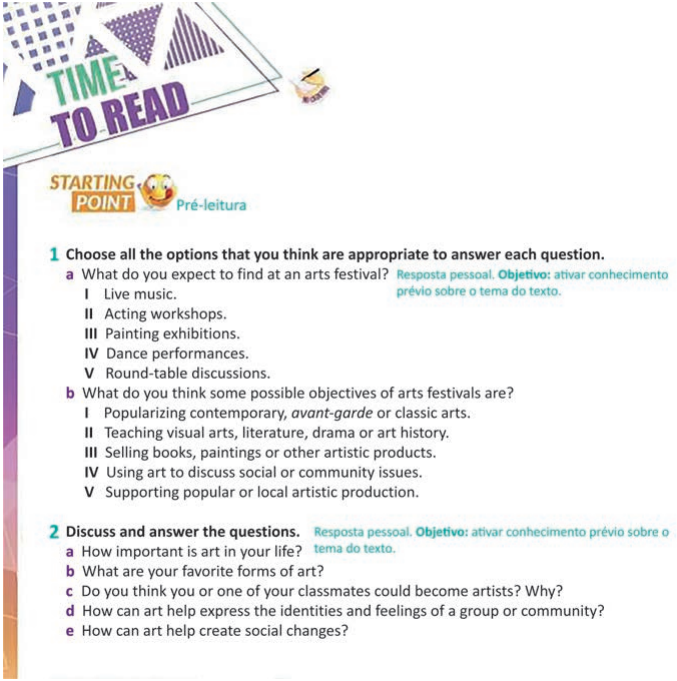
Starting point is a pre-reading activity that provides a specific sociocultural context. In our contemporary scenario, the focus of this cultural teaching view is to raise global cultural consciousness.
Considering this, how does this High School textbook activity promote a multicultural approach?
• explicit correction, which refers to the explicit provision of the correct form; • recast, which involves the teacher’s reformulation of all or part of a student’s utterance, minus the error;
• clarification requests, which indicate to students either that their utterance has been misunderstood by the teacher or that the utterance is ill-formed in some way;
• metalinguistic feedback, which contains either comments, information or questions related to the well-formedness of the student’s utterance;
• elicitation, where the teacher prompts the students to correct themselves by asking questions or pausing to allow them to complete the teacher’s utterance correctly;
• repetition, where the teacher repeats the student’s error, often with a change in intonation to highlight the mistake.
LYSTER, R.; RANTA, L. Corrective feedback and learner uptake: Negotiation of form in communicative classrooms. Studies in Second Language Acquisition, n. 19, p. 37-66, 1997 (adapted).
In an Elementary English class, the teacher asks the students to introduce themselves. The first student stands up and says, “Hi, my name is Carlos. I from Venezuela. I have 12 years old.” The teacher didn’t want to demotivate the students by pointing out the errors because he believes making errors is part of the learning process. So, he used a type of corrective feedback by saying, “I am from Venezuela. I am 12 years old.”
Considering this scenario, to correct the student’s utterance in Text 2, the teacher used a type of corrective feedback known as

 Conheça nossos planos