Questões de Concurso
Para educa
Foram encontradas 8.920 questões
Resolva questões gratuitamente!
Junte-se a mais de 4 milhões de concurseiros!


Ano: 2025
Banca:
EDUCA
Órgão:
Prefeitura de São João do Rio do Peixe - PB
Prova:
EDUCA - 2025 - Prefeitura de São João do Rio do Peixe - PB - Professor Básico II - História |
Q3483287
História
O início do século XIX na Europa foi marcado por
grandes transformações, como as guerras
revolucionárias e napoleônicas, que reconfiguraram
as relações de poder entre as monarquias europeias.
Tais eventos exerceram influência direta na decisão da
Coroa portuguesa de transferir-se para o Brasil,
desencadeando mudanças profundas na colônia.
Relacione os acontecimentos da COLUNA A com seus impactos ou significados descritos na COLUNA B.
COLUNA A – Contexto europeu e luso-brasileiro.
1. Bloqueio Continental decretado por Napoleão Bonaparte.
2. Aliança diplomática e militar entre Portugal e Inglaterra.
3. Invasão das tropas napoleônicas à Península Ibérica (1807).
4. Transferência da família real portuguesa para o Brasil.
5. Transformações políticas advindas da Revolução Francesa.
COLUNA B – Desdobramentos e significados históricos.
( ) Ameaça direta à soberania de Portugal, forçando a fuga da monarquia para sua principal colônia.
( ) Influência da ideologia liberal e dos direitos civis, que colocaram em xeque o absolutismo europeu.
( ) Medida que visava isolar economicamente a Inglaterra, afetando diretamente aliados comerciais como Portugal.
( ) Fortalecimento dos laços econômicos e militares entre dois reinos, com garantias britânicas à monarquia lusa.
( ) Alteração do status do Brasil na estrutura do império português e início de reformas institucionais na colônia.
Assinale a alternativa que apresenta a sequência CORRETA:
Relacione os acontecimentos da COLUNA A com seus impactos ou significados descritos na COLUNA B.
COLUNA A – Contexto europeu e luso-brasileiro.
1. Bloqueio Continental decretado por Napoleão Bonaparte.
2. Aliança diplomática e militar entre Portugal e Inglaterra.
3. Invasão das tropas napoleônicas à Península Ibérica (1807).
4. Transferência da família real portuguesa para o Brasil.
5. Transformações políticas advindas da Revolução Francesa.
COLUNA B – Desdobramentos e significados históricos.
( ) Ameaça direta à soberania de Portugal, forçando a fuga da monarquia para sua principal colônia.
( ) Influência da ideologia liberal e dos direitos civis, que colocaram em xeque o absolutismo europeu.
( ) Medida que visava isolar economicamente a Inglaterra, afetando diretamente aliados comerciais como Portugal.
( ) Fortalecimento dos laços econômicos e militares entre dois reinos, com garantias britânicas à monarquia lusa.
( ) Alteração do status do Brasil na estrutura do império português e início de reformas institucionais na colônia.
Assinale a alternativa que apresenta a sequência CORRETA:
Ano: 2025
Banca:
EDUCA
Órgão:
Prefeitura de São João do Rio do Peixe - PB
Prova:
EDUCA - 2025 - Prefeitura de São João do Rio do Peixe - PB - Professor Básico II - História |
Q3483286
História
Leia o trecho a seguir, retirado de uma obra clássica da
historiografia brasileira:
"A colonização do Brasil foi, desde o começo, um empreendimento de exploração econômica. Toda a sua estrutura social, política e administrativa gira em torno do sentido da empresa colonizadora: produzir gêneros apropriados ao comércio europeu em condições tais que permitissem o máximo de lucro."
(CAIO PRADO JÚNIOR. Formação do Brasil Contemporâneo. São Paulo: Brasiliense, 2000)
Com base no trecho acima e nos conhecimentos sobre a história do Brasil no período colonial, assinale a alternativa CORRETA:
"A colonização do Brasil foi, desde o começo, um empreendimento de exploração econômica. Toda a sua estrutura social, política e administrativa gira em torno do sentido da empresa colonizadora: produzir gêneros apropriados ao comércio europeu em condições tais que permitissem o máximo de lucro."
(CAIO PRADO JÚNIOR. Formação do Brasil Contemporâneo. São Paulo: Brasiliense, 2000)
Com base no trecho acima e nos conhecimentos sobre a história do Brasil no período colonial, assinale a alternativa CORRETA:
Ano: 2025
Banca:
EDUCA
Órgão:
Prefeitura de São João do Rio do Peixe - PB
Prova:
EDUCA - 2025 - Prefeitura de São João do Rio do Peixe - PB - Professor Básico II - História |
Q3483285
Pedagogia
Ao longo das últimas décadas, o ensino de História tem
incorporado contribuições da Teoria da História, da
Didática da História e das Metodologias Ativas. Esse
processo reflete uma mudança na forma como se
compreende o papel do professor, do aluno e do próprio
conhecimento histórico, que deixa de ser visto como
algo fixo e passa a ser tratado como construção crítica,
situada e plural.
Com base nessas discussões, relacione os conceitos da COLUNA “A” com suas respectivas características ou práticas pedagógicas na COLUNA “B”:
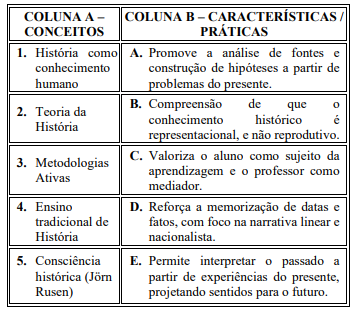
Assinale a alternativa que apresenta a correspondência CORRETA:
Com base nessas discussões, relacione os conceitos da COLUNA “A” com suas respectivas características ou práticas pedagógicas na COLUNA “B”:
Assinale a alternativa que apresenta a correspondência CORRETA:
Ano: 2025
Banca:
EDUCA
Órgão:
Prefeitura de São João do Rio do Peixe - PB
Prova:
EDUCA - 2025 - Prefeitura de São João do Rio do Peixe - PB - Professor Básico II - História |
Q3483282
Pedagogia
De acordo com o Art. 14. § 1º da Lei nº 9394/96 – LDB, o Conselho Escolar, órgão deliberativo, será composto do Diretor da Escola, membro nato, e de representantes das comunidades escolar e local, eleitos por seus pares nas seguintes categorias:
Assinale a alternativa INCORRETA:
Assinale a alternativa INCORRETA:
Ano: 2025
Banca:
EDUCA
Órgão:
Prefeitura de São João do Rio do Peixe - PB
Prova:
EDUCA - 2025 - Prefeitura de São João do Rio do Peixe - PB - Professor Básico II - História |
Q3483281
Pedagogia
De acordo com o Art. 5º, § 1º da Lei nº 9.394/96 – LDB, O poder público, na esfera de sua competência federativa, deverá:
I. Recensear anualmente as crianças e adolescentes em idade escolar, bem como os jovens e adultos que não concluíram a educação básica.
II. Fazer-lhes a chamada pública.
III. Zelar, junto aos pais ou responsáveis, pela frequência à escola.
IV. Divulgar a lista de espera por vagas nos estabelecimentos de educação básica de sua rede, inclusive creches, por ordem de colocação e, sempre que possível, por unidade escolar, bem como divulgar os critérios para a elaboração da lista.
V. Garantir aos pais, aos responsáveis e aos estudantes acesso aos resultados das avaliações de qualidade e de rendimento escolar nas instituições de ensino, diretamente realizadas por ele ou em parceria com organizações internacionais.
Estão CORRETOS:
I. Recensear anualmente as crianças e adolescentes em idade escolar, bem como os jovens e adultos que não concluíram a educação básica.
II. Fazer-lhes a chamada pública.
III. Zelar, junto aos pais ou responsáveis, pela frequência à escola.
IV. Divulgar a lista de espera por vagas nos estabelecimentos de educação básica de sua rede, inclusive creches, por ordem de colocação e, sempre que possível, por unidade escolar, bem como divulgar os critérios para a elaboração da lista.
V. Garantir aos pais, aos responsáveis e aos estudantes acesso aos resultados das avaliações de qualidade e de rendimento escolar nas instituições de ensino, diretamente realizadas por ele ou em parceria com organizações internacionais.
Estão CORRETOS:
Ano: 2025
Banca:
EDUCA
Órgão:
Prefeitura de São João do Rio do Peixe - PB
Prova:
EDUCA - 2025 - Prefeitura de São João do Rio do Peixe - PB - Professor Básico II - Matemática |
Q3483239
Matemática
A empresa Conecta+ Telecom instalou uma torre de
sinal em um terreno plano, cuja localização foi marcada
na planta por meio das coordenadas (3,−2), em um
sistema cartesiano. Para garantir a cobertura ideal, a
área de alcance da torre é definida por uma
circunferência de raio 5 unidades, centrada exatamente
nesse ponto.
• Um técnico precisa verificar se o ponto P = (7,1) está dentro da área de cobertura do sinal.
• Com base nessas informações, é correto afirmar que o ponto P:
• O ponto P está dentro da circunferência, pois a distância do ponto ao centro é maior que 5 unidades.
• Um técnico precisa verificar se o ponto P = (7,1) está dentro da área de cobertura do sinal.
• Com base nessas informações, é correto afirmar que o ponto P:
• O ponto P está dentro da circunferência, pois a distância do ponto ao centro é maior que 5 unidades.
Ano: 2025
Banca:
EDUCA
Órgão:
Prefeitura de São João do Rio do Peixe - PB
Prova:
EDUCA - 2025 - Prefeitura de São João do Rio do Peixe - PB - Professor Básico II - Matemática |
Q3483238
Matemática
Letícia começou a fazer aulas de violão em março. A
mensalidade sofreu dois reajustes sucessivos nos meses
seguintes: em abril, houve um aumento de 15% em
relação ao valor de março, e em maio, a mensalidade
foi 20% maior do que a de abril.
Sabendo que a média aritmética das três mensalidades (março, abril e maio) foi de R$ 561,60, qual foi o valor da mensalidade do mês de abril?
Sabendo que a média aritmética das três mensalidades (março, abril e maio) foi de R$ 561,60, qual foi o valor da mensalidade do mês de abril?
Ano: 2025
Banca:
EDUCA
Órgão:
Prefeitura de São João do Rio do Peixe - PB
Prova:
EDUCA - 2025 - Prefeitura de São João do Rio do Peixe - PB - Professor Básico II - Matemática |
Q3483237
Matemática
Um drone é lançado do ponto zero de um referencial
horizontal e sua altura h (em metros) em função da
distância d (em metros) percorrida horizontalmente é
dada pela função:
h(d) = −4d 2 + 16d + 3
Considerando que d representa a distância horizontal do drone em relação ao ponto de lançamento e h(d) a altura atingida, qual a altura máxima que o drone alcança durante o voo?
h(d) = −4d 2 + 16d + 3
Considerando que d representa a distância horizontal do drone em relação ao ponto de lançamento e h(d) a altura atingida, qual a altura máxima que o drone alcança durante o voo?
Ano: 2025
Banca:
EDUCA
Órgão:
Prefeitura de São João do Rio do Peixe - PB
Prova:
EDUCA - 2025 - Prefeitura de São João do Rio do Peixe - PB - Professor Básico II - Matemática |
Q3483236
Matemática
Durante um experimento em laboratório, uma colônia
de bactérias é monitorada em intervalos regulares.
Sabe-se que a população dobra a cada 3 horas, em
ambiente ideal e temperatura constante. No início da
observação (t = 0), havia 500 bactérias.
Considerando que o crescimento segue uma progressão exponencial, a quantidade de bactérias ao final de 12 horas será:
Considerando que o crescimento segue uma progressão exponencial, a quantidade de bactérias ao final de 12 horas será:
Ano: 2025
Banca:
EDUCA
Órgão:
Prefeitura de São João do Rio do Peixe - PB
Prova:
EDUCA - 2025 - Prefeitura de São João do Rio do Peixe - PB - Professor Básico II - Matemática |
Q3483235
Matemática
Em uma fábrica de embalagens, 6 operários
produziram 468 unidades de um determinado item em
8 dias, trabalhando 6,5 horas por dia. Com o aumento
da demanda, a equipe foi reforçada, agora são 9
operários, que trabalham 7,5 horas por dia durante 6
dias.
Mantendo o mesmo ritmo de produção por hora, qual foi o aumento na quantidade total de unidades produzidas após a ampliação da equipe e mudança na jornada de trabalho?]
Mantendo o mesmo ritmo de produção por hora, qual foi o aumento na quantidade total de unidades produzidas após a ampliação da equipe e mudança na jornada de trabalho?]
Ano: 2025
Banca:
EDUCA
Órgão:
Prefeitura de São João do Rio do Peixe - PB
Prova:
EDUCA - 2025 - Prefeitura de São João do Rio do Peixe - PB - Professor Básico II - Matemática |
Q3483234
Matemática
Um plano de celular cobra uma taxa fixa mensal de R$
40,00, mais R$ 13,50 por gigabyte consumido.
Recentemente, o cliente mudou para um plano
promocional que cobra uma taxa fixa mensal de R$
30,00 (mais barata), mas o valor por gigabyte
consumido aumentou para R$ 15,00.
Se em um mês o cliente consumiu 3 GB e no mês seguinte passou a consumir 7 GB, qual foi a variação no valor da fatura mensal considerando as duas mudanças (taxa fixa e preço por GB)?
Se em um mês o cliente consumiu 3 GB e no mês seguinte passou a consumir 7 GB, qual foi a variação no valor da fatura mensal considerando as duas mudanças (taxa fixa e preço por GB)?
Ano: 2025
Banca:
EDUCA
Órgão:
Prefeitura de São João do Rio do Peixe - PB
Prova:
EDUCA - 2025 - Prefeitura de São João do Rio do Peixe - PB - Professor Básico II - Matemática |
Q3483233
Matemática
Considere as sentenças abaixo sobre o desenvolvimento do Binômio de Newton:
I. O número de termos no desenvolvimento (a + b) n é sempre n + 1.
II. No desenvolvimento de (a + b) n , o coeficiente do termo geral ( n/k ) a n−k b k é dado pelo coeficiente binomial geral ( n/k ) n! / k! (n−k)! .
III. Para(x + y) n , o termo do meio no desenvolvimento ocorre sempre para k = n/2 , independentemente de n ser par ou ímpar.
IV. Os coeficientes do desenvolvimento do Binômio de Newton formam uma sequência simétrica.
Assinale a alternativa CORRETA:
Ano: 2025
Banca:
EDUCA
Órgão:
Prefeitura de São João do Rio do Peixe - PB
Prova:
EDUCA - 2025 - Prefeitura de São João do Rio do Peixe - PB - Professor Básico II - Matemática |
Q3483232
Matemática
Em uma pesquisa de opinião feita com consumidores
de uma cafeteria, constatou-se que:
• 30% dos clientes consomem café da marca A. • 40% consomem café da marca B. • 15% consomem ambas as marcas.
Com base nesses dados, pode-se concluir corretamente que os eventos "consumir café da marca A" e "consumir café da marca B" são:
• 30% dos clientes consomem café da marca A. • 40% consomem café da marca B. • 15% consomem ambas as marcas.
Com base nesses dados, pode-se concluir corretamente que os eventos "consumir café da marca A" e "consumir café da marca B" são:
Ano: 2025
Banca:
EDUCA
Órgão:
Prefeitura de São João do Rio do Peixe - PB
Prova:
EDUCA - 2025 - Prefeitura de São João do Rio do Peixe - PB - Professor Básico II - Matemática |
Q3483231
Matemática
Durante uma campanha publicitária, uma montadora
decidiu personalizar modelos de veículos com placas
comemorativas formadas pela palavra "MOTORAR",
onde cada placa exibe uma permutação das letras dessa
palavra. Por uma questão estética, não são permitidas
placas com a mesma sequência de letras.
Sabendo que a palavra "MOTORAR" possui letras repetidas, o número de placas distintas que podem ser formadas é:
Sabendo que a palavra "MOTORAR" possui letras repetidas, o número de placas distintas que podem ser formadas é:
Ano: 2025
Banca:
EDUCA
Órgão:
Prefeitura de São João do Rio do Peixe - PB
Prova:
EDUCA - 2025 - Prefeitura de São João do Rio do Peixe - PB - Professor Básico II - Matemática |
Q3483230
Matemática
Durante a análise de desempenho de uma equipe de
ginástica em uma competição amadora, registraram-se
os escores médios de três dos seus competidores (A, B
e C) em três critérios: precisão, velocidade e
dificuldade. Esses escores foram organizados na
seguinte matriz:
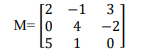
A equipe técnica verificou o desempenho do grupo por meio do determinante da matriz de escores. Qual é o valor do determinante de M?
A equipe técnica verificou o desempenho do grupo por meio do determinante da matriz de escores. Qual é o valor do determinante de M?
Ano: 2025
Banca:
EDUCA
Órgão:
Prefeitura de São João do Rio do Peixe - PB
Prova:
EDUCA - 2025 - Prefeitura de São João do Rio do Peixe - PB - Terapeuta Ocupacional |
Q3483174
Terapia Ocupacional
Sobre próteses, órteses e adaptações no contexto da
Terapia Ocupacional, assinale
CORRETA:
Ano: 2025
Banca:
EDUCA
Órgão:
Prefeitura de São João do Rio do Peixe - PB
Prova:
EDUCA - 2025 - Prefeitura de São João do Rio do Peixe - PB - Terapeuta Ocupacional |
Q3483173
Terapia Ocupacional
No contexto da atuação do Terapeuta Ocupacional em
pacientes com alcoolismo, as estratégias de
intervenção devem considerar múltiplos aspectos para
promover a recuperação da autonomia e reintegração
social.
Sobre essas estratégias, assinale a alternativa CORRETA:
Sobre essas estratégias, assinale a alternativa CORRETA:
Ano: 2025
Banca:
EDUCA
Órgão:
Prefeitura de São João do Rio do Peixe - PB
Prova:
EDUCA - 2025 - Prefeitura de São João do Rio do Peixe - PB - Terapeuta Ocupacional |
Q3483172
Terapia Ocupacional
No contexto da Terapia Ocupacional para disfunções
físicas, a avaliação, a definição de objetivos, a seleção e a análise das atividades são etapas fundamentais
para o planejamento do tratamento.
Sobre essas etapas, assinale a alternativa CORRETA:
Sobre essas etapas, assinale a alternativa CORRETA:
Ano: 2025
Banca:
EDUCA
Órgão:
Prefeitura de São João do Rio do Peixe - PB
Prova:
EDUCA - 2025 - Prefeitura de São João do Rio do Peixe - PB - Terapeuta Ocupacional |
Q3483171
Terapia Ocupacional
Sobre o Código de Ética do Terapeuta Ocupacional,
assinale a alternativa CORRETA:
Ano: 2025
Banca:
EDUCA
Órgão:
Prefeitura de São João do Rio do Peixe - PB
Prova:
EDUCA - 2025 - Prefeitura de São João do Rio do Peixe - PB - Terapeuta Ocupacional |
Q3483170
Terapia Ocupacional
Durante o atendimento de um paciente com hemiparesia esquerda pós-AVC, em fase subaguda, o
Terapeuta Ocupacional decide utilizar técnicas de
reeducação neuromuscular para estimular o retorno da
funcionalidade do membro superior afetado. Uma das
estratégias escolhidas envolve movimentos diagonais
com resistência manual controlada, instruções verbais
claras e contato tátil direcionado.
Com base nesse caso, assinale a alternativa que melhor descreve a técnica e sua finalidade:
Com base nesse caso, assinale a alternativa que melhor descreve a técnica e sua finalidade:

 Conheça nossos planos