Questões de Concurso
Sobre teorias e práticas para o ensino de língua estrangeira em pedagogia
Foram encontradas 683 questões


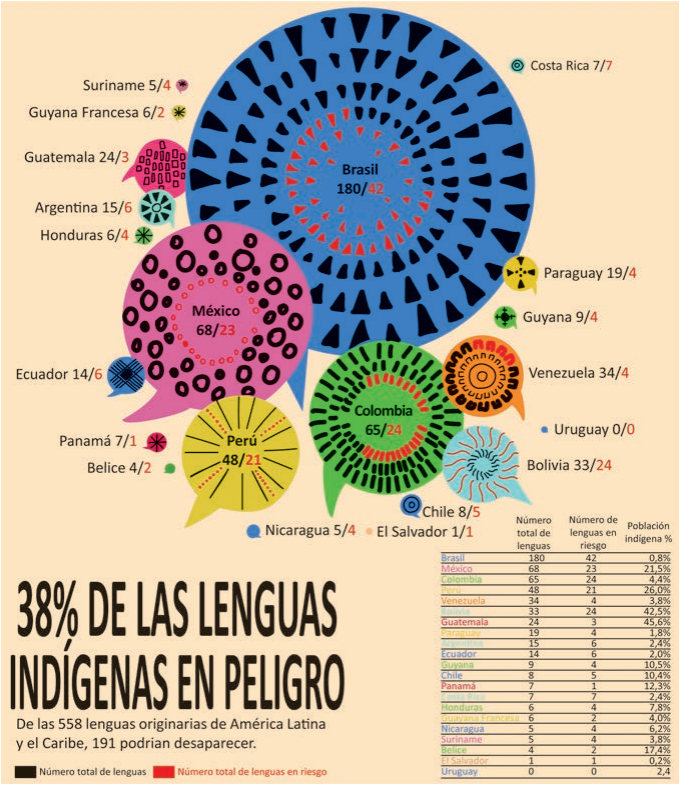 Disponible en: https://www.segib.org/el-384-de-las-lenguas-indigenas-de-america-latina-y-caribese-encuentran-en-peligro-de-desaparicion/. Acceso en: 25 mayo 2024 (adaptado).
 Considerando el escenario presentado, una forma de contribución a la resolución de este problema por parte de profesores de lenguas y de otros profesionales, sobre todo de los vinculados a la educación escolar indígena, es investigar las políticas lingüísticas dirigidas a los pueblos originarios con el fin de
Con el uso del enfoque inductivo y de la lengua materna, el profesor utilizó la estrategia adecuada para este caso porque los alumnos
T: Hello, class!
Ss: Hi, teacher.
T: Today, I am going to introduce a new verb tense to you: the simple past. The simple past tense is used to describe actions or events that happened in the past. For example, If I say, “I walked to school yesterday,” what tense am I using?
(The teacher writes the sentences on the blackboard)
Ss: It is easy. It is simple past.
T: Ok, very good. What happened to the verb in the sentence?
Ss: You added “-ed.”
(The teacher underlines “-ed” in a different color)
T: Great. So, to change from the present tense to the past tense, with regular verbs, we simply add “-ed” to the verb. If the verb ends in “-y” preceded by a consonant, we drop the “-e” and add “-ied”, ok? Now let’s practice. Change the verbs below from present to past tense.
Scenario II: An English teacher (T) introduces the simple past tense to a group of 7th-grade students (Ss, S1, S2).
T: Hello, class!
Ss: Hello, teacher.
T: What day is today?
Ss: It is Monday.
T: Excellent. So, can you tell me what you did yesterday?
S1: I watch a movie on TV.
T: You watched a movie on TV, how nice.
S2: I played soccer with my friends.
T: Great. Now let’s practice. Sit in pairs and talk to your friend about things you did last week.
(The teacher observes their performances and assists them when required).
We can state about scenario I and scenario II, respectively, that
MACHADO, L. de P.; SILVA, A. S.; COSTA, R. F. da; FARIA, I. G. Metodologias ativas aplicadas em dois cursos técnicos pelos docentes no IFTO, Câmpus Palmas. Educação: Teoria e Prática, [S. l.], v. 32, n. 65, 2022 (adapted).
In light of the previous information, one activity that aligns with the assumptions of active methodologies is the use of
An English teacher analyzes the written work of her class of basic level students and notices that some errors are recurrent, related to orthographic and/or phonological similarities to the mother tongue (L1), such as: (1) the transit in São Paulo is bad; (2) when she was a child, she studied at a public college; (3) I want to study a stranger language. The challenge for the teacher is to find strategies to facilitate the understanding and correction of these errors in order to help her students develop greater autonomy and awareness of them, as well as to promote more effective learning.
TEXT 2
Errors, once considered obstacles in behaviorist theory, are now recognized as an essential part of learning. This requires a pedagogical approach that values them as teaching tools and encourages students to learn from them and become autonomous in their correction and learning. If we want our students to become good fishermen, we need to use a correction method that teaches them how to fish without giving them the fish.
FIGUEIREDO, F. J. Q. Aprendendo com os erros – uma perspectiva comunicativa do ensino de línguas. 4ª edição: São Paulo: Parábola, 2023 (adapted).
In view of the information provided, the teacher should
• explicit correction, which refers to the explicit provision of the correct form; • recast, which involves the teacher’s reformulation of all or part of a student’s utterance, minus the error;
• clarification requests, which indicate to students either that their utterance has been misunderstood by the teacher or that the utterance is ill-formed in some way;
• metalinguistic feedback, which contains either comments, information or questions related to the well-formedness of the student’s utterance;
• elicitation, where the teacher prompts the students to correct themselves by asking questions or pausing to allow them to complete the teacher’s utterance correctly;
• repetition, where the teacher repeats the student’s error, often with a change in intonation to highlight the mistake.
LYSTER, R.; RANTA, L. Corrective feedback and learner uptake: Negotiation of form in communicative classrooms. Studies in Second Language Acquisition, n. 19, p. 37-66, 1997 (adapted).
In an Elementary English class, the teacher asks the students to introduce themselves. The first student stands up and says, “Hi, my name is Carlos. I from Venezuela. I have 12 years old.” The teacher didn’t want to demotivate the students by pointing out the errors because he believes making errors is part of the learning process. So, he used a type of corrective feedback by saying, “I am from Venezuela. I am 12 years old.”
Considering this scenario, to correct the student’s utterance in Text 2, the teacher used a type of corrective feedback known as
Which theoretical approach to language learning underlies this teacher’s decisions?
GARCÍA, O., FLORES, N., E WOODLEY, H. Transgressing monolingualism and bilingual dualities: education. Bern: Peter Lang, 2012 (adapted).
Based on the approach presented in the case study, we can state that
 O ensino de leitura deve integrar outras habilidades, como
fala e escuta. Com base no texto, qual atividade em sala de
aula reflete essa integração?
O ensino de leitura deve integrar outras habilidades, como
fala e escuta. Com base no texto, qual atividade em sala de
aula reflete essa integração?
Texto 3

Leia o trecho a seguir:
Para se aprender uma língua é necessário um ambiente afetivo, sem ameaças para o aprendiz. Para tanto, os alunos, inicialmente, estabelecem relações interpessoais em sua própria língua para evitar qualquer constrangimento. O objetivo é instaurar uma comunidade de aprendizagem, e como em uma seção de aconselhamento, o professor vai traduzindo as falas a partir do que os alunos dizem em sua língua. Em seguida os aprendizes repetem, e a conversa continua. Esse processo se estende e caso haja necessidade, o professor explica algumas regras ou itens lexicais específicos.
Fonte: GESSER, Audrei. Metodologia de ensino em Libras como L2. Florianópolis: Universidade Federal de Santa Catarina, 2010.
O trecho citado diz respeito a qual método de ensino de línguas?
The methodologies and approaches of English Language teaching are organized around distinct principles regarding the nature of language and of learning. Regarding these approaches, analyze the following statements:
I. The communicative approach prioritizes language use in situations of meaningful interaction, shifting the focus from the formal mastery of grammar rules to the negotiation of meanings among speakers.
II. The grammar-translation method organizes teaching around the analysis of target-language structures and the translation of texts, with little emphasis on oral practice and communicative interaction.
III. The audiolingual approach relies on repetition and structural substitution drills, grounded in behaviorist principles applied to foreign language teaching.
The correct statements are:
¿Cómo enseñar español a extranjeros?
Enseñar español a extranjeros es una tarea gratificante pero desafiante que requiere habilidades específicas y enfoques pedagógicos adaptados. En este artículo te mostraremos diversas estrategias y métodos para enseñar español a extranjeros: 1. Conocer el perfil de los estudiantes y establecer objetivos claros; 2. Desarrollar la comunicación oral y escrita, utilizando situaciones y contextos reales para que los estudiantes desarrollen sus habilidades lingüísticas, pragmáticas y sociales, de manera significativa y práctica; 3. Inmersión en el idioma, uso de recursos multimedia e incorporar la cultura hispana; 4. Práctica de la escritura, proporcionar retroalimentación constructiva y fomentar la interacción entre estudiantes y 5. Ser creativo y flexible, evaluar el progreso y fomentar la autonomía.
Facultad de Humanidades y Ciencias Sociales – Universidad Isabel I. ¿Cómo enseñar español a extranjeros? Disponível em: https://www.ui1.es/blogui1/como-ensenar-espanol-extranjeros. Acesso em: 22 dez. 2025. [Adaptado].
Das cinco recomendações para o ensino da língua espanhola a estrangeiros, infere-se que na proposta apresentada predomina
Após análise, marque a opção CORRETA.
CONCEITOS
1 - Comunicativa 2 - Gramática ou linguística 3 - Sociolinguística 4 - Discursiva 5 - Estratégica
SIGNIFICADOS
( ) considera a questão da coesão e da coerência relevantes num determinado texto.
( ) é definida como um sistema de conhecimentos e habilidades exigidos para a comunicação.
( ) refere-se ao conhecimento do papel do falante no contexto e à sua escolha de registro e estilo.
( ) refere-se ao conhecimento do vocabulário, à formação de palavras, à formação de frases, ao significado literal de enunciados.
( ) refere-se ao domínio de técnicas verbais e não verbais para compensar rupturas na comunicação, devidas à competência insuficiente ou a limitações de desempenho e para aperfeiçoar o efeito retórico dos enunciados.
A sequência correta é

Isso te espera no Elite
Além das questões objetivas, o Elite tem 4 formatos de exercício: múltipla escolha, associação (relacione itens entre colunas), ordenação (organize a sequência correta) e preencher lacunas (complete o texto). São mais de 11 mil exercícios pra fixar o conteúdo de um jeito diferente do tradicional, com correção na hora.
- Mais de 11 mil exercícios de fixação disponíveis
- Múltipla escolha, associação, ordenação e preencher lacunas
- Filtre por disciplina, assunto e desempenho (acertei/errei)
Título do modal
Você sabe que pode fazer mais!
-
.
-
.
-
.
-
.
-
.
Limite de 10 questões por dia atingido!
Você pode fazer muito mais, !
-
Ambiente de prática com questões, gabaritos, simulados e provas!
-
Preparatório completo com videoaulas, PDFs e conteúdo teórico atualizado
-
Tecnologia de ponta com análises avançadas para melhorar sua performance e desempenho
-
E muito mais! São dezenas de recursos para você se preparar com qualidade
 Conheça nossos planos