Questões de Concurso
Sobre temas educacionais pedagógicos em pedagogia
Foram encontradas 60.169 questões


I. O documento assim produzido perde a função de referência da ação coletiva, pois a autoria compartilhada integra a natureza do projeto.
II. A dimensão política do projeto reside no compromisso com a formação do cidadão para determinado projeto de sociedade que se pretende.
III. O projeto político-pedagógico e o regimento escolar cumprem função equivalente, sendo o primeiro a síntese normativa do segundo.
IV. A avaliação institucional periódica sustenta a revisão do documento, que se constitui como processo permanente e não como peça acabada.
É CORRETO o que se afirma em:
FAZENDA, Ivani Catarina Arantes. Integração e interdisciplinaridade no ensino brasileiro: efetividade ou ideologia. São Paulo: Loyola, 2011. p. 59. apud MOUSINHO, Silvia Helena. A interdisciplinaridade ao alcance de todos. Revista Educação Pública, Rio de Janeiro, v. 18, n. 12, 19 jun. 2018. Disponível em: https://educacaopublica.cecierj.edu.br/artigos/18/12/a-interdisciplinarida de-ao-alcance-de-todos.
Uma equipe escolar apresenta como projeto interdisciplinar um cronograma no qual cada componente curricular trata do mesmo assunto na mesma semana, conservando planejamentos, critérios e instrumentos de avaliação independentes entre si. Considerando a caracterização da interdisciplinaridade como atitude, apresentada no texto, é CORRETO afirmar que a proposta da equipe configura:
(__) Ensinar exige respeito aos saberes construídos pelo educando em sua prática comunitária, tomados como ponto de partida da problematização.
(__) A dialogicidade constitui exigência da própria natureza do ato educativo, e não recurso metodológico acionado por conveniência do educador.
(__) Na concepção bancária, o educando é reconhecido como sujeito da própria formação, cabendo ao educador acompanhar a construção que ele realiza.
(__) A conscientização corresponde à leitura crítica da realidade articulada à possibilidade de intervenção transformadora sobre as condições vividas.
Assinale a alternativa com a sequência correta, de cima para baixo:
(__) Publicização da decisão junto à comunidade escolar.
(__) Identificação e registro da demanda pelo colegiado.
(__) Deliberação por maioria entre as alternativas debatidas.
(__) Estudo das alternativas viáveis pelos segmentos representados.
(__) Debate coletivo das alternativas estudadas em plenária.
Assinale a alternativa que apresenta a sequência CORRETA, de cima para baixo:
I. A Educação a Distância caracteriza-se pela mediação didático-pedagógica desenvolvida por meio das tecnologias da informação e da comunicação, possibilitando atividades educativas em tempos ou espaços distintos.
II. O planejamento pedagógico, os objetivos de aprendizagem e as estratégias de acompanhamento dos estudantes, na Educação a Distância, não precisam estar articulados aos recursos pedagógicos.
III. Ambientes virtuais de aprendizagem, recursos multimídia e diferentes formas de interação podem contribuir para o desenvolvimento das atividades propostas na Educação a Distância.
IV. A Educação a Distância caracteriza-se pela disponibilização de conteúdos digitais aos estudantes, mantendo reduzida a necessidade de acompanhamento pedagógico durante o desenvolvimento das atividades educacionais.
V. A organização da Educação a Distância pode contemplar diferentes metodologias, tecnologias e estratégias de interação, observadas as normas aplicáveis a essa modalidade.
É CORRETO o que se afirma em:
Considerando o uso pedagógico da internet e o desenvolvimento das competências digitais no contexto escolar, assinale a alternativa CORRETA.
The quest to understand the fundamental nature of light has sparked debate for centuries and ultimately played a pivotal role in the development of quantum physics. Even the earliest recorded speculations about light contained the seeds of concepts that would, centuries later, be woven into our quantum understanding of reality. Some of the earliest recorded ideas about the nature of light appeared in the 6th century BCE. In India, for instance, the Vaisheshika school of philosophy described light as consisting of fire-like particles moving at a high speed. In ancient Greece, the Pythagoreans (6th 5th century BCE) and later Euclid (c. 300 BCE) advocated the emission theory of vision, suggesting that rays of light emanate from the eyes toward objects. In contrast, Epicurus (341 270 BCE) proposed an intromission theory, arguing that light consists of material images or "eidola" emitted by objects that travel to the eyes. Further insights into the nature of light emerged in Egypt, where Ptolemy (c. AD 90 168), working in Alexandria, conducted experiments showing that light reflects off smooth surfaces and bends when passing through transparent materials of different optical densities. Building on these concepts, Arab scholars made significant contributions to the understanding of light by establishing foundational principles governing its behavior in lenses, mirrors, and prisms. The most influential among them was the 11th-century scholar Ibn al-Haytham, who lived in present-day Iraq. Ibn al-Haytham corrected the emission theory, stating thatvision results from light entering the eye rather thanemanating from it. By the 17th century, European scientists were dividedbetween two competing theories about the fundamentalnature of light: whether it behaved as a wave or as aparticle. Dutch physicist Christiaan Huygens argued thatlight propagates as waves according to his wave-frontprinciple, which explains how waves evolve when theyencounter obstacles. In contrast, Isaac Newton proposeda corpuscular theory, suggesting that light consists ofparticles traveling in straight paths, capable of reflectingoff surfaces like mirrors. Newton's prism experiments,which showed white light splitting into colors with distinctrefraction angles, supported his corpuscular theory bysuggesting that light consists of particles of differentsizes, each corresponding to a different color, whichbend by different amounts. Both theories, however, were incomplete. Huygens' wavetheory struggled to fully explain why light travels in astraight path, and Newton's particle theory couldn'taccount for diffraction, the spreading of light as it passesaround edges or through narrow openings. Nevertheless,Newton's theory gained significant influence not onlybecause of his clever prism experiments, but alsobecause he was highly revered in the scientificcommunity, making his ideas difficult to challenge foryears. But science doesn't bow to reputation. As RichardFeynman famously pointed out in his 1964 MessengerLectures at Cornell University, "It doesn't matter howbeautiful your theory is, it doesn't matter how smart youare. If it doesn't agree with the experiment, it's wrong."Indeed, nearly a century after Newton's corpusculartheory of 1704, the scientific consensus gradually shiftedtoward the wave theory of light through decades ofexperiments, modeling, and debates. One of the keycontributors to this shift was Thomas Young, an Englishpolymath. In 1801, Young passed sunlight through anarrow slit to produce a coherent light beam. He thenplaced a thin obstacle, such as a hair or a narrow strip,across the beam, splitting it into two waves that spreadout and overlapped. When these waves recombined on ascreen, they produced a pattern of bright and dark bands.This interference pattern provided clear and compellingevidence that light behaves as a wave rather than as aparticle. A familiar example of this phenomenon is when waves onthe surface of water either combine to form larger peaksor cancel each other out. Later, in 1845, another Englishphysicist Michael Faraday showed that magnetic fieldscould alter the polarization plane of light, revealing aconnection between light and electromagnetism. In the1860s, Scottish physicist James Clerk Maxwell built onthis connection by formulating the theory ofelectromagnetism, describing light as an electromagneticwave composed of oscillating electric and magnetic fields at right angles to each other and to the wave's direction of travel. Heinrich Hertz's experimental confirmation of Maxwell's predictions in the 1880s provided further validation of the electromagnetic wave theory of light. By the 1890s, Maxwell's mathematical description of electromagnetic waves was considered so successful, particularly for its predictive power, that many physicists believed the fundamental nature of light was fully understood. But in the early 20th century, experimental discoveries began to challenge this consensus. The electromagnetic wave theory failed to predict how matter emits and absorbs radiation at thermal equilibrium. To address this question, German physicist Max Planck introduced a revolutionary idea known as energy quantization. He proposed that electromagnetic radiation is emitted or absorbed in discrete amounts, now called quanta, with higher frequency light corresponding to larger quanta. His theory accurately matched experimental results and earned him the Nobel Prize in Physics in 1918. Another major blow to the wave theory of light came from the photoelectric effect, first observed by Heinrich Hertz in 1887, when ultraviolet light caused electric charge to be emitted from a metal surface. By 1900, Philipp Lenard conducted detailed experiments to show that the energy of ejected electrons depended on light frequency, not intensity, an observation that classical wave theory struggled to explain. In 1905, Albert Einstein addressed this by proposing that light is made of discrete energy packets, now called photons, each carrying an energy proportional to its frequency according to Planck's quantization rule. This idea successfully explained the photoelectric effect and was later confirmed by Robert Millikan's experiments in 1915, which verified that the energy of the ejected electrons depends on light frequency and that intensity affects only the number of ejected electrons. Einstein's explanation earned him the 1921 Nobel Prize in Physics. The existence of the photon was further reinforced in 1923 by American physicist Arthur Compton, who showed that X-rays scatter off electrons and emerge with smaller frequencies. The photoelectric effect showed that light interacts with matter through discrete, fundamental processes, behaving as if it were made up of particles known as photons. On the other hand, Young's double-slit experiment provided convincing evidence that light also exhibits wave-like behavior through interference. These seemingly contradictory findings reveal the dual nature of light, a concept known as wave-particle duality. Today, this principle is central to quantum physics, which describes light as a quantum electromagnetic field. This field has discrete energy excitations called photons that can produce particle-like effects, while also exhibiting wave-like behavior depending on how light interacts with its environment. https://quantum2025.org/news-link/the-history-of-light-and-the-birth-of-q uantum-physics/ (adapted)
The quest to understand the fundamental nature of light has sparked debate for centuries and ultimately played a pivotal role in the development of quantum physics. Even the earliest recorded speculations about light contained the seeds of concepts that would, centuries later, be woven into our quantum understanding of reality. Some of the earliest recorded ideas about the nature of light appeared in the 6th century BCE. In India, for instance, the Vaisheshika school of philosophy described light as consisting of fire-like particles moving at a high speed. In ancient Greece, the Pythagoreans (6th 5th century BCE) and later Euclid (c. 300 BCE) advocated the emission theory of vision, suggesting that rays of light emanate from the eyes toward objects. In contrast, Epicurus (341 270 BCE) proposed an intromission theory, arguing that light consists of material images or "eidola" emitted by objects that travel to the eyes. Further insights into the nature of light emerged in Egypt, where Ptolemy (c. AD 90 168), working in Alexandria, conducted experiments showing that light reflects off smooth surfaces and bends when passing through transparent materials of different optical densities. Building on these concepts, Arab scholars made significant contributions to the understanding of light by establishing foundational principles governing its behavior in lenses, mirrors, and prisms. The most influential among them was the 11th-century scholar Ibn al-Haytham, who lived in present-day Iraq. Ibn al-Haytham corrected the emission theory, stating thatvision results from light entering the eye rather thanemanating from it. By the 17th century, European scientists were dividedbetween two competing theories about the fundamentalnature of light: whether it behaved as a wave or as aparticle. Dutch physicist Christiaan Huygens argued thatlight propagates as waves according to his wave-frontprinciple, which explains how waves evolve when theyencounter obstacles. In contrast, Isaac Newton proposeda corpuscular theory, suggesting that light consists ofparticles traveling in straight paths, capable of reflectingoff surfaces like mirrors. Newton's prism experiments,which showed white light splitting into colors with distinctrefraction angles, supported his corpuscular theory bysuggesting that light consists of particles of differentsizes, each corresponding to a different color, whichbend by different amounts. Both theories, however, were incomplete. Huygens' wavetheory struggled to fully explain why light travels in astraight path, and Newton's particle theory couldn'taccount for diffraction, the spreading of light as it passesaround edges or through narrow openings. Nevertheless,Newton's theory gained significant influence not onlybecause of his clever prism experiments, but alsobecause he was highly revered in the scientificcommunity, making his ideas difficult to challenge foryears. But science doesn't bow to reputation. As RichardFeynman famously pointed out in his 1964 MessengerLectures at Cornell University, "It doesn't matter howbeautiful your theory is, it doesn't matter how smart youare. If it doesn't agree with the experiment, it's wrong."Indeed, nearly a century after Newton's corpusculartheory of 1704, the scientific consensus gradually shiftedtoward the wave theory of light through decades ofexperiments, modeling, and debates. One of the keycontributors to this shift was Thomas Young, an Englishpolymath. In 1801, Young passed sunlight through anarrow slit to produce a coherent light beam. He thenplaced a thin obstacle, such as a hair or a narrow strip,across the beam, splitting it into two waves that spreadout and overlapped. When these waves recombined on ascreen, they produced a pattern of bright and dark bands.This interference pattern provided clear and compellingevidence that light behaves as a wave rather than as aparticle. A familiar example of this phenomenon is when waves onthe surface of water either combine to form larger peaksor cancel each other out. Later, in 1845, another Englishphysicist Michael Faraday showed that magnetic fieldscould alter the polarization plane of light, revealing aconnection between light and electromagnetism. In the1860s, Scottish physicist James Clerk Maxwell built onthis connection by formulating the theory ofelectromagnetism, describing light as an electromagneticwave composed of oscillating electric and magnetic fields at right angles to each other and to the wave's direction of travel. Heinrich Hertz's experimental confirmation of Maxwell's predictions in the 1880s provided further validation of the electromagnetic wave theory of light. By the 1890s, Maxwell's mathematical description of electromagnetic waves was considered so successful, particularly for its predictive power, that many physicists believed the fundamental nature of light was fully understood. But in the early 20th century, experimental discoveries began to challenge this consensus. The electromagnetic wave theory failed to predict how matter emits and absorbs radiation at thermal equilibrium. To address this question, German physicist Max Planck introduced a revolutionary idea known as energy quantization. He proposed that electromagnetic radiation is emitted or absorbed in discrete amounts, now called quanta, with higher frequency light corresponding to larger quanta. His theory accurately matched experimental results and earned him the Nobel Prize in Physics in 1918. Another major blow to the wave theory of light came from the photoelectric effect, first observed by Heinrich Hertz in 1887, when ultraviolet light caused electric charge to be emitted from a metal surface. By 1900, Philipp Lenard conducted detailed experiments to show that the energy of ejected electrons depended on light frequency, not intensity, an observation that classical wave theory struggled to explain. In 1905, Albert Einstein addressed this by proposing that light is made of discrete energy packets, now called photons, each carrying an energy proportional to its frequency according to Planck's quantization rule. This idea successfully explained the photoelectric effect and was later confirmed by Robert Millikan's experiments in 1915, which verified that the energy of the ejected electrons depends on light frequency and that intensity affects only the number of ejected electrons. Einstein's explanation earned him the 1921 Nobel Prize in Physics. The existence of the photon was further reinforced in 1923 by American physicist Arthur Compton, who showed that X-rays scatter off electrons and emerge with smaller frequencies. The photoelectric effect showed that light interacts with matter through discrete, fundamental processes, behaving as if it were made up of particles known as photons. On the other hand, Young's double-slit experiment provided convincing evidence that light also exhibits wave-like behavior through interference. These seemingly contradictory findings reveal the dual nature of light, a concept known as wave-particle duality. Today, this principle is central to quantum physics, which describes light as a quantum electromagnetic field. This field has discrete energy excitations called photons that can produce particle-like effects, while also exhibiting wave-like behavior depending on how light interacts with its environment. https://quantum2025.org/news-link/the-history-of-light-and-the-birth-of-q uantum-physics/ (adapted)
Consider the following situation.
Two English teachers use the same section of the text towork with passive constructions. The first teacher asksstudents to locate forms such as "was first observed" and"was later confirmed", classify their verb structure, andtransform them into active sentences. The secondteacher also examines the grammatical form but asksstudents to compare the passive and active versions,identify changes in information focus, and discuss whypassive constructions occur frequently in descriptions ofexperiments and scientific discoveries.
Considering approaches to grammar teaching in thelanguage-learning process, mark the CORRECTalternative.
Uma professora do Atendimento Educacional Especializado (AEE) relatou um caso em que um aluno com deficiência intelectual levou aproximadamente quatro anos para estabelecer vínculo de confiança com ela. Para favorecer esse processo, a docente desenvolveu uma proposta pedagógica baseada em um tema de interesse do próprio estudante: um caderno com nomes femininos. A atividade envolveu a pesquisa desses nomes em diferentes fontes, sua organização em ordem alfabética, a digitação e, posteriormente, a impressão e encadernação do material.
Fonte: SILUK, Ana Claudia Pavão; PAVÃO, Sílvia Maria de Oliveira (org.). Atendimento educacional especializado: práticas pedagógicas na sala de recursos multifuncional. Santa Maria: UFSM; PRE; Ed. pE.com, 2015. (Adaptado).
Diante desse relato, assinale a alternativa que apresenta corretamente os objetivos pedagógicos dessa estratégia.
De acordo com essa perspectiva, assinale a alternativa que corresponde a uma dessas dimensões.
Texto II
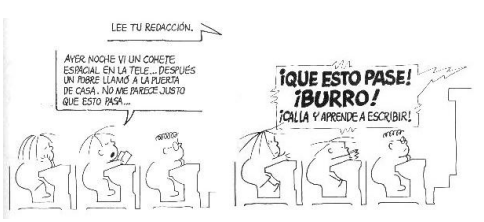
Fonte: Viñeta “Los deberes, de Francesco Tonucci (Frato), 1940, publicação original: Roma, 1968. Disponível em: http://macarena-formacinparaeltrabajo.blogspot.com/2011/07/el-error-como-base-de-la-ensenanaza.html. Acceso el: 29 abr. 2026.
Fuente: DA SILVA, Caroline Veloso; CAIADO, Katia Regina Moreno. O professor de língua espanhola em contexto de educação inclusiva: desafios e perspectivas no ensino para deficientes visuais. Educação e Fronteiras, Dourados, v. 5, n. 14, p. 109-124, 2016. Disponible en: https://ojs. ufgd.edu.br/index.php/educacao/article/view/3777. Acceso el: 29 abr. 2026.
RETORTA, M.S., & TONELLI, J.R.A. (2023). O ensino de línguas adicionais para alunos com dificuldades específicas de aprendizagem: desafios e possibilidades de engajamento. Raído, 17 (44), 63-82. Disponible en: https://ojs.ufgd.edu.br/Raido/article/view/17042 . Acceso el: 29 abr. 2026.
Fuente: PRATA, Andréa Moreno N.; LESSA, Angela B.C.T. Espanhol como língua estrangeira em uma escola inclusiva: A atividade social na educação inclusiva. Novas Edições Acadêmicas, 2015.
I. De manera clara y objetiva, corregir de inmediato los errores morfológicos y sintácticos que cometa el estudiante durante la exposición oral, evitando que estos errores se arraiguen.
II. Como forma de retroalimentación correctiva, reformular y pedir a los estudiantes que aclaren sobre los errores, negociando el significado sin interrumpir el proceso comunicativo, son estrategias que se consideran adecuadas para la adquisición de la L2.
III. Tras la fase de preparación, proponer una producción oral, que tenga en cuenta el vocabulario temático del texto, siempre y cuando en la evaluación priorice la fluidez y la adecuación pragmática.
IV. El enfoque más eficaz es dar prioridad a la homogeneización del grupo, dividiéndolo por nivel de dominio, y evitar proponer actividades que superen el nivel lingüístico de los estudiantes.
Fuente: ALMEIDA FILHO, J. C. P. Dimensões comunicativas no ensino de línguas, 1993. CANALE, M., SWAIN, M. Theoretical bases of communicative approaches to second language teaching and testing, 1980.
Las afirmaciones correctas se encuentran en:
Fonte: PAIVA, Vera Lúcia Menezes de Oliveira. Aquisição de Segunda Língua, São Paulo: Parábola, 2020. CONSELHO DA EUROPA. Marco Común Europeo de Referencia para las Lenguas: Aprendizaje, Enseñanza, Evaluación. Tradução: Instituto Cervantes. Madrid: Secretaría General Técnica del MECD, Anaya e Instituto Cervantes, 2002.
Statement I:
Comparing everyday practices from different communities can help students understand that social meanings vary according to historical and cultural contexts.
Statement II:
Intercultural competence involves interpreting perspectives, examining one's own assumptions and interacting respectfully with cultural differences.
Based on these statements, select the appropriate alternative.
A aprendizagem histórica não se limita à assimilação de informações consolidadas.
Situações investigativas podem mobilizar documentos escritos, relatos orais, imagens, objetos e produções digitais relacionados a determinado problema.
A atuação docente envolve orientar perguntas, contextualizar os registros e promover a comparação entre evidências e interpretações concorrentes.
Considere os fundamentos dessa abordagem:
I.A problematização transforma conteúdos históricos em questões passíveis de investigação.
II.A análise crítica requer considerar autoria, contexto, finalidade e circulação das fontes.
III.A pesquisa escolar deve reproduzir os procedimentos acadêmicos sem adaptações pedagógicas.
IV.A formulação de argumentos exige relacionar evidências documentais e conhecimentos históricos.
V.A diversidade de fontes torna desnecessária a mediação conceitual realizada pelo professor.
Está correto o que se afirma em:

 Conheça nossos planos