Questões de Concurso
Para inep
Foram encontradas 3.879 questões
Resolva questões gratuitamente!
Junte-se a mais de 4 milhões de concurseiros!


Q4151667
Pedagogia
Any student, regardless of their varied skills, experiences, or identities, should have access to fair and
equitable educational opportunities, according to the inclusive education movement (UNESCO, 2019). The
ideas of inclusive education are expanded to the field of language acquisition within the context of English
Language Teaching (ELT). It places a focus on creating a welcoming environment for language instruction
where all students may actively participate and realize their full potential.
ANIS, M., KHAN, R. Integrating Multimodal Approaches in English Language Teaching for Inclusive Education: A Pedagogical Exploration. Universal Journal of Educational Research. (online), v.2, n.3, p. 2.960-3.722, jun./sept. 2023 (adapted).
Taking into consideration what UNESCO suggests about inclusive ELT, choose the alternative that brings an adequate source of intrinsic motivation to be observed by teachers when planning a lesson that is based on students’ learning styles, aiming at promoting students’ inclusion.
ANIS, M., KHAN, R. Integrating Multimodal Approaches in English Language Teaching for Inclusive Education: A Pedagogical Exploration. Universal Journal of Educational Research. (online), v.2, n.3, p. 2.960-3.722, jun./sept. 2023 (adapted).
Taking into consideration what UNESCO suggests about inclusive ELT, choose the alternative that brings an adequate source of intrinsic motivation to be observed by teachers when planning a lesson that is based on students’ learning styles, aiming at promoting students’ inclusion.
Q4151666
Pedagogia
Lesson plan
Objectives: To help students understand and apply pragmatic aspects of the English language in various contexts by using role-play and real-life scenarios.
Duration: 90 minutes.
Materials: Whiteboard and markers; printed role-play scenario cards; audio recordings of dialogues (optional); handouts with discussion prompts and reflection questions.
Assessment: Participation in role-play activities and class discussion.
Introduction (10 minutes): Explain that pragmatics involves understanding the context in which language is used and how meaning is constructed in different situations.
Warm-up activity (10 minutes):
Role-play activity (40 minutes):
Class discussion (15 minutes):
Audio analysis (optional) (10 minutes):
Reflection and homework (5 minutes):
The teacher has started planning the lesson. Taking into consideration this teacher’s lesson plan for a High School context, choose the alternative that fits the warm-up activity.
Objectives: To help students understand and apply pragmatic aspects of the English language in various contexts by using role-play and real-life scenarios.
Duration: 90 minutes.
Materials: Whiteboard and markers; printed role-play scenario cards; audio recordings of dialogues (optional); handouts with discussion prompts and reflection questions.
Assessment: Participation in role-play activities and class discussion.
Introduction (10 minutes): Explain that pragmatics involves understanding the context in which language is used and how meaning is constructed in different situations.
Warm-up activity (10 minutes):
Role-play activity (40 minutes):
Class discussion (15 minutes):
Audio analysis (optional) (10 minutes):
Reflection and homework (5 minutes):
The teacher has started planning the lesson. Taking into consideration this teacher’s lesson plan for a High School context, choose the alternative that fits the warm-up activity.
Q4151665
Inglês
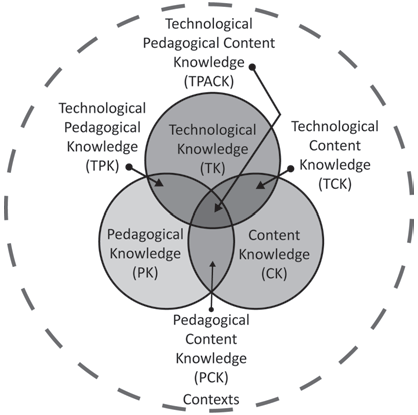
The Technological Pedagogical Content Knowledge (TPACK) is a model that seeks to identify the types of
knowledge a teacher needs to master to integrate Information and Communication Technologies (ICT) in
an effective way in the teaching process. Its main objective is the articulation of the three knowledges that
form its basis. The model can be viewed in the figure below.
 SILVA, J. B.; BILESSIMO, S. M. S.; MACHADO, L. R. Integration of technology in education:
proposal for a teacher training model inspired by TPACK.
Educação em revista, v. 27, 2021 (adapted).
SILVA, J. B.; BILESSIMO, S. M. S.; MACHADO, L. R. Integration of technology in education:
proposal for a teacher training model inspired by TPACK.
Educação em revista, v. 27, 2021 (adapted).
After a two-week workshop on TPACK, a High School teacher prepared a class to be taught in a computer lab in which he had to focus on a coursebook unit entitled Fashion & English, and on the Base Nacional Comum Curricular (BNCC) skill EM13LP17, which covers the phenomenon of regional language variation in its pragmatic-discursive dimension and seeks to promote a students’ broader understanding of the living and dynamic nature of the English language.
Based on these informations, which of the following class ideas can he develop in order to meet the elements presented above?
SILVA, J. B.; BILESSIMO, S. M. S.; MACHADO, L. R. Integration of technology in education:
proposal for a teacher training model inspired by TPACK.
Educação em revista, v. 27, 2021 (adapted).
After a two-week workshop on TPACK, a High School teacher prepared a class to be taught in a computer lab in which he had to focus on a coursebook unit entitled Fashion & English, and on the Base Nacional Comum Curricular (BNCC) skill EM13LP17, which covers the phenomenon of regional language variation in its pragmatic-discursive dimension and seeks to promote a students’ broader understanding of the living and dynamic nature of the English language.
Based on these informations, which of the following class ideas can he develop in order to meet the elements presented above?
Q4151664
Inglês
Discussions around teaching in a culturally sustaining manner in the English language arts classroom,
specifically when teaching literary analysis, often address the need to incorporate multicultural literature
so that students are exposed to stories told from diverse perspectives. However, the reality in many schools
is that teachers do not have ownership over their curriculum in a way that allows them to choose which
texts they should read and study with students. In this context, culturally sustaining teaching presents a
difficult challenge. In this literature review, the author presents classroom strategies that apply a critical
literacy lens to analysis of canonical literature as a way to create a place for culturally sustaining teaching
within a prescribed curriculum.
ERVIN, J. Critically reading the canon: culturally sustaining approaches to a prescribed literary curriculum. Journal of adolescent & adult literacy, v. 65, n. 4, 2022 (adapted).
The abstract excerpt above points to a challenge faced by literature teachers in finding classroom procedures that ensure more culturally sustaining teaching considering limitations imposed by a prescribed curriculum.
In this context, which of the following examples of classes conducted in the scope of literary analysis would align with the approach advocated in the abstract?
ERVIN, J. Critically reading the canon: culturally sustaining approaches to a prescribed literary curriculum. Journal of adolescent & adult literacy, v. 65, n. 4, 2022 (adapted).
The abstract excerpt above points to a challenge faced by literature teachers in finding classroom procedures that ensure more culturally sustaining teaching considering limitations imposed by a prescribed curriculum.
In this context, which of the following examples of classes conducted in the scope of literary analysis would align with the approach advocated in the abstract?
Q4151663
Inglês
 AMOS, E.; CONDI, R. (Orgs.). Peacemakers: 6º Ano. 2 ed. São Paulo: Richmond, 2022.
Due to the spread of English in the 21st century to countries where it is neither a first nor an official language, its use is evident in various contexts, as illustrated in the textbook pictures above. A teacher could use this material to
Q4151662
Pedagogia
In a High School class, a group of students from different cultural backgrounds is learning English as an
additional language. Among these students are Black English speakers, a dialect with its own grammar and
vocabulary. The teacher recognizes the importance of working with linguistic diversity to promote inclusive
language learning. As part of a collaborative interdisciplinary project, students were asked to work in pairs
to do research about African Literature and texts with Black English expressions and idioms. After this,
they would present their findings and discuss their impressions.
GARCÍA, O., FLORES, N., E WOODLEY, H. Transgressing monolingualism and bilingual dualities: education. Bern: Peter Lang, 2012 (adapted).
Based on the approach presented in the case study, we can state that
GARCÍA, O., FLORES, N., E WOODLEY, H. Transgressing monolingualism and bilingual dualities: education. Bern: Peter Lang, 2012 (adapted).
Based on the approach presented in the case study, we can state that
Q4151661
Linguística
[Dialogue between students]
Paulo: Fernanda, look how I can speak in English: We are Carnaval / We are, we are folia / We are, we are the world of Carnaval / We are Bahia.
Fernanda: That’s not English, it does not make sense. Nobody would say: We are Carnival. An American would say: I like Carnival or I don’t like Carnival.
Paulo: Well, I am Brazilian and my English is Brazilian. I speak Brazilian English, my friend!
Considering this scenario, the English teacher decided to widen the debate and involve the rest of the class. She said that language is more than just a means of verbal communication: it is a social construct shaped by cultural, historical and social context. She emphasized that language reflects the norms, values and identities of a language community, which is constituted through the interactions between its members. In addition to grammatical skills, language also involves the interpretation and production of meaning in different social and cultural contexts and is subject to change both during its use and in its influence on us. Finally, echoing Leffa (2002), the teacher also said that, when learning a new language, we negotiate the code without denying who we are, because a Brazilian who speaks English is not an American, a British or an Australian who speaks English: s/he is a Brazilian who speaks English. She concluded by saying that the language you learn is not foreign; it is not from others — it can also belong to you and be part of your identity.
That situation shows that the teacher recognized the relationship between language and identity as
Paulo: Fernanda, look how I can speak in English: We are Carnaval / We are, we are folia / We are, we are the world of Carnaval / We are Bahia.
Fernanda: That’s not English, it does not make sense. Nobody would say: We are Carnival. An American would say: I like Carnival or I don’t like Carnival.
Paulo: Well, I am Brazilian and my English is Brazilian. I speak Brazilian English, my friend!
Considering this scenario, the English teacher decided to widen the debate and involve the rest of the class. She said that language is more than just a means of verbal communication: it is a social construct shaped by cultural, historical and social context. She emphasized that language reflects the norms, values and identities of a language community, which is constituted through the interactions between its members. In addition to grammatical skills, language also involves the interpretation and production of meaning in different social and cultural contexts and is subject to change both during its use and in its influence on us. Finally, echoing Leffa (2002), the teacher also said that, when learning a new language, we negotiate the code without denying who we are, because a Brazilian who speaks English is not an American, a British or an Australian who speaks English: s/he is a Brazilian who speaks English. She concluded by saying that the language you learn is not foreign; it is not from others — it can also belong to you and be part of your identity.
That situation shows that the teacher recognized the relationship between language and identity as
Q4151660
Inglês
Imagine a situation in which an English teacher has to deal with students’ diverse linguistic background
knowledge and make them recognize and value the different English dialects and varieties, promoting a
pluralistic view of English.
Considering this scenario, to foster an inclusive learning environment, the teacher should address the linguistic diversity and geopolitical aspects of English by
Considering this scenario, to foster an inclusive learning environment, the teacher should address the linguistic diversity and geopolitical aspects of English by
Q4151659
Pedagogia
In the post-colonial era, economic and political forces underlie discourse. [...] Individuals who spoke or
thought outside the dominant discourse were ignored. [...] On the other hand, the so-called ethnic and
cultural “minorities” exercise another type of power, discursive resistance, by taking over the language of
the dominant to question and talk about their problems.
PAULA, M. A. R. de; FERREIRA, G. D.; FELDMAN, A. K. T. Diversity and multiculturalism through English-language literature. In: PARANÁ, The challenges of public schools in Paraná from the perspective of the PDE teacher. Articles. v. 1, 2016.
Aligning with the ideas presented in the text, using non-canonical texts in English classes in Basic Education
PAULA, M. A. R. de; FERREIRA, G. D.; FELDMAN, A. K. T. Diversity and multiculturalism through English-language literature. In: PARANÁ, The challenges of public schools in Paraná from the perspective of the PDE teacher. Articles. v. 1, 2016.
Aligning with the ideas presented in the text, using non-canonical texts in English classes in Basic Education
Q4151658
Pedagogia
Assessment is not only central to the teaching and learning processes; it is, above all, the integrating element
between the two processes and, as such, should support them from the beginning and, therefore, should
not be treated as an independent final stage. Thinking about assessment from the start is fundamental to
define not only the end point or the aims to be achieved, but, above all, the starting point.
SCARAMUCCI, M. V. R. Avaliação: mecanismo propulsor de mudanças no ensino/aprendizagem de língua estrangeira. Revista Contexturas. São Paulo, APLIESP, p. 75- 81, 1999 (adapted).
What type of assessment aligns with the text?
SCARAMUCCI, M. V. R. Avaliação: mecanismo propulsor de mudanças no ensino/aprendizagem de língua estrangeira. Revista Contexturas. São Paulo, APLIESP, p. 75- 81, 1999 (adapted).
What type of assessment aligns with the text?
Q4151657
Pedagogia
A portfolio in the foreign language classroom is a collection of a learner’s work that displays the progress
that learner is making in connection with classroom goals. This assessment method is very learner-centered.
A portfolio can contain student work samples, optimally chosen by both the teacher and the learner, that
are based on the learning goals. Apart from being learner-centered and allowing ownership of learning,
portfolios offer opportunities for self-assessment and therefore critical thinking processes (Which work is
my best and why?) and for collaboration processes with peers, for example, when learners work together
on one task for the portfolio.
TSAGARI, D., et al. Handbook of Assessment for Language Teachers. 2018 (adapted).
According to the excerpt, reflective assessment tools such as portfolios
TSAGARI, D., et al. Handbook of Assessment for Language Teachers. 2018 (adapted).
According to the excerpt, reflective assessment tools such as portfolios
Q4151656
Pedagogia
Bennett (2009) endorses the idea that it is unhelpful, and simplistic, to equate assessment for learning with
formative assessment and assessment of learning with summative assessment. From a “more nuanced”
view, he suggests that assessments designed primarily to serve a summative function may also function
formatively, while those designed primarily to serve a formative function may also function summatively.
WILIAM, D. What is assessment for learning? Studies in Education Evaluation, v. 37, n. 1, 2011. p. 3-14 (adapted).
In a given school, each year, students of the third year of High School take a reading test which includes items taken from past Exame Nacional do Ensino Médio (ENEM) tests. These scores are not considered to their academic records. A group of English teachers meet together to review students’ performance on the test, and in particular, look at the facility (proportion correct) for different kinds of English reading items on the test. Where item facilities are lower than expected, they look at how the instruction on those which required reading skills was planned and delivered and they look at ways in which the instruction can be strengthened in the following year.
Considering the above scenario, the teacher’s decision is correctly described as assessment for learning, since
WILIAM, D. What is assessment for learning? Studies in Education Evaluation, v. 37, n. 1, 2011. p. 3-14 (adapted).
In a given school, each year, students of the third year of High School take a reading test which includes items taken from past Exame Nacional do Ensino Médio (ENEM) tests. These scores are not considered to their academic records. A group of English teachers meet together to review students’ performance on the test, and in particular, look at the facility (proportion correct) for different kinds of English reading items on the test. Where item facilities are lower than expected, they look at how the instruction on those which required reading skills was planned and delivered and they look at ways in which the instruction can be strengthened in the following year.
Considering the above scenario, the teacher’s decision is correctly described as assessment for learning, since
Q4151655
Pedagogia
West Side Story is a contemporary film inspired in William Shakespeare’s Romeo and Juliet. The central
theme of forbidden love between young lovers from opposing groups portrays the destructive nature of
prejudice and hatred, leading to tragic outcomes. The lovers, Romeo and Juliet, and Tony and Maria, face
immense societal pressures and personal sacrifices. Ultimately, both narratives highlight the senselessness
of violence and the enduring power of love amidst conflict.
A teacher presents to her High School students the film West Side Story, and then associates it with the play Romeo and Juliet to conduct a thematic comparative analysis; by doing this, she
A teacher presents to her High School students the film West Side Story, and then associates it with the play Romeo and Juliet to conduct a thematic comparative analysis; by doing this, she
Q4151654
Pedagogia
The distinction between meaning-focused and form-focused is also intended to capture another key
difference between an exercise and a task relating to the role of the participants. Thus, a ‘task’ requires
the participants to function primarily as ‘language users’ in the sense that they must employ the same
kinds of communicative processes as those involved in real-world activities. Thus, any learning that takes
place is incidental. In contrast, an ‘exercise’ requires the participants to function primarily as ‘learners’;
here learning is intentional.”
ELLIS, R. Task-based Language Learning and Teaching. Oxford: Oxford University Press, 2003 (adapted).
According to the distinction between ‘activity’ and ‘task’, discussed in the text by Ellis, which of the following could be considered an exercise?
ELLIS, R. Task-based Language Learning and Teaching. Oxford: Oxford University Press, 2003 (adapted).
According to the distinction between ‘activity’ and ‘task’, discussed in the text by Ellis, which of the following could be considered an exercise?
Q4151653
Pedagogia
An Elementary School English teacher wants to create a didactic sequence based on the theme “social
media”. The teacher decided to explore the following texts with her students, considering the principles
of a critical approach and the principles proposed in the Base Nacional Comum Curricular (BNCC).
TEXT 1
News is irrelevant. Out of the approximately 10,000 news stories you have read in the last 12 months, name one that – because you consumed it – allowed you to make a better decision about a serious matter affecting your life, your career or your business. The point is: the consumption of news is irrelevant to you. But people find it very difficult to recognise what’s relevant. It’s much easier to recognise what’s new. The relevant versus the new is the fundamental battle of the current age. In reality, news consumption is a competitive disadvantage. The less news you consume, the bigger the advantage you have.
Available at: https://www.theguardian.com/. Accessed on: June 06, 2024 (adapted).
TEXT 2
What students are saying about how social media affects their body image?
By The Learning Network – March 31, 2022
As we regularly do when The Times writes about an issue that touches the lives of young people, we used our daily Student Opinion forum to ask teenagers to share their perspectives on social media and body image. Let’s see what students from Hanover Horton High School think about it:
Student: LB, Hoggard High School, Wilmington NC
“When I was in fifth grade, I got Instagram and, at first, I was obsessed… It was all so new, but eventually I realized there was “no harm”. I regret thinking that. I would follow all the celebrities my friends did [...]. I started to feel inadequate about the way I dressed and looked… Eventually, I couldn’t stand the unhappiness of it all and I deleted the app. At first it felt weird. I would turn my phone to check it and nothing was there, in the end I forgot about it and I am better because of it. Social media makes you feel like you are less than you are.”
Student: Alexis, Hanover Horton High School “I find that I encounter more body positive content than negative. The reason for this though depends who you follow and surround yourself with, and I make sure to surround myself and follow those who encourage me instead of putting me down. When I see body positive content on social media I find that it just makes me feel normal for the body I have. Positive content can show people that your body doesn’t define you.”
Available at: https://www.nytimes.com/. Accessed on: August 9, 2024 (adapted). *R1001202422* LETRAS - INGLÊS 23
TEXT 3
Available at: https://inglesnoteclado.com.br/. Accessed on: August 9, 2024.
The Base Nacional Comum Curricular (BNCC) objective that could be covered in such a teaching proposal is
TEXT 1
News is irrelevant. Out of the approximately 10,000 news stories you have read in the last 12 months, name one that – because you consumed it – allowed you to make a better decision about a serious matter affecting your life, your career or your business. The point is: the consumption of news is irrelevant to you. But people find it very difficult to recognise what’s relevant. It’s much easier to recognise what’s new. The relevant versus the new is the fundamental battle of the current age. In reality, news consumption is a competitive disadvantage. The less news you consume, the bigger the advantage you have.
Available at: https://www.theguardian.com/. Accessed on: June 06, 2024 (adapted).
TEXT 2
What students are saying about how social media affects their body image?
By The Learning Network – March 31, 2022
As we regularly do when The Times writes about an issue that touches the lives of young people, we used our daily Student Opinion forum to ask teenagers to share their perspectives on social media and body image. Let’s see what students from Hanover Horton High School think about it:
Student: LB, Hoggard High School, Wilmington NC
“When I was in fifth grade, I got Instagram and, at first, I was obsessed… It was all so new, but eventually I realized there was “no harm”. I regret thinking that. I would follow all the celebrities my friends did [...]. I started to feel inadequate about the way I dressed and looked… Eventually, I couldn’t stand the unhappiness of it all and I deleted the app. At first it felt weird. I would turn my phone to check it and nothing was there, in the end I forgot about it and I am better because of it. Social media makes you feel like you are less than you are.”
Student: Alexis, Hanover Horton High School “I find that I encounter more body positive content than negative. The reason for this though depends who you follow and surround yourself with, and I make sure to surround myself and follow those who encourage me instead of putting me down. When I see body positive content on social media I find that it just makes me feel normal for the body I have. Positive content can show people that your body doesn’t define you.”
Available at: https://www.nytimes.com/. Accessed on: August 9, 2024 (adapted). *R1001202422* LETRAS - INGLÊS 23
TEXT 3
Available at: https://inglesnoteclado.com.br/. Accessed on: August 9, 2024.
The Base Nacional Comum Curricular (BNCC) objective that could be covered in such a teaching proposal is
Q4151302
Química
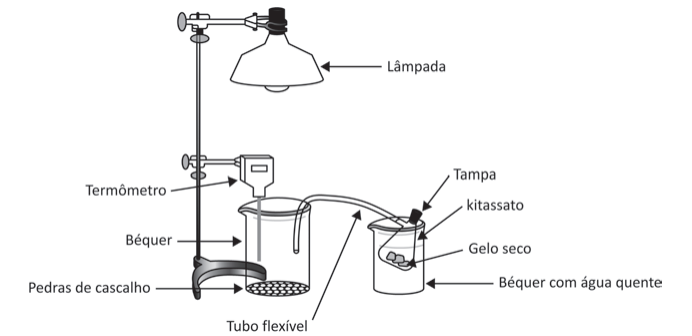
Na Figura a seguir é apresentado o aparato experimental para o estudo de gases, simulando condições
ambientais, em que o sol é representado pela lâmpada, a superfície terrestre pelas pedras de cascalho
no fundo do béquer e a troposfera pelos gases presentes no béquer com as pedras de cascalho.
O experimento descrito permite a discussão de problemas ambientais associados à composição da
atmosfera terrestre.
O primeiro experimento é realizado a partir da produção de um gás específico, produzido no sistema formado por gelo seco dentro de um kitassato fechado, mergulhado em outro béquer, com água quente, e conectado ao béquer com as pedras de cascalho por meio de um tubo flexível. O gás liberado pelo tubo flexível chega ao béquer que contém um termômetro e as pedras de cascalho no fundo. Todo sistema está exposto à uma lâmpada acesa e a temperatura é aferida a cada minuto. Após algum tempo de coleta de dados, a lâmpada é desligada e a temperatura é novamente aferida minuto a minuto.
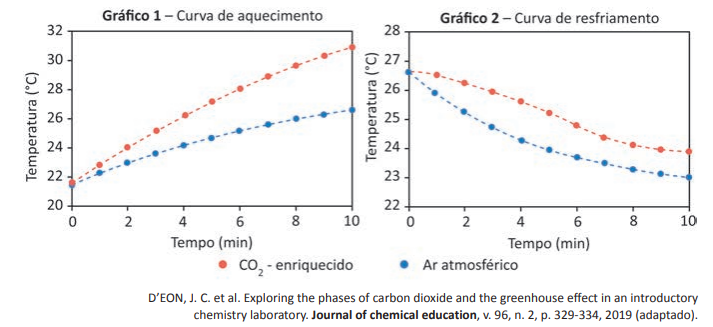
Em um outro momento, o experimento é novamente realizado somente com ar atmosférico, sem a presença do gás gerado a partir do gelo seco. Novamente os dados são coletados, inicialmente com a lâmpada acesa e, posteriormente, com a lâmpada apagada. Com os resultados de temperatura coletados no experimento, foram elaborados os gráficos seguir.
Considerando essa situação, assinale a opção que, simulando condições ambientais com o sol, faz considerações corretas sobre o estudo dos gases.
O primeiro experimento é realizado a partir da produção de um gás específico, produzido no sistema formado por gelo seco dentro de um kitassato fechado, mergulhado em outro béquer, com água quente, e conectado ao béquer com as pedras de cascalho por meio de um tubo flexível. O gás liberado pelo tubo flexível chega ao béquer que contém um termômetro e as pedras de cascalho no fundo. Todo sistema está exposto à uma lâmpada acesa e a temperatura é aferida a cada minuto. Após algum tempo de coleta de dados, a lâmpada é desligada e a temperatura é novamente aferida minuto a minuto.
Em um outro momento, o experimento é novamente realizado somente com ar atmosférico, sem a presença do gás gerado a partir do gelo seco. Novamente os dados são coletados, inicialmente com a lâmpada acesa e, posteriormente, com a lâmpada apagada. Com os resultados de temperatura coletados no experimento, foram elaborados os gráficos seguir.
Considerando essa situação, assinale a opção que, simulando condições ambientais com o sol, faz considerações corretas sobre o estudo dos gases.
Q4151301
Química
Uma docente de Química do Ensino Médio realizou uma atividade experimental sobre corrosão do mármore
provocada pelo ácido muriático, para que os estudantes tivessem a oportunidade de aplicar o que aprenderam
em situações reais, testar hipóteses, analisar dados e refletir acerca destes.
Considerando-se os propósitos da experimentação em uma perspectiva investigativa, a atividade experimental em questão foi realizada com o objetivo de
Considerando-se os propósitos da experimentação em uma perspectiva investigativa, a atividade experimental em questão foi realizada com o objetivo de
Q4151300
Química
Um grupo de licenciandos em Química, inscritos no Estágio Curricular Supervisionado, aplicou uma
sequência didática alinhada com a perspectiva da Ciência, Tecnologia e Sociedade, tendo como questão de
investigação a seguinte pergunta: O rompimento de barragem em Brumadinho – MG: crime ambiental ou
acidente? Para responder à questão, foi necessário o aprofundamento em aspectos científicos, tecnológicos,
ambientais e sociais. Em determinado momento da sequência didática, foi aplicada uma atividade avaliativa
em que se buscava compreender as explicações científicas dos estudantes acerca dos compostos químicos
presentes na lama.
Por meio dessa avaliação foram identificadas concepções equivocadas acerca do conteúdo de ligações químicas. As principais confusões encontradas estavam relacionadas com: tipo de ligação; regra do octeto; antropomorfismo; geometria das moléculas e polaridade; e energia das ligações químicas.
Considerando que as opções que se seguem são possíveis respostas apresentadas pelos estudantes na referida avaliação, assinale a opção que apresenta a explicação equivocada relacionada aos conceitos de Ligações Químicas e Interações Intermoleculares.
Por meio dessa avaliação foram identificadas concepções equivocadas acerca do conteúdo de ligações químicas. As principais confusões encontradas estavam relacionadas com: tipo de ligação; regra do octeto; antropomorfismo; geometria das moléculas e polaridade; e energia das ligações químicas.
Considerando que as opções que se seguem são possíveis respostas apresentadas pelos estudantes na referida avaliação, assinale a opção que apresenta a explicação equivocada relacionada aos conceitos de Ligações Químicas e Interações Intermoleculares.
Q4151299
Química
Uma professora de Química propôs aos seus alunos do Ensino Médio a seguinte atividade, acerca dos
conhecimentos estequiométricos estudados em sala de aula.
“Uma massa de 276 g de etanol sofreu combustão completa na presença de 440 L de gás oxigênio em condições ambientes (1 atm e 25 °C). Com base nessas informações, escreva a equação química balanceada, calcule a massa e o volume do óxido gasoso liberado e determine se há algum reagente em excesso, informando, em caso positivo, a quantidade que sobrará deste reagente. Dados: MH = 1 g/mol, MC = 12 g/mol, MO = 16 g/mol; considere o volume molar nas condições em que a reação ocorreu igual a 25 L/mol.”
A partir dessas informações, assinale a opção que apresenta a resposta correta ao questionamento levantado pela professora.
“Uma massa de 276 g de etanol sofreu combustão completa na presença de 440 L de gás oxigênio em condições ambientes (1 atm e 25 °C). Com base nessas informações, escreva a equação química balanceada, calcule a massa e o volume do óxido gasoso liberado e determine se há algum reagente em excesso, informando, em caso positivo, a quantidade que sobrará deste reagente. Dados: MH = 1 g/mol, MC = 12 g/mol, MO = 16 g/mol; considere o volume molar nas condições em que a reação ocorreu igual a 25 L/mol.”
A partir dessas informações, assinale a opção que apresenta a resposta correta ao questionamento levantado pela professora.
Q4151298
Química
A partir de visões contemporâneas da filosofia da ciência, entende-se que a evolução científica ocorre pela
quebra de paradigmas. Isso pode ser percebido no avanço das teorias elaboradas para compreender as
ligações químicas. Nesse sentido, as três principais teorias estão representadas na Figura a seguir.
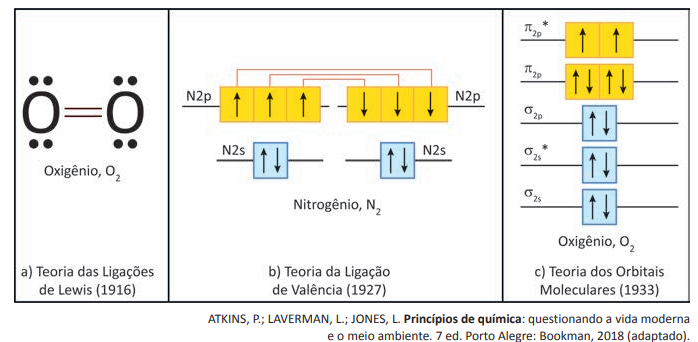
Um professor ao abordar o assunto das ligações químicas, após realizar uma transposição didática sobre a Teoria de Lewis, Teoria da Ligação de Valência e Teoria do Orbital Molecular, solicitou aos estudantes que investigassem as principais contribuições e limitações destas teorias.
Nesse caso, entre as respostas fornecidas, está correta a do estudante que respondeu que
Um professor ao abordar o assunto das ligações químicas, após realizar uma transposição didática sobre a Teoria de Lewis, Teoria da Ligação de Valência e Teoria do Orbital Molecular, solicitou aos estudantes que investigassem as principais contribuições e limitações destas teorias.
Nesse caso, entre as respostas fornecidas, está correta a do estudante que respondeu que

 Conheça nossos planos