Questões de Concurso
Comentadas para vunesp
Foram encontradas 108.707 questões
Resolva questões gratuitamente!
Junte-se a mais de 4 milhões de concurseiros!


Ano: 2025
Banca:
VUNESP
Órgão:
SEDUC-SP
Prova:
VUNESP - 2025 - SEDUC-SP - Professor de Educação Básica II - Alemão - QM 2020 |
Q3528351
Pedagogia
No artigo “Cultura no ensino de língua estrangeira” (2024),
são citados os cinco savoirs (saberes) ou capacidades
elencadas por Byram e Zarate (1997) como componentes
da competência intercultural. Um deles, o savoir être (saber
ser), diz respeito a
Ano: 2025
Banca:
VUNESP
Órgão:
SEDUC-SP
Prova:
VUNESP - 2025 - SEDUC-SP - Professor de Educação Básica II - Alemão - QM 2020 |
Q3528350
Pedagogia
Segundo a tipologia de exercícios de Neuner et al. (1981),
citada por Garcia (2018) no artigo “Abordagens sintética e
analítica na progressão gramatical em cursos de alemão
como língua estrangeira”, na abordagem comunicativa há
uma progressão de tipos de exercícios (de A a D) que se
caracteriza por
Ano: 2025
Banca:
VUNESP
Órgão:
SEDUC-SP
Prova:
VUNESP - 2025 - SEDUC-SP - Professor de Educação Básica II - Alemão - QM 2020 |
Q3528349
Pedagogia
Wilkins (1978), citado por Garcia (2018) em seu artigo
“Abordagens sintética e analítica na progressão gramatical
em cursos de alemão como língua estrangeira”, denominou
“sintética” a forma de apresentação de conteúdos aos alunos que ocorre de forma distribuída ao longo de diversas
unidades do livro didático, e “analítica” aquela em que os
conteúdos complexos são explorados em sala de aula de
uma só vez. Partindo dessa classificação, é correto afirmar
que a apresentação
Ano: 2025
Banca:
VUNESP
Órgão:
SEDUC-SP
Prova:
VUNESP - 2025 - SEDUC-SP - Professor de Educação Básica II - Alemão - QM 2020 |
Q3528348
Pedagogia
Segundo Canato e Rozenfeld (2017), em seu artigo “A
motivação de alunos de alemão e prática de multiletramentos em um CEL”, estudiosos como Gillet e Vallerand
(2012), entre outros, afirmam que a motivação para a
aprendizagem de uma língua pode ser classificada como
extrínseca ou intrínseca. Segundo essa classificação, é
correto afirmar sobre a motivação extrínseca que ela
Ano: 2025
Banca:
VUNESP
Órgão:
SEDUC-SP
Prova:
VUNESP - 2025 - SEDUC-SP - Professor de Educação Básica II - Alemão - QM 2020 |
Q3528336
Pedagogia
A meta 6 do Plano Estadual de Educação de São Paulo (2016) refere-se à temática da educação integral.
Tendo em vista o que o documento estabelece a esse respeito na própria meta e nas estratégias para sua consecução, é correto afirmar:
Ano: 2025
Banca:
VUNESP
Órgão:
SEDUC-SP
Prova:
VUNESP - 2025 - SEDUC-SP - Professor de Educação Básica II - Química - QM 2018 |
Q3528053
Pedagogia
No livro Jogos e Atividades Lúdicas para o Ensino de
Química, o autor Marlon H.F.B. Soares apresenta as
definições a seguir:
1 – Ação divertida, relacionada aos jogos, seja qual for o contexto linguístico, com ou sem presença de regras, sendo apenas uma ação que gere o mínimo de divertimento.
2 – Resultado de um diálogo aberto, sem preconceitos ou ideias prévias sobre o que são os alunos no mundo atual e o que eles acham do estudo no seu desenvolvimento e formação.
3 – Ação intencional do professor voltada e orientada ao equilíbrio do aspecto prazeroso e pedagógico da atividade a ser desenvolvida.
As definições 1, 2 e 3 referem-se, correta e respectivamente, aos termos
1 – Ação divertida, relacionada aos jogos, seja qual for o contexto linguístico, com ou sem presença de regras, sendo apenas uma ação que gere o mínimo de divertimento.
2 – Resultado de um diálogo aberto, sem preconceitos ou ideias prévias sobre o que são os alunos no mundo atual e o que eles acham do estudo no seu desenvolvimento e formação.
3 – Ação intencional do professor voltada e orientada ao equilíbrio do aspecto prazeroso e pedagógico da atividade a ser desenvolvida.
As definições 1, 2 e 3 referem-se, correta e respectivamente, aos termos
Ano: 2025
Banca:
VUNESP
Órgão:
SEDUC-SP
Prova:
VUNESP - 2025 - SEDUC-SP - Professor de Educação Básica II - Química - QM 2018 |
Q3528049
Química
A figura representa a estrutura primária da fração de uma proteína.
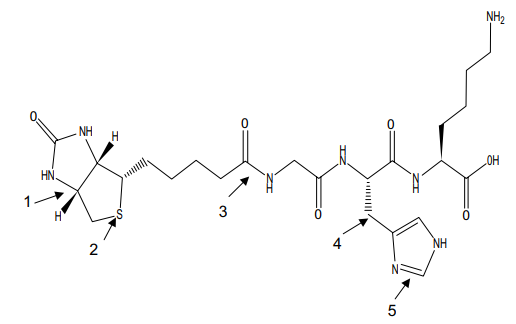
A ligação peptídica é indicada pela seta de número
Ano: 2025
Banca:
VUNESP
Órgão:
SEDUC-SP
Prova:
VUNESP - 2025 - SEDUC-SP - Professor de Educação Básica II - Química - QM 2018 |
Q3528039
Biologia
A energia necessária para a realização de processos
metabólicos em organismos vegetais e animais provém,
principalmente, de uma substância que os organismos armazenam em locais específicos. Nos vegetais, essa substância é armazenada em estruturas especializadas, como
sementes e raízes, enquanto nos animais essa substância
é armazenada principalmente no fígado e nos músculos.
A substância à qual o texto se refere pertence a um grupo denominado
A substância à qual o texto se refere pertence a um grupo denominado
Ano: 2025
Banca:
VUNESP
Órgão:
SEDUC-SP
Prova:
VUNESP - 2025 - SEDUC-SP - Professor de Educação Básica II - Química - QM 2018 |
Q3528034
Química
Um professor de química dispõe de uma solução residual
de uma aula de laboratório que contém uma mistura de
íons cromato e dicromato de potássio. Para recuperar
esse resíduo e reutilizá-lo, o professor deverá cristalizar o
sal na forma de cromato. A equação a seguir representa o
equilíbrio químico que se estabelece entre esses íons em
solução.
2CrO4 2– (aq) + 2H+(aq) ⇄ Cr2 O7 2– (aq) + H2 O(l)
Para que o íon cromato seja o preponderante no sal cristalizado, deve-se adicionar _________à mistura que contém esses dois íons antes da cristalização.
A lacuna é preenchida corretamente por
2CrO4 2– (aq) + 2H+(aq) ⇄ Cr2 O7 2– (aq) + H2 O(l)
Para que o íon cromato seja o preponderante no sal cristalizado, deve-se adicionar _________à mistura que contém esses dois íons antes da cristalização.
A lacuna é preenchida corretamente por
Ano: 2025
Banca:
VUNESP
Órgão:
SEDUC-SP
Prova:
VUNESP - 2025 - SEDUC-SP - Professor de Educação Básica II - Química - QM 2018 |
Q3528026
Química
Texto associado
As rochas calcáreas contêm alto teor de carbonato de
cálcio (CaCO3
), que é matéria-prima de diversos processos industriais. Sua decomposição térmica dá origem a
dois óxidos, de acordo com a equação.
CaCO3
(s) ⟶ CaO (s) + CO2
(g)
O carbonato de cálcio é também empregado na fabricação do cloreto de cálcio (CaCl2
) por meio da reação com
ácido clorídrico (HCl) com a formação de água e gás carbônico como subprodutos.
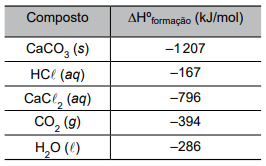
Na tabela são fornecidos os valores das entalpias de formação (ΔHºformação) dos compostos que participam das
reações envolvendo o carbonato de cálcio.
O cálcio é classificado como metal ________. Dentre
os óxidos formados na decomposição térmica do carbonato de cálcio, o óxido que é classificado como ácido é o ________e suas ligações são preponderantemente __________.
As lacunas são preenchidas, correta e respectivamente, por
As lacunas são preenchidas, correta e respectivamente, por
Ano: 2025
Banca:
VUNESP
Órgão:
SEDUC-SP
Prova:
VUNESP - 2025 - SEDUC-SP - Professor de Educação Básica II - Química - QM 2018 |
Q3528025
Química
Texto associado
As rochas calcáreas contêm alto teor de carbonato de
cálcio (CaCO3
), que é matéria-prima de diversos processos industriais. Sua decomposição térmica dá origem a
dois óxidos, de acordo com a equação.
CaCO3
(s) ⟶ CaO (s) + CO2
(g)
O carbonato de cálcio é também empregado na fabricação do cloreto de cálcio (CaCl2
) por meio da reação com
ácido clorídrico (HCl) com a formação de água e gás carbônico como subprodutos.
Na tabela são fornecidos os valores das entalpias de formação (ΔHºformação) dos compostos que participam das
reações envolvendo o carbonato de cálcio.
A fórmula do composto de cálcio que resulta da reação total do carbonato de cálcio com o ácido fosfórico
(H3
PO4
) é:
Ano: 2025
Banca:
VUNESP
Órgão:
SEDUC-SP
Prova:
VUNESP - 2025 - SEDUC-SP - Professor de Educação Básica II - Química - QM 2018 |
Q3528022
Química
A equação química não balanceada apresentada a seguir
representa uma reação que envolve compostos de ouro.
HAuCl4 (s) + H2 S (g) ⟶ Au2 S3 (s) + HCl (g)
A soma dos coeficientes estequiométricos dos reagentes da equação balanceada que resulta na formação de 8 mol de HCl é igual a
HAuCl4 (s) + H2 S (g) ⟶ Au2 S3 (s) + HCl (g)
A soma dos coeficientes estequiométricos dos reagentes da equação balanceada que resulta na formação de 8 mol de HCl é igual a
Ano: 2025
Banca:
VUNESP
Órgão:
SEDUC-SP
Prova:
VUNESP - 2025 - SEDUC-SP - Professor de Educação Básica II - Sociologia - QM 2018 |
Q3527958
Sociologia
Se democracia se confunde com igualdade, a implementação do direito à igualdade, por sua vez, impõe tanto
o desafio de eliminar toda e qualquer forma de discriminação como o desafio de promover a igualdade. Para
a implementação do direito à igualdade, é decisivo que
se intensifiquem e aprimorem ações em prol do alcance
dessas duas metas que, por serem indissociáveis, hão
de ser desenvolvidas de forma conjugada.
(Flávia Piovesan, 2005. Adaptado)
No excerto, Flávia Piovesan argumenta que, para a conquista da igualdade efetiva, é necessário que sejam
(Flávia Piovesan, 2005. Adaptado)
No excerto, Flávia Piovesan argumenta que, para a conquista da igualdade efetiva, é necessário que sejam
Ano: 2025
Banca:
VUNESP
Órgão:
SEDUC-SP
Prova:
VUNESP - 2025 - SEDUC-SP - Professor de Educação Básica II - Sociologia - QM 2018 |
Q3527957
Sociologia
Um empregador “ponto com” pode comentar, com aprovação, sobre um empregado: “Ele é um chateação zero”,
querendo dizer que ele está disponível para assumir atribuições extras, responder a chamados de emergência, ou
ser realocado a qualquer momento. Morar a alguma distância do emprego e/ou carregar o peso de uma mulher
ou filho aumentam o “coeficiente de chateação” e reduzem as chances de emprego do candidato. O empregado
ideal seria uma pessoa sem vínculos, compromissos ou
ligações emocionais anteriores, e que evite estabelecê-los agora; uma pessoa pronta a assumir qualquer tarefa
que lhe apareça e preparada para se reajustar e reacomodar de imediato suas próprias inclinações; uma pessoa acostumada a um ambiente em que “acostumar-se”
é algo malvisto e, portanto, imprudente; além de tudo,
uma pessoa que deixará a empresa quando não for mais
necessária, sem queixa nem processo.
(Zygmunt Bauman, 2022)
No excerto, aponta(m)-se criticamente
(Zygmunt Bauman, 2022)
No excerto, aponta(m)-se criticamente
Ano: 2025
Banca:
VUNESP
Órgão:
SEDUC-SP
Prova:
VUNESP - 2025 - SEDUC-SP - Professor de Educação Básica II - Sociologia - QM 2018 |
Q3527956
Sociologia
Os adolescentes equipados com confessionários eletrônicos portáteis são apenas aprendizes treinando e treinados na arte de viver numa sociedade confessional – uma
sociedade notória por eliminar a fronteira que antes separava o privado e o público, por transformar o ato de expor
publicamente o privado em uma virtude e em um dever
públicos, e por afastar da comunicação pública qualquer
coisa que resista a ser reduzida a confidências privadas,
assim como aqueles que se recusam a confidenciá-las.
Como Jim Gamble, diretor de uma agência de monitoramento de rede, admitiu ao jornal britânico The Guardian,
“ela representa tudo aquilo que se vê no playground – a
única diferença é que nesse playground não há professores, policiais ou moderadores que fiquem de olho no
que se passa”.
(Zygmunt Bauman, 2022. Adaptado)
Na passagem, Zygmunt Bauman problematiza
(Zygmunt Bauman, 2022. Adaptado)
Na passagem, Zygmunt Bauman problematiza
Ano: 2025
Banca:
VUNESP
Órgão:
SEDUC-SP
Prova:
VUNESP - 2025 - SEDUC-SP - Professor de Educação Básica II - Sociologia - QM 2018 |
Q3527955
Sociologia
Considerando as especificidades do Brasil em relação
aos direitos humanos, que é o segundo país do mundo
com o maior contingente populacional afrodescendente
(45% da população brasileira, perdendo apenas para a
Nigéria), tendo sido, contudo, o último país do mundo
ocidental a abolir a escravidão, faz-se emergencial a
adoção de medidas eficazes para romper com o legado de exclusão étnico-racial, que compromete não só
a plena vigência dos direitos humanos, mas também a
própria democracia no país – sob pena de termos democracia sem cidadania.
(Flávia Piovesan, 2005. Adaptado)
Segundo Flávia Piovesan, diante do legado de exclusão étnico-racial, o Brasil arrisca-se a ter uma “democracia sem cidadania”, ou seja, uma democracia
(Flávia Piovesan, 2005. Adaptado)
Segundo Flávia Piovesan, diante do legado de exclusão étnico-racial, o Brasil arrisca-se a ter uma “democracia sem cidadania”, ou seja, uma democracia
Ano: 2025
Banca:
VUNESP
Órgão:
SEDUC-SP
Prova:
VUNESP - 2025 - SEDUC-SP - Professor de Educação Básica II - Sociologia - QM 2018 |
Q3527954
Sociologia
As minorias étnico-raciais, as populações LGBTQIA+,
os desempregados, empobrecidos, as populações em
situação de rua, a população carcerária, as populações
remanescentes de quilombos, as nações indígenas são
segmentos da sociedade submetidos a desvantagens estruturais. Nem sempre esses segmentos estão isolados
entre si; por vezes mesclam-se e apresentam reivindicações. O ativismo, como sugere Iris Marion Young (2014),
chama a atenção das estruturas, mas não gera transformações.
Segundo a autora, o que poderia causar uma mudança efetiva nesse quadro de marginalização seria
Segundo a autora, o que poderia causar uma mudança efetiva nesse quadro de marginalização seria
Ano: 2025
Banca:
VUNESP
Órgão:
SEDUC-SP
Prova:
VUNESP - 2025 - SEDUC-SP - Professor de Educação Básica II - Sociologia - QM 2018 |
Q3527953
Português
A luta em torno do mito de origem da República mostrou
a dificuldade de construir um herói para o novo regime.
Heróis são encarnações de ideias e aspirações, pontos
de referência, fulcros de identificação coletiva. Não há
regime que não promova o culto de seus heróis e não
possua seu panteão cívico.
(José Murilo de Carvalho, 2017. Adaptado)
Desse modo, no entendimento de José Murilo de Carvalho, os heróis
(José Murilo de Carvalho, 2017. Adaptado)
Desse modo, no entendimento de José Murilo de Carvalho, os heróis
Ano: 2025
Banca:
VUNESP
Órgão:
SEDUC-SP
Prova:
VUNESP - 2025 - SEDUC-SP - Professor de Educação Básica II - Sociologia - QM 2018 |
Q3527952
Direitos Humanos
A primeira fase de proteção dos direitos humanos foi
marcada pela tônica da proteção geral, que expressava
o temor da diferença (que no nazismo havia sido orientada para o extermínio) com base na igualdade formal.
A título de exemplo, basta avaliar quem é o destinatário
da Declaração Universal de Direitos Humanos de 1948,
bem como basta atentar para a Convenção para a Prevenção e Repressão ao Crime de Genocídio, também de
1948, que pune a lógica da intolerância pautada na destruição do “outro” em razão de sua nacionalidade, etnia,
raça ou religião.
(Flávia Piovesan, 2005)
Segundo a autora, a ampliação do escopo que se deu na fase seguinte da proteção dos direitos humanos buscou
(Flávia Piovesan, 2005)
Segundo a autora, a ampliação do escopo que se deu na fase seguinte da proteção dos direitos humanos buscou
Ano: 2025
Banca:
VUNESP
Órgão:
SEDUC-SP
Prova:
VUNESP - 2025 - SEDUC-SP - Professor de Educação Básica II - Sociologia - QM 2018 |
Q3527951
Sociologia
Em 1822, o Brasil não conseguiu entrar no ritmo da
história. A declaração de independência, a Assembleia
Nacional Constituinte, os conflitos com os portugueses e
as lutas populares não conseguiram lançar o país a um
patamar mais avançado. O que prevaleceu foi o passado,
a continuidade colonial, o escravismo, o absolutismo.
O modo pelo qual organizou-se o estado nacional garantiu a continuidade, o conservadorismo, as estruturas sociais herdadas do colonialismo, do lusitanismo.
(Ianni, 1994. Adaptado)
Octavio Ianni esclarece que, posteriormente à declaração da independência, o Brasil
(Ianni, 1994. Adaptado)
Octavio Ianni esclarece que, posteriormente à declaração da independência, o Brasil

 Conheça nossos planos