Questões de Concurso
Sobre interpretação de texto | reading comprehension em inglês
Foram encontradas 12.689 questões


Ano: 2025
Banca:
FUNDATEC
Órgão:
Prefeitura de Venâncio Aires - RS
Prova:
FUNDATEC - 2025 - Prefeitura de Venâncio Aires - RS - Professor de Língua Inglesa |
Q3762117
Inglês
Texto associado
A One-Man Recycling Revolution on The Cornish Coast
By Rupert Neate
(Available at: www.theguardian.com/environment/2025/oct/16/fishing-nets-money-a-one-man-recyclingrevolution-on-the-cornish-coast – text specially adapted for this test).
Analyze the statements below about the text and mark T, if true, or F, if false.
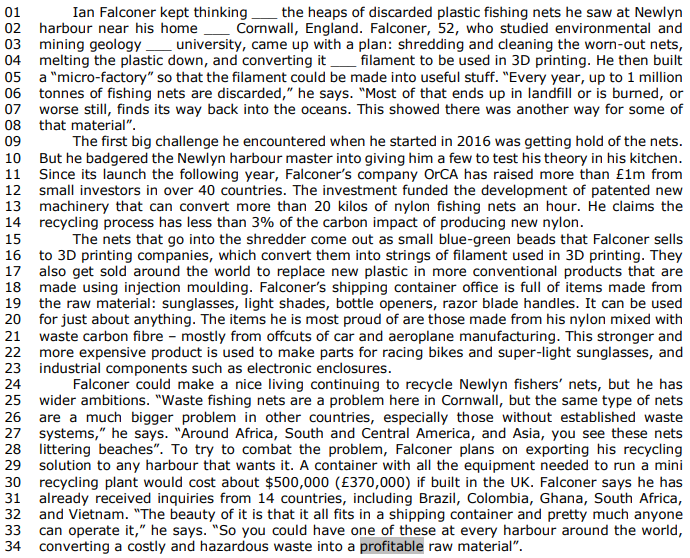
( ) Falconer had the idea for his business because he needed filament for his 3D printer.
( ) Falconer’s first challenge was having access to the fishnets in order to test his idea.
( ) The beads sold by Falconer have a 3% lower carbon footprint than new nylon.
The correct order of filling in the parentheses, from top to bottom, is:
( ) Falconer had the idea for his business because he needed filament for his 3D printer.
( ) Falconer’s first challenge was having access to the fishnets in order to test his idea.
( ) The beads sold by Falconer have a 3% lower carbon footprint than new nylon.
The correct order of filling in the parentheses, from top to bottom, is:
Ano: 2025
Banca:
FUNDATEC
Órgão:
Prefeitura de Venâncio Aires - RS
Prova:
FUNDATEC - 2025 - Prefeitura de Venâncio Aires - RS - Professor de Língua Inglesa |
Q3762116
Inglês
Texto associado
A One-Man Recycling Revolution on The Cornish Coast
By Rupert Neate
(Available at: www.theguardian.com/environment/2025/oct/16/fishing-nets-money-a-one-man-recyclingrevolution-on-the-cornish-coast – text specially adapted for this test).
What is Ian Falconer’s next step in expanding his business?
Ano: 2025
Banca:
FUNDATEC
Órgão:
Prefeitura de Três de Maio - RS
Prova:
FUNDATEC - 2025 - Prefeitura de Três de Maio - RS - Professor - Língua Inglesa 20H e 40H |
Q3760452
Inglês
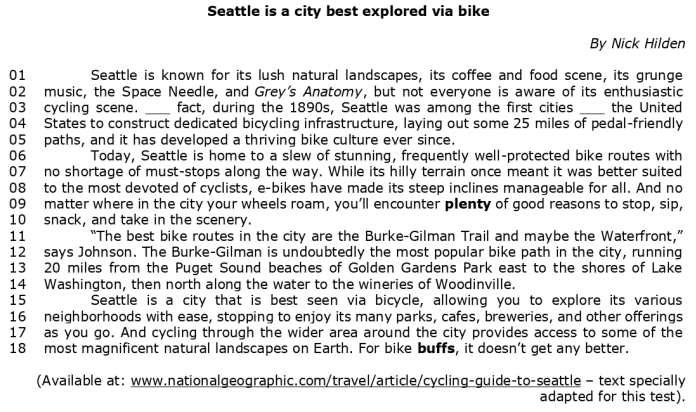
According to the text, mark the INCORRECT statement about cycling in Seattle.
Ano: 2025
Banca:
FUNDATEC
Órgão:
Prefeitura de Três de Maio - RS
Prova:
FUNDATEC - 2025 - Prefeitura de Três de Maio - RS - Professor - Língua Inglesa 20H e 40H |
Q3760451
Inglês
Analyze the following statements about the text and mark T, if true, or F, if false.
( ) Johnson explains that the Burke-Gilman Trail and perhaps the Waterfront are the best bike routes in the city.
( ) The Burke-Gilman is running 20 miles from the shores of Lake Washington to the Puget Sound beaches of Golden Gardens Park.
( ) It is not allowed cycling through the wider area around the city.
The correct order of filling in the parentheses, from top to bottom, is:
( ) Johnson explains that the Burke-Gilman Trail and perhaps the Waterfront are the best bike routes in the city.
( ) The Burke-Gilman is running 20 miles from the shores of Lake Washington to the Puget Sound beaches of Golden Gardens Park.
( ) It is not allowed cycling through the wider area around the city.
The correct order of filling in the parentheses, from top to bottom, is:
Ano: 2025
Banca:
Ápice Consultoria
Órgão:
Prefeitura de Boqueirão - PB
Prova:
Ápice Consultoria - 2025 - Prefeitura de Boqueirão - PB - Professor de Educação Básica II - Inglês |
Q3758796
Inglês
Texto associado
Leia o texto abaixo para responder da questão.
New Study: This Regional Accent Is Considered
the Most Trustworthy in the U.S.—And the
Results Will Really Surprise You!
By Jennifer Geddes
A person’s cadence counts for a lot.
Everyone knows first impressions are important—
and we don’t just make them based on sight. Beyond
a chic outfit and well-coiffed hair, how a person
sounds can also be a big factor when forming an
initial opinion. In fact, a recent analysis of more than a
dozen American accents conducted by BetUS Casino
found that some folks’ speech actually conveys more
honesty and reliability than others’.
At this point, you’re probably praying your own voice
sounds dependable, not shifty or shady, right? Try to
relax, and then read on to learn (nay, hear!) where
the most trustworthy accents are located.
How was the study conducted?
As with many studies today, internet data helped
determine which parts of the country sound the most
steadfast and true. BetUS Casino crafted the report,
which is current as of Aug. 15, 2025, by focusing on
how people feel about 14 different regional accents.
How did the company determine those feelings?
First, researchers looked at internet search terms like
“friendly (accent)” or “professional (accent).” Then,
to complete the rankings, they compiled data on the
rate of financial crimes per 10,000 people, plus the
number of lawyers and primary-care doctors in each
area.
Why doctors and lawyers, you may ask? Well, these
are professions that rely on trust—after all, you might
have to put your life in their hands! The more of these
professionals in an area, the more trustworthy the
accent. Once the study authors had the information
in hand, they weighted the data and ranked the
regions on a scale of 1–100.
Which regional accent is considered the most
trustworthy?
Now hear this: The regional accent that’s considered
to be the most trustworthy hails from Boston!
Yup, the fine citizens of Beantown scored 56.1, which
was enough to take top honors for sounding highly
dependable. Boston ranks so strongly thanks to
more than 23,300 searches related to how kind and
upstanding the accent sounds. The Massachusetts
capital and largest city in New England also sports
a low level of financial crime and is home to tens of
thousands of lawyers and doctors.
Boston shines in other ways too, underlining the trust
factor essential to its distinctive accent. For example,
one recent WalletHub report list Boston as the third
most caring city in the nation, while another names
Massachusetts as the best U.S. state to live in. And
the Bay State has excellent health care, with the
highest childhood vaccination rates, lowest infant
mortality and fewest premature avoidable deaths.
Want to sound just like a Bostonian? Start by
dropping some of your R’s, as in “pahk the cah” and
“wicked smaht.” Or listen to Ben Affleck turn on the
telltale accent in his Dunkin’ commercials. Other
famous Bostonians with perfect inflection include
Matt Damon, Mark Wahlberg and Amy Poehler.
In: https://www.rd.com/article/happiest-cities-america-2025/
Marque verdadeiro ou falso para as sentenças
abaixo.
( ) No trecho “Everyone knows first impressions are important—and we don’t just make them based on sight,” o pronome “them” refere-se a “first impressions”, e seu uso está correto no contexto da frase.
( ) Na sentença “BetUS Casino crafted the report, which is current as of Aug. 15, 2025,” o pronome relativo “which” refere-se a BetUS Casino, funcionando como sujeito da oração subordinada.
( ) Na frase “The more of these professionals in an area, the more trustworthy the accent,” a palavra “these” refere-se especificamente a lawyers and primary-care doctors, mencionados anteriormente.
( ) Em “Once the study authors had the information in hand, they weighted the data and ranked the regions,” o pronome “they” está incorretamente empregado, pois não possui um referente claro no texto anterior.
( ) Na sentença “Want to sound just like a Bostonian? Start by dropping some of your R’s,” o pronome possessivo “your” referese genericamente ao leitor, mantendo o tom informal e direto do texto.
A sequência correta é:
( ) No trecho “Everyone knows first impressions are important—and we don’t just make them based on sight,” o pronome “them” refere-se a “first impressions”, e seu uso está correto no contexto da frase.
( ) Na sentença “BetUS Casino crafted the report, which is current as of Aug. 15, 2025,” o pronome relativo “which” refere-se a BetUS Casino, funcionando como sujeito da oração subordinada.
( ) Na frase “The more of these professionals in an area, the more trustworthy the accent,” a palavra “these” refere-se especificamente a lawyers and primary-care doctors, mencionados anteriormente.
( ) Em “Once the study authors had the information in hand, they weighted the data and ranked the regions,” o pronome “they” está incorretamente empregado, pois não possui um referente claro no texto anterior.
( ) Na sentença “Want to sound just like a Bostonian? Start by dropping some of your R’s,” o pronome possessivo “your” referese genericamente ao leitor, mantendo o tom informal e direto do texto.
A sequência correta é:
Ano: 2025
Banca:
Ápice Consultoria
Órgão:
Prefeitura de Boqueirão - PB
Prova:
Ápice Consultoria - 2025 - Prefeitura de Boqueirão - PB - Professor de Educação Básica II - Inglês |
Q3758792
Inglês
Texto associado
Leia o texto abaixo para responder da questão.
New Study: This Regional Accent Is Considered
the Most Trustworthy in the U.S.—And the
Results Will Really Surprise You!
By Jennifer Geddes
A person’s cadence counts for a lot.
Everyone knows first impressions are important—
and we don’t just make them based on sight. Beyond
a chic outfit and well-coiffed hair, how a person
sounds can also be a big factor when forming an
initial opinion. In fact, a recent analysis of more than a
dozen American accents conducted by BetUS Casino
found that some folks’ speech actually conveys more
honesty and reliability than others’.
At this point, you’re probably praying your own voice
sounds dependable, not shifty or shady, right? Try to
relax, and then read on to learn (nay, hear!) where
the most trustworthy accents are located.
How was the study conducted?
As with many studies today, internet data helped
determine which parts of the country sound the most
steadfast and true. BetUS Casino crafted the report,
which is current as of Aug. 15, 2025, by focusing on
how people feel about 14 different regional accents.
How did the company determine those feelings?
First, researchers looked at internet search terms like
“friendly (accent)” or “professional (accent).” Then,
to complete the rankings, they compiled data on the
rate of financial crimes per 10,000 people, plus the
number of lawyers and primary-care doctors in each
area.
Why doctors and lawyers, you may ask? Well, these
are professions that rely on trust—after all, you might
have to put your life in their hands! The more of these
professionals in an area, the more trustworthy the
accent. Once the study authors had the information
in hand, they weighted the data and ranked the
regions on a scale of 1–100.
Which regional accent is considered the most
trustworthy?
Now hear this: The regional accent that’s considered
to be the most trustworthy hails from Boston!
Yup, the fine citizens of Beantown scored 56.1, which
was enough to take top honors for sounding highly
dependable. Boston ranks so strongly thanks to
more than 23,300 searches related to how kind and
upstanding the accent sounds. The Massachusetts
capital and largest city in New England also sports
a low level of financial crime and is home to tens of
thousands of lawyers and doctors.
Boston shines in other ways too, underlining the trust
factor essential to its distinctive accent. For example,
one recent WalletHub report list Boston as the third
most caring city in the nation, while another names
Massachusetts as the best U.S. state to live in. And
the Bay State has excellent health care, with the
highest childhood vaccination rates, lowest infant
mortality and fewest premature avoidable deaths.
Want to sound just like a Bostonian? Start by
dropping some of your R’s, as in “pahk the cah” and
“wicked smaht.” Or listen to Ben Affleck turn on the
telltale accent in his Dunkin’ commercials. Other
famous Bostonians with perfect inflection include
Matt Damon, Mark Wahlberg and Amy Poehler.
In: https://www.rd.com/article/happiest-cities-america-2025/
Considere o seguinte trecho do texto:
“Once the study authors had the information in hand, they weighted the data and ranked the regions on a scale of 1–100.”
Com base nesse trecho, analise as afirmativas a seguir:
I. O tempo verbal predominante é o past perfect, usado para indicar que uma ação foi concluída antes de outra no passado.
II. Os verbos “weighted” e “ranked” estão no past simple, e seus objetos diretos são, respectivamente, the data e the regions.
III. O verbo “had” funciona como verbo auxiliar na formação do past perfect, e o objeto direto da ação é the study authors.
IV. Não há objeto indireto explícito em nenhuma das orações do trecho citado.
Assinale a alternativa correta:
“Once the study authors had the information in hand, they weighted the data and ranked the regions on a scale of 1–100.”
Com base nesse trecho, analise as afirmativas a seguir:
I. O tempo verbal predominante é o past perfect, usado para indicar que uma ação foi concluída antes de outra no passado.
II. Os verbos “weighted” e “ranked” estão no past simple, e seus objetos diretos são, respectivamente, the data e the regions.
III. O verbo “had” funciona como verbo auxiliar na formação do past perfect, e o objeto direto da ação é the study authors.
IV. Não há objeto indireto explícito em nenhuma das orações do trecho citado.
Assinale a alternativa correta:
Ano: 2025
Banca:
FACET Concursos
Órgão:
Prefeitura de Monteiro - PB
Prova:
FACET Concursos - 2025 - Prefeitura de Monteiro - PB - Professor de Educação Fundamental 2 - Língua Inglesa |
Q3758306
Inglês
Multilingual classrooms require norms coconstructed, clear procedures, and collaborative
structures (jigsaw, think-pair-share). Translanguaging
can scaffold meaning while maintaining English-medium
goals. Conflict resolution emphasizes restorative
practices and expectation clarity. Choose the correct
alternative.
Ano: 2025
Banca:
FACET Concursos
Órgão:
Prefeitura de Monteiro - PB
Prova:
FACET Concursos - 2025 - Prefeitura de Monteiro - PB - Professor de Educação Fundamental 2 - Língua Inglesa |
Q3758305
Inglês
Motivation frameworks (cf. Dörnyei) integrate
autonomy, competence, and relatedness; differentiation
and UDL propose multiple means of representation and
expression. For neurodivergent learners, predictable
routines, processing time, and sensory
accommodations support participation. Select the
correct option.
Ano: 2025
Banca:
FACET Concursos
Órgão:
Prefeitura de Monteiro - PB
Prova:
FACET Concursos - 2025 - Prefeitura de Monteiro - PB - Professor de Educação Fundamental 2 - Língua Inglesa |
Q3758304
Inglês
Materials should be contextualized, inclusive,
and multimodal (cf. Tomlinson). Technology (LMSs,
corpora, ASR, adaptive platforms) supports input variety
and feedback but must respect privacy and validity.
Data-driven learning leverages corpora to raise noticing
of collocation and phraseology. Choose the correct
alternative.
Ano: 2025
Banca:
FACET Concursos
Órgão:
Prefeitura de Monteiro - PB
Prova:
FACET Concursos - 2025 - Prefeitura de Monteiro - PB - Professor de Educação Fundamental 2 - Língua Inglesa |
Q3758300
Inglês
Skimming surveys macro-structure; scanning
targets specific data; inferencing maps cues to
schemata; deduction tests hypotheses. In technical
prose, metadiscourse (e.g., “in contrast”, “it follows
that”) scaffolds coherence (cf. Hyland). Genre
awareness (cf. Swales) accelerates comprehension of
moves and goals. Choose the best alternative.
Ano: 2025
Banca:
FACET Concursos
Órgão:
Prefeitura de Monteiro - PB
Prova:
FACET Concursos - 2025 - Prefeitura de Monteiro - PB - Professor de Educação Fundamental 2 - Língua Inglesa |
Q3758299
Inglês
From Shakespeare and Donne to Woolf,
Achebe, and Toni Morrison, the Anglophone canon
foregrounds evolving aesthetics and politics. Close
reading interrogates voice, focalization, and form, while
cultural criticism traces power and representation.
Pedagogically, literature builds linguistic range and
intercultural competence. Select the correct option.
Ano: 2025
Banca:
FACET Concursos
Órgão:
Prefeitura de Monteiro - PB
Prova:
FACET Concursos - 2025 - Prefeitura de Monteiro - PB - Professor de Educação Fundamental 2 - Língua Inglesa |
Q3758298
Inglês
Cross-cultural pragmatics shows how speech
acts (apologies, requests) vary in directness, mitigation,
and stance across English-speaking communities (cf.
Blum-Kulka; Wierzbicka). Misalignment in politeness
systems may produce unintended rudeness or
deference. Pedagogy should address pragmalinguistic
and sociopragmatic knowledge, not merely forms.
Choose the correct alternative.
Ano: 2025
Banca:
FACET Concursos
Órgão:
Prefeitura de Monteiro - PB
Prova:
FACET Concursos - 2025 - Prefeitura de Monteiro - PB - Professor de Educação Fundamental 2 - Língua Inglesa |
Q3758297
Inglês
Hymes’ communicative competence and
Halliday’s register theory frame how lexico-grammar
varies across field, tenor, mode. With English as a
Lingua Franca (cf. Seidlhofer; Jenkins), intelligibility and
accommodation outweigh native-speaker norms in
many contexts. Genre expectations constrain stance
and phraseology (cf. Biber & Conrad). Select the correct
option.
Ano: 2025
Banca:
FACET Concursos
Órgão:
Prefeitura de Monteiro - PB
Prova:
FACET Concursos - 2025 - Prefeitura de Monteiro - PB - Professor de Educação Fundamental 2 - Língua Inglesa |
Q3758295
Inglês
Conversational implicatures arise from
inferential reasoning guided by cooperative principles
(Grice), while presuppositions project background
assumptions that persist across embedding. Deictic
anchoring links expressions to speaking context, and
advanced proficiency demands distinguishing
entailment from inference and managing contextual reanchoring in reported discourse. Choose the correct
option.
Ano: 2025
Banca:
FGV
Órgão:
CPRM
Provas:
FGV - 2025 - CPRM - Pesquisador em Geociências - Engenharia Ambiental
|
FGV - 2025 - CPRM - Pesquisador em Geociências - Geologia - Levantamento Geológico e de Recursos Minerais |
FGV - 2025 - CPRM - Pesquisador em Geociências - Geologia - Ordenamento Territorial - Área de Risco |
FGV - 2025 - CPRM - Pesquisador em Geociências - Geologia - Sedimentologia, Estratigrafia e Análise tectônica de Bacias Sedimentares |
FGV - 2025 - CPRM - Pesquisador em Geociências - Hidrologia |
FGV - 2025 - CPRM - Pesquisador em Geociências - Paleontologia |
FGV - 2025 - CPRM - Pesquisador em Geociências - Hidrogeologia |
Q3758068
Inglês
Texto associado
Jadarite, described as ‘Earth's kryptonite twin,’ has potential to
replace fossil fuels
A plain-white mineral found in western Serbia has a name straight
out of the comics and a chemical profile that battery makers crave.
Called jadarite, also known as sodium-lithium- boron silicate
hydroxide, was first pulled from drill cores in 2004 and officially
recognized as a new mineral two years later.
Geologists soon noticed that the formula on the sample label
matched the faux “kryptonite” shown in a 2006 Superman film,
minus the fluorine and the green glow. That pop-culture twist
helped the discovery grab headlines, yet the real excitement lies in
what the mineral could do for electric vehicles and renewable
power storage.
Jadarite occurs as dull, chalky nodules tucked inside fine-grained
shale in the Jadar Valley. The host rocks formed in an ancient lake
basin rich in volcanic ash, allowing lithium and boron to build up in
the pore waters until the mineral crystallized. Those conditions
have been found only in Serbia so far, making the deposit both
unique and strategically valuable.
Michael Page, a process chemist at Australia’s Nuclear Science and
Technology Organisation (ANSTO), points out that the valley “is
considered one of the largest lithium deposits in the world, making
it a potential game-changer for the global green energy
transition.” […]
Serbian communities are not unanimous in welcoming the mine.
Environmental groups warn that alkali-rich tailings could leak into
the Jadar River and harm local agriculture. Independent studies
have found elevated boron and lithium downstream of exploratory
boreholes, fueling weekly protests in Belgrade.
Supporters counter that rigorous water-management plans and
sealed tailings cells can limit impacts, and that the economic gains,
including thousands of skilled jobs, are hard to ignore. European
automakers also see the project as a chance to shorten supply
chains now dominated by South American brines and Chinese
refiners.
Whether or not the Jadar project reaches full production, the
mineral has already altered the critical-minerals map. Its existence
proves that lithium can concentrate outside traditional pegmatites
and brines, broadening the hunt to basins once dismissed as
uneconomic clay.
Researchers are now experimenting with synthetic pathways,
seeding gels of silica, borate, and lithium under lake-like conditions
to see if jadarite can be grown on demand. Success could pave the
way for engineered deposits that bypass mining altogether. For
now, though, nature’s one known batch in western Serbia remains
the focus of intense scientific, industrial, and public scrutiny.
Adapted from https://www.earth.com/news/jadarite-described-as-earthskryptonite-twin-has-potential-to-replace-fossil-fuels/
Based on the last paragraph, analyse the assertions below:
I. Scientific experimentation might do away with the need for mining.
II. Currently, interest in jadarite deposits seems to be waning.
III. It is highly unlikely that the deposits found in Serbia will reshape the future of energy.
Choose the correct answer.
I. Scientific experimentation might do away with the need for mining.
II. Currently, interest in jadarite deposits seems to be waning.
III. It is highly unlikely that the deposits found in Serbia will reshape the future of energy.
Choose the correct answer.
Ano: 2025
Banca:
FGV
Órgão:
CPRM
Provas:
FGV - 2025 - CPRM - Pesquisador em Geociências - Engenharia Ambiental
|
FGV - 2025 - CPRM - Pesquisador em Geociências - Geologia - Levantamento Geológico e de Recursos Minerais |
FGV - 2025 - CPRM - Pesquisador em Geociências - Geologia - Ordenamento Territorial - Área de Risco |
FGV - 2025 - CPRM - Pesquisador em Geociências - Geologia - Sedimentologia, Estratigrafia e Análise tectônica de Bacias Sedimentares |
FGV - 2025 - CPRM - Pesquisador em Geociências - Hidrologia |
FGV - 2025 - CPRM - Pesquisador em Geociências - Paleontologia |
FGV - 2025 - CPRM - Pesquisador em Geociências - Hidrogeologia |
Q3758067
Inglês
Texto associado
Jadarite, described as ‘Earth's kryptonite twin,’ has potential to
replace fossil fuels
A plain-white mineral found in western Serbia has a name straight
out of the comics and a chemical profile that battery makers crave.
Called jadarite, also known as sodium-lithium- boron silicate
hydroxide, was first pulled from drill cores in 2004 and officially
recognized as a new mineral two years later.
Geologists soon noticed that the formula on the sample label
matched the faux “kryptonite” shown in a 2006 Superman film,
minus the fluorine and the green glow. That pop-culture twist
helped the discovery grab headlines, yet the real excitement lies in
what the mineral could do for electric vehicles and renewable
power storage.
Jadarite occurs as dull, chalky nodules tucked inside fine-grained
shale in the Jadar Valley. The host rocks formed in an ancient lake
basin rich in volcanic ash, allowing lithium and boron to build up in
the pore waters until the mineral crystallized. Those conditions
have been found only in Serbia so far, making the deposit both
unique and strategically valuable.
Michael Page, a process chemist at Australia’s Nuclear Science and
Technology Organisation (ANSTO), points out that the valley “is
considered one of the largest lithium deposits in the world, making
it a potential game-changer for the global green energy
transition.” […]
Serbian communities are not unanimous in welcoming the mine.
Environmental groups warn that alkali-rich tailings could leak into
the Jadar River and harm local agriculture. Independent studies
have found elevated boron and lithium downstream of exploratory
boreholes, fueling weekly protests in Belgrade.
Supporters counter that rigorous water-management plans and
sealed tailings cells can limit impacts, and that the economic gains,
including thousands of skilled jobs, are hard to ignore. European
automakers also see the project as a chance to shorten supply
chains now dominated by South American brines and Chinese
refiners.
Whether or not the Jadar project reaches full production, the
mineral has already altered the critical-minerals map. Its existence
proves that lithium can concentrate outside traditional pegmatites
and brines, broadening the hunt to basins once dismissed as
uneconomic clay.
Researchers are now experimenting with synthetic pathways,
seeding gels of silica, borate, and lithium under lake-like conditions
to see if jadarite can be grown on demand. Success could pave the
way for engineered deposits that bypass mining altogether. For
now, though, nature’s one known batch in western Serbia remains
the focus of intense scientific, industrial, and public scrutiny.
Adapted from https://www.earth.com/news/jadarite-described-as-earthskryptonite-twin-has-potential-to-replace-fossil-fuels/
In the fourth paragraph, the process chemist’s opinion about the
Jadar Valley is that it is
Ano: 2025
Banca:
FGV
Órgão:
CPRM
Provas:
FGV - 2025 - CPRM - Pesquisador em Geociências - Engenharia Ambiental
|
FGV - 2025 - CPRM - Pesquisador em Geociências - Geologia - Levantamento Geológico e de Recursos Minerais |
FGV - 2025 - CPRM - Pesquisador em Geociências - Geologia - Ordenamento Territorial - Área de Risco |
FGV - 2025 - CPRM - Pesquisador em Geociências - Geologia - Sedimentologia, Estratigrafia e Análise tectônica de Bacias Sedimentares |
FGV - 2025 - CPRM - Pesquisador em Geociências - Hidrologia |
FGV - 2025 - CPRM - Pesquisador em Geociências - Paleontologia |
FGV - 2025 - CPRM - Pesquisador em Geociências - Hidrogeologia |
Q3758066
Inglês
Texto associado
Jadarite, described as ‘Earth's kryptonite twin,’ has potential to
replace fossil fuels
A plain-white mineral found in western Serbia has a name straight
out of the comics and a chemical profile that battery makers crave.
Called jadarite, also known as sodium-lithium- boron silicate
hydroxide, was first pulled from drill cores in 2004 and officially
recognized as a new mineral two years later.
Geologists soon noticed that the formula on the sample label
matched the faux “kryptonite” shown in a 2006 Superman film,
minus the fluorine and the green glow. That pop-culture twist
helped the discovery grab headlines, yet the real excitement lies in
what the mineral could do for electric vehicles and renewable
power storage.
Jadarite occurs as dull, chalky nodules tucked inside fine-grained
shale in the Jadar Valley. The host rocks formed in an ancient lake
basin rich in volcanic ash, allowing lithium and boron to build up in
the pore waters until the mineral crystallized. Those conditions
have been found only in Serbia so far, making the deposit both
unique and strategically valuable.
Michael Page, a process chemist at Australia’s Nuclear Science and
Technology Organisation (ANSTO), points out that the valley “is
considered one of the largest lithium deposits in the world, making
it a potential game-changer for the global green energy
transition.” […]
Serbian communities are not unanimous in welcoming the mine.
Environmental groups warn that alkali-rich tailings could leak into
the Jadar River and harm local agriculture. Independent studies
have found elevated boron and lithium downstream of exploratory
boreholes, fueling weekly protests in Belgrade.
Supporters counter that rigorous water-management plans and
sealed tailings cells can limit impacts, and that the economic gains,
including thousands of skilled jobs, are hard to ignore. European
automakers also see the project as a chance to shorten supply
chains now dominated by South American brines and Chinese
refiners.
Whether or not the Jadar project reaches full production, the
mineral has already altered the critical-minerals map. Its existence
proves that lithium can concentrate outside traditional pegmatites
and brines, broadening the hunt to basins once dismissed as
uneconomic clay.
Researchers are now experimenting with synthetic pathways,
seeding gels of silica, borate, and lithium under lake-like conditions
to see if jadarite can be grown on demand. Success could pave the
way for engineered deposits that bypass mining altogether. For
now, though, nature’s one known batch in western Serbia remains
the focus of intense scientific, industrial, and public scrutiny.
Adapted from https://www.earth.com/news/jadarite-described-as-earthskryptonite-twin-has-potential-to-replace-fossil-fuels/
In the fragment “a chemical profile that battery makers crave” (1st
paragraph), the verb is close in meaning to
Ano: 2025
Banca:
FGV
Órgão:
CPRM
Provas:
FGV - 2025 - CPRM - Pesquisador em Geociências - Engenharia Ambiental
|
FGV - 2025 - CPRM - Pesquisador em Geociências - Geologia - Levantamento Geológico e de Recursos Minerais |
FGV - 2025 - CPRM - Pesquisador em Geociências - Geologia - Ordenamento Territorial - Área de Risco |
FGV - 2025 - CPRM - Pesquisador em Geociências - Geologia - Sedimentologia, Estratigrafia e Análise tectônica de Bacias Sedimentares |
FGV - 2025 - CPRM - Pesquisador em Geociências - Hidrologia |
FGV - 2025 - CPRM - Pesquisador em Geociências - Paleontologia |
FGV - 2025 - CPRM - Pesquisador em Geociências - Hidrogeologia |
Q3758065
Inglês
Texto associado
Jadarite, described as ‘Earth's kryptonite twin,’ has potential to
replace fossil fuels
A plain-white mineral found in western Serbia has a name straight
out of the comics and a chemical profile that battery makers crave.
Called jadarite, also known as sodium-lithium- boron silicate
hydroxide, was first pulled from drill cores in 2004 and officially
recognized as a new mineral two years later.
Geologists soon noticed that the formula on the sample label
matched the faux “kryptonite” shown in a 2006 Superman film,
minus the fluorine and the green glow. That pop-culture twist
helped the discovery grab headlines, yet the real excitement lies in
what the mineral could do for electric vehicles and renewable
power storage.
Jadarite occurs as dull, chalky nodules tucked inside fine-grained
shale in the Jadar Valley. The host rocks formed in an ancient lake
basin rich in volcanic ash, allowing lithium and boron to build up in
the pore waters until the mineral crystallized. Those conditions
have been found only in Serbia so far, making the deposit both
unique and strategically valuable.
Michael Page, a process chemist at Australia’s Nuclear Science and
Technology Organisation (ANSTO), points out that the valley “is
considered one of the largest lithium deposits in the world, making
it a potential game-changer for the global green energy
transition.” […]
Serbian communities are not unanimous in welcoming the mine.
Environmental groups warn that alkali-rich tailings could leak into
the Jadar River and harm local agriculture. Independent studies
have found elevated boron and lithium downstream of exploratory
boreholes, fueling weekly protests in Belgrade.
Supporters counter that rigorous water-management plans and
sealed tailings cells can limit impacts, and that the economic gains,
including thousands of skilled jobs, are hard to ignore. European
automakers also see the project as a chance to shorten supply
chains now dominated by South American brines and Chinese
refiners.
Whether or not the Jadar project reaches full production, the
mineral has already altered the critical-minerals map. Its existence
proves that lithium can concentrate outside traditional pegmatites
and brines, broadening the hunt to basins once dismissed as
uneconomic clay.
Researchers are now experimenting with synthetic pathways,
seeding gels of silica, borate, and lithium under lake-like conditions
to see if jadarite can be grown on demand. Success could pave the
way for engineered deposits that bypass mining altogether. For
now, though, nature’s one known batch in western Serbia remains
the focus of intense scientific, industrial, and public scrutiny.
Adapted from https://www.earth.com/news/jadarite-described-as-earthskryptonite-twin-has-potential-to-replace-fossil-fuels/
In the second paragraph, the text informs that the discovery
Ano: 2025
Banca:
FGV
Órgão:
CPRM
Provas:
FGV - 2025 - CPRM - Pesquisador em Geociências - Engenharia Ambiental
|
FGV - 2025 - CPRM - Pesquisador em Geociências - Geologia - Levantamento Geológico e de Recursos Minerais |
FGV - 2025 - CPRM - Pesquisador em Geociências - Geologia - Ordenamento Territorial - Área de Risco |
FGV - 2025 - CPRM - Pesquisador em Geociências - Geologia - Sedimentologia, Estratigrafia e Análise tectônica de Bacias Sedimentares |
FGV - 2025 - CPRM - Pesquisador em Geociências - Hidrologia |
FGV - 2025 - CPRM - Pesquisador em Geociências - Paleontologia |
FGV - 2025 - CPRM - Pesquisador em Geociências - Hidrogeologia |
Q3758064
Inglês
Texto associado
Jadarite, described as ‘Earth's kryptonite twin,’ has potential to
replace fossil fuels
A plain-white mineral found in western Serbia has a name straight
out of the comics and a chemical profile that battery makers crave.
Called jadarite, also known as sodium-lithium- boron silicate
hydroxide, was first pulled from drill cores in 2004 and officially
recognized as a new mineral two years later.
Geologists soon noticed that the formula on the sample label
matched the faux “kryptonite” shown in a 2006 Superman film,
minus the fluorine and the green glow. That pop-culture twist
helped the discovery grab headlines, yet the real excitement lies in
what the mineral could do for electric vehicles and renewable
power storage.
Jadarite occurs as dull, chalky nodules tucked inside fine-grained
shale in the Jadar Valley. The host rocks formed in an ancient lake
basin rich in volcanic ash, allowing lithium and boron to build up in
the pore waters until the mineral crystallized. Those conditions
have been found only in Serbia so far, making the deposit both
unique and strategically valuable.
Michael Page, a process chemist at Australia’s Nuclear Science and
Technology Organisation (ANSTO), points out that the valley “is
considered one of the largest lithium deposits in the world, making
it a potential game-changer for the global green energy
transition.” […]
Serbian communities are not unanimous in welcoming the mine.
Environmental groups warn that alkali-rich tailings could leak into
the Jadar River and harm local agriculture. Independent studies
have found elevated boron and lithium downstream of exploratory
boreholes, fueling weekly protests in Belgrade.
Supporters counter that rigorous water-management plans and
sealed tailings cells can limit impacts, and that the economic gains,
including thousands of skilled jobs, are hard to ignore. European
automakers also see the project as a chance to shorten supply
chains now dominated by South American brines and Chinese
refiners.
Whether or not the Jadar project reaches full production, the
mineral has already altered the critical-minerals map. Its existence
proves that lithium can concentrate outside traditional pegmatites
and brines, broadening the hunt to basins once dismissed as
uneconomic clay.
Researchers are now experimenting with synthetic pathways,
seeding gels of silica, borate, and lithium under lake-like conditions
to see if jadarite can be grown on demand. Success could pave the
way for engineered deposits that bypass mining altogether. For
now, though, nature’s one known batch in western Serbia remains
the focus of intense scientific, industrial, and public scrutiny.
Adapted from https://www.earth.com/news/jadarite-described-as-earthskryptonite-twin-has-potential-to-replace-fossil-fuels/
Based on the information provided by the text, mark the
statements below as true (T) or false (F).
( ) Jadarite resembles to some extent a mineral previously depicted in fiction.
( ) Environmentalists support the Jadar project due to its harmless effects.
( ) Experimental work is underway to assess the possibility of producing the mineral upon request.
The statements are, respectively
( ) Jadarite resembles to some extent a mineral previously depicted in fiction.
( ) Environmentalists support the Jadar project due to its harmless effects.
( ) Experimental work is underway to assess the possibility of producing the mineral upon request.
The statements are, respectively
Q3757724
Inglês
READ TEXT II AND ANSWER THE QUESTION:
TEXT II
“Trench-parallel mid-ocean ridge subduction driven by alongstrike transmission of slab pull”
Source: https://pubs.geoscienceworld.org/geology/issue/52/12
In this title, the noun phrase “slab pull” refers to
TEXT II
“Trench-parallel mid-ocean ridge subduction driven by alongstrike transmission of slab pull”
Source: https://pubs.geoscienceworld.org/geology/issue/52/12
In this title, the noun phrase “slab pull” refers to

 Conheça nossos planos