Questões de Concurso
Sobre interpretação de texto | reading comprehension em inglês
Foram encontradas 12.689 questões


Ano: 2025
Banca:
UECE-CEV
Órgão:
Prefeitura de Tauá - CE
Prova:
UECE-CEV - 2025 - Prefeitura de Tauá - CE - Professor de Educação Básica Nível II - Língua Inglesa |
Q3768158
Inglês
Texto associado
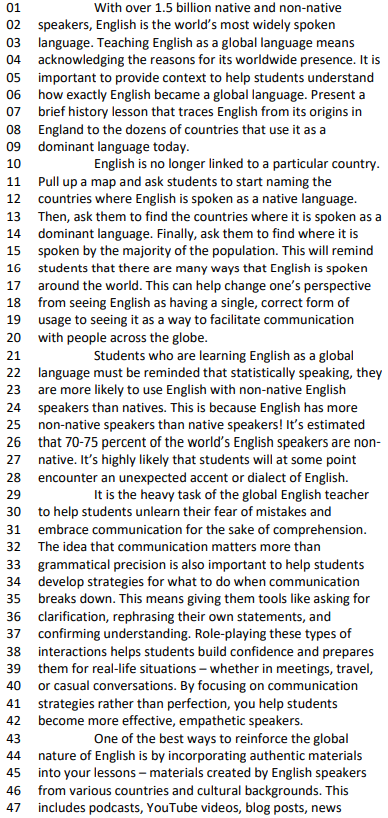
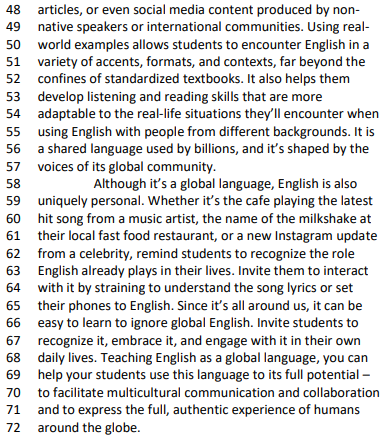
T E X T 1
Teaching English as a Global Language
Adapted from: https://bridge.edu/tefl/March 21, 2025
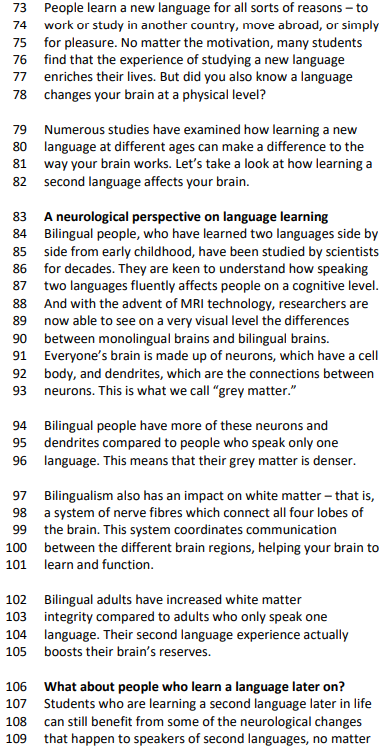
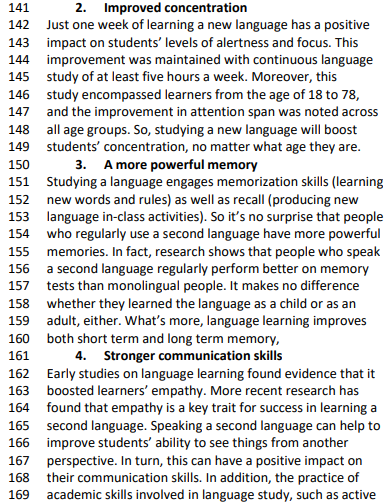
T E X T 2
How learning a new language changes your brain
Adapted from: https://www.cambridge.org/elt/blog/2022/04/29.
The text highlights the importance of global English teachers
making students aware of the fact that English is around us in many
different ways being already part of their lives, citing as examples,
among others,
Ano: 2025
Banca:
UECE-CEV
Órgão:
Prefeitura de Tauá - CE
Prova:
UECE-CEV - 2025 - Prefeitura de Tauá - CE - Professor de Educação Básica Nível II - Língua Inglesa |
Q3768157
Inglês
Texto associado
T E X T 1
Teaching English as a Global Language
Adapted from: https://bridge.edu/tefl/March 21, 2025
T E X T 2
How learning a new language changes your brain
Adapted from: https://www.cambridge.org/elt/blog/2022/04/29.
According to the text, the teaching of English as a global
language should focus mostly on
Ano: 2025
Banca:
UECE-CEV
Órgão:
Prefeitura de Tauá - CE
Prova:
UECE-CEV - 2025 - Prefeitura de Tauá - CE - Professor de Educação Básica Nível II - Língua Inglesa |
Q3768156
Inglês
Texto associado
T E X T 1
Teaching English as a Global Language
Adapted from: https://bridge.edu/tefl/March 21, 2025
T E X T 2
How learning a new language changes your brain
Adapted from: https://www.cambridge.org/elt/blog/2022/04/29.
As to the use of materials in Global English lessons, the text
suggests that one excellent idea is to bring authentic materials to
the classrooms mentioning, for example, YouTube videos and social
media content. Such materials should be produced by
Ano: 2025
Banca:
UECE-CEV
Órgão:
Prefeitura de Tauá - CE
Prova:
UECE-CEV - 2025 - Prefeitura de Tauá - CE - Professor de Educação Básica Nível II - Língua Inglesa |
Q3768155
Inglês
Texto associado
T E X T 1
Teaching English as a Global Language
Adapted from: https://bridge.edu/tefl/March 21, 2025
T E X T 2
How learning a new language changes your brain
Adapted from: https://www.cambridge.org/elt/blog/2022/04/29.
As to the number of speakers of the English language in the
world nowadays, it is stated in the text that
Ano: 2025
Banca:
UECE-CEV
Órgão:
Prefeitura de Tauá - CE
Prova:
UECE-CEV - 2025 - Prefeitura de Tauá - CE - Professor de Educação Básica Nível II - Língua Inglesa |
Q3768154
Inglês
Texto associado
T E X T 1
Teaching English as a Global Language
Adapted from: https://bridge.edu/tefl/March 21, 2025
T E X T 2
How learning a new language changes your brain
Adapted from: https://www.cambridge.org/elt/blog/2022/04/29.
As stated in the text, taking a map to the classroom and
having students spotting the countries in which the English
language is spoken nowadays would help them grasp the idea that
English
Ano: 2025
Banca:
UECE-CEV
Órgão:
Prefeitura de Tauá - CE
Prova:
UECE-CEV - 2025 - Prefeitura de Tauá - CE - Professor de Educação Básica Nível II - Língua Inglesa |
Q3768153
Inglês
Texto associado
T E X T 1
Teaching English as a Global Language
Adapted from: https://bridge.edu/tefl/March 21, 2025
T E X T 2
How learning a new language changes your brain
Adapted from: https://www.cambridge.org/elt/blog/2022/04/29.
The text presents approaches and ideas to teaching English as
a global language, bringing practical suggestions for teachers
involved in the process. One of these suggestions to be put in
practice early on in classes is a
Ano: 2025
Banca:
Avança SP
Órgão:
Prefeitura de Araçariguama - SP
Prova:
Avança SP - 2025 - Prefeitura de Araçariguama - SP - PEB II - Língua Estrangeira (Inglês) |
Q3764988
Inglês
Read the quotation below and answer the question.
“Man is least himself when he talks in his own person. Give him a mask, and he will tell you the truth.”
— Oscar Wilde
The quotation suggests that:
“Man is least himself when he talks in his own person. Give him a mask, and he will tell you the truth.”
— Oscar Wilde
The quotation suggests that:
Ano: 2025
Banca:
Avança SP
Órgão:
Prefeitura de Araçariguama - SP
Prova:
Avança SP - 2025 - Prefeitura de Araçariguama - SP - PEB II - Língua Estrangeira (Inglês) |
Q3764983
Inglês
The cardiovascular system provides blood supply
throughout the body. Responding to various
stimuli can control the velocity and amount of
blood carried through the vessels. The
cardiovascular system comprises the heart,
arteries, veins, and capillaries. The heart and
vessels work intricately to provide adequate
blood flow to all body parts. The regulation of the
cardiovascular system occurs via a myriad of
stimuli, including changing blood volume,
hormones, electrolytes, osmolarity, medications,
adrenal glands, kidneys, and much more.
Chaudhry, R., Miao, J. H., & Rehman, A. (2022, October 16). Physiology, Cardiovascular. In StatPearls. StatPearls Publishing.
Mark the alternative that correctly fills in the blank:
The heart functions as a ______ that works intricately with blood vessels to provide adequate blood flow to all parts of the body.
Chaudhry, R., Miao, J. H., & Rehman, A. (2022, October 16). Physiology, Cardiovascular. In StatPearls. StatPearls Publishing.
Mark the alternative that correctly fills in the blank:
The heart functions as a ______ that works intricately with blood vessels to provide adequate blood flow to all parts of the body.
Ano: 2025
Banca:
Instituto Access
Órgão:
Prefeitura de Navegantes - SC
Prova:
Instituto Access - 2025 - Prefeitura de Navegantes - SC - Professor de Inglês |
Q3764856
Inglês
Regarding the teaching of reading strategies (Scanning
vs. Skimming), judge the following statements as True (T)
or False (F).
(__)A teacher asks students to look for a specific date and name in a text. This practice develops Scanning.
(__)A teacher asks students to read the title and first paragraph to get the gist of the text. This practice develops Skimming.
(__)Skimming requires reading every word intensively to understand the detailed meaning.
(__)Scanning is a top-down strategy that focuses on the general organization of the text.
Mark the alternative that shows the correct sequence, from top to bottom.
(__)A teacher asks students to look for a specific date and name in a text. This practice develops Scanning.
(__)A teacher asks students to read the title and first paragraph to get the gist of the text. This practice develops Skimming.
(__)Skimming requires reading every word intensively to understand the detailed meaning.
(__)Scanning is a top-down strategy that focuses on the general organization of the text.
Mark the alternative that shows the correct sequence, from top to bottom.
Ano: 2025
Banca:
Quadrix
Órgão:
SEDF
Prova:
Quadrix - 2025 - SEDF - Professor de Educação Básica: Lem/Inglês |
Q3763534
Inglês
Texto associado
Formative assessment in the context of English language
teaching is a dynamic and interactive process that prioritizes
the continuous monitoring of learners’ linguistic, cognitive,
and socio‑emotional development (Black & Wiliam, 1998).
Its primary purpose is not merely to quantify achievement,
but to scaffold learning through diagnostic feedback,
reflective practices, and metacognitive engagement. In
basic education, formative assessment encourages learners
to co‑construct meaning, identify strengths and areas for
improvement, and develop autonomous strategies for
language use. Effective implementation requires teachers
to integrate multimodal resources, collaborative tasks, and
culturally authentic materials, ensuring that assessment
aligns with communicative competence, intercultural
awareness, and ethical dimensions of learning. By
positioning assessment as a tool for empowerment rather
than control, educators foster critical thinking, learner
agency, and a deeper engagement with both linguistic
structures and social practices of the target language.
BLACK, P., & WILIAM, D. (1998). Assessment and classroom learning.
Assessment in Education: Principles, Policy & Practice, 5(1), p. 7–74.
About the text and based on advanced perspectives on
formative assessment in English language teaching in basic
education, judge the following items.
Formative assessment is designed to align with
communicative competence, intercultural awareness,
and ethical dimensions of learning.
Ano: 2025
Banca:
Quadrix
Órgão:
SEDF
Prova:
Quadrix - 2025 - SEDF - Professor de Educação Básica: Lem/Inglês |
Q3763532
Inglês
Texto associado
Formative assessment in the context of English language
teaching is a dynamic and interactive process that prioritizes
the continuous monitoring of learners’ linguistic, cognitive,
and socio‑emotional development (Black & Wiliam, 1998).
Its primary purpose is not merely to quantify achievement,
but to scaffold learning through diagnostic feedback,
reflective practices, and metacognitive engagement. In
basic education, formative assessment encourages learners
to co‑construct meaning, identify strengths and areas for
improvement, and develop autonomous strategies for
language use. Effective implementation requires teachers
to integrate multimodal resources, collaborative tasks, and
culturally authentic materials, ensuring that assessment
aligns with communicative competence, intercultural
awareness, and ethical dimensions of learning. By
positioning assessment as a tool for empowerment rather
than control, educators foster critical thinking, learner
agency, and a deeper engagement with both linguistic
structures and social practices of the target language.
BLACK, P., & WILIAM, D. (1998). Assessment and classroom learning.
Assessment in Education: Principles, Policy & Practice, 5(1), p. 7–74.
About the text and based on advanced perspectives on
formative assessment in English language teaching in basic
education, judge the following items.
Learners are encouraged to co‑construct meaning,
identify strengths and weaknesses, and develop
autonomous strategies.
Ano: 2025
Banca:
Quadrix
Órgão:
SEDF
Prova:
Quadrix - 2025 - SEDF - Professor de Educação Básica: Lem/Inglês |
Q3763531
Inglês
Texto associado
Formative assessment in the context of English language
teaching is a dynamic and interactive process that prioritizes
the continuous monitoring of learners’ linguistic, cognitive,
and socio‑emotional development (Black & Wiliam, 1998).
Its primary purpose is not merely to quantify achievement,
but to scaffold learning through diagnostic feedback,
reflective practices, and metacognitive engagement. In
basic education, formative assessment encourages learners
to co‑construct meaning, identify strengths and areas for
improvement, and develop autonomous strategies for
language use. Effective implementation requires teachers
to integrate multimodal resources, collaborative tasks, and
culturally authentic materials, ensuring that assessment
aligns with communicative competence, intercultural
awareness, and ethical dimensions of learning. By
positioning assessment as a tool for empowerment rather
than control, educators foster critical thinking, learner
agency, and a deeper engagement with both linguistic
structures and social practices of the target language.
BLACK, P., & WILIAM, D. (1998). Assessment and classroom learning.
Assessment in Education: Principles, Policy & Practice, 5(1), p. 7–74.
About the text and based on advanced perspectives on
formative assessment in English language teaching in basic
education, judge the following items.
Formative assessment aims primarily to quantify
students’ achievement and rank them according
to performance.
Ano: 2025
Banca:
Quadrix
Órgão:
SEDF
Prova:
Quadrix - 2025 - SEDF - Professor de Educação Básica: Lem/Inglês |
Q3763519
Inglês
Texto associado
Within the domain of English language pedagogy,
assessment is increasingly envisioned as a dialogic and
emancipatory practice, one that refuses to be confined to
technocratic procedures of measurement. It is conceived
as part of the learning ecology itself, whereby learners are
positioned as co‑agents in meaning‑making and evaluative
negotiation. In this paradigm, formative assessment
assumes primacy: rather than functioning as a summative
closure, it operates as an open‑ended process of scaffolding,
contingent upon social interaction and linguistic mediation.
Feedback, correspondingly, is not reduced to the correction
of surface‑level inaccuracies, but reconfigured as a form of
pedagogical dialogue, enabling learners to uncover systemic
patterns of discourse, to activate latent competences,
and to cultivate strategic repertoires for autonomous
transfer across contexts. When embedded in an integrated
curriculum, assessment and feedback also perform a civic
function, fostering critical literacy, intercultural awareness,
and ethical engagement. Thus, teachers must construct
reflexive, transparent, and context‑sensitive evaluative
practices that simultaneously validate learner identities
and prepare them for participatory agency in a globalized,
multimodal world.
About the text and based on advanced perspectives on
assessment and feedback in English language teaching,
judge the following items.
The integrated curriculum assigns assessment and
feedback a civic role, advancing critical literacy and
ethical engagement.
Ano: 2025
Banca:
Quadrix
Órgão:
SEDF
Prova:
Quadrix - 2025 - SEDF - Professor de Educação Básica: Lem/Inglês |
Q3763516
Inglês
Texto associado
Within the domain of English language pedagogy,
assessment is increasingly envisioned as a dialogic and
emancipatory practice, one that refuses to be confined to
technocratic procedures of measurement. It is conceived
as part of the learning ecology itself, whereby learners are
positioned as co‑agents in meaning‑making and evaluative
negotiation. In this paradigm, formative assessment
assumes primacy: rather than functioning as a summative
closure, it operates as an open‑ended process of scaffolding,
contingent upon social interaction and linguistic mediation.
Feedback, correspondingly, is not reduced to the correction
of surface‑level inaccuracies, but reconfigured as a form of
pedagogical dialogue, enabling learners to uncover systemic
patterns of discourse, to activate latent competences,
and to cultivate strategic repertoires for autonomous
transfer across contexts. When embedded in an integrated
curriculum, assessment and feedback also perform a civic
function, fostering critical literacy, intercultural awareness,
and ethical engagement. Thus, teachers must construct
reflexive, transparent, and context‑sensitive evaluative
practices that simultaneously validate learner identities
and prepare them for participatory agency in a globalized,
multimodal world.
About the text and based on advanced perspectives on
assessment and feedback in English language teaching,
judge the following items.
The text conceptualizes assessment as emancipatory
and dialogic, resisting purely technocratic
measurement.
Ano: 2025
Banca:
Quadrix
Órgão:
SEDF
Prova:
Quadrix - 2025 - SEDF - Professor de Educação Básica: Lem/Inglês |
Q3763515
Inglês
Texto associado
The Currículo em Movimento do Distrito Federal
establishes that English teaching in Elementary Education
must go beyond the mechanistic acquisition of vocabulary
and grammar, focusing instead on communicative
competence, intercultural dialogue, and the development
of socio‑emotional skills. The objectives include fostering
learners’ ability to interpret, produce, and critically
analyze texts in diverse modalities and contexts. In High
School, within Linguagens e suas Tecnologias, English is
conceived as a tool for global interaction, scientific‑literary
engagement, and technological literacy. This curricular
design emphasizes the integration of linguistic, cultural,
and multimodal dimensions, ensuring that students
not only master the code but also participate actively
in contemporary society. Consequently, teachers are
expected to align their didactic‑pedagogical organization
with critical‑reflective practices that cultivate autonomy,
citizenship, and ethical awareness.
About the text and based on the principles of the Currículo
em Movimento do Distrito Federal for English in Elementary
Education and for the area of Linguagens e suas Tecnologias
in High School, judge the following items.
Teachers are expected to adopt uncritical, transmissive
methodologies, minimizing the role of autonomy and
ethical awareness.
Ano: 2025
Banca:
Quadrix
Órgão:
SEDF
Prova:
Quadrix - 2025 - SEDF - Professor de Educação Básica: Lem/Inglês |
Q3763514
Inglês
Texto associado
The Currículo em Movimento do Distrito Federal
establishes that English teaching in Elementary Education
must go beyond the mechanistic acquisition of vocabulary
and grammar, focusing instead on communicative
competence, intercultural dialogue, and the development
of socio‑emotional skills. The objectives include fostering
learners’ ability to interpret, produce, and critically
analyze texts in diverse modalities and contexts. In High
School, within Linguagens e suas Tecnologias, English is
conceived as a tool for global interaction, scientific‑literary
engagement, and technological literacy. This curricular
design emphasizes the integration of linguistic, cultural,
and multimodal dimensions, ensuring that students
not only master the code but also participate actively
in contemporary society. Consequently, teachers are
expected to align their didactic‑pedagogical organization
with critical‑reflective practices that cultivate autonomy,
citizenship, and ethical awareness.
About the text and based on the principles of the Currículo
em Movimento do Distrito Federal for English in Elementary
Education and for the area of Linguagens e suas Tecnologias
in High School, judge the following items.
The curricular approach highlights the integration of
linguistic, cultural, and multimodal dimensions, aiming
at active social participation.
Ano: 2025
Banca:
Quadrix
Órgão:
SEDF
Prova:
Quadrix - 2025 - SEDF - Professor de Educação Básica: Lem/Inglês |
Q3763513
Inglês
Texto associado
The Currículo em Movimento do Distrito Federal
establishes that English teaching in Elementary Education
must go beyond the mechanistic acquisition of vocabulary
and grammar, focusing instead on communicative
competence, intercultural dialogue, and the development
of socio‑emotional skills. The objectives include fostering
learners’ ability to interpret, produce, and critically
analyze texts in diverse modalities and contexts. In High
School, within Linguagens e suas Tecnologias, English is
conceived as a tool for global interaction, scientific‑literary
engagement, and technological literacy. This curricular
design emphasizes the integration of linguistic, cultural,
and multimodal dimensions, ensuring that students
not only master the code but also participate actively
in contemporary society. Consequently, teachers are
expected to align their didactic‑pedagogical organization
with critical‑reflective practices that cultivate autonomy,
citizenship, and ethical awareness.
About the text and based on the principles of the Currículo
em Movimento do Distrito Federal for English in Elementary
Education and for the area of Linguagens e suas Tecnologias
in High School, judge the following items.
In High School, English is framed exclusively as
a subject of literary study, with no reference to
technological or global dimensions.
Ano: 2025
Banca:
Quadrix
Órgão:
SEDF
Prova:
Quadrix - 2025 - SEDF - Professor de Educação Básica: Lem/Inglês |
Q3763506
Inglês
Texto associado
In contemporary education, the didactic‑pedagogical
organization of English language teaching requires a
shift from traditional transmission models to integrative,
learner‑centered methodologies. Globalization has
accentuated the demand for communicative competence,
intercultural awareness, and critical thinking. Thus, English
teaching cannot be reduced to grammatical instruction; it
must be articulated with broader socio‑educational goals.
Integrative approaches, such as CLIL (Content and Language
Integrated Learning), highlight the synergy between
linguistic development and knowledge construction,
linking classroom practices to real‑world issues. In this
sense, teaching English contributes not only to linguistic
proficiency but also to the formation of active citizenship, as
learners engage with ethical, cultural, and civic dimensions
of language use. The challenge for teachers lies in balancing
methodological rigor with flexibility, ensuring that language
instruction addresses global demands while respecting
local contexts.
About the text, based on methodological approaches
to English language teaching, didactic‑pedagogical
organization and the implications for citizenship formation
in a globalized context, judge the following items.
The text suggests that English teaching should remain
focused exclusively on grammar and vocabulary,
since these are the only stable components of
language learning.
Ano: 2025
Banca:
Quadrix
Órgão:
SEDF
Prova:
Quadrix - 2025 - SEDF - Professor de Educação Básica: Lem/Inglês |
Q3763490
Inglês
Texto associado
During an advanced English class, a student asks about the
difference between these two sentences: (1)“The teacher
stopped talking to the students.” and (2)“The teacher
stopped to talk to the students.”. The trainee teachers give
different interpretations, and you must clarify the semantic
aspects involved.
As a senior English teacher, you are guiding trainee teachers
to analyze semantic nuances in classroom communication,
consider the situation above and judge the following items,
according to English semantics.
Sentence (2) semantically entails that the teacher was
already talking before the stop.
Ano: 2025
Banca:
Quadrix
Órgão:
SEDF
Prova:
Quadrix - 2025 - SEDF - Professor de Educação Básica: Lem/Inglês |
Q3763489
Inglês
Texto associado
During an advanced English class, a student asks about the
difference between these two sentences: (1)“The teacher
stopped talking to the students.” and (2)“The teacher
stopped to talk to the students.”. The trainee teachers give
different interpretations, and you must clarify the semantic
aspects involved.
As a senior English teacher, you are guiding trainee teachers
to analyze semantic nuances in classroom communication,
consider the situation above and judge the following items,
according to English semantics.
Sentence (1) semantically entails that the teacher had
been speaking before stopping.

 Conheça nossos planos