Questões de Concurso
Para professor - inglês
Foram encontradas 31.359 questões
Resolva questões gratuitamente!
Junte-se a mais de 4 milhões de concurseiros!


Ano: 2022
Banca:
FCM
Órgão:
IF-BA
Prova:
FCM - 2022 - IF-BA - Professor PEBTT - Língua Estrangeira Moderna - Inglês |
Q4115368
Inglês
Indicate whether each of the following statements,
made by Warschauer (2004), about literacy and
education is true (T) or false (F).
( ) The mere existence of the Internet will create researchers or knowledge seekers out of those without the requisite background or skills.
( ) Education and literacy are also important at the individual microlevel, since reading, writing, and thinking skills remain crucial for being able to use the Internet.
( ) At the macrolevel, mass literacy and education serve to grease the wheels of economic development and thus create conditions for greater technologization of society.
( ) As the Internet becomes more widespread, it is highly likely that its use will be stratified, with some using it principally as an entertainment device and others using it to seek and create new knowledge.
( ) The correlation between mass education and societal Internet access is lowest in countries that have a large “tertiary” economic sector (based on consumer and producer services, typical of the postindustrial economy)
De acordo com as afirmações, a sequência correta é:
( ) The mere existence of the Internet will create researchers or knowledge seekers out of those without the requisite background or skills.
( ) Education and literacy are also important at the individual microlevel, since reading, writing, and thinking skills remain crucial for being able to use the Internet.
( ) At the macrolevel, mass literacy and education serve to grease the wheels of economic development and thus create conditions for greater technologization of society.
( ) As the Internet becomes more widespread, it is highly likely that its use will be stratified, with some using it principally as an entertainment device and others using it to seek and create new knowledge.
( ) The correlation between mass education and societal Internet access is lowest in countries that have a large “tertiary” economic sector (based on consumer and producer services, typical of the postindustrial economy)
De acordo com as afirmações, a sequência correta é:
Ano: 2022
Banca:
FCM
Órgão:
IF-BA
Prova:
FCM - 2022 - IF-BA - Professor PEBTT - Língua Estrangeira Moderna - Inglês |
Q4115367
Inglês
Analise as asserções a seguir e a relação proposta
entre elas.
I - The term computer literacy emerged in the early 1980s together with the spread of the personal computer; within a decade, the term had become widely discredited among educators
BECAUSE
II - it generally referred to only the most basic forms of computer operation, such as turning on a computer, opening a folder, and saving a file, and thus tended to justify a very limited view of computer-related education.
Sobre as asserções é correto afirmar que
I - The term computer literacy emerged in the early 1980s together with the spread of the personal computer; within a decade, the term had become widely discredited among educators
BECAUSE
II - it generally referred to only the most basic forms of computer operation, such as turning on a computer, opening a folder, and saving a file, and thus tended to justify a very limited view of computer-related education.
Sobre as asserções é correto afirmar que
Ano: 2022
Banca:
FCM
Órgão:
IF-BA
Prova:
FCM - 2022 - IF-BA - Professor PEBTT - Língua Estrangeira Moderna - Inglês |
Q4115366
Pedagogia
Methods serve as a foil for reflection that can aid
teachers in bringing to conscious awareness the
thinking that underlies their actions. Considering such
idea, developed by Larsen-Freeman in Techniques
and Principles in Language (2011), associate the
method to its respective principle.
METHODS
1 - Direct 2 - Audio-Lingual 3 - Silent Way 4 - Desuggestopedia 5 - Community Language Learning 6 - Total Physical Response 7 - Communicative Language Teaching
PRINCIPLES
( ) Dramatization is a particularly valuable way of playfully activating the material. Fantasy reduces barriers to learning.
( ) Developing a community among the class members builds trust and can help to reduce the threat of the new learning situation.
( ) The purpose of language learning is communication; therefore, students need to learn how to ask questions as well as answer them.
( ) Spoken language should he emphasized over written language. Students can initially learn one part of the language rapidly by moving their bodies.
( ) Language learning is a process of habit formation. The more often something is repeated, the stronger the habit and the greater the learning.
( ) The teacher works with gestures, and sometimes instructions in the student’s native language, to help the students to produce the target language sounds as accurately as possible.
( ) Students should be given opportunities to listen to language as it is used in authentic communication. They may be coached on strategies for how to improve their comprehension.
A sequência correta é
METHODS
1 - Direct 2 - Audio-Lingual 3 - Silent Way 4 - Desuggestopedia 5 - Community Language Learning 6 - Total Physical Response 7 - Communicative Language Teaching
PRINCIPLES
( ) Dramatization is a particularly valuable way of playfully activating the material. Fantasy reduces barriers to learning.
( ) Developing a community among the class members builds trust and can help to reduce the threat of the new learning situation.
( ) The purpose of language learning is communication; therefore, students need to learn how to ask questions as well as answer them.
( ) Spoken language should he emphasized over written language. Students can initially learn one part of the language rapidly by moving their bodies.
( ) Language learning is a process of habit formation. The more often something is repeated, the stronger the habit and the greater the learning.
( ) The teacher works with gestures, and sometimes instructions in the student’s native language, to help the students to produce the target language sounds as accurately as possible.
( ) Students should be given opportunities to listen to language as it is used in authentic communication. They may be coached on strategies for how to improve their comprehension.
A sequência correta é
Ano: 2022
Banca:
FCM
Órgão:
IF-BA
Prova:
FCM - 2022 - IF-BA - Professor PEBTT - Língua Estrangeira Moderna - Inglês |
Q4115365
Inglês
Evaluate the following statements, made by LarsenFreeman in Techniques and Principles in Language
(2011), about the Grammar-Translation Method.
I - The ability to communicate in the target language is the goal of the Grammar-Translation Method.
II - The primary skills to be developed are reading and writing. Little attention is given to speaking and listening, and almost none to pronunciation.
III - Most of the interaction in the classroom is from the teacher to the students. There is little student initiation and little student-student interaction.
IV - The roles are not traditional. The teacher is not the authority in the classroom. However, it is very important that students get the correct answers.
V - According to this method, a fundamental purpose of learning a foreign language is to be able to read literature written in it; since literary language is superior to spoken language.
Está correto apenas o que se afirma em
I - The ability to communicate in the target language is the goal of the Grammar-Translation Method.
II - The primary skills to be developed are reading and writing. Little attention is given to speaking and listening, and almost none to pronunciation.
III - Most of the interaction in the classroom is from the teacher to the students. There is little student initiation and little student-student interaction.
IV - The roles are not traditional. The teacher is not the authority in the classroom. However, it is very important that students get the correct answers.
V - According to this method, a fundamental purpose of learning a foreign language is to be able to read literature written in it; since literary language is superior to spoken language.
Está correto apenas o que se afirma em
Ano: 2022
Banca:
FCM
Órgão:
IF-BA
Prova:
FCM - 2022 - IF-BA - Professor PEBTT - Língua Estrangeira Moderna - Inglês |
Q4115364
Pedagogia
Indicate whether each of the following statements
made by Lightbown and Spada, about learning and
teaching a second language in structure-based
instructional settings, is true (T) or false (F).
( ) Errors are frequently corrected. Accuracy tends to be given priority over meaningful interaction.
( ) Students do not feel pressured to speak or write the second language and to do so correctly from the very beginning.
( ) Linguistic items are presented and practiced in isolation, one item at a time, in a sequence from what teacher or textbook writes believe is ‘simple’ to that which is ‘complex’.
( ) Students experience a limited range of language discourse types. The written language they encounter is selected primarily to provide practice with specific grammatical features rather than for its content.
( ) Teachers never use the learners’ native language to give instructions or in classroom management events. When they use the target language, they tend to modify their language in order to ensure comprehension and compliance.
De acordo com as afirmações, a sequência correta é:
( ) Errors are frequently corrected. Accuracy tends to be given priority over meaningful interaction.
( ) Students do not feel pressured to speak or write the second language and to do so correctly from the very beginning.
( ) Linguistic items are presented and practiced in isolation, one item at a time, in a sequence from what teacher or textbook writes believe is ‘simple’ to that which is ‘complex’.
( ) Students experience a limited range of language discourse types. The written language they encounter is selected primarily to provide practice with specific grammatical features rather than for its content.
( ) Teachers never use the learners’ native language to give instructions or in classroom management events. When they use the target language, they tend to modify their language in order to ensure comprehension and compliance.
De acordo com as afirmações, a sequência correta é:
Ano: 2022
Banca:
FCM
Órgão:
IF-BA
Prova:
FCM - 2022 - IF-BA - Professor PEBTT - Língua Estrangeira Moderna - Inglês |
Q4115363
Pedagogia
Analise as asserções a seguir e a relação proposta
entre elas.
I - According to some researchers, learners who willingly communicate in a wide range of conversational interactions are able to do so
BECAUSE
II - their prior language learning has led to development of self-confidence, which is based on a lack of anxiety combined with a sufficient level of communicative competence, arising from a series of reasonably pleasant [second language] experiences.
Sobre as asserções é correto afirmar que
I - According to some researchers, learners who willingly communicate in a wide range of conversational interactions are able to do so
BECAUSE
II - their prior language learning has led to development of self-confidence, which is based on a lack of anxiety combined with a sufficient level of communicative competence, arising from a series of reasonably pleasant [second language] experiences.
Sobre as asserções é correto afirmar que
Ano: 2022
Banca:
FCM
Órgão:
IF-BA
Prova:
FCM - 2022 - IF-BA - Professor PEBTT - Língua Estrangeira Moderna - Inglês |
Q4115362
Pedagogia
As discussed by Kumaravadivelu in Understanding
Language Teaching: From Method to Postmethod
(2006), according to Breen (2001), a well-designed
teaching syllabus should ideally NOT provide
Ano: 2022
Banca:
FCM
Órgão:
IF-BA
Prova:
FCM - 2022 - IF-BA - Professor PEBTT - Língua Estrangeira Moderna - Inglês |
Q4115361
Inglês
Evaluate the following statements made by Kroskrity
(2000), and discussed by Kumaravadivelu in
Understanding Language Teaching: From Method to
Postmethod (2006), about the connection between
language and ideology.
I - Language and discourse are grounded in social experience and often demonstrably tied to the promotion and protection of political-economic interests.
II - Language ideologies are grounded in social experiences that are always uniformly distributed across diverse communities.
III - Depending on the role they play, people develop different degrees of consciousness about ideologically grounded discourse.
IV - People’s sociocultural experience and interactive patterns contribute to their construction and understanding of language ideologies.
Está correto apenas o que se afirma em
I - Language and discourse are grounded in social experience and often demonstrably tied to the promotion and protection of political-economic interests.
II - Language ideologies are grounded in social experiences that are always uniformly distributed across diverse communities.
III - Depending on the role they play, people develop different degrees of consciousness about ideologically grounded discourse.
IV - People’s sociocultural experience and interactive patterns contribute to their construction and understanding of language ideologies.
Está correto apenas o que se afirma em
Ano: 2022
Banca:
FCM
Órgão:
IF-BA
Prova:
FCM - 2022 - IF-BA - Professor PEBTT - Língua Estrangeira Moderna - Inglês |
Q4115360
Linguística
Communicative competence consists of grammatical
competence as well as sociolinguistic competence,
that is, factors governing successful communication.
Considering such idea, developed by Hymes (1972),
and discussed by Kumaravadivelu in Understanding
Language Teaching: From Method to Postmethod
(2006), associate the factors to its respective
definition.
FACTORS
1 - Setting 2 - Participants 3 - Ends 4 - Key 5 - Instrumentalities 6 - Norms 7 - Genres
DEFINITIONS
( ) refers to categories of communication such as lecture, report, essay, poem and so forth.
( ) refers to the manner and tone (serious, sarcastic, etc.) of the utterance.
( ) refers to the place and time in which the communicative event takes place.
( ) refers to conventions of interaction and interpretation based on shared knowledge.
( ) refers to speakers and their role relationships.
( ) refers to the unstated objectives the participants wish to accomplish.
( ) refers to the channel (oral or written) and the code (formal or informal).
A sequência correta é:
FACTORS
1 - Setting 2 - Participants 3 - Ends 4 - Key 5 - Instrumentalities 6 - Norms 7 - Genres
DEFINITIONS
( ) refers to categories of communication such as lecture, report, essay, poem and so forth.
( ) refers to the manner and tone (serious, sarcastic, etc.) of the utterance.
( ) refers to the place and time in which the communicative event takes place.
( ) refers to conventions of interaction and interpretation based on shared knowledge.
( ) refers to speakers and their role relationships.
( ) refers to the unstated objectives the participants wish to accomplish.
( ) refers to the channel (oral or written) and the code (formal or informal).
A sequência correta é:
Ano: 2022
Banca:
FUNDATEC
Órgão:
Prefeitura de Agudo - RS
Prova:
FUNDATEC - 2022 - Prefeitura de Agudo - RS - Professor de Língua Inglesa |
Q4101150
Inglês
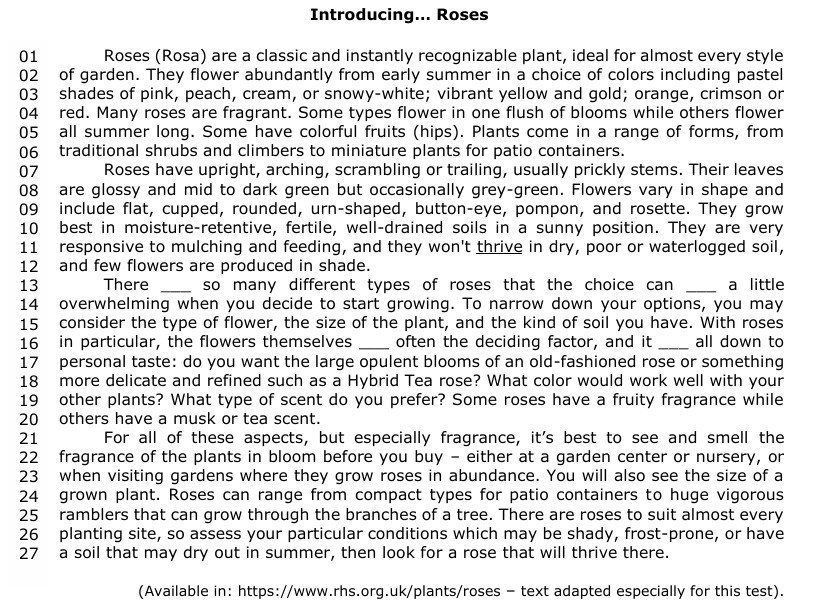
Choose the best synonym for the underlined word “thrive” (l. 11), considering
the context presented in the article.
Ano: 2022
Banca:
FUNDATEC
Órgão:
Prefeitura de Agudo - RS
Prova:
FUNDATEC - 2022 - Prefeitura de Agudo - RS - Professor de Língua Inglesa |
Q4101149
Inglês
Mark the alternative that correctly fills in the blanks of lines 13 (two occurrences)
and 16 (two occurrences) respectively, in the text.
Ano: 2022
Banca:
FUNDATEC
Órgão:
Prefeitura de Agudo - RS
Prova:
FUNDATEC - 2022 - Prefeitura de Agudo - RS - Professor de Língua Inglesa |
Q4101148
Inglês
The word “flower” (l. 02), in that sentence, is a/an:
Ano: 2022
Banca:
FUNDATEC
Órgão:
Prefeitura de Agudo - RS
Prova:
FUNDATEC - 2022 - Prefeitura de Agudo - RS - Professor de Língua Inglesa |
Q4101147
Inglês
Analyse the statements below and mark T, if true, or F, if false, according to the text.
( ) The author thinks roses should come in a wider range of colors.
( ) There are different kind of roses, and the article describes at least seven forms of flowers.
( ) The size of a rose is always adjustable to patio planters.
The correct order of filling the parentheses, from top to bottom, is:
Ano: 2022
Banca:
FUNDATEC
Órgão:
Prefeitura de Agudo - RS
Prova:
FUNDATEC - 2022 - Prefeitura de Agudo - RS - Professor de Língua Inglesa |
Q4101146
Inglês
Which of the following questions is NOT answered by the text?
Ano: 2022
Banca:
FUNDATEC
Órgão:
Prefeitura de Agudo - RS
Provas:
FUNDATEC - 2022 - Prefeitura de Agudo - RS - Professor de Língua Portuguesa
|
FUNDATEC - 2022 - Prefeitura de Agudo - RS - Professor de Educação Especial |
FUNDATEC - 2022 - Prefeitura de Agudo - RS - Professor de Artes |
FUNDATEC - 2022 - Prefeitura de Agudo - RS - Professor de Ciências |
FUNDATEC - 2022 - Prefeitura de Agudo - RS - Professor de Educação Física |
FUNDATEC - 2022 - Prefeitura de Agudo - RS - Professor de História |
FUNDATEC - 2022 - Prefeitura de Agudo - RS - Professor de Língua Inglesa |
FUNDATEC - 2022 - Prefeitura de Agudo - RS - Professor de Matemática |
FUNDATEC - 2022 - Prefeitura de Agudo - RS - Professor de Música |
FUNDATEC - 2022 - Prefeitura de Agudo - RS - Professor de Língua Alemã |
FUNDATEC - 2022 - Prefeitura de Agudo - RS - Professor de Geografia |
Q4099518
Pedagogia
Entre os modelos híbridos possíveis, há aqueles que se apoiam no formato tradicional
da sala de aula (como a sala de aula invertida e o laboratório rotacional, que são chamados de modelos
sustentados) e aqueles que rompem completamente com o tradicional (os chamados modelos
disruptivos). Com base nessa informação, relacione a Coluna 1 à Coluna 2, em relação aos diferentes
modelos de ensino híbrido.
Coluna 1
1. Modelos sustentados.
2. Modelos disruptivos.
Coluna 2
( ) Flex.
( ) Sala de aula invertida.
( ) Laboratório rotacional.
( ) À la carte.
A ordem correta de preenchimento dos parênteses, de cima para baixo, é:
Coluna 1
1. Modelos sustentados.
2. Modelos disruptivos.
Coluna 2
( ) Flex.
( ) Sala de aula invertida.
( ) Laboratório rotacional.
( ) À la carte.
A ordem correta de preenchimento dos parênteses, de cima para baixo, é:
Ano: 2022
Banca:
FUNDATEC
Órgão:
Prefeitura de Agudo - RS
Provas:
FUNDATEC - 2022 - Prefeitura de Agudo - RS - Professor de Língua Portuguesa
|
FUNDATEC - 2022 - Prefeitura de Agudo - RS - Professor de Educação Especial |
FUNDATEC - 2022 - Prefeitura de Agudo - RS - Professor de Artes |
FUNDATEC - 2022 - Prefeitura de Agudo - RS - Professor de Ciências |
FUNDATEC - 2022 - Prefeitura de Agudo - RS - Professor de Educação Física |
FUNDATEC - 2022 - Prefeitura de Agudo - RS - Professor de História |
FUNDATEC - 2022 - Prefeitura de Agudo - RS - Professor de Língua Inglesa |
FUNDATEC - 2022 - Prefeitura de Agudo - RS - Professor de Matemática |
FUNDATEC - 2022 - Prefeitura de Agudo - RS - Professor de Música |
FUNDATEC - 2022 - Prefeitura de Agudo - RS - Professor de Língua Alemã |
FUNDATEC - 2022 - Prefeitura de Agudo - RS - Professor de Geografia |
Q4099517
Pedagogia
O desafio do PPP é propiciar uma educação de qualidade para todos, não sendo um
privilégio de minorias econômicas e sociais, além de assegurar um padrão mínimo de qualidade para
a instituição de ensino. Segundo Veiga (2013), analise as assertivas abaixo:
I. A escola de qualidade tem obrigação de evitar de todas as maneiras possíveis a repetência e a evasão.
II. Precisa garantir a meta qualitativa do desempenho satisfatório de todos.
III. Qualidade para todos, portanto, vai além da meta quantitativa de acesso global, no sentido de que as crianças, em idade escolar, entrem na escola.
Quais estão corretas?
I. A escola de qualidade tem obrigação de evitar de todas as maneiras possíveis a repetência e a evasão.
II. Precisa garantir a meta qualitativa do desempenho satisfatório de todos.
III. Qualidade para todos, portanto, vai além da meta quantitativa de acesso global, no sentido de que as crianças, em idade escolar, entrem na escola.
Quais estão corretas?
Ano: 2022
Banca:
FUNDATEC
Órgão:
Prefeitura de Agudo - RS
Provas:
FUNDATEC - 2022 - Prefeitura de Agudo - RS - Professor de Língua Portuguesa
|
FUNDATEC - 2022 - Prefeitura de Agudo - RS - Professor de Educação Especial |
FUNDATEC - 2022 - Prefeitura de Agudo - RS - Professor de Artes |
FUNDATEC - 2022 - Prefeitura de Agudo - RS - Professor de Ciências |
FUNDATEC - 2022 - Prefeitura de Agudo - RS - Professor de Educação Física |
FUNDATEC - 2022 - Prefeitura de Agudo - RS - Professor de História |
FUNDATEC - 2022 - Prefeitura de Agudo - RS - Professor de Língua Inglesa |
FUNDATEC - 2022 - Prefeitura de Agudo - RS - Professor de Matemática |
FUNDATEC - 2022 - Prefeitura de Agudo - RS - Professor de Música |
FUNDATEC - 2022 - Prefeitura de Agudo - RS - Professor de Língua Alemã |
FUNDATEC - 2022 - Prefeitura de Agudo - RS - Professor de Geografia |
Q4099516
Pedagogia
De acordo com Veiga (1991), assinale a alternativa que NÃO corresponde aos
princípios de um Projeto Político-Pedagógico.
Ano: 2022
Banca:
FUNDATEC
Órgão:
Prefeitura de Agudo - RS
Provas:
FUNDATEC - 2022 - Prefeitura de Agudo - RS - Professor de Língua Portuguesa
|
FUNDATEC - 2022 - Prefeitura de Agudo - RS - Professor de Educação Especial |
FUNDATEC - 2022 - Prefeitura de Agudo - RS - Professor de Artes |
FUNDATEC - 2022 - Prefeitura de Agudo - RS - Professor de Ciências |
FUNDATEC - 2022 - Prefeitura de Agudo - RS - Professor de Educação Física |
FUNDATEC - 2022 - Prefeitura de Agudo - RS - Professor de História |
FUNDATEC - 2022 - Prefeitura de Agudo - RS - Professor de Língua Inglesa |
FUNDATEC - 2022 - Prefeitura de Agudo - RS - Professor de Matemática |
FUNDATEC - 2022 - Prefeitura de Agudo - RS - Professor de Música |
FUNDATEC - 2022 - Prefeitura de Agudo - RS - Professor de Língua Alemã |
FUNDATEC - 2022 - Prefeitura de Agudo - RS - Professor de Geografia |
Q4099515
Pedagogia
A avaliação __________________ examina o desempenho dos alunos como um todo,
entendendo se ele realmente tem domínio do conteúdo ou não.
Assinale a alternativa que preenche corretamente a lacuna do trecho acima.
Assinale a alternativa que preenche corretamente a lacuna do trecho acima.
Ano: 2022
Banca:
FUNDATEC
Órgão:
Prefeitura de Agudo - RS
Provas:
FUNDATEC - 2022 - Prefeitura de Agudo - RS - Professor de Língua Portuguesa
|
FUNDATEC - 2022 - Prefeitura de Agudo - RS - Professor de Educação Especial |
FUNDATEC - 2022 - Prefeitura de Agudo - RS - Professor de Artes |
FUNDATEC - 2022 - Prefeitura de Agudo - RS - Professor de Ciências |
FUNDATEC - 2022 - Prefeitura de Agudo - RS - Professor de Educação Física |
FUNDATEC - 2022 - Prefeitura de Agudo - RS - Professor de História |
FUNDATEC - 2022 - Prefeitura de Agudo - RS - Professor de Língua Inglesa |
FUNDATEC - 2022 - Prefeitura de Agudo - RS - Professor de Matemática |
FUNDATEC - 2022 - Prefeitura de Agudo - RS - Professor de Música |
FUNDATEC - 2022 - Prefeitura de Agudo - RS - Professor de Língua Alemã |
FUNDATEC - 2022 - Prefeitura de Agudo - RS - Professor de Geografia |
Q4099514
Pedagogia
Para Feuerstein (2007), existem critérios de mediação na aprendizagem. Nesse
sentido, assinale V, se verdadeiro, ou F, se falso, quanto a esses critérios.
( ) Transcendência: a mediação da transcendência é auxiliar o aluno a desenvolver metacognição para que seja possível, a partir do trabalho, da reflexão e da interação com o objeto de aprendizagem, a generalização e abstração objetivando a construção de novos conceitos a partir daqueles iniciais.
( ) Mediação do sentimento de competência: uma das características principais no desenvolvimento saudável do ser humano é sua capacidade de olhar para si mesmo e perceber-se como alguém competente.
( ) Mediação do desafio: a busca por inovação e complexidade: a escola pode promover situações em que os alunos se sintam desafiados na execução de suas tarefas.
A ordem correta de preenchimento dos parênteses, de cima para baixo, é:
( ) Transcendência: a mediação da transcendência é auxiliar o aluno a desenvolver metacognição para que seja possível, a partir do trabalho, da reflexão e da interação com o objeto de aprendizagem, a generalização e abstração objetivando a construção de novos conceitos a partir daqueles iniciais.
( ) Mediação do sentimento de competência: uma das características principais no desenvolvimento saudável do ser humano é sua capacidade de olhar para si mesmo e perceber-se como alguém competente.
( ) Mediação do desafio: a busca por inovação e complexidade: a escola pode promover situações em que os alunos se sintam desafiados na execução de suas tarefas.
A ordem correta de preenchimento dos parênteses, de cima para baixo, é:
Ano: 2022
Banca:
FUNDATEC
Órgão:
Prefeitura de Agudo - RS
Provas:
FUNDATEC - 2022 - Prefeitura de Agudo - RS - Professor de Língua Portuguesa
|
FUNDATEC - 2022 - Prefeitura de Agudo - RS - Professor de Educação Especial |
FUNDATEC - 2022 - Prefeitura de Agudo - RS - Professor de Artes |
FUNDATEC - 2022 - Prefeitura de Agudo - RS - Professor de Ciências |
FUNDATEC - 2022 - Prefeitura de Agudo - RS - Professor de Educação Física |
FUNDATEC - 2022 - Prefeitura de Agudo - RS - Professor de História |
FUNDATEC - 2022 - Prefeitura de Agudo - RS - Professor de Língua Inglesa |
FUNDATEC - 2022 - Prefeitura de Agudo - RS - Professor de Matemática |
FUNDATEC - 2022 - Prefeitura de Agudo - RS - Professor de Música |
FUNDATEC - 2022 - Prefeitura de Agudo - RS - Professor de Língua Alemã |
FUNDATEC - 2022 - Prefeitura de Agudo - RS - Professor de Geografia |
Q4099513
Pedagogia
Segundo Feuerstein (2007), sobre a mediação da aprendizagem, assinale a
alternativa INCORRETA.

 Conheça nossos planos