Foram encontradas 359 questões

Resolva questões gratuitamente!

Junte-se a mais de 4 milhões de concurseiros!

Q3258889 Legislação Federal
A Lei nº 9.427/1996, instituiu a Agência Nacional de Energia Elétrica – ANEEL e disciplinou o regime das concessões de serviços públicos de energia elétrica.
Analise as afirmativas a seguir.

I. Compete à ANEEL regular a geração, a transmissão, a distribuição e a comercialização de energia elétrica.

II. Compete a ANELL estabelecer tarifas que remunerem o serviço de forma adequada, que viabilizem a estrutura para manter o serviço com qualidade e que criem incentivos para eficiência.

III. Cabe ao Ministério de Minas e Energia – MME promover as atividades de outorgas de concessão, permissão e autorização de empreendimentos e serviços de energia elétrica, por delegação do Governo Federal.


Está correto o que se afirma em 
Alternativas
Q3258882 Economia
Regressão espúria é quando tentamos relacionar variáveis que, por possuírem propriedades estatísticas semelhantes, apresentam correlação alta e significativa mesmo que não faça sentido.
A respeito de regressão espúria, analise as afirmativas a seguir.

I. A regressão espúria é bastante comum em séries temporais. Isso ocorre porque séries que apresentam tendência ao longo do tempo são não estacionárias. Essa característica de não estacionariedade pode levar à obtenção de uma correlação significativa entre as séries somente por crescerem com o tempo, sem que haja uma relação entre elas.

II. Uma relação espúria é a relação estatística existente entre duas variáveis, mas onde não existe nenhuma relação causa-efeito entre elas. Essa relação estatística pode ocorrer por pura coincidência ou por causa de uma terceira variável.

III. São exemplos de relação espúria: a quantidade de calor em uma sala pode fazer com que ela se torne mais húmida; a quantidade de luz solar recebida por uma planta pode afetar o seu crescimento; o stress a que uma pessoa está sujeita pode afetar seu desempenho no trabalho.


Está correto o que se afirma em
Alternativas
Q3258880 Matemática Financeira

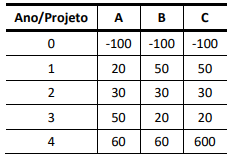
Analise a tabela a seguir.


Imagem associada para resolução da questão


Sobre os projetos apresentados na tabela, analise as afirmativas a seguir, e assinale (V) para a verdadeira e (F) para a falsa.


( ) Embora os três projetos tenham o período de payback de três anos, não são igualmente atraentes.


( ) O payback considera a distribuição dos fluxos de caixa dentro do período de payback. Por essa razão, à medida que cresce a importância da decisão, ou seja, quando são considerados projetos maiores, mais se usa o critério de payback.


( ) O payback é utilizado em decisões de investimento que envolvam montantes relativamente pequenos, tais como conversão do carro para gás natural ou troca do chuveiro elétrico por aquecedor a gás.


As afirmativas são, respectivamente,

Alternativas
Q3258879 Economia
Para a escola clássica, a economia é o estudo do processo de produção, distribuição, circulação e consumo dos bens e serviços; para a corrente neoclássica, a economia é definida como a ciência das escolhas ou preferências via meios da alocação para atingir determinado fim; e para a escola keynesiana, a economia é o estudo das condições institucionais que levam à instabilidade do capitalismo e vão condicionar a ação do Estado.
Sobre o tema, analise as afirmativas a seguir.

I. Um dos principais desacordos entre a economia e a ecologia deriva do fato de que a natureza tem processos cíclicos, enquanto nossos sistemas produtivos são pensados linearmente, sem considerar que todo sistema tem entradas e saídas.

II. Um dos principais desafios encontrados na economia do meio ambiente é que a transição para uma economia sustentável pode ter um custo alto e ser bem dificultada, especialmente para países e empresas que dependem fortemente de setores econômicos poluentes e insustentáveis.

III. O ecocapitalismo parte do pressuposto de que a economia de mercado é a melhor forma de alocar recursos e incentivar a inovação A ideia central desse conceito é que a proteção ambiental e o desenvolvimento econômico são opostos, não complementares. O ecocapitalismo institui a mercantilização da natureza, onde o meio ambiente é tratado como um objeto a ser negociado no mercado


Está correto o que se afirma em
Alternativas
Q3258876 Matemática
Pesquisadores entrevistaram funcionários das sociedades empresárias A e B, do ramo de produção de equipamentos de segurança para o setor de óleo e gás.
A tabela a seguir mostra a renda anual dos funcionários de A e B que responderam à pesquisa.
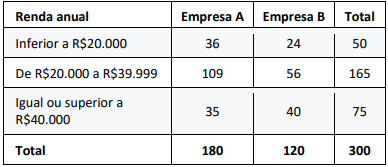
Imagem associada para resolução da questão


Escolhe-se aleatoriamente um funcionário.
Com base nas informações acima, analise as afirmativas a seguir e assinale (V) para a verdadeira e (F) para a falsa.
( ) Os eventos “renda igual ou superior a $40.000” e “trabalha na sociedade empresária B” são dependentes.
( ) A probabilidade de o funcionário selecionado aleatoriamente receber R$40.000 ou mais é 0,25.
( ) A probabilidade de o funcionário selecionado aleatoriamente receber R$40.000 ou mais, sabendo-se que ele trabalha na sociedade empresária B, é de 0,20.


As afirmativas são, respectivamente,
Alternativas
Q3258875 Matemática
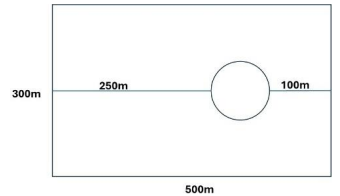
Em uma família no interior de São Paulo, há uma lenda de que um tesouro foi enterrado em algum lugar abaixo da superfície da terra do terreno da chácara da família. A figura a seguir mostra a vista superior do terreno em que o círculo mostrado é a projeção ortogonal de um lago existente na chácara.

Imagem associada para resolução da questão

Considerando π = 3, a probabilidade de que o tesouro não tenha sido escondido abaixo da região limitada pelo lago é de, aproximadamente,
Alternativas
Q3258871 Engenharia Ambiental e Sanitária
Sobre captura e armazenamento de carbono biogênico (Bio-CCS), analise as afirmativas a seguir.

I. Bio-CCS é a terminologia empregada para a captura e armazenamento geológico dê dióxido de carbono (CCS) proveniente da biomassa. Na literatura internacional é comum o uso da sigla BECCS, do inglês Bio Energy with Carbon Capture and Storage.

II. Bio-CCS é uma das soluções para a mitigação da mudança do clima e pode ser um elemento chave para a atração de investimentos na bioenergia. Indústrias estabelecidas ou de grande potencial, sobretudo aquelas com produção de CO2 em alta pureza, permitem a obtenção de emissões negativas a custos relativamente baixos. Como exemplo podemos citar a produção de etanol e biodiesel.

III. A Bio-CCS diminui a intensidade de carbono do etanol e tem potencial de torná-la negativa. No setor sucroenergético, além da maior escala típica, o CO2 do biogás se soma a outras fontes e podem contribuir para o desenvolvimento da infraestrutura de CCS.


Está correto o que se afirma em
Alternativas
Q3258869 Engenharia Ambiental e Sanitária
O biogás, é produzido a partir da decomposição da matéria orgânica – especialmente de resíduos da atividade agropecuária e antrópicas, como aterros sanitários.
Sobre o biogás, analise as afirmativas a seguir e assinale (V) para a verdadeira e (F) para a falsa.

( ) O biogás ocorre em alto grau de descentralização, podendo ser consumido no próprio local em que é produzido, sem que se necessite de redes de transmissão, transporte ou de distribuição, ou pode, ainda, ser transportado via Gás Natural Comprimido (GNC) ou injetado em gasodutos de distribuição, possibilitando a interiorização do gás metano.

( ) A biodigestão tem como produtos finais o biofertilizante, de elevado valor estratégico para a produção agrícola, e o biogás, combustível gasoso potencialmente utilizável para a geração de energia elétrica, térmica ou automotiva. Ambos os produtos contribuem ainda mais para a redução de emissão dos GEEs.

( ) O biogás é o único combustível que tem origem em passivos ambientais com potencial de se tornar um ativo energético. Pode gerar energia elétrica de base e, quando há oferta excedente de energia elétrica, é possível utilizá-lo como biometano, o que o torna um energético muito flexível.


As afirmativas são, respectivamente,
Alternativas
Q3258865 Economia
A análise macroeconômica permite compreender a conjuntura econômica de um país como um todo, serve para balizar as políticas econômicas de um governo, além de decisões de negócios, investimentos e consumo.
Sobre macroeconomia, analise as afirmativas a seguir.

I. No Brasil, aplica-se o chamado tripé macroeconômico, câmbio flutuante, metas fiscais e metas de inflação.

II. Para atingir as metas de inflação, o Banco Central, por meio do Comitê de Política Monetária (Copom), pode aumentar ou reduzir a Selic. Se o IPCA estiver em alta, com perspectiva de estouro da meta, o BC reduz os juros para conter o consumo e deter o aumento de preços.

III. Nas metas fiscais, o superávit primário mostra o esforço feito pelo governo para conter despesas e “economizar” recursos para o pagamento da dívida pública.


Está correto o que se afirma em
Alternativas
Q3258855 Legislação Federal

A Lei nº 14.600/2023 trata da organização atual dos órgãos da Presidência da República e dos Ministérios.


Ela estabelece que

Alternativas
Q3258854 Legislação Federal

A Lei nº 14.300/2022 institui o marco legal da microgeração e minigeração distribuída e dá outras providências.

Ela estabelece que

Alternativas
Q3258853 Engenharia Ambiental e Sanitária
O mercado procura por empresas sustentáveis, que demonstram preocupação com o uso sustentável de energia.
Dentro desse contexto, edificações podem atestar sua eficiência energético por meio da obtenção do selo Procel.
Nesse contexto, assinale a opção que indica um parâmetro a ser atendido por uma edificação para obter o Selo A Procel.
Alternativas
Q3258851 Administração Financeira e Orçamentária
O orçamento público no Brasil é um instrumento essencial para o planejamento e a gestão dos recursos financeiros do Estado, com o objetivo de atender às necessidades da sociedade e promover o desenvolvimento econômico e social do país.
Com relação ao orçamento público, analise os itens a seguir:

I. A elaboração de propostas orçamentárias é o processo de preparação da proposta de orçamento anual de um ente público. Esse processo envolve a consolidação, pelo Poder Executivo, do projeto da Lei de Diretrizes Orçamentárias, incluindo as propostas orçamentárias dos demais Poderes, e o subsequente envio ao Poder Legislativo para apreciação.

II. A verificação da fidelidade funcional dos agentes da administração responsáveis por bens e valores públicos é parte integrante do controle da execução orçamentária.

III. O cumprimento do programa de trabalho, expresso em termos monetários e de realização de obras e prestação de serviços, é parte integrante do controle da execução orçamentária.

Está correto o que se afirma em
Alternativas
Q3258850 Direito Constitucional
A Constituição Federal Brasileira de 1988 estabelece os princípios fundamentais da Administração Pública. Inscritos no artigo 37, esses princípios formam a base para uma administração pública que deve ser transparente, responsável e comprometida com o bem-estar coletivo.
O princípio relacionado ao modo de organizar, estruturar e disciplinar a Administração Pública para alcançar os melhores resultados na prestação do serviço público é denominado Princípio da
Alternativas
Q3258849 Direito Administrativo
A organização administrativa no setor público envolve modelos que delineiam a distribuição de poder e responsabilidades.
Relacione as organizações abaixo com suas respectivas naturezas jurídicas.
1. Empresa de Pesquisa Energética 2. Nuclebrás Equipamentos Pesados 3. Ministério de Minas e Energia 4. Autoridade Nacional de Segurança Nuclear
( ) Autarquia ( ) Sociedade de Economia Mista ( ) Ministério ( ) Empresa Pública

Assinale a opção que apresenta a relação correta, na ordem apresentada.
Alternativas
Q3258848 Direito Administrativo
A Constituição Federal de 1988 estabelece que a Administração Pública no Brasil pode ser direta ou indireta. Essa estrutura visa promover a eficiência, transparência e responsabilidade na prestação de serviços públicos e na execução de políticas governamentais.
A entidade dotada de personalidade jurídica de direito privado, com patrimônio próprio e capital exclusivo da União, criada por lei para a exploração de atividade econômica que o governo seja levado a exercer por força de contingência ou de conveniência administrativa, é denominada

Alternativas
Q3258847 Inglês
Text I


Shock of the old: Believe it or not, battery-powered vehicles
have been around since Victorian times.

   The history of the electric car is surprisingly enraging. If you imagine early electric vehicles at all (full disclosure: I didn’t until recently), it will probably be as the quixotic and possibly dangerous dream of a few eccentrics, maybe in the 1920s or 1930s, when domestic electrification became widespread. It’s easy to imagine some stiff-collared proto-Musk getting bored of hunting and affairs, eyeing his newly installed electric lights speculatively, then wreaking untold havoc and mass electrocutions. The reality is entirely different.

   By 1900, a third of all cars on the road in the US were electric; we’re looking at the history of a cruelly missed opportunity, and it started astonishingly early. The Scottish engineer Robert Anderson had a go at an electric car of sorts way back in the 1830s, though his invention was somewhat stymied by the fact rechargeable batteries were not invented until 1859, making his crude carriage something of a one-trick pony (and far less useful than an actual pony).

   It’s debatable whether or not Scotland was ready for this brave new world anyway: in 1842, Robert Davidson (another Scot, who had, a few years earlier, also tried his hand at an electric vehicle) saw his electric locomotive Galvani “broken by some malicious hands almost beyond repair” in Perth. The contemporary consensus was that it was attacked by railway workers fearful for their jobs.

   Despite this unpromising start, electric vehicles had entered widespread commercial circulation by the start of the 20th century, particularly in the US. Electric cabs crisscrossed Manhattan, 1897’s bestselling US car was electric and, when he was shot in 1901, President McKinley was taken to hospital in an electric ambulance. London had Walter Bersey’s electric taxis, and Berlin’s fire engines went electric in 1908; the future looked bright, clean and silent.

   By the 1930s, however, the tide had definitively turned against electric, cursed by range limitations and impractical charging times while petrol gained the upper hand thanks partly – and ironically – to the electric starter motor. The Horseless Age magazine, which vehemently backed the petrol non-horse, would have been delighted. There was a brief resurgence of interest in the late 1960s, when the US Congress passed a bill promoting electrical vehicle development, but nothing much actually happened until the Nissan Leaf sparked interest in 2009. Electric still isn’t quite there yet, battling infrastructure and battery problems that might have been familiar to Anderson and friends.


Adapted from The Guardian, Tuesday 24 October 2023, p. 6 https://www.theguardian.com/lifeandstyle/series/shock-of-the-old/2023/oct/24/all
In “which vehemently backed” (5th paragraph) the verb is similar in meaning to:
Alternativas
Q3258846 Inglês
Text I


Shock of the old: Believe it or not, battery-powered vehicles
have been around since Victorian times.

   The history of the electric car is surprisingly enraging. If you imagine early electric vehicles at all (full disclosure: I didn’t until recently), it will probably be as the quixotic and possibly dangerous dream of a few eccentrics, maybe in the 1920s or 1930s, when domestic electrification became widespread. It’s easy to imagine some stiff-collared proto-Musk getting bored of hunting and affairs, eyeing his newly installed electric lights speculatively, then wreaking untold havoc and mass electrocutions. The reality is entirely different.

   By 1900, a third of all cars on the road in the US were electric; we’re looking at the history of a cruelly missed opportunity, and it started astonishingly early. The Scottish engineer Robert Anderson had a go at an electric car of sorts way back in the 1830s, though his invention was somewhat stymied by the fact rechargeable batteries were not invented until 1859, making his crude carriage something of a one-trick pony (and far less useful than an actual pony).

   It’s debatable whether or not Scotland was ready for this brave new world anyway: in 1842, Robert Davidson (another Scot, who had, a few years earlier, also tried his hand at an electric vehicle) saw his electric locomotive Galvani “broken by some malicious hands almost beyond repair” in Perth. The contemporary consensus was that it was attacked by railway workers fearful for their jobs.

   Despite this unpromising start, electric vehicles had entered widespread commercial circulation by the start of the 20th century, particularly in the US. Electric cabs crisscrossed Manhattan, 1897’s bestselling US car was electric and, when he was shot in 1901, President McKinley was taken to hospital in an electric ambulance. London had Walter Bersey’s electric taxis, and Berlin’s fire engines went electric in 1908; the future looked bright, clean and silent.

   By the 1930s, however, the tide had definitively turned against electric, cursed by range limitations and impractical charging times while petrol gained the upper hand thanks partly – and ironically – to the electric starter motor. The Horseless Age magazine, which vehemently backed the petrol non-horse, would have been delighted. There was a brief resurgence of interest in the late 1960s, when the US Congress passed a bill promoting electrical vehicle development, but nothing much actually happened until the Nissan Leaf sparked interest in 2009. Electric still isn’t quite there yet, battling infrastructure and battery problems that might have been familiar to Anderson and friends.


Adapted from The Guardian, Tuesday 24 October 2023, p. 6 https://www.theguardian.com/lifeandstyle/series/shock-of-the-old/2023/oct/24/all
The idiom in “the tide had definitively turned” (5th paragraph) implies that the course of events had:
Alternativas
Q3258845 Inglês
Text I


Shock of the old: Believe it or not, battery-powered vehicles
have been around since Victorian times.

   The history of the electric car is surprisingly enraging. If you imagine early electric vehicles at all (full disclosure: I didn’t until recently), it will probably be as the quixotic and possibly dangerous dream of a few eccentrics, maybe in the 1920s or 1930s, when domestic electrification became widespread. It’s easy to imagine some stiff-collared proto-Musk getting bored of hunting and affairs, eyeing his newly installed electric lights speculatively, then wreaking untold havoc and mass electrocutions. The reality is entirely different.

   By 1900, a third of all cars on the road in the US were electric; we’re looking at the history of a cruelly missed opportunity, and it started astonishingly early. The Scottish engineer Robert Anderson had a go at an electric car of sorts way back in the 1830s, though his invention was somewhat stymied by the fact rechargeable batteries were not invented until 1859, making his crude carriage something of a one-trick pony (and far less useful than an actual pony).

   It’s debatable whether or not Scotland was ready for this brave new world anyway: in 1842, Robert Davidson (another Scot, who had, a few years earlier, also tried his hand at an electric vehicle) saw his electric locomotive Galvani “broken by some malicious hands almost beyond repair” in Perth. The contemporary consensus was that it was attacked by railway workers fearful for their jobs.

   Despite this unpromising start, electric vehicles had entered widespread commercial circulation by the start of the 20th century, particularly in the US. Electric cabs crisscrossed Manhattan, 1897’s bestselling US car was electric and, when he was shot in 1901, President McKinley was taken to hospital in an electric ambulance. London had Walter Bersey’s electric taxis, and Berlin’s fire engines went electric in 1908; the future looked bright, clean and silent.

   By the 1930s, however, the tide had definitively turned against electric, cursed by range limitations and impractical charging times while petrol gained the upper hand thanks partly – and ironically – to the electric starter motor. The Horseless Age magazine, which vehemently backed the petrol non-horse, would have been delighted. There was a brief resurgence of interest in the late 1960s, when the US Congress passed a bill promoting electrical vehicle development, but nothing much actually happened until the Nissan Leaf sparked interest in 2009. Electric still isn’t quite there yet, battling infrastructure and battery problems that might have been familiar to Anderson and friends.


Adapted from The Guardian, Tuesday 24 October 2023, p. 6 https://www.theguardian.com/lifeandstyle/series/shock-of-the-old/2023/oct/24/all
In “Despite this unpromising start” (4th paragraph), the first word can be replaced by:
Alternativas
Q3258844 Inglês
Text I


Shock of the old: Believe it or not, battery-powered vehicles
have been around since Victorian times.

   The history of the electric car is surprisingly enraging. If you imagine early electric vehicles at all (full disclosure: I didn’t until recently), it will probably be as the quixotic and possibly dangerous dream of a few eccentrics, maybe in the 1920s or 1930s, when domestic electrification became widespread. It’s easy to imagine some stiff-collared proto-Musk getting bored of hunting and affairs, eyeing his newly installed electric lights speculatively, then wreaking untold havoc and mass electrocutions. The reality is entirely different.

   By 1900, a third of all cars on the road in the US were electric; we’re looking at the history of a cruelly missed opportunity, and it started astonishingly early. The Scottish engineer Robert Anderson had a go at an electric car of sorts way back in the 1830s, though his invention was somewhat stymied by the fact rechargeable batteries were not invented until 1859, making his crude carriage something of a one-trick pony (and far less useful than an actual pony).

   It’s debatable whether or not Scotland was ready for this brave new world anyway: in 1842, Robert Davidson (another Scot, who had, a few years earlier, also tried his hand at an electric vehicle) saw his electric locomotive Galvani “broken by some malicious hands almost beyond repair” in Perth. The contemporary consensus was that it was attacked by railway workers fearful for their jobs.

   Despite this unpromising start, electric vehicles had entered widespread commercial circulation by the start of the 20th century, particularly in the US. Electric cabs crisscrossed Manhattan, 1897’s bestselling US car was electric and, when he was shot in 1901, President McKinley was taken to hospital in an electric ambulance. London had Walter Bersey’s electric taxis, and Berlin’s fire engines went electric in 1908; the future looked bright, clean and silent.

   By the 1930s, however, the tide had definitively turned against electric, cursed by range limitations and impractical charging times while petrol gained the upper hand thanks partly – and ironically – to the electric starter motor. The Horseless Age magazine, which vehemently backed the petrol non-horse, would have been delighted. There was a brief resurgence of interest in the late 1960s, when the US Congress passed a bill promoting electrical vehicle development, but nothing much actually happened until the Nissan Leaf sparked interest in 2009. Electric still isn’t quite there yet, battling infrastructure and battery problems that might have been familiar to Anderson and friends.


Adapted from The Guardian, Tuesday 24 October 2023, p. 6 https://www.theguardian.com/lifeandstyle/series/shock-of-the-old/2023/oct/24/all
The phrase “wreaking […] havoc” (1st paragraph) is similar in meaning to:
Alternativas
Respostas
281: B
282: B
283: D
284: B
285: B
286: C
287: E
288: D
289: C
290: D
291: C
292: D
293: D
294: E
295: C
296: B
297: A
298: A
299: E
300: D