Questões de Concurso
Comentadas para oficial da polícia militar
Foram encontradas 656 questões
Resolva questões gratuitamente!
Junte-se a mais de 4 milhões de concurseiros!


Q4014362
Direito Processual Penal
Em relação às previsões do Decreto-Lei nº 3.689/41 – Código de Processo Penal, marque
a alternativa CORRETA:
Q4014361
Direito Processual Penal
De acordo com o Decreto-Lei nº 3.689/41 – Código de Processo Penal, marque a
alternativa CORRETA.
Q4014360
Direito Processual Penal
De acordo com o Decreto-Lei nº 3.689/41 – Código de Processo Penal, marque a
alternativa CORRETA.
Q4014359
Direito Processual Penal
Considerando o que dispõe o Decreto-Lei nº 3.689/41 – Código de Processo Penal,
marque a alternativa CORRETA.
Q4014358
Direito Penal
De acordo com o Decreto-Lei nº 2.848/40 – Código Penal, marque a alternativa
CORRETA.
Q4014357
Direito Penal
De acordo com o Decreto-Lei nº 2.848/40 – Código Penal, marque a alternativa
CORRETA.
Q4014356
Direito Penal
De acordo com o Decreto-Lei nº 2.848/40 – Código Penal, marque a alternativa
CORRETA.
Q4014355
Direito Penal
De acordo com o Decreto-Lei nº 2.848/40 – Código Penal e a jurisprudência do Supremo
Tribunal Federal (STF), marque a alternativa CORRETA.
Q4014354
Direito Penal
De acordo com o Decreto-Lei nº 2.848/40 – Código Penal e a jurisprudência do Superior
Tribunal de Justiça (STJ), marque a alternativa CORRETA.
Q4014353
Direito Penal
Considerando o que dispõe o Decreto-Lei nº 2.848/40 – Código Penal, marque a alternativa
CORRETA.
Q4014352
Direito Constitucional
Acerca das disposições da Constituição do Estado de Minas Gerais de 1989 (CEMG/89),
marque a assertiva CORRETA.
Q4014351
Direito Constitucional
De acordo com o que está expressamente previsto na Constituição da República
Federativa do Brasil de 1988, marque a alternativa que NÃO se inclui entre os objetivos fundamentais da
República Federativa do Brasil.
Q4014350
Direito Constitucional
Sobre o tema Controle de Constitucionalidade marque a assertiva CORRETA.
Q4014349
Direito Constitucional
No que tange aos diversos aspectos do Direito Constitucional, marque a alternativa
CORRETA.
Q4014348
Direito Constitucional
Considere que um servidor público da administração direta assumiu um mandato eletivo.
Com base na Constituição da República Federativa do Brasil de 1988 (CRFB/88), em relação ao que se
aplica a esse servidor, marque a alternativa CORRETA.
Q4014347
Direito Constitucional
Analise o texto abaixo e ao final responda ao que se pede.
Um casal de brasileiros foi trabalhar no exterior, sem estarem a serviço da República Federativa do Brasil, e lá tiveram um filho. Esse filho foi devidamente registrado em repartição brasileira e, ao completar vinte e quatro anos de idade, ele veio ao Brasil para residir. Em razão de seu envolvimento com atividades políticas no país de nascimento, ele decidiu, ainda com vinte e quatro anos de idade, se candidatar a um cargo político no Brasil.
Com base na Constituição da República Federativa do Brasil de 1988, marque a assertiva CORRETA.
Q4014346
Direito Constitucional
Considerando o que prevê a Constituição da República Federativa do Brasil de 1988
(CRFB/88) sobre estado de sítio e estado de defesa é CORRETO afirmar que:
Q4014342
Matemática
O brasão da Polícia Militar de Minas Gerais é uma representação heráldica que condensa,
em sua forma e composição, os valores históricos, a tradição militar e a identidade simbólica da Corporação.
Ao centro: o escudo tradicional da PMMG. Acima dele: o capacete dos Dragões da Inconfidência. Ao fundo:
duas espadas cruzadas. Ao redor: folhagens ornamentais. Para cálculo, visando plotagem em viaturas,
fachadas e edificações da Corporação, é necessário que a forma seja simplificada para desenhos geométricos
mais simples e com a mesma área total, de forma a se calcular a área aproximada que será plotada.
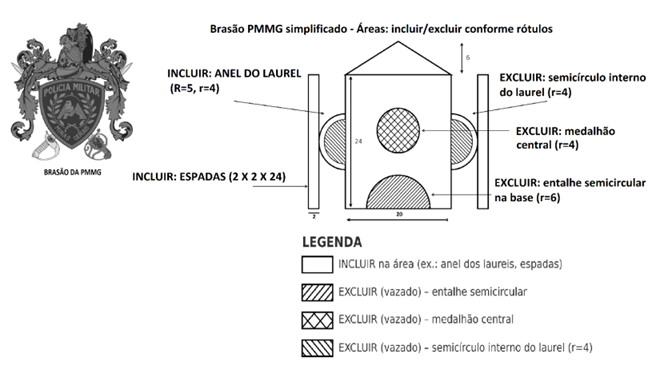
O Brasão da PMMG simplificado é representado pela figura acima e composto por:
I. Escudo, um retângulo de 20 m × 24 m, com duas áreas vazadas internas: a.1) - entalhe semicircular (raio 6 m) na base e a.2) - medalhão central (círculo de raio 4 m);
II. Um triângulo isósceles superior (base 20 m, altura 6 m) representando o capacete dos Dragões da Inconfidência;
III. Lauréis: duas meias-coronas (semianéis) com raio externo 5 m e raio interno 4 m representando as folhagens ornamentais;
IV. Espadas: dois retângulos de 2 m × 24 m tangentes aos laureis no ponto médio.
Considere que todas as regiões hachuradas são vazadas (excluídas do cálculo). Calcule e marque a alternativa que contém a área total a ser adesivada (m²), sem aproximações, em função de π.
Q4014341
Inglês
Texto associado
Read text I and then answer the question below.
TEXT I
“Through the Law Enforcement Officers Killed and Assaulted (LEOKA) Data Collection, the FBI provides data
and training that helps keep law enforcement officers safe as they protect the nation’s communities. The goal
is to provide relevant, high quality, potentially lifesaving information to law enforcement agencies focusing on
why an incident occurred, as opposed to what occurred during the incident, with the hope of preventing future
incidents. The data collected is analyzed by the LEOKA team and the results are incorporated into the officer
safety awareness training the FBI provides for partner agencies.
LEOKA’S Three-Tier Approach
LEOKA has a three-tier approach in order to fulfill its mission and promote officer safety awareness to the law
enforcement community nationwide:
▪ Data collection: Data on line-of-duty deaths and assaults are collected from participating agencies
across the country through the FBI’s Uniform Crime Reporting (UCR) Program, and the recent
expansion of the data collection methods are providing even more facts that can be studied by experts
and officer safety trainers in order to tailor training to real world circumstances. The data are also
published annually in the Bureau’s Law Enforcement Officers Killed and Assaulted report.
▪ Research: Over the years, researchers led by the LEOKA Data Collection have been conducting indepth research using UCR data collected regarding incidents in which officers are killed or assaulted.
The published research gives officers a sharper understanding of what types of scenarios and
circumstances have resulted in fatalities and assaults. These articles and publications also contain
information obtained through extensive interviews with officers and offenders involved in critical
incidents to develop lessons learned, trends and curriculum development for the FBI’s Officer Safety
Awareness Training (OSAT).
▪ Training: The objective of the Bureau’s OSAT, which has been provided to thousands of our law
enforcement partners in the U.S. and abroad, is to assist law enforcement managers, trainers, and
personnel with identifying issues and circumstances that may contribute to officer deaths and assaults
and help prevent them. Data has shown an increase in ambushes on our nation’s law enforcement
officers. As a result, LEOKA trainers are studying the data with the purpose of shaping future training
to help reverse this trend with information and education.
LEOKA Criteria
The data collected under the auspices of the LEOKA Data Collection involves law enforcement officers who
meet a certain set of criteria established by the FBI.
General Criteria
The publishable data pertains to felonious deaths, accidental deaths, and assaults of duly sworn city, university
and college, county, state, tribal, and federal law enforcement officers who, at the time of the incident, met the
following criteria:
▪ Wore/carried a badge (ordinarily)
▪ Carried a firearm (ordinarily)
▪ Were duly sworn and had full arrest powers
▪ Were members of a law enforcement agency
▪ Were acting in an official capacity, whether on or off duty, at the time of the incident
▪ If killed, the deaths were directly related to the injuries received during the incidentes.”
Source (adapted): Federal Bureau of Investigation - FBI. Available at: https://www.fbi.gov/how-we-can-help-you/more-fbiservices-and-information/ucr/leoka Accessed on: September 08, 2025.
All the alternatives match the meaning of the word “awareness” as used in the sentence,
EXCEPT:
“The data collected is analyzed by the LEOKA team and the results are incorporated into the officer safety awareness training the FBI provides for partner agencies.”
“The data collected is analyzed by the LEOKA team and the results are incorporated into the officer safety awareness training the FBI provides for partner agencies.”
Q4014340
Inglês
Texto associado
Read text I and then answer the question below.
TEXT I
“Through the Law Enforcement Officers Killed and Assaulted (LEOKA) Data Collection, the FBI provides data
and training that helps keep law enforcement officers safe as they protect the nation’s communities. The goal
is to provide relevant, high quality, potentially lifesaving information to law enforcement agencies focusing on
why an incident occurred, as opposed to what occurred during the incident, with the hope of preventing future
incidents. The data collected is analyzed by the LEOKA team and the results are incorporated into the officer
safety awareness training the FBI provides for partner agencies.
LEOKA’S Three-Tier Approach
LEOKA has a three-tier approach in order to fulfill its mission and promote officer safety awareness to the law
enforcement community nationwide:
▪ Data collection: Data on line-of-duty deaths and assaults are collected from participating agencies
across the country through the FBI’s Uniform Crime Reporting (UCR) Program, and the recent
expansion of the data collection methods are providing even more facts that can be studied by experts
and officer safety trainers in order to tailor training to real world circumstances. The data are also
published annually in the Bureau’s Law Enforcement Officers Killed and Assaulted report.
▪ Research: Over the years, researchers led by the LEOKA Data Collection have been conducting indepth research using UCR data collected regarding incidents in which officers are killed or assaulted.
The published research gives officers a sharper understanding of what types of scenarios and
circumstances have resulted in fatalities and assaults. These articles and publications also contain
information obtained through extensive interviews with officers and offenders involved in critical
incidents to develop lessons learned, trends and curriculum development for the FBI’s Officer Safety
Awareness Training (OSAT).
▪ Training: The objective of the Bureau’s OSAT, which has been provided to thousands of our law
enforcement partners in the U.S. and abroad, is to assist law enforcement managers, trainers, and
personnel with identifying issues and circumstances that may contribute to officer deaths and assaults
and help prevent them. Data has shown an increase in ambushes on our nation’s law enforcement
officers. As a result, LEOKA trainers are studying the data with the purpose of shaping future training
to help reverse this trend with information and education.
LEOKA Criteria
The data collected under the auspices of the LEOKA Data Collection involves law enforcement officers who
meet a certain set of criteria established by the FBI.
General Criteria
The publishable data pertains to felonious deaths, accidental deaths, and assaults of duly sworn city, university
and college, county, state, tribal, and federal law enforcement officers who, at the time of the incident, met the
following criteria:
▪ Wore/carried a badge (ordinarily)
▪ Carried a firearm (ordinarily)
▪ Were duly sworn and had full arrest powers
▪ Were members of a law enforcement agency
▪ Were acting in an official capacity, whether on or off duty, at the time of the incident
▪ If killed, the deaths were directly related to the injuries received during the incidentes.”
Source (adapted): Federal Bureau of Investigation - FBI. Available at: https://www.fbi.gov/how-we-can-help-you/more-fbiservices-and-information/ucr/leoka Accessed on: September 08, 2025.
Choose the alternative that best matches the meaning of the word “badge” as used in the
sentence:
“Wore/carried a badge (ordinarily).”
“Wore/carried a badge (ordinarily).”

 Conheça nossos planos