Questões de Vestibular Sobre interpretação de texto | reading comprehension em inglês

Foram encontradas 5.299 questões

Ano: 2024 Banca: CESPE / CEBRASPE Órgão: UNB Prova: CESPE / CEBRASPE - 2024 - UNB - Prova de Conhecimentos I - Inglês - 1° dia |
Q3107423 Inglês
         The idea that we might one day be able to construct some artefact which has a mind in the same sense that we have minds is not a new one. It has featured in entertaining and frightening fictions since Mary Shelley first conceived of Frankenstein’s monster.

        In the classic science fiction of the early to mid-twentieth century, this idea was generally cashed out in terms of ‘mechanical men’ or robots – from the Czech word robata, which translates roughly as the feudal term corvée, a term which refers to the unpaid labour provided to one’s liege lord.

    In more modern fiction, the idea of a mechanical mind has given way to the now commonplace notion of a computational artificial intelligence. The possibility of actually developing artificial intelligence, however, is not just a question of sufficiently advanced technology. It is rather a philosophical question. 


Matt Carter. Minds and Computers: an introduction to the philosophy of artficial intelligence. Edinburgh: Edinburgh University Press, 2007 (adapted). 

About the preceding text, judge the following item.

The word “It”, in the beginning of the second sentence of the text, refers to “some artifact which has a mind in the same sense that we have minds”. 
Alternativas
Ano: 2024 Banca: CESPE / CEBRASPE Órgão: UNB Prova: CESPE / CEBRASPE - 2024 - UNB - Prova de Conhecimentos I - Inglês - 1° dia |
Q3107422 Inglês
       In January 1818, Mary Shelley anonymously published a strange little novel that would eventually make her world-famous. Frankenstein; or, The Modern Prometheus is the story of a scientist, Victor Frankenstein, who is driven by an unrelenting “thirst for knowledge,” an ambition to penetrate the secrets of nature, heaven, and Earth. He works tirelessly to engineer a sentient being who, upon coming alive, is hideous to him. Realizing with horror that his plan has gone awry, Frankenstein flees his creature who in turn angrily chases him to the end of the Earth and finally destroys him at the novel’s end.

        Shelley’s dystopian tale has managed to stay relevant since its publication. It has a riddling quality that has edified and entertained readers for centuries, inspiring a range of interpretations. Recently, it has been making appearances in the heated debates over generative artificial intelligence, where it often is evoked as a cautionary tale about the dangers of scientific overreach. Some worry that in pursuing technologies like AI, we are recklessly consigning our species to Victor Frankenstein’s tragic fate. Our wonderchildren, our miraculous machines, might ultimately destroy us. This fear is an expression of what science fiction writer Isaac Asimov once called the “Frankenstein complex.”

        Strangely, it’s not only people who are afraid of robots who are expressing such fears today; it is also some of the people who are most aggressively at the forefront of technological innovation. Elon Musk seemed to have had Mary Shelley’s story in mind when he warned a World Government Summit in Dubai in 2017 that sometimes “a scientist will get so engrossed in their work that they don’t really realize the ramifications of what they’re doing.”


Jennifer Banks. Mary Shelley’s Frankenstein can illuminate the debate over generative AI. In: Big Think. Internet: (adapted)
Based on the previous text, judge the following item. 

According to the text, Elon Musk is someone who is afraid of robots, even though he is one of the leaders of technological innovation. 
Alternativas
Ano: 2024 Banca: CESPE / CEBRASPE Órgão: UNB Prova: CESPE / CEBRASPE - 2024 - UNB - Prova de Conhecimentos I - Inglês - 1° dia |
Q3107421 Inglês
       In January 1818, Mary Shelley anonymously published a strange little novel that would eventually make her world-famous. Frankenstein; or, The Modern Prometheus is the story of a scientist, Victor Frankenstein, who is driven by an unrelenting “thirst for knowledge,” an ambition to penetrate the secrets of nature, heaven, and Earth. He works tirelessly to engineer a sentient being who, upon coming alive, is hideous to him. Realizing with horror that his plan has gone awry, Frankenstein flees his creature who in turn angrily chases him to the end of the Earth and finally destroys him at the novel’s end.

        Shelley’s dystopian tale has managed to stay relevant since its publication. It has a riddling quality that has edified and entertained readers for centuries, inspiring a range of interpretations. Recently, it has been making appearances in the heated debates over generative artificial intelligence, where it often is evoked as a cautionary tale about the dangers of scientific overreach. Some worry that in pursuing technologies like AI, we are recklessly consigning our species to Victor Frankenstein’s tragic fate. Our wonderchildren, our miraculous machines, might ultimately destroy us. This fear is an expression of what science fiction writer Isaac Asimov once called the “Frankenstein complex.”

        Strangely, it’s not only people who are afraid of robots who are expressing such fears today; it is also some of the people who are most aggressively at the forefront of technological innovation. Elon Musk seemed to have had Mary Shelley’s story in mind when he warned a World Government Summit in Dubai in 2017 that sometimes “a scientist will get so engrossed in their work that they don’t really realize the ramifications of what they’re doing.”


Jennifer Banks. Mary Shelley’s Frankenstein can illuminate the debate over generative AI. In: Big Think. Internet: (adapted)
Based on the previous text, judge the following item. 

The last paragraph of the text states that Elon Musk was thinking of Mary Shelley when he declared scientists didn’t realize the ramifications of what they were doing.  
Alternativas
Ano: 2024 Banca: CESPE / CEBRASPE Órgão: UNB Prova: CESPE / CEBRASPE - 2024 - UNB - Prova de Conhecimentos I - Inglês - 1° dia |
Q3107419 Inglês
       In January 1818, Mary Shelley anonymously published a strange little novel that would eventually make her world-famous. Frankenstein; or, The Modern Prometheus is the story of a scientist, Victor Frankenstein, who is driven by an unrelenting “thirst for knowledge,” an ambition to penetrate the secrets of nature, heaven, and Earth. He works tirelessly to engineer a sentient being who, upon coming alive, is hideous to him. Realizing with horror that his plan has gone awry, Frankenstein flees his creature who in turn angrily chases him to the end of the Earth and finally destroys him at the novel’s end.

        Shelley’s dystopian tale has managed to stay relevant since its publication. It has a riddling quality that has edified and entertained readers for centuries, inspiring a range of interpretations. Recently, it has been making appearances in the heated debates over generative artificial intelligence, where it often is evoked as a cautionary tale about the dangers of scientific overreach. Some worry that in pursuing technologies like AI, we are recklessly consigning our species to Victor Frankenstein’s tragic fate. Our wonderchildren, our miraculous machines, might ultimately destroy us. This fear is an expression of what science fiction writer Isaac Asimov once called the “Frankenstein complex.”

        Strangely, it’s not only people who are afraid of robots who are expressing such fears today; it is also some of the people who are most aggressively at the forefront of technological innovation. Elon Musk seemed to have had Mary Shelley’s story in mind when he warned a World Government Summit in Dubai in 2017 that sometimes “a scientist will get so engrossed in their work that they don’t really realize the ramifications of what they’re doing.”


Jennifer Banks. Mary Shelley’s Frankenstein can illuminate the debate over generative AI. In: Big Think. Internet: (adapted)
Based on the previous text, judge the following item. 

According to the author of the text, Shelley’s novel should be mentioned in debates over AI because it proves things can go very wrong with new technologies.  
Alternativas
Ano: 2024 Banca: CESPE / CEBRASPE Órgão: UNB Prova: CESPE / CEBRASPE - 2024 - UNB - Prova de Conhecimentos I - Inglês - 1° dia |
Q3107418 Inglês
       In January 1818, Mary Shelley anonymously published a strange little novel that would eventually make her world-famous. Frankenstein; or, The Modern Prometheus is the story of a scientist, Victor Frankenstein, who is driven by an unrelenting “thirst for knowledge,” an ambition to penetrate the secrets of nature, heaven, and Earth. He works tirelessly to engineer a sentient being who, upon coming alive, is hideous to him. Realizing with horror that his plan has gone awry, Frankenstein flees his creature who in turn angrily chases him to the end of the Earth and finally destroys him at the novel’s end.

        Shelley’s dystopian tale has managed to stay relevant since its publication. It has a riddling quality that has edified and entertained readers for centuries, inspiring a range of interpretations. Recently, it has been making appearances in the heated debates over generative artificial intelligence, where it often is evoked as a cautionary tale about the dangers of scientific overreach. Some worry that in pursuing technologies like AI, we are recklessly consigning our species to Victor Frankenstein’s tragic fate. Our wonderchildren, our miraculous machines, might ultimately destroy us. This fear is an expression of what science fiction writer Isaac Asimov once called the “Frankenstein complex.”

        Strangely, it’s not only people who are afraid of robots who are expressing such fears today; it is also some of the people who are most aggressively at the forefront of technological innovation. Elon Musk seemed to have had Mary Shelley’s story in mind when he warned a World Government Summit in Dubai in 2017 that sometimes “a scientist will get so engrossed in their work that they don’t really realize the ramifications of what they’re doing.”


Jennifer Banks. Mary Shelley’s Frankenstein can illuminate the debate over generative AI. In: Big Think. Internet: (adapted)
Based on the previous text, judge the following item. 

In the last sentence of the first paragraph, “awry” is used to indicate that Victor Frankenstein’s plan went well, as his creature was similar to a human being. 
Alternativas
Ano: 2024 Banca: CESPE / CEBRASPE Órgão: UNB Prova: CESPE / CEBRASPE - 2024 - UNB - Prova de Conhecimentos I - Inglês - 1° dia |
Q3107417 Inglês
       In January 1818, Mary Shelley anonymously published a strange little novel that would eventually make her world-famous. Frankenstein; or, The Modern Prometheus is the story of a scientist, Victor Frankenstein, who is driven by an unrelenting “thirst for knowledge,” an ambition to penetrate the secrets of nature, heaven, and Earth. He works tirelessly to engineer a sentient being who, upon coming alive, is hideous to him. Realizing with horror that his plan has gone awry, Frankenstein flees his creature who in turn angrily chases him to the end of the Earth and finally destroys him at the novel’s end.

        Shelley’s dystopian tale has managed to stay relevant since its publication. It has a riddling quality that has edified and entertained readers for centuries, inspiring a range of interpretations. Recently, it has been making appearances in the heated debates over generative artificial intelligence, where it often is evoked as a cautionary tale about the dangers of scientific overreach. Some worry that in pursuing technologies like AI, we are recklessly consigning our species to Victor Frankenstein’s tragic fate. Our wonderchildren, our miraculous machines, might ultimately destroy us. This fear is an expression of what science fiction writer Isaac Asimov once called the “Frankenstein complex.”

        Strangely, it’s not only people who are afraid of robots who are expressing such fears today; it is also some of the people who are most aggressively at the forefront of technological innovation. Elon Musk seemed to have had Mary Shelley’s story in mind when he warned a World Government Summit in Dubai in 2017 that sometimes “a scientist will get so engrossed in their work that they don’t really realize the ramifications of what they’re doing.”


Jennifer Banks. Mary Shelley’s Frankenstein can illuminate the debate over generative AI. In: Big Think. Internet: (adapted)
Based on the previous text, judge the following item. 

According to the text, at the end of Mary Shelley’s novel, Doctor Frankenstein kills the monster he created. 
Alternativas
Ano: 2024 Banca: CESPE / CEBRASPE Órgão: UNB Prova: CESPE / CEBRASPE - 2024 - UNB - Prova de Conhecimentos I - Inglês - 1° dia |
Q3107416 Inglês
       In January 1818, Mary Shelley anonymously published a strange little novel that would eventually make her world-famous. Frankenstein; or, The Modern Prometheus is the story of a scientist, Victor Frankenstein, who is driven by an unrelenting “thirst for knowledge,” an ambition to penetrate the secrets of nature, heaven, and Earth. He works tirelessly to engineer a sentient being who, upon coming alive, is hideous to him. Realizing with horror that his plan has gone awry, Frankenstein flees his creature who in turn angrily chases him to the end of the Earth and finally destroys him at the novel’s end.

        Shelley’s dystopian tale has managed to stay relevant since its publication. It has a riddling quality that has edified and entertained readers for centuries, inspiring a range of interpretations. Recently, it has been making appearances in the heated debates over generative artificial intelligence, where it often is evoked as a cautionary tale about the dangers of scientific overreach. Some worry that in pursuing technologies like AI, we are recklessly consigning our species to Victor Frankenstein’s tragic fate. Our wonderchildren, our miraculous machines, might ultimately destroy us. This fear is an expression of what science fiction writer Isaac Asimov once called the “Frankenstein complex.”

        Strangely, it’s not only people who are afraid of robots who are expressing such fears today; it is also some of the people who are most aggressively at the forefront of technological innovation. Elon Musk seemed to have had Mary Shelley’s story in mind when he warned a World Government Summit in Dubai in 2017 that sometimes “a scientist will get so engrossed in their work that they don’t really realize the ramifications of what they’re doing.”


Jennifer Banks. Mary Shelley’s Frankenstein can illuminate the debate over generative AI. In: Big Think. Internet: (adapted)

Based on the previous text, judge the following item. 


In the second sentence of the first paragraph, the excerpt “an ambition to penetrate the secrets of nature, heaven, and Earth” can be understood as an explanation for the “unrelenting ‘thirst of knowledge’” that drove Victor Frankenstein.


Alternativas
Ano: 2024 Banca: COMVEST - UNICAMP Órgão: UNICAMP Prova: COMVEST - UNICAMP - 2024 - UNICAMP - Vestibular |
Q3107204 Inglês
Leia o resumo de uma pesquisa que, em 2021, já alertava para questões climáticas e fatores a elas relacionados.

Politics of attributing extreme events to climate change

Climate change shapes weather events. However, describing it as the cause of disasters can be misleading, since disasters are caused by pre-existing fragilities and inequalities on the ground. Attribution is not neutral. Hence, analytic frames that attribute disaster to climate can divert attention from place-based vulnerabilities and their sociopolitical causes. While politicians may blame climate change, the public may hold the government accountable for inadequate investments in flood or drought prevention. To be strategic and moral, framing choices must therefore be sensitive to context and to how the values implicit within analytic frames about the causes of disasters shape policy responses. Such sensitivity requires multicausal analysis of weather-linked disasters to reduce the damages. Through examples from around the world, especially Brazil, we discuss how and why climate-centric disaster framing can erase from view—and, thus, from policy agendas—the very socioeconomic and political factors that centrally cause vulnerability and suffering in weather extremes.
(Adaptado de https://wires.onlinelibrary.wiley.com/doi/full/10.1002/wcc.750. Acesso em 15/05/2024.)

Qual alternativa expressa corretamente os argumentos dos autores do texto?
Alternativas
Ano: 2024 Banca: COMVEST - UNICAMP Órgão: UNICAMP Prova: COMVEST - UNICAMP - 2024 - UNICAMP - Vestibular |
Q3107203 Inglês
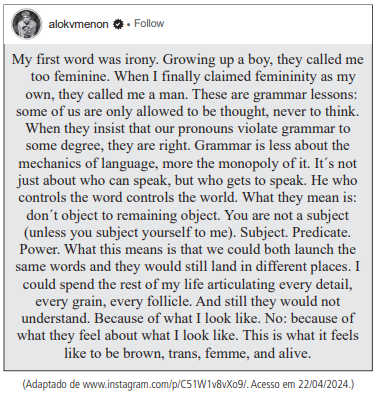
O post a seguir foi retirado da rede social de ALOK, artista cujos trabalhos abordam questões de gênero e identidade.

Imagem associada para resolução da questão


No post, a argumentação é articulada a partir dos diferentes sentidos das palavras
Alternativas
Ano: 2024 Banca: COMVEST - UNICAMP Órgão: UNICAMP Prova: COMVEST - UNICAMP - 2024 - UNICAMP - Vestibular |
Q3107202 Inglês
Texto 1

The fact that so few African Americans write science fiction is perplexing since they, in a very real sense, inhabit a sci-fi nightmare in which unseen but no less palpable acts of intolerance frustrate their movement; official histories undo what has been done; and technology is too often brought to bear on black bodies. Moreover, the sublegitimate status of science fiction in literature mirrors the subaltern position to which blacks have been relegated throughout American history. The notion of Afrofuturism gives rise to a troubling antinomy: can a community whose past has been deliberately rubbed out, and whose energies have been consumed by the search for legible traces of its history, imagine possible futures?


(Adaptado de DERY, M. Black to the future: interviews with Samuel R. Delany, Greg Tate, and Tricia Rose. In: ___. (Ed.) The Discourse of cyberculture. Durham; London: Duke University Press, p. 179-222, 1994.)
Texto 2
“Parable of the Talents” (Octavia E. Butler)
“To survive, Let the past Teach you-- Past customs, Struggles, Leaders and thinkers. Let These Help you. Let them inspire you, Warn you, Give you strength. But beware: God is Change. Past is past. What was Cannot Come again. To survive, know the past. Let it touch you. Then let The past Go.”
(BUTLER, Octavia E. Parable of the Talents. New York, Durham and London: Open Road, 1998.)

O texto 2 toca em um aspecto central do afrofuturismo e remete ao tema do questionamento do texto 1. Assim, pode-se dizer que o poema reconhece que
Alternativas
Ano: 2024 Banca: COMVEST - UNICAMP Órgão: UNICAMP Prova: COMVEST - UNICAMP - 2024 - UNICAMP - Vestibular |
Q3107201 Inglês
Texto 1

The fact that so few African Americans write science fiction is perplexing since they, in a very real sense, inhabit a sci-fi nightmare in which unseen but no less palpable acts of intolerance frustrate their movement; official histories undo what has been done; and technology is too often brought to bear on black bodies. Moreover, the sublegitimate status of science fiction in literature mirrors the subaltern position to which blacks have been relegated throughout American history. The notion of Afrofuturism gives rise to a troubling antinomy: can a community whose past has been deliberately rubbed out, and whose energies have been consumed by the search for legible traces of its history, imagine possible futures?


(Adaptado de DERY, M. Black to the future: interviews with Samuel R. Delany, Greg Tate, and Tricia Rose. In: ___. (Ed.) The Discourse of cyberculture. Durham; London: Duke University Press, p. 179-222, 1994.)
De acordo com o texto 1, a escassez de autores afro-americanos em obras de ficção científica representa um
Alternativas
Ano: 2024 Banca: COMVEST - UNICAMP Órgão: UNICAMP Prova: COMVEST - UNICAMP - 2024 - UNICAMP - Vestibular |
Q3107200 Inglês
Use as informações do texto e da figura a seguir para a escolha da alternativa correta.
Images generated with artificial intelligence (AI) are often not faithful representations of reality. The chart illustrates the level of disparity between a realistic representation of race and gender in various professions and the images generated by AI. The center line in this graph means equal representation. In one case, AI-generated images exclusively represented a certain profession as being held by white males, even though it is actually held by a range of men, women, white, and non-white people. In another case, although more than half of the people holding this position self-identified as white, AI represented it as being held solely by women who were primarily non-white.
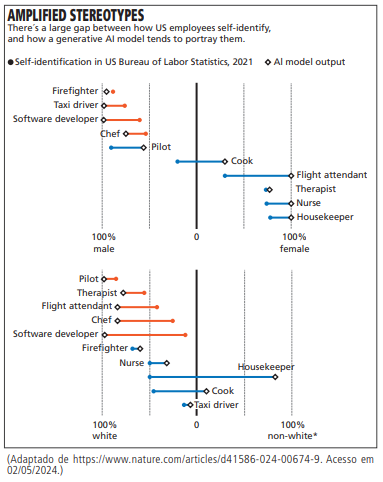
Imagem associada para resolução da questão

Considerando as informações da figura, quais as duas profissões referidas no texto? 
Alternativas
Ano: 2024 Banca: COMVEST - UNICAMP Órgão: UNICAMP Prova: COMVEST - UNICAMP - 2024 - UNICAMP - Vestibular |
Q3107199 Inglês

A imagem a seguir apresenta a transcrição de um diálogo em um vídeo publicado no Instagram.
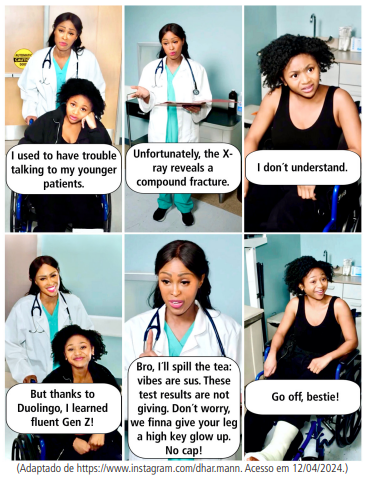

Imagem associada para resolução da questão


No diálogo, a principal característica da reformulação da fala da médica é a inserção de 

Alternativas
Ano: 2024 Banca: COMVEST - UNICAMP Órgão: UNICAMP Prova: COMVEST - UNICAMP - 2024 - UNICAMP - Vestibular |
Q3107198 Inglês

Leia o texto a seguir.


Police under fire after threat to arrest

‘openly Jewish’ man near pro-Palestinian

protest


Scotland Yard criticised after suggesting Gideon Falter’s presence was ‘provocative’ and he was ‘antagonising’ protesters

(https://www.telegraph.co.uk/news/2024/04/19/. Acesso em 20/04/2024.)


Depreende-se, da leitura desse texto, que

Alternativas
Ano: 2023 Banca: UFRGS Órgão: UFRGS Prova: UFRGS - 2023 - UFRGS - Vestibular 2024 - 2º Dia |
Q4163404 Inglês


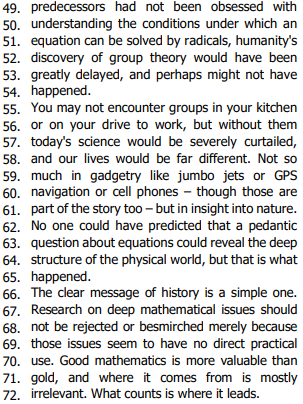
Adapted from: STEWART, I. Why Beauty is Truth – The History of Symmetry. Cambridge, MA: Basic Books, 2007. p. 275-276.

Consider the following propositions for rephrasing the sentence If Galois and his predecessors had not been obsessed with understanding the conditions under which an equation can be solved by radicals, humanity’s discovery of group theory would have been greatly delayed (l. 48-53).

I - Had Galois and his predecessors not been obsessed with understanding the conditions under which an equation can be solved by radicals, humanity’s discovery of group theory would have been greatly delayed.

II - Humanity’s discovery of group theory would have been greatly delayed had Galois and his predecessors not been obsessed with understanding the conditions under which an equation can be solved by radicals.

III- Had Galois and his predecessors been obsessed with understanding the conditions under which an equation can be solved by radicals, humanity´s discovery of group theory would not have been greatly delayed.


If applied to the text, which one(s) would be correct and keep the original meaning?
Alternativas
Ano: 2023 Banca: UFRGS Órgão: UFRGS Prova: UFRGS - 2023 - UFRGS - Vestibular 2024 - 2º Dia |
Q4163403 Inglês


Adapted from: STEWART, I. Why Beauty is Truth – The History of Symmetry. Cambridge, MA: Basic Books, 2007. p. 275-276.

Consider the following propositions for rephrasing the segment It may not matter directly for everyday life, but it surely matters to humanity as a whole (l. 42-44).

I - It surely matters to humanity as a whole, however it may not matter directly for everyday life.
II - Though it may not matter directly for everyday life, it surely matters to humanity as a whole.
III- Despite it may matter directly for everyday life, it surely matters to humanity as a whole.


If applied to the text, which ones would be correct and keep the original meaning?
Alternativas
Ano: 2023 Banca: UFRGS Órgão: UFRGS Prova: UFRGS - 2023 - UFRGS - Vestibular 2024 - 2º Dia |
Q4163402 Inglês


Adapted from: STEWART, I. Why Beauty is Truth – The History of Symmetry. Cambridge, MA: Basic Books, 2007. p. 275-276.

If the segment the universe (l. 12) were replaced by universes, how many additional changes would be necessary for the paragraph from lines 12 to 17 to be grammatically correct?
Alternativas
Ano: 2023 Banca: UFRGS Órgão: UFRGS Prova: UFRGS - 2023 - UFRGS - Vestibular 2024 - 2º Dia |
Q4163401 Inglês


Adapted from: STEWART, I. Why Beauty is Truth – The History of Symmetry. Cambridge, MA: Basic Books, 2007. p. 275-276.

Consider the statements below.

I - By using the phrase philosophical conundrum of the highest order (l. 07-08), the author expresses ethical issues related to the relationship between mathematics and physics.

II - By stating that Mathematics is not some disembodied version of the ultimate truth (l. 18-19), the author states mathematics is fallible just like the other social sciences.

III- By using the term unequivocal (l. 42), the author states that the importance of mathematics is not under question regardless of whether people agree on its importance.


Which ones are correct according to the text? 
Alternativas
Ano: 2023 Banca: UFRGS Órgão: UFRGS Prova: UFRGS - 2023 - UFRGS - Vestibular 2024 - 2º Dia |
Q4163399 Inglês


Adapted from: STEWART, I. Why Beauty is Truth – The History of Symmetry. Cambridge, MA: Basic Books, 2007. p. 275-276.

Mark the statements below T (true) or F (false), according to the text.

( ) Mathematics is not an area detached from human experience. Nevertheless, the text fails to provide practical examples of how it contributes to improve aspects of our daily life.

( ) The word could (l. 62) may be replaced by must, without causing changes to grammar accuracy or to the original meaning of the sentence.

( ) Mathematics unequivocally relates to social processes, history, logic, and philosophy.

( ) The segment Research on deep mathematical issues should not be rejected or besmirched (l. 67-68) may be rephrased as One should not reject or besmirch research on deep mathematical issues, without causing changes to grammar accuracy or to the original meaning of the sentence.

The correct sequence of filling in the parentheses, from top to bottom, is
Alternativas
Ano: 2023 Banca: UFRGS Órgão: UFRGS Prova: UFRGS - 2023 - UFRGS - Vestibular 2024 - 2º Dia |
Q4163398 Inglês


Adapted from: STEWART, I. Why Beauty is Truth – The History of Symmetry. Cambridge, MA: Basic Books, 2007. p. 275-276.

Select the alternative that adequately summarizes the text.
Alternativas
Respostas
301: E
302: E
303: E
304: E
305: E
306: E
307: C
308: D
309: B
310: A
311: D
312: C
313: D
314: B
315: C
316: B
317: D
318: C
319: B
320: C