Questões de Concurso
Sobre interpretação de texto | reading comprehension em inglês
Foram encontradas 12.689 questões


Leia o texto a seguir para responder à questão:
So what languages do I know? I speak English, Spanish, Portuguese, a little French, and a little in a few others. But I would be a bit uncomfortable to say that I ‘know’ all of these languages. The reason for my discomfort is that language learning is such a slow, piece-by-piece process that it is hard to tell when someone has finally ‘arrived’.
In fact, this idea of ‘arriving’ in language is misguided. Language, you see, is more of a journey than a destination, and most learners never feel comfortable saying they have arrived when asked about how much they know. This is especially true because, as in all educational pursuits, the more you learn, the more you are aware of what you do not know.
To illustrate, many of my Asian English learning students studying here in Arizona, U.S., are quite proficient in English. However, when people ask them if they speak English, here are the answers I most often hear:
“I speak okay.”
“I’m not so good.”
“I don’t know.”
The truth is that even these excellent English speakers often feel the distance between them and native-like proficiency. They have accents, they do not know certain words, and they constantly second-guess their grammar. The question “Do you speak a language?” comes out sounding, in their ears, a lot like “Have you mastered the language?”
So how can my foreign students, who by all accounts are doing amazing things in the United States, still feel like they have not arrived? The truth is this: when we focus on mastering a language - perfect pronunciation, complete command of the vocabulary, ability to speak in any and every possible situation -, we are always going to feel insufficient, because by that measure, we all fall short. This way of learning a language is exhausting. A better question than “Do you know the language?” is this: “In the language you are learning, are you creating friendships and experiences?” What I am suggesting is that learners reframe their perspectives. If they are fueled by meeting others, trying new things, and making memories and friendships for themselves, they have a great shot.
I believe that language learning is, at its core, about relationships and experiences – about connecting and learning from those connections. It is my belief that every story (even those who fail) can teach us something about language learning.
(DIXON, S. The language learner guidebook: powerful tools to help you conquer any language. [S.l.]: Wayzgoose, 2018. Adaptado)
Leia o texto a seguir para responder à questão:
Brian Tomlinson and Hitomi Masuhara, The Complete Guide to the Theory and Practice of Materials Development for Language Learning
Whenever we look for resources on materials development, it is difficult to find books which bring together theory and practice in an organic manner. This book does precisely that; it provides the practicality of materials development guides and the academic rigour of reports and research studies published in the field.
Tomlinson and Masuhara’s book has three specific aims. First is to help teachers, researchers and students to know, understand and be constructively critical of what has been achieved to date; secondly to help them develop, adapt, use, review and research materials on their own. Finally, while talking most particularly to teachers, the authors highlight that they want the strong opinions and approaches presented in the book to inspire readers to think independently and to develop and apply innovative approaches on their own.
These three aims seem to be very ambitious and that is the feeling you get when you read through the chapters. The book includes everything related to the theory and practice in materials development to date, and advocates that theory must inform practice and vice versa. Each of the fifteen chapters ends with a section which includes recommendations for teachers followed by a ‘What do you think?’ section to encourage them to reflect on their own contexts and teaching experience in them.
Although at times the book seems overwhelming as it attempts to provide everything about materials in language learning, it successfully realizes its aim to address a wide audience from publishers, researchers to teachers.
(https://www.fortell.org. acessado em 02.10.2025. Adaptado)
Leia o texto a seguir para responder à questão:
Brian Tomlinson and Hitomi Masuhara, The Complete Guide to the Theory and Practice of Materials Development for Language Learning
Whenever we look for resources on materials development, it is difficult to find books which bring together theory and practice in an organic manner. This book does precisely that; it provides the practicality of materials development guides and the academic rigour of reports and research studies published in the field.
Tomlinson and Masuhara’s book has three specific aims. First is to help teachers, researchers and students to know, understand and be constructively critical of what has been achieved to date; secondly to help them develop, adapt, use, review and research materials on their own. Finally, while talking most particularly to teachers, the authors highlight that they want the strong opinions and approaches presented in the book to inspire readers to think independently and to develop and apply innovative approaches on their own.
These three aims seem to be very ambitious and that is the feeling you get when you read through the chapters. The book includes everything related to the theory and practice in materials development to date, and advocates that theory must inform practice and vice versa. Each of the fifteen chapters ends with a section which includes recommendations for teachers followed by a ‘What do you think?’ section to encourage them to reflect on their own contexts and teaching experience in them.
Although at times the book seems overwhelming as it attempts to provide everything about materials in language learning, it successfully realizes its aim to address a wide audience from publishers, researchers to teachers.
(https://www.fortell.org. acessado em 02.10.2025. Adaptado)
Leia o texto a seguir para responder à questão:
Brian Tomlinson and Hitomi Masuhara, The Complete Guide to the Theory and Practice of Materials Development for Language Learning
Whenever we look for resources on materials development, it is difficult to find books which bring together theory and practice in an organic manner. This book does precisely that; it provides the practicality of materials development guides and the academic rigour of reports and research studies published in the field.
Tomlinson and Masuhara’s book has three specific aims. First is to help teachers, researchers and students to know, understand and be constructively critical of what has been achieved to date; secondly to help them develop, adapt, use, review and research materials on their own. Finally, while talking most particularly to teachers, the authors highlight that they want the strong opinions and approaches presented in the book to inspire readers to think independently and to develop and apply innovative approaches on their own.
These three aims seem to be very ambitious and that is the feeling you get when you read through the chapters. The book includes everything related to the theory and practice in materials development to date, and advocates that theory must inform practice and vice versa. Each of the fifteen chapters ends with a section which includes recommendations for teachers followed by a ‘What do you think?’ section to encourage them to reflect on their own contexts and teaching experience in them.
Although at times the book seems overwhelming as it attempts to provide everything about materials in language learning, it successfully realizes its aim to address a wide audience from publishers, researchers to teachers.
(https://www.fortell.org. acessado em 02.10.2025. Adaptado)
Leia o cartum a seguir.

(www.itchyfeetcomic.com)
Image and text help capture the humor in the cartoon, which derives from
Concerning the previous text, judge the following item.
It can be inferred from the text that seeking sovereign AI means, among other things, paying attention to features that are typical of human interactions and do not only concern technology.
Concerning the previous text, judge the following item.
According to the text, data security is the greatest concern of the nations that are interested in promoting their own AI sovereignty.
Concerning the previous text, judge the following item.
It is correct to conclude from the non-technical vocabulary used in the text that its target audience is specifically formed by people who are not at all familiar with AI related concepts.
Concerning the previous text, judge the following item.
It is possible to infer from the text that the implementation of sovereign AI strategies by most nations would potentially diminish the influence of a number of multinational IT (information technology) companies.
Text 6

Disponível em: https://www.facebook.com/groups/1609193636291426/posts/ Acesso em jan. 2026
TEXT 5
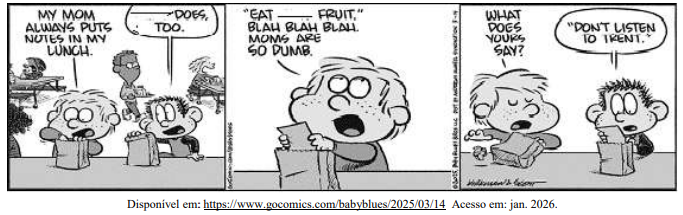
Trent and Hammie are best friends since kindergarten. At the moment, they are in the school cafeteria for lunch.
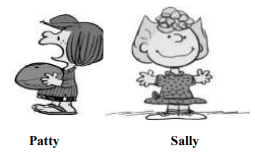
Peppermint Patty and Sally Brown are iconic characters from Charles Schulz's Peanuts comic strip, known for their distinct personalities: Patty is a tomboyish, athletic, freckled girl who is best friends with Marcie.
Sally is Charlie Brown's younger sister, known for her dramatic flair, love of Linus, and often-misguided schemes for money or attention.
Text 3

Disponível em: https://x.com/Snoopy/status/384756646099959808 Acesso em dez. 2025.
Text 4

Disponível em: https://x.com/Snoopy/status/1514614712540884993 Acesso em dez. 2025
No Text 4, último quadrinho, Sally está numa interlocução com sua professora.
Ela usa a expressão “What are the odds...”, que no contexto significa
Peppermint Patty and Sally Brown are iconic characters from Charles Schulz's Peanuts comic strip, known for their distinct personalities: Patty is a tomboyish, athletic, freckled girl who is best friends with Marcie.
Sally is Charlie Brown's younger sister, known for her dramatic flair, love of Linus, and often-misguided schemes for money or attention.
Text 3
Disponível em: https://x.com/Snoopy/status/384756646099959808 Acesso em dez. 2025.
Text 4
Disponível em: https://x.com/Snoopy/status/1514614712540884993 Acesso em dez. 2025
No Text 3, percebe-se que Patty está falando com a professora.
No último quadrinho, sua fala deixa transparecer que ela está
Peppermint Patty and Sally Brown are iconic characters from Charles Schulz's Peanuts comic strip, known for their distinct personalities: Patty is a tomboyish, athletic, freckled girl who is best friends with Marcie.
Sally is Charlie Brown's younger sister, known for her dramatic flair, love of Linus, and often-misguided schemes for money or attention.
Text 3
Disponível em: https://x.com/Snoopy/status/384756646099959808 Acesso em dez. 2025.
Text 4
Disponível em: https://x.com/Snoopy/status/1514614712540884993 Acesso em dez. 2025
In both comic strips (Texts 3 and 4), Patty and Sally are handing in their schoolwork.
They seem a little insecure about their tasks – a term paper and a book report – which mainly involve:
Because she was correcting homework and planning lessons, Britany went to bed late – and then she overslept!
She had a quick shower but she didn’t have ________ 1 time to put on her makeup. Luckily, she doesn’t wear much anyway, but she had wanted to put on some lipstick at least. Too bad! She made herself a coffee and checked the mail. But ________ 2 , it seemed, had remembered her birthday – except for John and Clare whom she had invited for dinner later in the day.
At school, ________ 3 of her colleagues seemed to have remembered that it was her birthday either and that made her miserable, but at least the children in her second grade class were in a happy mood. It cheered her up, and so every time one of them did ________ 4 good or gave her a correct answer, she gave them a gold star. They loved that. Luckily, she had enough stars so ________ 5 went home with at least one!
When she got home, Britany was still tired, so she lay down to have a bit of rest but she didn’t get much sleep because her parents rang from the UK to wish her a happy birthday. At least _________ 6 had remembered! When she finished the call there was ________ 7 time left for sleeping. She had to get dinner ready.
A few minutes later the doorbell rang. She opened the door. There were a lot of people outside. All of them were wearing party hats! A few of them were carrying plates of food. Most of them were colleagues from her school, but there were many others, too. And then they started to sing ‘Happy Birthday …’.
In: HARMER, Jeremy. Teacher Knowledge: core concepts in English language teaching. Pearson Education limited. Essex, UK: 2012

Like many homeless people in America, Derek Forter’s story is not one of crime or bad choices. Instead, he was a casualty of the economic recession.
"One day my company laid off half its employees. Soon I was behind on my rent, and before I knew it I’d lost my apartment.”
Imagem: https://www.foxbusiness.com/markets/
To make matters worse, Derek could not secure employment and thinks he knows why.
“I would show up in my cleanest pants and shirt, but I knew I didn’t represent myself well – the other applicants all looked so much more professional. It really affected my self-esteem.”
Luckily, through a local agency, Derek got in touch with Look the Part, a non-profit organization dedicated to helping homeless people join the workforce. Their motto: Look the part.
“They were phenomenal, giving me a complete makeover inside and out. Not only did they get me a haircut too. Then, they helped with my resume, and we practiced mock interviews. I was more confident than ever, and I nailed my next interview. I’ve been working ever since, and I couldn’t be more grateful.”
Unfortunately, the demand for services like those provided by Look the Part far outweighs their current capabilities. And even though there are other similar organizations, like JobReady and First Impressions, there are many people still struggling to find employment.
In: American Inside Out Evolution. Student’s book Advanced B. KAY, Sue et all. Macmillan Publishers, São Paulo: 2028. Adaptado
Like many homeless people in America, Derek Forter’s story is not one of crime or bad choices. Instead, he was a casualty of the economic recession.
"One day my company laid off half its employees. Soon I was behind on my rent, and before I knew it I’d lost my apartment.”
Imagem: https://www.foxbusiness.com/markets/
To make matters worse, Derek could not secure employment and thinks he knows why.
“I would show up in my cleanest pants and shirt, but I knew I didn’t represent myself well – the other applicants all looked so much more professional. It really affected my self-esteem.”
Luckily, through a local agency, Derek got in touch with Look the Part, a non-profit organization dedicated to helping homeless people join the workforce. Their motto: Look the part.
“They were phenomenal, giving me a complete makeover inside and out. Not only did they get me a haircut too. Then, they helped with my resume, and we practiced mock interviews. I was more confident than ever, and I nailed my next interview. I’ve been working ever since, and I couldn’t be more grateful.”
Unfortunately, the demand for services like those provided by Look the Part far outweighs their current capabilities. And even though there are other similar organizations, like JobReady and First Impressions, there are many people still struggling to find employment.
In: American Inside Out Evolution. Student’s book Advanced B. KAY, Sue et all. Macmillan Publishers, São Paulo: 2028. Adaptado
No texto, a expressão “To make matters worse” introduz o 3º parágrafo, antecipando uma ideia ao leitor.
Assinale a alternativa que apresenta o sentido correspondente dessa expressão em língua portuguesa.
Like many homeless people in America, Derek Forter’s story is not one of crime or bad choices. Instead, he was a casualty of the economic recession.
"One day my company laid off half its employees. Soon I was behind on my rent, and before I knew it I’d lost my apartment.”
Imagem: https://www.foxbusiness.com/markets/
To make matters worse, Derek could not secure employment and thinks he knows why.
“I would show up in my cleanest pants and shirt, but I knew I didn’t represent myself well – the other applicants all looked so much more professional. It really affected my self-esteem.”
Luckily, through a local agency, Derek got in touch with Look the Part, a non-profit organization dedicated to helping homeless people join the workforce. Their motto: Look the part.
“They were phenomenal, giving me a complete makeover inside and out. Not only did they get me a haircut too. Then, they helped with my resume, and we practiced mock interviews. I was more confident than ever, and I nailed my next interview. I’ve been working ever since, and I couldn’t be more grateful.”
Unfortunately, the demand for services like those provided by Look the Part far outweighs their current capabilities. And even though there are other similar organizations, like JobReady and First Impressions, there are many people still struggling to find employment.
In: American Inside Out Evolution. Student’s book Advanced B. KAY, Sue et all. Macmillan Publishers, São Paulo: 2028. Adaptado
Read the following text and answer the next five question.
The implications of a rapidly changing information ecosystem on how governments communicate
Public communication does not happen in a vacuum: the context in which it occurs is core to understanding the challenges and opportunities it faces. Indeed, the analysis of its role for policy and governance mechanisms is made urgent by shifts in the information ecosystem that have transformed the function over the past decade and raised important implications for democracy. The technological revolution that has connected the world through social media has given rise to online social movements and simplified the creation and sharing of content and data. Such changes have also facilitated, however, the spread of mis- and disinformation, contributed to undermining the role of traditional information gatekeepers, and have fundamentally changed how governments communicate. Whereas until the early 2000s a so-called “one-to-many” model of communication prevailed, this has shifted today to a “many-to-many” model. Anyone can be both a producer and a consumer of information, and anybody with an internet connection has the potential to engage with and influence public debates.
Traditionally, governments had largely relied on traditional media to amplify official messages to reach citizens. With the advent of digital channels, this approach has gradually lost its primacy to direct institution-to-individual communication via online platforms that bypass traditional media. This shift has also enabled a broader scope for governments to communicate about more diverse policy issues targeted to more specific audiences, as traditional media tend to concentrate on “newsworthy” subjects and political affairs, often under-reporting less mainstream issues. The unprecedented volumes of data that promise to make communication ever more precise, combined with the direct, unmediated access to vast and diverse publics, are some of the opportunities and challenges that have emerged.
At the same time, digital platforms have altered patterns in eople’s consumption of information and raised demands on their attention. The latter has become a resource that technology companies sell to advertisers. In turn, the design of online platforms and their algorithms, and the massive increase in the volume of information served to increase competition for what content people pay attention to, while making focus more superficial. As governments compete with all other information sources for the public’s attention, cognitive and psychological factors such as information overload can undermine the efficacy of even well-crafted content.
Online and social media have also heightened the pace at which information travels, accelerated the news cycle, and enabled a wider range of actors to drive discussions on policy issues. Taken together, digital technologies have produced a complex information ecosystem that has made it more challenging for official messages to “cut through the noise”. Cumulatively, these changes require considerable adjustments to practices, public officials’ skills, and even to how communication is organised, if governments are to make the most of the digital transformation and ensure it can promote better governance. […]
The ability for governments to use the communication function to promote constructive democratic spaces is critically threatened by widespread mis- and disinformation. When falsehoods spread extensively and rapidly on issues of public policy, official messages are drowned out, creating significant challenges for public communicators to get key information out to all groups in society. Whether in the context of elections, health crises, migration or climate change, mis- and disinformation cast evidence and facts into doubt, sow distrust, and work against policy goals.
Adapted from: https://www.oecd.org/content/dam/oecd/en/publications/ reports/2021/12/oecd-report-on-public-communication_b74311bc/22f8031c-en.pdf
The text ends by pointing out the need for governments to be:

 Conheça nossos planos