Selecionar segmento
Estude com questões de diferentes segmentos
Atenção: Isso limpará todos os campos já preenchidos no filtro!
Foram encontradas 75.219 questões
Resolva questões gratuitamente!
Junte-se a mais de 4 milhões de concurseiros!


Ano: 2019
Banca:
CESPE / CEBRASPE
Órgão:
UNCISAL
Prova:
CESPE / CEBRASPE - 2019 - UNCISAL - Vestibular - 2º Dia |
Q4010450
Português
Jogar juntos pode ser um excelente espaço para
aproximar diferentes gerações, como idosos e crianças, desde
que respeitadas as regras de segurança.
Para valorizar a experiência e o conhecimento particular dos idosos e contemplar a curiosidade e o dinamismo das crianças, a melhor opção para que indivíduos desses dois grupos joguem juntos são os
Para valorizar a experiência e o conhecimento particular dos idosos e contemplar a curiosidade e o dinamismo das crianças, a melhor opção para que indivíduos desses dois grupos joguem juntos são os
Ano: 2019
Banca:
CESPE / CEBRASPE
Órgão:
UNCISAL
Prova:
CESPE / CEBRASPE - 2019 - UNCISAL - Vestibular - 2º Dia |
Q4010449
Português


Disponível em: http://pontoecontraponto.com.br. Acesso em: 19 nov. 2018 (adaptado).
O emprego de uma linguagem coloquial nos cartazes da campanha “Eu sou legal no trânsito”, lançada pelo Departamento Nacional de Trânsito no Carnaval de 2011, é adequado a essa situação de uso social da linguagem porque, por meio dessa variedade linguística,
Ano: 2019
Banca:
CESPE / CEBRASPE
Órgão:
UNCISAL
Prova:
CESPE / CEBRASPE - 2019 - UNCISAL - Vestibular - 2º Dia |
Q4010448
Português
Poema tirado de uma notícia de jornal
João Gostoso era carregador de feira-livre e morava no morro da Babilônia num barracão sem número
Uma noite ele chegou no bar Vinte de Novembro
Bebeu
Cantou
Dançou
Depois se atirou na Lagoa Rodrigo de Freitas e morreu afogado.
BANDEIRA, Manuel. Libertinagem. Estrela da vida inteira. Rio de Janeiro: José Olympio, 1966, p. 197. A
função da linguagem predominante no texto Poema tirado de uma notícia de jornal é
João Gostoso era carregador de feira-livre e morava no morro da Babilônia num barracão sem número
Uma noite ele chegou no bar Vinte de Novembro
Bebeu
Cantou
Dançou
Depois se atirou na Lagoa Rodrigo de Freitas e morreu afogado.
BANDEIRA, Manuel. Libertinagem. Estrela da vida inteira. Rio de Janeiro: José Olympio, 1966, p. 197. A
função da linguagem predominante no texto Poema tirado de uma notícia de jornal é
Ano: 2019
Banca:
CESPE / CEBRASPE
Órgão:
UNCISAL
Prova:
CESPE / CEBRASPE - 2019 - UNCISAL - Vestibular - 2º Dia |
Q4010447
Inglês
Yury Azhichakov set out early by bike for Senogda
Bay, his favorite beach, on the northwestern shore of Lake
Baikal in Siberia. The world’s oldest, deepest and most
voluminous lake, Baikal holds 20 percent of the planet’s
unfrozen freshwater. It is often described as the world’s cleanest
lake.
As Mr. Azhichakov discovered, that is no longer the case. Senogda’s once pristine sands were buried under thick mats of reeking greenish-black goo.
“This stuff stretched far into the distance, for several kilometers,” said Mr. Azhichakov, 61, a retired ecological engineer. “The beach was in terrible condition.”
The muck, scientists have discovered, follows mass algal blooms at dozens of sites around Lake Baikal’s 1,240-mile perimeter. Confined to shallow water and shores near towns and villages, the problem seems to stem from an influx of untreated sewage – the result of inadequate wastewater treatment.
Algal blooms threaten iconic freshwater bodies around the world, including the Great Lakes, Lake Geneva, and Lake Biwa in Japan. But Lake Baikal is especially precious: a World Heritage site home to more than 3,700 species, more than half found nowhere else.
“People are dumping sewage, waste and rubbish around the lake, creating pretty appalling conditions in some places,” said Anson MacKay, an environmental scientist at University College London.
Disponível em: www.nytimes.com. Acesso em: 15 nov. 2018 (adaptado).
Conforme o texto anterior,
As Mr. Azhichakov discovered, that is no longer the case. Senogda’s once pristine sands were buried under thick mats of reeking greenish-black goo.
“This stuff stretched far into the distance, for several kilometers,” said Mr. Azhichakov, 61, a retired ecological engineer. “The beach was in terrible condition.”
The muck, scientists have discovered, follows mass algal blooms at dozens of sites around Lake Baikal’s 1,240-mile perimeter. Confined to shallow water and shores near towns and villages, the problem seems to stem from an influx of untreated sewage – the result of inadequate wastewater treatment.
Algal blooms threaten iconic freshwater bodies around the world, including the Great Lakes, Lake Geneva, and Lake Biwa in Japan. But Lake Baikal is especially precious: a World Heritage site home to more than 3,700 species, more than half found nowhere else.
“People are dumping sewage, waste and rubbish around the lake, creating pretty appalling conditions in some places,” said Anson MacKay, an environmental scientist at University College London.
Disponível em: www.nytimes.com. Acesso em: 15 nov. 2018 (adaptado).
Conforme o texto anterior,
Ano: 2019
Banca:
CESPE / CEBRASPE
Órgão:
UNCISAL
Prova:
CESPE / CEBRASPE - 2019 - UNCISAL - Vestibular - 2º Dia |
Q4010446
Inglês
The youngest of Uchendu’s five sons, Amikwu, was
marrying a new wife. The brideprice had been paid and all but
the last ceremony had been performed. Amikwu and his people
had taken palm-wine to the bride’s kinsmen about two moons
before Okonkwo’s arrival in Mbanta. And so it was time for the
final ceremony of confession.
The daughters of the family were all there, some of them having come a long way from their homes in distant villages. Uchendu’s eldest daughter had come from Obodo, nearly half a day’s journey away. There were twenty-two of them.
They sat in a big circle on the ground and the young bride in the centre with a hen in her right hand. Uchendu before her, holding the ancestral staff of the family. The men stood outside the circle, watching. Their wives also. It was evening and the sun was setting. Uchendu’s eldest daughter, Njide, asked her, “Remember that if you do not answer truthfully you will suffer or even die at childbirth”.
ACHEBE, C. Things fall apart. Nova York: Random House Inc., 1994.
O trecho do romance Things fall apart apresentado anteriormente revela uma peculiaridade cultural referente à realização da cerimônia de casamento na comunidade apresentada. Essa peculiaridade consiste na realização da cerimônia de casamento
The daughters of the family were all there, some of them having come a long way from their homes in distant villages. Uchendu’s eldest daughter had come from Obodo, nearly half a day’s journey away. There were twenty-two of them.
They sat in a big circle on the ground and the young bride in the centre with a hen in her right hand. Uchendu before her, holding the ancestral staff of the family. The men stood outside the circle, watching. Their wives also. It was evening and the sun was setting. Uchendu’s eldest daughter, Njide, asked her, “Remember that if you do not answer truthfully you will suffer or even die at childbirth”.
ACHEBE, C. Things fall apart. Nova York: Random House Inc., 1994.
O trecho do romance Things fall apart apresentado anteriormente revela uma peculiaridade cultural referente à realização da cerimônia de casamento na comunidade apresentada. Essa peculiaridade consiste na realização da cerimônia de casamento
Ano: 2019
Banca:
CESPE / CEBRASPE
Órgão:
UNCISAL
Prova:
CESPE / CEBRASPE - 2019 - UNCISAL - Vestibular - 2º Dia |
Q4010445
Inglês
Most of us don’t enjoy having difficult conversations.
When we have a difficult conversation with someone from a
different culture, however, our task becomes harder.
Getting down to business vs. relationship building: In some countries like the U.S., people view conversations as an opportunity to exchange information. Participants expect each other to get down to business fairly quickly. However, in countries such as Mexico, conversations are first and foremost an opportunity to enhance the relationship.
Direct vs. indirect communication: In countries like Germany, it is a sign of respect and professionalism to speak clearly and leave no room for misinterpretation. By contrast, in countries like Japan, people prefer to communicate indirectly, especially when it comes to a sensitive topic.
Low vs. high context: In countries like Canada, the message of a conversation is primarily contained within the exact words that are spoken. In other countries, like South Korea, they read between the lines in the words that are spoken and pay very close attention to the emotional side of the message.
Informality vs. formality: In some countries, such as Australia, where people are generally casual and laid back, they might interpret an overtly formal setting as a sign that the situation was worse than they’d thought. Yet in other countries, like Poland, meeting in a formal office with some observance of protocol would be expected.
Disponível em: https://hbr.org. Acesso em: 9 nov. 2018 (adaptado).
A função primordial do texto anterior é
Getting down to business vs. relationship building: In some countries like the U.S., people view conversations as an opportunity to exchange information. Participants expect each other to get down to business fairly quickly. However, in countries such as Mexico, conversations are first and foremost an opportunity to enhance the relationship.
Direct vs. indirect communication: In countries like Germany, it is a sign of respect and professionalism to speak clearly and leave no room for misinterpretation. By contrast, in countries like Japan, people prefer to communicate indirectly, especially when it comes to a sensitive topic.
Low vs. high context: In countries like Canada, the message of a conversation is primarily contained within the exact words that are spoken. In other countries, like South Korea, they read between the lines in the words that are spoken and pay very close attention to the emotional side of the message.
Informality vs. formality: In some countries, such as Australia, where people are generally casual and laid back, they might interpret an overtly formal setting as a sign that the situation was worse than they’d thought. Yet in other countries, like Poland, meeting in a formal office with some observance of protocol would be expected.
Disponível em: https://hbr.org. Acesso em: 9 nov. 2018 (adaptado).
A função primordial do texto anterior é
Ano: 2019
Banca:
CESPE / CEBRASPE
Órgão:
UNCISAL
Prova:
CESPE / CEBRASPE - 2019 - UNCISAL - Vestibular - 2º Dia |
Q4010444
Inglês
New data released by the World Meteorological
Organisation (WMO) shows that the five years from 2011 to
2015 were the warmest on record. The report, strongly links
human activities to rising temperatures. It says that some studies
found that the burning of fossil fuels had increased the
probability of extreme heat by 10 times or more.
In their report on the global climate 2011-2015, the WMO says that the world’s temperature was 0.57 °C above the long term average, which they define as being between 1961 and 1990. The five year period was the warmest for all continents except Africa. Throughout these years, temperatures over most of Europe were more than one degree Celsius above the long term trend. This was also the case in the Asian part of the Russian Federation, over much of the Sahara and Arabian regions, parts of South Africa, southwest US and the interior of Brazil. The mercury even reached three degrees above the average on the Arctic coast of Russia.
“This report confirms that the average temperature in 2015 had already reached the 1 degree C mark. We just had the hottest five-year period on record, with 2015 claiming the title of hottest individual year. Even that record is likely to be beaten in 2016.”
Disponível em: www.bbc.com. Acesso em: 9 nov. 2018 (adaptado).
Conforme o texto, no ano de 2015, a temperatura global
In their report on the global climate 2011-2015, the WMO says that the world’s temperature was 0.57 °C above the long term average, which they define as being between 1961 and 1990. The five year period was the warmest for all continents except Africa. Throughout these years, temperatures over most of Europe were more than one degree Celsius above the long term trend. This was also the case in the Asian part of the Russian Federation, over much of the Sahara and Arabian regions, parts of South Africa, southwest US and the interior of Brazil. The mercury even reached three degrees above the average on the Arctic coast of Russia.
“This report confirms that the average temperature in 2015 had already reached the 1 degree C mark. We just had the hottest five-year period on record, with 2015 claiming the title of hottest individual year. Even that record is likely to be beaten in 2016.”
Disponível em: www.bbc.com. Acesso em: 9 nov. 2018 (adaptado).
Conforme o texto, no ano de 2015, a temperatura global
Ano: 2019
Banca:
CESPE / CEBRASPE
Órgão:
UNCISAL
Prova:
CESPE / CEBRASPE - 2019 - UNCISAL - Vestibular - 2º Dia |
Q4010443
Inglês
A client sits before me, seeking help untangling his
relationship problems. As a psychotherapist, I strive to be warm,
nonjudgmental and encouraging. I am a bit unsettled, then,
when in the midst of describing his painful experiences, he says,
“I’m sorry for being so negative.”
A crucial goal of therapy is to learn to acknowledge and express a full range of emotions, and here was a client apologizing for doing just that. In my psychotherapy practice, many of my clients struggle with highly distressing emotions, such as extreme anger, or with suicidal thoughts. In recent years I have noticed an increase in the number of people who also feel guilty or ashamed about what they perceive to be negativity. Such reactions undoubtedly stem from our culture’s overriding bias toward positive thinking. Although positive emotions are worth cultivating, problems arise when people start believing they must be upbeat all the time.
In fact, anger and sadness are an important part of life, and new research shows that experiencing and accepting such emotions are vital to our mental health. Attempting to suppress thoughts can backfire and even diminish our sense of contentment. “Acknowledging the complexity of life may be an especially fruitful path to psychological well-being,” says psychologist Jonathan M. Adler of the Franklin W. Olin College of Engineering.
Disponível em: www.scientificamerican.com. Acesso em: 15 nov. 2018 (adaptado).
No texto, a passagem “untangling his relationship problems” relaciona-se diretamente com o trecho
A crucial goal of therapy is to learn to acknowledge and express a full range of emotions, and here was a client apologizing for doing just that. In my psychotherapy practice, many of my clients struggle with highly distressing emotions, such as extreme anger, or with suicidal thoughts. In recent years I have noticed an increase in the number of people who also feel guilty or ashamed about what they perceive to be negativity. Such reactions undoubtedly stem from our culture’s overriding bias toward positive thinking. Although positive emotions are worth cultivating, problems arise when people start believing they must be upbeat all the time.
In fact, anger and sadness are an important part of life, and new research shows that experiencing and accepting such emotions are vital to our mental health. Attempting to suppress thoughts can backfire and even diminish our sense of contentment. “Acknowledging the complexity of life may be an especially fruitful path to psychological well-being,” says psychologist Jonathan M. Adler of the Franklin W. Olin College of Engineering.
Disponível em: www.scientificamerican.com. Acesso em: 15 nov. 2018 (adaptado).
No texto, a passagem “untangling his relationship problems” relaciona-se diretamente com o trecho
Ano: 2025
Banca:
VUNESP
Órgão:
UNIFIPA
Prova:
VUNESP - 2025 - UNIFIPA - Vestibular Medicina - Conhecimentos Gerais |
Q3966815
Inglês
Texto associado
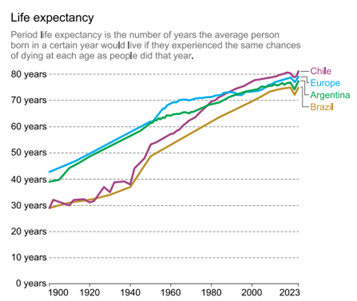
Leia o texto e analise o gráfico para responder à questão.
Life Expectancy (1900-2023)
People are living longer. In 1900, the average life
expectancy of a newborn was 32 years. By 2021 this had
more than doubled to 71 years.
The large reduction in child mortality has played
an important role in increasing life expectancy. But life
expectancy has increased at all ages. Infants, children,
adults, and the elderly are all less likely to die than in the
past, and death is being delayed. This remarkable shift
results from advances in medicine, public health, and living
standards. Along with it, many predictions of the “limit” of life
expectancy have been broken.
(Saloni Dattani et al. https://ourworldindata.org, 2023. Adaptado.)
In the excerpt from the second paragraph, “Along with it,
many predictions of the ‘limit’ of life expectancy have been
broken”, the underlined expression can be replaced, without
meaning change, by:
Ano: 2025
Banca:
VUNESP
Órgão:
UNIFIPA
Prova:
VUNESP - 2025 - UNIFIPA - Vestibular Medicina - Conhecimentos Gerais |
Q3966814
Inglês
Texto associado
Leia o texto e analise o gráfico para responder à questão.
Life Expectancy (1900-2023)
People are living longer. In 1900, the average life
expectancy of a newborn was 32 years. By 2021 this had
more than doubled to 71 years.
The large reduction in child mortality has played
an important role in increasing life expectancy. But life
expectancy has increased at all ages. Infants, children,
adults, and the elderly are all less likely to die than in the
past, and death is being delayed. This remarkable shift
results from advances in medicine, public health, and living
standards. Along with it, many predictions of the “limit” of life
expectancy have been broken.
(Saloni Dattani et al. https://ourworldindata.org, 2023. Adaptado.)
No trecho do segundo parágrafo “Infants, children, adults,
and the elderly are all less likely to die than in the past”, o
termo sublinhado equivale, em português, a:
Ano: 2025
Banca:
VUNESP
Órgão:
UNIFIPA
Prova:
VUNESP - 2025 - UNIFIPA - Vestibular Medicina - Conhecimentos Gerais |
Q3966813
Inglês
Texto associado
Leia o texto e analise o gráfico para responder à questão.
Life Expectancy (1900-2023)
People are living longer. In 1900, the average life
expectancy of a newborn was 32 years. By 2021 this had
more than doubled to 71 years.
The large reduction in child mortality has played
an important role in increasing life expectancy. But life
expectancy has increased at all ages. Infants, children,
adults, and the elderly are all less likely to die than in the
past, and death is being delayed. This remarkable shift
results from advances in medicine, public health, and living
standards. Along with it, many predictions of the “limit” of life
expectancy have been broken.
(Saloni Dattani et al. https://ourworldindata.org, 2023. Adaptado.)
According to the chart,
Ano: 2025
Banca:
VUNESP
Órgão:
UNIFIPA
Prova:
VUNESP - 2025 - UNIFIPA - Vestibular Medicina - Conhecimentos Gerais |
Q3966812
Inglês
Texto associado
Leia o texto e analise o gráfico para responder à questão.
Life Expectancy (1900-2023)
People are living longer. In 1900, the average life
expectancy of a newborn was 32 years. By 2021 this had
more than doubled to 71 years.
The large reduction in child mortality has played
an important role in increasing life expectancy. But life
expectancy has increased at all ages. Infants, children,
adults, and the elderly are all less likely to die than in the
past, and death is being delayed. This remarkable shift
results from advances in medicine, public health, and living
standards. Along with it, many predictions of the “limit” of life
expectancy have been broken.
(Saloni Dattani et al. https://ourworldindata.org, 2023. Adaptado.)
O trecho do texto que pode ser confirmado no gráfico é:
Ano: 2025
Banca:
VUNESP
Órgão:
UNIFIPA
Prova:
VUNESP - 2025 - UNIFIPA - Vestibular Medicina - Conhecimentos Gerais |
Q3966811
Inglês
Texto associado
Leia o texto para responder à questão.
Admixture’s impact on Brazilian population
evolution and health
Brazil is a vast continental country home to the largest
population in Latin America and boasts the world’s largest
recently admixed population1
. The colonization process
brought approximately 5 million Europeans to Brazil,
alongside the forced migration of at least 5 million Africans
and the decimation of Indigenous populations, which once
included more than 10 million people speaking more than
1000 languages. This distinctive historical interplay shaped
a complex mosaic of genetic diversity, underscoring the
importance of detailed genomic studies. Nevertheless,
similar to other populations in the Global South2
, the Brazilian
population remains notably underrepresented in genomic
research, where there is a lack of studies investigating the
effects of this population’s admixture on its evolution, diversity,
and health status.
To address these gaps, a research group generated
2723 high-coverage whole-genome sequences of the
Brazilian population, encompassing urban, rural, and riverine
communities from all five geographical regions of Brazil.
This dataset reflects a diverse group of ethnic backgrounds,
including Afro-Brazilians and descendants of Indigenous
people, and provides a comprehensive representation of
Brazilian genomic diversity.
(Kelly Nunes et al. www.science.org, 15.05.2025. Adaptado.)
1admixed population: group of individuals formed through interbreeding
of two or more previously isolated populations.
2Global South: a group of countries mainly located in the Southern
Hemisphere that are often characterized as developing, less developed
or underdeveloped.
According to the second paragraph, as a result of the study,
the researchers managed to supply
Ano: 2025
Banca:
VUNESP
Órgão:
UNIFIPA
Prova:
VUNESP - 2025 - UNIFIPA - Vestibular Medicina - Conhecimentos Gerais |
Q3966810
Inglês
Texto associado
Leia o texto para responder à questão.
Admixture’s impact on Brazilian population
evolution and health
Brazil is a vast continental country home to the largest
population in Latin America and boasts the world’s largest
recently admixed population1
. The colonization process
brought approximately 5 million Europeans to Brazil,
alongside the forced migration of at least 5 million Africans
and the decimation of Indigenous populations, which once
included more than 10 million people speaking more than
1000 languages. This distinctive historical interplay shaped
a complex mosaic of genetic diversity, underscoring the
importance of detailed genomic studies. Nevertheless,
similar to other populations in the Global South2
, the Brazilian
population remains notably underrepresented in genomic
research, where there is a lack of studies investigating the
effects of this population’s admixture on its evolution, diversity,
and health status.
To address these gaps, a research group generated
2723 high-coverage whole-genome sequences of the
Brazilian population, encompassing urban, rural, and riverine
communities from all five geographical regions of Brazil.
This dataset reflects a diverse group of ethnic backgrounds,
including Afro-Brazilians and descendants of Indigenous
people, and provides a comprehensive representation of
Brazilian genomic diversity.
(Kelly Nunes et al. www.science.org, 15.05.2025. Adaptado.)
1admixed population: group of individuals formed through interbreeding
of two or more previously isolated populations.
2Global South: a group of countries mainly located in the Southern
Hemisphere that are often characterized as developing, less developed
or underdeveloped.
No trecho do segundo parágrafo “To address these
gaps, a research group generated 2 723 high-coverage
whole-genome sequences”, a expressão sublinhada
refere-se, no contexto,
Ano: 2025
Banca:
VUNESP
Órgão:
UNIFIPA
Prova:
VUNESP - 2025 - UNIFIPA - Vestibular Medicina - Conhecimentos Gerais |
Q3966809
Inglês
Texto associado
Leia o texto para responder à questão.
Admixture’s impact on Brazilian population
evolution and health
Brazil is a vast continental country home to the largest
population in Latin America and boasts the world’s largest
recently admixed population1
. The colonization process
brought approximately 5 million Europeans to Brazil,
alongside the forced migration of at least 5 million Africans
and the decimation of Indigenous populations, which once
included more than 10 million people speaking more than
1000 languages. This distinctive historical interplay shaped
a complex mosaic of genetic diversity, underscoring the
importance of detailed genomic studies. Nevertheless,
similar to other populations in the Global South2
, the Brazilian
population remains notably underrepresented in genomic
research, where there is a lack of studies investigating the
effects of this population’s admixture on its evolution, diversity,
and health status.
To address these gaps, a research group generated
2723 high-coverage whole-genome sequences of the
Brazilian population, encompassing urban, rural, and riverine
communities from all five geographical regions of Brazil.
This dataset reflects a diverse group of ethnic backgrounds,
including Afro-Brazilians and descendants of Indigenous
people, and provides a comprehensive representation of
Brazilian genomic diversity.
(Kelly Nunes et al. www.science.org, 15.05.2025. Adaptado.)
1admixed population: group of individuals formed through interbreeding
of two or more previously isolated populations.
2Global South: a group of countries mainly located in the Southern
Hemisphere that are often characterized as developing, less developed
or underdeveloped.
In the excerpt from the first paragraph “Nevertheless, similar
to other populations in the Global South”, the underlined word
expresses
Ano: 2025
Banca:
VUNESP
Órgão:
UNIFIPA
Prova:
VUNESP - 2025 - UNIFIPA - Vestibular Medicina - Conhecimentos Gerais |
Q3966808
Inglês
Texto associado
Leia o texto para responder à questão.
Admixture’s impact on Brazilian population
evolution and health
Brazil is a vast continental country home to the largest
population in Latin America and boasts the world’s largest
recently admixed population1
. The colonization process
brought approximately 5 million Europeans to Brazil,
alongside the forced migration of at least 5 million Africans
and the decimation of Indigenous populations, which once
included more than 10 million people speaking more than
1000 languages. This distinctive historical interplay shaped
a complex mosaic of genetic diversity, underscoring the
importance of detailed genomic studies. Nevertheless,
similar to other populations in the Global South2
, the Brazilian
population remains notably underrepresented in genomic
research, where there is a lack of studies investigating the
effects of this population’s admixture on its evolution, diversity,
and health status.
To address these gaps, a research group generated
2723 high-coverage whole-genome sequences of the
Brazilian population, encompassing urban, rural, and riverine
communities from all five geographical regions of Brazil.
This dataset reflects a diverse group of ethnic backgrounds,
including Afro-Brazilians and descendants of Indigenous
people, and provides a comprehensive representation of
Brazilian genomic diversity.
(Kelly Nunes et al. www.science.org, 15.05.2025. Adaptado.)
1admixed population: group of individuals formed through interbreeding
of two or more previously isolated populations.
2Global South: a group of countries mainly located in the Southern
Hemisphere that are often characterized as developing, less developed
or underdeveloped.
In the excerpt from the first paragraph “The colonization
process brought approximately 5 million Europeans to Brazil,
alongside the forced migration of at least 5 million Africans”,
the underlined word can be replaced, without meaning
change, by:
Ano: 2025
Banca:
VUNESP
Órgão:
UNIFIPA
Prova:
VUNESP - 2025 - UNIFIPA - Vestibular Medicina - Conhecimentos Gerais |
Q3966807
Inglês
Texto associado
Leia o texto para responder à questão.
Admixture’s impact on Brazilian population
evolution and health
Brazil is a vast continental country home to the largest
population in Latin America and boasts the world’s largest
recently admixed population1
. The colonization process
brought approximately 5 million Europeans to Brazil,
alongside the forced migration of at least 5 million Africans
and the decimation of Indigenous populations, which once
included more than 10 million people speaking more than
1000 languages. This distinctive historical interplay shaped
a complex mosaic of genetic diversity, underscoring the
importance of detailed genomic studies. Nevertheless,
similar to other populations in the Global South2
, the Brazilian
population remains notably underrepresented in genomic
research, where there is a lack of studies investigating the
effects of this population’s admixture on its evolution, diversity,
and health status.
To address these gaps, a research group generated
2723 high-coverage whole-genome sequences of the
Brazilian population, encompassing urban, rural, and riverine
communities from all five geographical regions of Brazil.
This dataset reflects a diverse group of ethnic backgrounds,
including Afro-Brazilians and descendants of Indigenous
people, and provides a comprehensive representation of
Brazilian genomic diversity.
(Kelly Nunes et al. www.science.org, 15.05.2025. Adaptado.)
1admixed population: group of individuals formed through interbreeding
of two or more previously isolated populations.
2Global South: a group of countries mainly located in the Southern
Hemisphere that are often characterized as developing, less developed
or underdeveloped.
According to the first paragraph, one of the facts about the
Brazilian population is:
Ano: 2025
Banca:
VUNESP
Órgão:
UNIFIPA
Prova:
VUNESP - 2025 - UNIFIPA - Vestibular Medicina - Conhecimentos Gerais |
Q3966806
Literatura
Enquanto rejeitam o herói, essas obras demoram-se em
retratar as cenas do cotidiano. Nesse contexto, bem e mal, belo
e feio, em vez de se contraporem estilizados, misturam-se, ou
melhor, revelam-se em sua convivência magmática. Buscam-
-se a verdade expressiva, a pintura fiel de situações, personagens concretos e a objetividade da descrição, recusando-se
a impor o selo do próprio julgamento do autor. Enfatizam-se
o ambiente, a raça, o momento e o “contexto”.
(Luciana Stegagno Picchio. História da literatura brasileira, 2024. Adaptado.)
Tendo em vista as características elencadas, as obras referidas no texto vinculam-se à estética
(Luciana Stegagno Picchio. História da literatura brasileira, 2024. Adaptado.)
Tendo em vista as características elencadas, as obras referidas no texto vinculam-se à estética
Ano: 2025
Banca:
VUNESP
Órgão:
UNIFIPA
Prova:
VUNESP - 2025 - UNIFIPA - Vestibular Medicina - Conhecimentos Gerais |
Q3966805
Português
Texto associado
Para responder à questão, leia o ensaio intitulado
“Tópicos distópicos” de Eduardo Giannetti.
Os jovens abúlicos1
, os velhos deprimidos; os pobres
entorpecidos, os ricos enfadados; os homens embrutecidos,
as mulheres desenganadas; os privilegiados acima da lei,
os excluídos aquém dela; os empregados como roldanas de
engrenagem, os desocupados esmagados por ela; os bem-
-sucedidos sem tempo para nada, os desvalidos sem saber
o que fazer com ele; as faxineiras negativadas, os banqueiros insones; os casais algemados, os amantes rompidos; os
poetas à míngua, os corruptos à larga. De tudo que foi e não
foi, resta o quê? A convivência entre desumanos desidratada ao mínimo legal do mercado: a troca mercenária de bens
e ofícios conforme valorações aguerridamente pactuadas.
O pagamento em dinheiro, à vista ou parcelado, como o único
vínculo entre bolhas narcísicas ambulantes. A rua onde voz
e buzina se confundem.
(Eduardo Giannetti. Trópicos utópicos, 2016.)
1abúlico: que se caracteriza pela incapacidade de tomar decisões.
A prefixação é o processo de formação de palavras pela
adição de prefixo a uma palavra já existente. Observa-se
uma palavra formada com prefixo que exprime ideia de
negação no seguinte trecho:
Ano: 2025
Banca:
VUNESP
Órgão:
UNIFIPA
Prova:
VUNESP - 2025 - UNIFIPA - Vestibular Medicina - Conhecimentos Gerais |
Q3966804
Português
Texto associado
Para responder à questão, leia o ensaio intitulado
“Tópicos distópicos” de Eduardo Giannetti.
Os jovens abúlicos1
, os velhos deprimidos; os pobres
entorpecidos, os ricos enfadados; os homens embrutecidos,
as mulheres desenganadas; os privilegiados acima da lei,
os excluídos aquém dela; os empregados como roldanas de
engrenagem, os desocupados esmagados por ela; os bem-
-sucedidos sem tempo para nada, os desvalidos sem saber
o que fazer com ele; as faxineiras negativadas, os banqueiros insones; os casais algemados, os amantes rompidos; os
poetas à míngua, os corruptos à larga. De tudo que foi e não
foi, resta o quê? A convivência entre desumanos desidratada ao mínimo legal do mercado: a troca mercenária de bens
e ofícios conforme valorações aguerridamente pactuadas.
O pagamento em dinheiro, à vista ou parcelado, como o único
vínculo entre bolhas narcísicas ambulantes. A rua onde voz
e buzina se confundem.
(Eduardo Giannetti. Trópicos utópicos, 2016.)
1abúlico: que se caracteriza pela incapacidade de tomar decisões.
No ensaio, o autor propõe uma pergunta. Como resposta,
ele afirma que os problemas descritos têm um fundamento

 Conheça nossos planos