Questões de Concurso
Para engenheiro eletricista
Foram encontradas 20.975 questões
Resolva questões gratuitamente!
Junte-se a mais de 4 milhões de concurseiros!


Ano: 2012
Banca:
CESGRANRIO
Órgão:
Transpetro
Prova:
CESGRANRIO - 2012 - Transpetro - Engenheiro Júnior - Elétrica |
Q264012
Engenharia Elétrica
O Inversor de Frequência é o elo entre a etapa de controle e a motorização de uma máquina.
NÃO atende às características de um Inversor de Frequência um equipamento que
NÃO atende às características de um Inversor de Frequência um equipamento que
Ano: 2012
Banca:
CESGRANRIO
Órgão:
Transpetro
Prova:
CESGRANRIO - 2012 - Transpetro - Engenheiro Júnior - Elétrica |
Q264011
Engenharia Mecânica
Considere uma esfera homogênea de volume V
esf , construída com um material cujo peso especifico é λx . Essa esfera é imersa em um recipiente com água, com peso específico λágua e volume Vágua .
Qual deve ser a expressão do peso específico da esfera para que, quando imersa na água, fique equilibrada de modo que o nível da água passe exatamente pelo seu centro?
Qual deve ser a expressão do peso específico da esfera para que, quando imersa na água, fique equilibrada de modo que o nível da água passe exatamente pelo seu centro?
Ano: 2012
Banca:
CESGRANRIO
Órgão:
Transpetro
Prova:
CESGRANRIO - 2012 - Transpetro - Engenheiro Júnior - Elétrica |
Q264010
Engenharia Mecânica
A grandeza que se caracteriza como a quantidade de energia contida em uma substância que sofre uma reação é a(o)
Ano: 2012
Banca:
CESGRANRIO
Órgão:
Transpetro
Prova:
CESGRANRIO - 2012 - Transpetro - Engenheiro Júnior - Elétrica |
Q264009
Engenharia Mecânica
Um determinado gás realiza um trabalho de 5 Joules, após receber uma quantidade de calor Q = 20 Joules.
Como a energia interna do sistema, antes de receber o calor, era U = 80 Joules, qual será, em Joules, essa energia após esse recebimento de calor?
Como a energia interna do sistema, antes de receber o calor, era U = 80 Joules, qual será, em Joules, essa energia após esse recebimento de calor?
Ano: 2012
Banca:
CESGRANRIO
Órgão:
Transpetro
Prova:
CESGRANRIO - 2012 - Transpetro - Engenheiro Júnior - Elétrica |
Q264008
Matemática
48
Se, para dados n, m ∈ , o limite  ? é finito e não nulo, então seu valor deve ser igual a
? é finito e não nulo, então seu valor deve ser igual a
Ano: 2012
Banca:
CESGRANRIO
Órgão:
Transpetro
Prova:
CESGRANRIO - 2012 - Transpetro - Engenheiro Júnior - Elétrica |
Q264007
Matemática
Se y: ℜ -> ℜ é a solução do problema de valor inicial
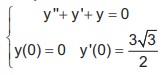 ,quanto vale y(2)
,quanto vale y(2)
Ano: 2012
Banca:
CESGRANRIO
Órgão:
Transpetro
Prova:
CESGRANRIO - 2012 - Transpetro - Engenheiro Júnior - Elétrica |
Q264006
Matemática
Se T: ℜn ℜm é uma transformação linear sobrejetora, que não é injetora, então, tem-se
Ano: 2012
Banca:
CESGRANRIO
Órgão:
Transpetro
Prova:
CESGRANRIO - 2012 - Transpetro - Engenheiro Júnior - Elétrica |
Q264005
Estatística
Uma variável aleatória quantitativa X assume todos os valores numéricos do intervalo real [3,11], e apenas esses. Sabe-se que a sua distribuição é simétrica e que sua variância é igual a 2.
Dessa forma, ao se considerar a variável aleatória Y definida por y = 4.X + 3, a média e o desvio padrão de Y serão, respectivamente, iguais a
Dessa forma, ao se considerar a variável aleatória Y definida por y = 4.X + 3, a média e o desvio padrão de Y serão, respectivamente, iguais a
Ano: 2012
Banca:
CESGRANRIO
Órgão:
Transpetro
Prova:
CESGRANRIO - 2012 - Transpetro - Engenheiro Júnior - Elétrica |
Q264004
Matemática
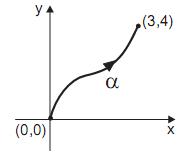
Se F:ℜ 2-ℜ2 é o campo vetorial definido por F (x,y) = (2x + 2y2 , 3y2 + 4xy + 1) e α [a,b] ℜ2 é uma curva simples e diferenciável, tal que a(a) = (0,0), a(b) = (3,4), cujo traço é indicado na figura acima, então o valor da integral de linha do campo vetorial F sobre a curva a, dada por ∫F(α(t))α`(t)dt=∫ab2x+2y2)dx+(3y2+4xy+1)dy é
Ano: 2012
Banca:
CESGRANRIO
Órgão:
Transpetro
Prova:
CESGRANRIO - 2012 - Transpetro - Engenheiro Júnior - Elétrica |
Q264003
Matemática
A fim de modelar a forma de uma das pilastras que sustenta uma obra de arte, um engenheiro utilizou o sólido do ℜ
3 que é limitado superiormente pelo paraboloide z = 2.(x2 + y2 ), lateralmente pelo cilindro x2 + y2 = 2y e, inferiormente, pelo plano xy.
Qual é o volume do sólido utilizado pelo engenheiro para modelar a forma da referida pilastra?
Qual é o volume do sólido utilizado pelo engenheiro para modelar a forma da referida pilastra?
Ano: 2012
Banca:
CESGRANRIO
Órgão:
Transpetro
Prova:
CESGRANRIO - 2012 - Transpetro - Engenheiro Júnior - Elétrica |
Q264002
Matemática
Dentre todas as retas tangentes ao gráfico da função f: ℜ-ℜ definida por f(x) = e
x . (x2 + 1), qual é aquela que possui o menor coeficiente angular?
Ano: 2012
Banca:
CESGRANRIO
Órgão:
Transpetro
Prova:
CESGRANRIO - 2012 - Transpetro - Engenheiro Júnior - Elétrica |
Q264001
Matemática
Uma empresa fornecedora de motores foi contratada por uma indústria para providenciar uma encomenda feita por uma de suas unidades. A empresa contratada fornece motores de apenas duas marcas: M e N. A marca M é a mais popular e, por motivo da grande demanda decorrente de sua popularidade, tornou-se mais rara no mercado. Diante disso, a empresa fornecedora avisa aos seus clientes que, para cada motor fornecido, a probabilidade de o mesmo ser da marca M é de apenas 25%.
Considerando verdadeiro o aviso dado pela empresa e sabendo que a encomenda realizada pela unidade industrial foi de 6 motores, qual é a probabilidade de, ao serem entregues, apenas 2 motores serem da marca M?
Ano: 2012
Banca:
CESGRANRIO
Órgão:
Transpetro
Prova:
CESGRANRIO - 2012 - Transpetro - Engenheiro Júnior - Elétrica |
Q264000
Engenharia Elétrica
Um determinado equipamento de um sistema elétrico de potência tem em sua especificação a tensão de alimentação de 1.000 V, potência de 1.500 kVA e reatância de sub- transitória de 20%. Esse equipamento está em um setor onde a tensão de base é de 2.000 V e a potência de base, de 4.500 kVA.
A reatância subtransitória desse equipamento, por ocasião da elaboração do diagrama de impedâncias, deve assumir, em p.u., o valor de
A reatância subtransitória desse equipamento, por ocasião da elaboração do diagrama de impedâncias, deve assumir, em p.u., o valor de
Ano: 2012
Banca:
CESGRANRIO
Órgão:
Transpetro
Prova:
CESGRANRIO - 2012 - Transpetro - Engenheiro Júnior - Elétrica |
Q263999
Engenharia Elétrica
Um sistema elétrico é composto por um gerador em série com um transformador elevador de tensão. O secundário desse transformador é conectado a uma linha de transmissão de j50 Ω e a relação de tensão de linha do transformador é de 1:10. Foram escolhidas as bases de 1 kV e 1.000 kVA, referentes ao lado do gerador.
A reatância da linha de transmissão, em p.u., é
A reatância da linha de transmissão, em p.u., é
Ano: 2012
Banca:
CESGRANRIO
Órgão:
Transpetro
Prova:
CESGRANRIO - 2012 - Transpetro - Engenheiro Júnior - Elétrica |
Q263998
Engenharia Elétrica
Um motor monofásico shunt de corrente contínua, de 10 HP de potência mecânica (1 HP = 746 W) e 100 V de tensão de alimentação, tem um rendimento de 80 %.
Sabendo-se que a corrente de excitação é de 2,5 A, a corrente do induzido, em ampères, desse motor é
Sabendo-se que a corrente de excitação é de 2,5 A, a corrente do induzido, em ampères, desse motor é
Ano: 2012
Banca:
CESGRANRIO
Órgão:
Transpetro
Prova:
CESGRANRIO - 2012 - Transpetro - Engenheiro Júnior - Elétrica |
Q263997
Engenharia Elétrica
Em uma instalação elétrica industrial, existem várias cargas resistivas e indutivas que, juntas, possuem uma potência aparente de 5.000 VA e uma potência ativa de 4.350 W. Nessa instalação, será instalado um motor síncrono de 3.333,33 W.
Para que esse motor eleve o fator de potência da instalação para 1,0 (um), ele deve ter, em VA, uma potência aparente mínima de
Para que esse motor eleve o fator de potência da instalação para 1,0 (um), ele deve ter, em VA, uma potência aparente mínima de
Ano: 2012
Banca:
CESGRANRIO
Órgão:
Transpetro
Prova:
CESGRANRIO - 2012 - Transpetro - Engenheiro Júnior - Elétrica |
Q263996
Engenharia Elétrica
Um sistema elétrico trifásico pode ter suas grandezas fasoriais representadas em termos de componentes simétricos nas sequências positiva, negativa e zero.
A expressão da potência complexa trifásica, em termos de componentes simétricos, é dada pela expressão
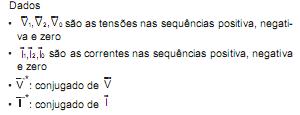
A expressão da potência complexa trifásica, em termos de componentes simétricos, é dada pela expressão
Ano: 2012
Banca:
CESGRANRIO
Órgão:
Transpetro
Prova:
CESGRANRIO - 2012 - Transpetro - Engenheiro Júnior - Elétrica |
Q263995
Engenharia Elétrica
Um transformador trifásico é composto por três enrolamentos para a configuração do primário e três para o secundário. A relação de transformação entre os enrolamentos primários e secundários é de 100:1 e a tensão de linha a ser aplicada no primário é de 900 V.
Para que a tensão de linha no secundário seja de 3 √3 V, é necessário que a configuração do primário e do secundário desse transformador sejam, respectivamente,
Para que a tensão de linha no secundário seja de 3 √3 V, é necessário que a configuração do primário e do secundário desse transformador sejam, respectivamente,
Ano: 2012
Banca:
CESGRANRIO
Órgão:
Transpetro
Prova:
CESGRANRIO - 2012 - Transpetro - Engenheiro Júnior - Elétrica |
Q263994
Engenharia Mecânica
Uma bomba centrífuga opera em uma velocidade de rotação de 900 rpm e com uma vazão de 40 m3 /h. Sabe-se que o diâmetro do impelidor da bomba é de 20 cm. Deseja-se substituir essa bomba por outra do mesmo tipo, porém, com diâmetro do impelidor de 10 cm e operando com uma velocidade de rotação de 1800 rpm.
Considerando que o fluído de trabalho é ideal e que todos os critérios de similaridade dinâmica são satisfeitos, o valor da vazão, em m3 /h, após a substituição da bomba, é
Considerando que o fluído de trabalho é ideal e que todos os critérios de similaridade dinâmica são satisfeitos, o valor da vazão, em m3 /h, após a substituição da bomba, é
Ano: 2012
Banca:
CESGRANRIO
Órgão:
Transpetro
Prova:
CESGRANRIO - 2012 - Transpetro - Engenheiro Júnior - Elétrica |
Q263993
Engenharia Elétrica
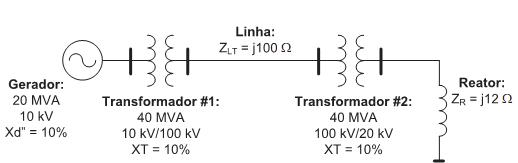
A figura acima mostra parcialmente um sistema elétrico de potência radial. O gerador está operando em condições nominais.
Considerando como base do sistema a tensão de 20 kV e a potência de 20 MVA na barra em que o reator está conectado, então, o valor por unidade da tensão nessa mesma barra é

 Conheça nossos planos