Questões de Concurso Sobre tradução | translation em inglês

Foram encontradas 653 questões

Q4038020 Inglês
Text 1


Popular career choices


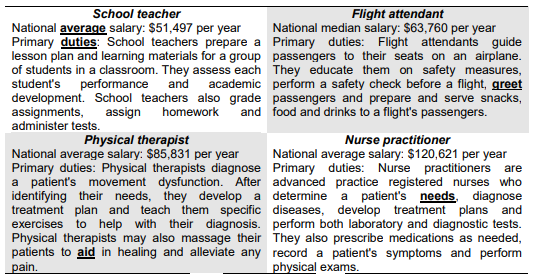
Researching popular career choices gives you an idea of the job opportunities other job seekers are interested in. Here are some popular career choices to consider:


Sources: https://www.indeed.com. [Adapted].
All the translations for the words below are correct, according to their use in text 1, except: 
Alternativas
Q4020430 Inglês
Analyze the following statements regarding the practice of translation:
I.Compensation is a translation technique used to make up for the loss of a particular effect in the source text by recreating a similar effect elsewhere in the target text.
II.Transcreation is a concept often used in advertising and poetry where the translator has the freedom to reinvent the text while maintaining the original emotional impact.
III.Machine translation has currently reached a level of perfection that eliminates the need for human post-editing or any cultural adaptation in literary works.
Which of the statements above is/are CORRECT?
Alternativas
Q4020425 Inglês
Translation theory has evolved from a prescriptive view to a functionalist perspective. Mark the CORRECT alternative.
Alternativas
Q3904799 Inglês
Choose the right choice to give the right translation for this sentence below:

Quanto tempo ele levou para escrever aquele livro? 
Alternativas
Q3884140 Inglês
A tradução não é uma mera substituição de etiquetas linguísticas, mas uma retextualização. Ao traduzir um texto literário mantendo a fidelidade ao "sentido pretendido" em vez da "forma literal", o tradutor deve: 
Alternativas
Q3862005 Inglês
Choose the alternative that correctly expresses a fundamental principle of translation and interpretation applicable to academic, technical, and journalistic texts. 
Alternativas
Q4037204 Inglês
When translating from English into Portuguese, certain idiomatic expressions resist literal transfer due to cultural specificity. According to modern translation theory, which strategy best addresses cases where semantic equivalence is impossible, but functional equivalence can be achieved?
Alternativas
Q4037194 Inglês
O texto seguinte servirá de base para responder à questão.

We can learn a lot from Troy's trash

Beneath the epic tales of heroes and gods, Troy's true story is written in something far less glamorous − its rubbish.

When we think of Troy, we imagine epic battles, valiant deeds, cunning tricks and the wrath of gods. Thanks to Homer's Iliad, the city is remembered as a stage for romance and heroism.

But long before Paris stole Helen and Achilles raged on the battlefield, the people of bronze age Troy lived ordinary lives − with extraordinary consequences. They built, cooked, stored, traded and, crucially, threw things away. And they did it right where they lived.

Today, waste is whisked away quickly − out of sight, out of mind. But in bronze age Troy (3000−1000BC), trash stayed close, often accumulating in domestic dumping grounds for generations.

Having spent more than 16 summers excavating and analysing the bronze age layers of Troy, I've learned to read the city's history this waste.

Hundreds of thousands of animal bones from cattle, sheep, fish − even turtles − were found alongside vast quantities of pottery shards, ash, food scraps, and human waste. Sometimes, these layers were reused to level floors or build walls, showing how closely intertwined daily life and refuse management were.

This wasn't laziness or neglect, it was pure pragmatism. In a world without rubbish trucks or sanitation systems, managing refuse was neither chaotic nor careless, but a collective, spatially negotiated − and surprisingly strategic − effort.

The excavations I have worked on as part of the University of Tübingen's Troy Project, which has been going on since 1988, have revealed just how deliberate these routines were. Where people chose to dump, or not to dump, speaks volumes about status, social roles, and community boundaries. Waste is the diary no one meant to write, yet it records the intimate rhythms of daily life with unfiltered clarity.

Far from a nuisance, Troy's waste is an archaeologist's treasure trove.

Over nearly 2,000 years, Troy ended up with 15 meters of built-up debris. Archaeologists can see nine major building phases in it, each made up of hundreds of thin layers, which formed as people lived their everyday lives. These layers act like snapshots, quietly recording how the city changed over time. Some capture hearth cleanings, others record the rebuilding of entire city quarters.

By analysing the layers and their ratios of bones to pottery, ash concentration, presence of storage jars, grinding stones, or production debris, specific spaces of activity become visible: kitchens, workshops, storage areas, rubbish pits. What appears chaotic turns out to be a carefully structured map of everyday routines − showing where meals were prepared, tools made, and discarded objects left behind.

The story these remains tell is one of profound transformation. Troy began as a modest agrarian settlement, shaped by the steady rhythms of farming, herding, and small-scale craft. Over time, it grew into a thriving regional centre.

The archaeological record, rich in refuse, traces this long arc of change. Exotic imports fashioned from stones such as carnelian and lapis lazuli begin to appear, revealing distant trade connections. Specialised metalworking tools emerge alongside monumental architecture. some buildings stretched nearly 30 metres, signalling growing ambitions and expanding capabilities.

This rise unfolded gradually, reflected not just in grander buildings, but in shifting tools, trade, and how people dealt with what they left behind. Waste management became more organised, with designated areas for different types of waste. This reflects broader shifts in how the community structured space and managed its economy. 

Yet this ascent was interrupted. By the mid-third millennium BC, signs that things were becoming smaller appear. Architecture simplifies, household inventories shrink, production debris declines suggesting economic slowdown or political instability.

Still, Troy endured. By the mid-second millennium BC, the city revived. Refined ceramics, luxury imports and evidence of social complexity marked a new chapter of recovery and reinvention. This splendid settlement later became the stage for Homer's Trojan War where Greek warriors faced the daunting task of climbing towering mounds of debris built up over centuries just to reach the palaces.

These insights allow us to see Troy not just as a city of walls and towers, but as a living organism shaped by daily routines, unspoken norms and social negotiation. The waste left behind is a remarkably honest archive of bronze age society − beneath myths, stones, and poetry.

Troy's trash heaps are the bronze age's search history. To know what mattered 4,500 years ago, don't ask poets − ask the garbage. From broken tools to shared meals, from imported luxuries to scraps, this waste reveals the pulse of everyday life and society's evolving structure.

Ironically, these mundane refuse layers preserved the bronze age world for us. Without them, we'd know far less about early Troy's people. Their depth and composition trace changes in economy, technology, and social structure. From scraps to towers of pottery shards, waste archaeology is key to understanding early urban complexity.

So next time you picture Achilles storming Troy's gates, remember: the heroes might have been divine, but their city smelled very human.


https://theconversation.com/we-can-learn-a-lot-from-troys-trash-260613 
Read the excerpt below:

"Today, waste is whisked away quickly − out of sight, out of mind. But in bronze age Troy (3000−1000BC), trash stayed close, often accumulating in domestic dumping grounds for generations."

A professional translator working on a Brazilian Portuguese edition of this archaeological text must address the idiomatic expression "out of sight, out of mind" and decide between maintaining the English idiom with explanatory footnote, creating a culturally equivalent Portuguese idiom, or providing a descriptive translation. When considering translation strategies that balance semantic fidelity, cultural accessibility, and stylistic naturalness for Brazilian readers while preserving the author's rhetorical impact, the appropriate translation approach would be: 
Alternativas
Q4034377 Inglês
Read the English sentence and its two possible Portuguese translations:
Source: "She broke down in tears when she heard the news."
(1) "Ela quebrou-se em lágrimas ao ouvir a notícia." (2) "Ela desabou em lágrimas ao ouvir a notícia."
From the perspective of translation theory, the second version is preferable because it illustrates:
Alternativas
Q4034372 Inglês
Digital archeology

The City Gallery presents Filip Popov with his exhibition "Digital Archeology"

With a large exhibition, including works from his most famous cycles, the visual artist Filip Popov will exhibit in the Hall "2019" at 32 Gladstone Street from March 2 to 31.

For the first time the artist makes such a large-scale performance in the city where he was born.

The opening will be on March 2 from 17:00 to 19:30.

The topics that excite the author of the exhibition "Digital Archeology" can be deciphered in the titles of the series of works created over the past 8 years: TransOrganic, Para Bellum, Order, Posthuman, Paleomatic Monologues and Prayers to the latest series - Bunker City and Zero City. As Velizara Ivanova emphasizes in her analysis:

Combining works dating back to 2014, Digital Archeology reflects Philip Popov's continuing focus on the posthumanism and transhumanism, confronting technology and our uncertain future and insight into the way machines are woven into our tomorrow's world. "

Born in 1964 in Plovdiv, Filip Popov spent several years of his childhood in Germany, where he formed his ideas for unity between art, architecture, design and technology. He studied art at the National Academy of Arts in Sofia, moved to Basel to study at the Kunstgewerbeschule, and later lived in Zurich.

He has had solo exhibitions at EASA, West Berlin (1988), EKG, Wetzikon, CH (1993), Binz Foundation 39, Zurich (1994), Kunsthalle Liesthal, CH (1996), ArtFront Gallery, Tokyo (2005). It is presented in the most famous galleries in Sofia and the country. In 2014 he participated in the National Autumn Exhibitions in Plovdiv. Filip Popov exhibits his works in numerous group exhibitions in Bulgaria, Switzerland, Austria, France.


https://www.visitplovdiv.com/en/node/10577
Read the excerpt below:
"For the first time the artist makes such a large-scale performance in the city where he was born."
An English teacher analyzing this sentence with advanced students identifies a potential ambiguity in the noun "performance" within this artistic context. When discussing polysemy, context-dependent meaning, and the semantic challenges this presents for translation into Portuguese, particularly distinguishing between "performance" as artistic presentation versus "performance" as theatrical/live art form, the most linguistically precise interpretation considering the broader textual context of an art exhibition would be_________.

Fill in the blank above and select the correct alternative.
Alternativas
Q4034370 Inglês
Digital archeology

The City Gallery presents Filip Popov with his exhibition "Digital Archeology"

With a large exhibition, including works from his most famous cycles, the visual artist Filip Popov will exhibit in the Hall "2019" at 32 Gladstone Street from March 2 to 31.

For the first time the artist makes such a large-scale performance in the city where he was born.

The opening will be on March 2 from 17:00 to 19:30.

The topics that excite the author of the exhibition "Digital Archeology" can be deciphered in the titles of the series of works created over the past 8 years: TransOrganic, Para Bellum, Order, Posthuman, Paleomatic Monologues and Prayers to the latest series - Bunker City and Zero City. As Velizara Ivanova emphasizes in her analysis:

Combining works dating back to 2014, Digital Archeology reflects Philip Popov's continuing focus on the posthumanism and transhumanism, confronting technology and our uncertain future and insight into the way machines are woven into our tomorrow's world. "

Born in 1964 in Plovdiv, Filip Popov spent several years of his childhood in Germany, where he formed his ideas for unity between art, architecture, design and technology. He studied art at the National Academy of Arts in Sofia, moved to Basel to study at the Kunstgewerbeschule, and later lived in Zurich.

He has had solo exhibitions at EASA, West Berlin (1988), EKG, Wetzikon, CH (1993), Binz Foundation 39, Zurich (1994), Kunsthalle Liesthal, CH (1996), ArtFront Gallery, Tokyo (2005). It is presented in the most famous galleries in Sofia and the country. In 2014 he participated in the National Autumn Exhibitions in Plovdiv. Filip Popov exhibits his works in numerous group exhibitions in Bulgaria, Switzerland, Austria, France.


https://www.visitplovdiv.com/en/node/10577
Judge the sentences below as TRUE (T) or FALSE (F) regarding translation theory and practice applied to the text "Digital Archeology."

(__)The phrase "large-scale performance" presents a translation challenge requiring the translator to consider register, domain-specific vocabulary, and context; a functionally equivalent Brazilian Portuguese translation would be "mostra de grande escala" or "exposição abrangente," prioritizing dynamic equivalence over formal equivalence to ensure target audience comprehension of the exhibition's scope and importance.

(__)The series titles "TransOrganic," "Para Bellum," "Posthuman," and "Bunker City" should all be systematically translated into Portuguese as "TransOrgânico," "Para a Guerra," "Pós-humano," and "Cidade Bunker" to ensure Brazilian readers fully comprehend the thematic content, as maintaining English titles would create unnecessary barriers to understanding and contradict accessibility principles in translation for non-specialist audiences.

(__)The sentence "The topics that excite the author of the exhibition" contains the verb "excite" which shares identical semantic range with Portuguese "excitar," making direct cognate translation appropriate and recommended, as both verbs carry the same connotations of intellectual stimulation and enthusiasm across academic and professional contexts in both languages without semantic divergence.


The CORRECT sequence is: 
Alternativas
Q4034367 Inglês

Cold Kimchi Tomato Bibim Noodles


Ingredients

For the sauce

 3 tablespoons tomato paste

 2 tablespoons gochujang

 1 teaspoon kosher salt

 1 1/2 tablespoons sesame oil

 3 tablespoons apple cider vinegar

 3 tablespoons kimchi juice

 1 tablespoon honey

 1 cup chopped kimchi

For the noodles

150 grams somen noodles

For the toppings

 2 Persian cucumbers, sliced into matchsticks

 1 shallot, minced

 2 cups cherry tomatoes, halved

 2 soft-boiled eggs (7 minutes, jammy yolks)

 4 radishes, thinly sliced

To finish

Extra sesame oil, for drizzling

 2 tablespoons furikake

Handful of cilantro

Directions

•Step 1


Make the sauce: In a medium bowl, whisk together the tomato paste, gochujang, salt, sesame oil, vinegar, kimchi juice, and honey until smooth. Stir in the chopped kimchi until evenly coated.

•Step 2 

Cook the noodles: Bring a pot of water to a rolling boil. Add the somen noodles and cook for 3 to 4 minutes, until just tender. Drain and rinse under cold water until completely cooled, then shake off excess water.

•Step 3

Toss together: Add the chilled noodles to the sauce bowl. Using tongs, gently mix until each strand is coated in the kimchi-gochujang sauce. 

•Step 4

Assemble: Divide the noodles between bowls. Top with cucumbers, shallot, tomatoes, soft-boiled eggs, and radishes. 

•Step 5

Finish & serve: Drizzle with a little extra sesame oil, sprinkle with furikake, and top with cilantro. Mix everything together at the table before eating.


https://food52.com/recipes/cold-kimchi-tomato-bibim-noodles
Read the excerpt below:
"In a medium bowl, whisk together the tomato paste, gochujang, salt, sesame oil, vinegar, kimchi juice, and honey until smooth. Stir in the chopped kimchi until evenly coated."
A translation professor analyzing this instructional text for a Brazilian audience must address the challenge of translating the adverb "evenly" in the phrase "until evenly coated," which modifies the past participle and specifies the manner and distribution quality of the coating action. When considering semantic precision, register appropriateness, and naturalness in Brazilian Portuguese while maintaining the instructional clarity essential for successful recipe execution, the most adequate translation strategy for "until evenly coated" would be______.
Fill in the blank above and select the correct alternative. 
Alternativas
Q4034366 Inglês

Cold Kimchi Tomato Bibim Noodles


Ingredients

For the sauce

 3 tablespoons tomato paste

 2 tablespoons gochujang

 1 teaspoon kosher salt

 1 1/2 tablespoons sesame oil

 3 tablespoons apple cider vinegar

 3 tablespoons kimchi juice

 1 tablespoon honey

 1 cup chopped kimchi

For the noodles

150 grams somen noodles

For the toppings

 2 Persian cucumbers, sliced into matchsticks

 1 shallot, minced

 2 cups cherry tomatoes, halved

 2 soft-boiled eggs (7 minutes, jammy yolks)

 4 radishes, thinly sliced

To finish

Extra sesame oil, for drizzling

 2 tablespoons furikake

Handful of cilantro

Directions

•Step 1


Make the sauce: In a medium bowl, whisk together the tomato paste, gochujang, salt, sesame oil, vinegar, kimchi juice, and honey until smooth. Stir in the chopped kimchi until evenly coated.

•Step 2 

Cook the noodles: Bring a pot of water to a rolling boil. Add the somen noodles and cook for 3 to 4 minutes, until just tender. Drain and rinse under cold water until completely cooled, then shake off excess water.

•Step 3

Toss together: Add the chilled noodles to the sauce bowl. Using tongs, gently mix until each strand is coated in the kimchi-gochujang sauce. 

•Step 4

Assemble: Divide the noodles between bowls. Top with cucumbers, shallot, tomatoes, soft-boiled eggs, and radishes. 

•Step 5

Finish & serve: Drizzle with a little extra sesame oil, sprinkle with furikake, and top with cilantro. Mix everything together at the table before eating.


https://food52.com/recipes/cold-kimchi-tomato-bibim-noodles
Consider the following translation challenge:

A professional translator working on a Brazilian Portuguese edition of an international cookbook encounters the recipe title "Cold Kimchi Tomato Bibim Noodles" and several culture-specific ingredients including "gochujang," "furikake," "Persian cucumbers," and "somen noodles." The translator must decide between foreignization (maintaining source-language terms to preserve cultural authenticity) and domestication (adapting to target-culture equivalents for familiarity). Regarding translation theory, particularly Lawrence Venuti's concepts of foreignization versus domestication and Eugene Nida's formal versus dynamic equivalence, which approach demonstrates the most theoretically informed and contextually appropriate translation strategy? 

Alternativas
Q3928901 Inglês
Text 1A15


    Last year, I had a strange dream. My father and I were walking through a canal with difficulty as thousands of fish were released around us. In the dream, I knew that the fish thought they were drowning, as if they had to face death before becoming adults. The next day, my father told me that when I was three, he had taken me to see fish being put into a pond. I could not remember it, but the vision had stayed in my mind. Memories, like images, can return years later in unexpected ways.

    Today, it is common to see old images suddenly appear online. We spend hours looking at photos that record our daily lives in ways never seen before. For young people under twenty-five, who have grown up with social media, childhood is no longer private or mysterious. According to Kate Eichhorn, a media historian at the New School, this constant exposure is sure to affect how identity develops, although we are not yet sure exactly how.

    Eichhorn explains that there are two sides. On the positive side, children and teenagers have more control than before. In the past, adults were the ones who decided how childhood should be remembered, using books, photo albums, or home videos. Today, young people can create and share their own images without depending on adults. This gives them the power to tell their own stories and decide what to remember about their lives.

    On the negative side, social media can make it difficult to leave the past behind. We are not the only ones posting—our friends and families also share moments of our lives, often without asking us. This makes it hard to forget mistakes or change identities. Eichhorn warns that the danger now is not that childhood disappears, but that it might never end, because the past is always visible online.

    It would, indeed, be surprising if we could see painful memories as finished and gone. But most difficult experiences are not captured on screens. Social media shows only part of life, often the happy or triumphant side, and leaves out the tears and struggles. What remains online is rarely the full truth, but fragments that stay with us, shaping how we remember ourselves.


Nausicaa Renner. How Social Media Shapes Our Identity.
Internet:<www.newyorker.com>  (adapted).  
Choose the option in which the fragment “this constant exposure is sure to affect how identity develops” (last sentence of the second paragraph of text 1A15) is adequately translated into Portuguese.  
Alternativas
Q3788262 Inglês
Em uma interpretação em contexto médico ou jurídico, o intérprete de Libras pode se deparar com termos técnicos para os quais não existe um sinal convencionado ou padronizado na comunidade surda local. Diante dessa lacuna lexical, assinale a alternativa CORRETA.
Alternativas
Q3783744 Inglês
Na frase "She understood the instructions clearly", o vocábulo destacado apresenta a classe e tradução seguintes: 
Alternativas
Q3783741 Inglês
No segmento "They bought a new car yesterday", o termo destacado apresenta a seguinte classificação e tradução:
Alternativas
Q3783684 Inglês
Na frase "She understood the instructions clearly", o vocábulo destacado apresenta a classe e tradução seguintes:
Alternativas
Q3783682 Inglês
No trecho "I will call you later", observa-se o seguinte uso e tradução para o português:
Alternativas
Q3783681 Inglês
No segmento "They bought a new car yesterday", o termo destacado apresenta a seguinte classificação e tradução: 
Alternativas
Respostas
1: A
2: D
3: B
4: D
5: B
6: A
7: B
8: A
9: B
10: A
11: D
12: A
13: C
14: C
15: B
16: D
17: C
18: D
19: A
20: C