Consider the following translation challenge: A profession...
Próximas questões
Com base no mesmo assunto
Ano: 2025
Banca:
UNIVALI
Órgão:
Prefeitura de Luiz Alves - SC
Prova:
UNIVALI - 2025 - Prefeitura de Luiz Alves - SC - Professor de Língua Inglesa - Edital nº 12 |
Q4034366
Inglês
Texto associado
Cold Kimchi Tomato Bibim Noodles
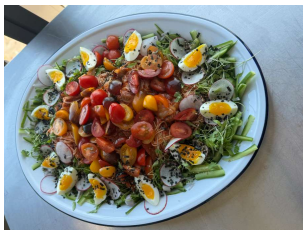
Ingredients
For the sauce
3 tablespoons tomato paste
2 tablespoons gochujang
1 teaspoon kosher salt
1 1/2 tablespoons sesame oil
3 tablespoons apple cider vinegar
3 tablespoons kimchi juice
1 tablespoon honey
1 cup chopped kimchi
For the noodles
150 grams somen noodles
For the toppings
2 Persian cucumbers, sliced into matchsticks
1 shallot, minced
2 cups cherry tomatoes, halved
2 soft-boiled eggs (7 minutes, jammy yolks)
4 radishes, thinly sliced
To finish
Extra sesame oil, for drizzling
2 tablespoons furikake
Handful of cilantro
Directions
•Step 1
Make the sauce: In a medium bowl, whisk together the
tomato paste, gochujang, salt, sesame oil, vinegar,
kimchi juice, and honey until smooth. Stir in the chopped
kimchi until evenly coated.
•Step 2
Cook the noodles: Bring a pot of water to a rolling boil.
Add the somen noodles and cook for 3 to 4 minutes, until
just tender. Drain and rinse under cold water until
completely cooled, then shake off excess water.
•Step 3
Toss together: Add the chilled noodles to the sauce bowl.
Using tongs, gently mix until each strand is coated in the
kimchi-gochujang sauce.
•Step 4
Assemble: Divide the noodles between bowls. Top with
cucumbers, shallot, tomatoes, soft-boiled eggs, and
radishes.
•Step 5
Finish & serve: Drizzle with a little extra sesame oil,
sprinkle with furikake, and top with cilantro. Mix
everything together at the table before eating.
https://food52.com/recipes/cold-kimchi-tomato-bibim-noodles
Consider the following translation challenge:
A professional translator working on a Brazilian Portuguese edition of an international cookbook encounters the recipe title "Cold Kimchi Tomato Bibim Noodles" and several culture-specific ingredients including "gochujang," "furikake," "Persian cucumbers," and "somen noodles." The translator must decide between foreignization (maintaining source-language terms to preserve cultural authenticity) and domestication (adapting to target-culture equivalents for familiarity). Regarding translation theory, particularly Lawrence Venuti's concepts of foreignization versus domestication and Eugene Nida's formal versus dynamic equivalence, which approach demonstrates the most theoretically informed and contextually appropriate translation strategy?
A professional translator working on a Brazilian Portuguese edition of an international cookbook encounters the recipe title "Cold Kimchi Tomato Bibim Noodles" and several culture-specific ingredients including "gochujang," "furikake," "Persian cucumbers," and "somen noodles." The translator must decide between foreignization (maintaining source-language terms to preserve cultural authenticity) and domestication (adapting to target-culture equivalents for familiarity). Regarding translation theory, particularly Lawrence Venuti's concepts of foreignization versus domestication and Eugene Nida's formal versus dynamic equivalence, which approach demonstrates the most theoretically informed and contextually appropriate translation strategy?
 Conheça nossos planos