Questões de Concurso
Sobre ensino da língua estrangeira inglesa em inglês
Foram encontradas 2.182 questões


Ano: 2025
Banca:
EDUCA
Órgão:
Prefeitura de São João do Rio do Peixe - PB
Prova:
EDUCA - 2025 - Prefeitura de São João do Rio do Peixe - PB - Professor de Educação Básica II - Língua Inglesa |
Q3482497
Inglês
Texto associado
TEXT 1
NATIVE-SPEAKERISM
Framing the Issue
Native-speakerism is an ideology that upholdsthe idea that
so-called “native speakers” are the best models and
teachers of English because they represent a “Western
culture” from which spring the ideals both of English and
of the methodology for teaching it (Holliday, 2005, p. 6).
As an ideology, it is a system of ideas that represents a
distorted worldview that supports a particular vested
interest. The vested interest in the case of nativespeakerism is the promotion by the ELT industry of the
so-called “native speaker” brand. The realization that this
is an ideologically constructed brand derives from
Phillipson’s (1992) linguistic imperialism thesis that the
concept of the “native speaker” as a superior model and
teacher was explicitly constructed by American and British aid agencies in the 1960s to support their agenda of
spreading English as a global product.
Further indication that the “native speaker” brand is an
ideological construction is that the native-non-native
speaker distinction is not self-evident on technical
linguistic or even nationality grounds. It is instead a
professionally popularized distinction that has been falsely
associated with cultural orientation (Kubota & Lin, 2006).
Teachers who are labeled “native speakers” have been
falsely idealized as organized and autonomous in fitting
with the common yet mistaken description of so-called
“individualist cultures” of the West; while teachers who
are labeled “non-native speakers” are demonized as
deficient in these attributes in fitting with the common yet
mistaken description of so-called “collectivist cultures” of
the non-West (Holliday, 2005, p. 19, citing Kubota,
Kumaravadivelu, Nayar, and Pennycook). The collectivist
stereotype is itself considered to be a Western construction
of non-Western cultural deficiency. An example of this is
a British teacher’s reference to a superior “native speaker”
“birthright” at the same time as criticizing, albeit without
foundation, not only the linguistic and pedagogic
performance, but also the cultural background and
proficiency of his “non-native speaker” colleagues
(Holliday & Aboshiha, 2009, p. 667).
The Othering of teachers who are labeled “non-native
speakers” therefore results in a cultural disbelief—not
believing in their ability to teach English within a Western,
and indeed superficially constructed “learning group
ideal” that is characterized by “active” oral expression,
initiation, self-direction, and students working in groups
and pairs (Holliday, 2005, p. 44). The association of the
“non-native speaker” label with deficiency is also deeply
rooted within a wider and equally mistaken Western
perception that people from non-Western cultural
backgrounds are unable to be critical and self-determined.
Excerpt extracted and adapted from:
https://adrianholliday.com/wp-content/uploads/2017/02/nativespeakerism-proofs.pdf
According to text 1, what is native-speakerism mainly
based on?
Ano: 2025
Banca:
VUNESP
Órgão:
Prefeitura de Itatiba - SP
Prova:
VUNESP - 2025 - Prefeitura de Itatiba - SP - Professor de Ensino Básico II - Inglês (Substituto) |
Q3464005
Inglês
Read the cartoon.
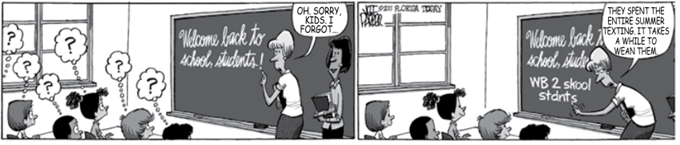
(https://larrycuban.wordpress.com)
The cartoon may be used in an English class for teenage learners in Brazil to discuss the
(https://larrycuban.wordpress.com)
The cartoon may be used in an English class for teenage learners in Brazil to discuss the
Ano: 2025
Banca:
VUNESP
Órgão:
Prefeitura de Itatiba - SP
Prova:
VUNESP - 2025 - Prefeitura de Itatiba - SP - Professor de Ensino Básico II - Inglês (Substituto) |
Q3464003
Inglês
Texto associado

Leia a entrevista a seguir para responder à questão.
Can childhood survive the smartphone?
Below is an excerpt from a conversation between the
reporter Katty Kay and Jonathan Haidt who, with his book The
Anxious Generation, sparked a global reckoning about mobile
phone usage among children when it came out last year.
Katty Kay: It’s been a year since your book came out
and caused a huge conversation. I wanted to start by getting
a kind of report card of where we are on the various aspects
of what you put forward: phones in school, age gating, social
media, getting kids to have more free playtime. Who’s doing
well and who isn’t in America on all of those issues?
Jonathan Haidt: I knew that the book was going to be
popular. What I wasn’t prepared for is that this issue would
spread like wildfire around the world, not just in the US.
Because around the world, family life has turned into a fight
over screen time. Everyone hates it. Everyone sees it.
Where it took off most quickly was phone-free schools,
because that is something that is more easily done. It’s so
hard to teach to a classroom when half of them are watching
short videos and playing video games. So, the teachers have
hated the phones from the beginning but they were afraid,
especially in America – maybe it’s the same in other countries
– but in America, there are a lot of parents who want to be able
to communicate all the time with their child, and they think they
have a right to check in on their child. And, ‘What if something
goes wrong? I need to be there.’ So, the overparenting — ...
KK: That’s a paradox, then, because you’ve got the
parents who are super worried about the phones; they see
what phones are doing to their kids. But they also don’t want
their kids to relinquish their phones when they go into school.
JH: Hey, look, people are complicated! They contain
multitudes. And I shouldn’t say that everyone saw the problem,
because there were a lot of parents who saw the phone as a
lifeline. They see the world as very threatening and dangerous.
But we have to focus on what it will take to allow kids to have
healthy brain development through puberty. We’ve got to give
kids a lot less screen time. A lot less fragmenting time. No
TikTok. No short videos. Let’s give them a lot more experience
interacting with people.
(Katty Kay. www.bbc.com, 10.04.2025. Adaptado)
Pela relevância do tema abordado, determinado professor decide usar a entrevista, ou trechos dela, em uma
aula de Língua Inglesa para alunos mais avançados.
Ciente da importância de se considerar o contexto de
produção para a compreensão mais plena de um texto,
em sua aula o professor decide
Ano: 2025
Banca:
VUNESP
Órgão:
Prefeitura de Itatiba - SP
Prova:
VUNESP - 2025 - Prefeitura de Itatiba - SP - Professor de Ensino Básico II - Inglês (Substituto) |
Q3463995
Inglês
Read the text and the dialogue which follows it.
“No mundo real, raramente as perguntas se referem a um único tipo de conteúdo. Para preparar os alunos para isso, tente avançar a partir de uma resposta certa, pedindo que integrem a ela conhecimentos aprendidos anteriormente.”
(Doug Lemov. Aula Nota 10 3.0, 2022. Adaptado)
Teacher: Who would like to use the verb “cook” in a sentence?”
Student: I like to cook. Teacher: Good! Who would add an indirect object to the sentence?
Student: I like to cook to my family.
Teacher: Could you use a compound indirect object?
Student: I like to cook to my family and friends.
Teacher: When do you cook to them? Add a time adverb to your sentence.
Student: I like to cook to my family and friends on weekends.
The interventions by the teacher recover the students’ knowledge about
“No mundo real, raramente as perguntas se referem a um único tipo de conteúdo. Para preparar os alunos para isso, tente avançar a partir de uma resposta certa, pedindo que integrem a ela conhecimentos aprendidos anteriormente.”
(Doug Lemov. Aula Nota 10 3.0, 2022. Adaptado)
Teacher: Who would like to use the verb “cook” in a sentence?”
Student: I like to cook. Teacher: Good! Who would add an indirect object to the sentence?
Student: I like to cook to my family.
Teacher: Could you use a compound indirect object?
Student: I like to cook to my family and friends.
Teacher: When do you cook to them? Add a time adverb to your sentence.
Student: I like to cook to my family and friends on weekends.
The interventions by the teacher recover the students’ knowledge about
Ano: 2025
Banca:
VUNESP
Órgão:
Prefeitura de Itatiba - SP
Prova:
VUNESP - 2025 - Prefeitura de Itatiba - SP - Professor de Ensino Básico II - Inglês (Titular) |
Q3456350
Inglês
Texto associado
Leia o texto para responder à questão.
Consider these anecdotes:
1. An ESL teacher instructs a group of 7 children every day
for 45 minutes. They sing “I’m a Little Teapot” over and over
again. Standing, they make gestures to show the tea pouring
out. “I’m a little teapot, short and stout, here is my handle,
here is my spout. When I get it all steamed up, hear me shout,
just tip me over and pour me out”. And then the group starts
again…
2. In visiting a class of a successful ESL teacher, you are
struck that each activity lasts no more than ten minutes, that
children are usually in movement - making something, holding
something, moving their hands and walking somewhere.
There are few major contrasts that we can make between
child and adult ESL learners. Children are more likely to play
with language than adults are. In general, children are more
holistic learners who need to use language for authentic
communication in ESL classes.
In a children’s class, activities need to be child centered
and communication should be authentic. Several themes
repeatedly come up:
• Focus on meaning, not correctness.
• Focus on the value of the activity, not the value of language.
• Focus on collaboration and social development.
• Provide a rich context, including movement, the senses,
objects and pictures, and a variety of activities.
• Teach ESL holistically, integrating the four skills.
• Treat learners appropriately in the light of their age and
interests.
• Treat language as a tool for children to use for their own
social and academic ends.
(S. Peck. Developing Children´s Listening and Speaking. IN: Marianne
Cerce-Murcia(ed). Teaching English as a second or foreign language.
Boston, Massachusstes: Heinle&Heinle. 2nd edition. 2001. Adaptado)
Items 1 and 2 in the excerpt represent
Ano: 2025
Banca:
VUNESP
Órgão:
Prefeitura de Itatiba - SP
Prova:
VUNESP - 2025 - Prefeitura de Itatiba - SP - Professor de Ensino Básico II - Inglês (Titular) |
Q3456347
Inglês
Texto associado
Leia o texto para responder à questão.
One of the major foci of applied linguistics scholarship
has been the foreign or second language classroom. A glance
through the past century or so of language teaching gives us
an interesting picture of varied interpretations of the best way
to teach a foreign language. As schools of thought have come
and gone, so have language teaching trends waxed and
waned in popularity.
Albert Marckwardt (1972) saw these “changing winds and
shifting sands” as a cyclical pattern where a new paradigm
of teaching methodology emerged about every quarter of a
century, with each new method breaking from the old but at
the same time taking with it some of the positive aspects of the
previous paradigm. One of the best examples of the cyclical
nature of methods is seen in the revolutionary Audiolingual
Method (ALM) of the late 1940s and 1950s. The ALM borrowed
principles and beliefs from its predecessor by almost half
a century, the Direct Method, while breaking away entirely
from the Grammar-Translation paradigm. Within a short time,
however, ALM critics were advocating more attention to rules
of language which, to some, smacked a return to Grammar
Translation.
(BROWN, H.Douglas. Principles of language learning and teaching.
5th ed. Longman, 2000. Adaptado)
É proposta de sala de aula condizente com o ensino
comunicativo de línguas:
Ano: 2025
Banca:
VUNESP
Órgão:
Prefeitura de Itatiba - SP
Prova:
VUNESP - 2025 - Prefeitura de Itatiba - SP - Professor de Ensino Básico II - Inglês (Titular) |
Q3456344
Inglês
Texto associado
Leia o texto para responder à questão.
One of the major foci of applied linguistics scholarship
has been the foreign or second language classroom. A glance
through the past century or so of language teaching gives us
an interesting picture of varied interpretations of the best way
to teach a foreign language. As schools of thought have come
and gone, so have language teaching trends waxed and
waned in popularity.
Albert Marckwardt (1972) saw these “changing winds and
shifting sands” as a cyclical pattern where a new paradigm
of teaching methodology emerged about every quarter of a
century, with each new method breaking from the old but at
the same time taking with it some of the positive aspects of the
previous paradigm. One of the best examples of the cyclical
nature of methods is seen in the revolutionary Audiolingual
Method (ALM) of the late 1940s and 1950s. The ALM borrowed
principles and beliefs from its predecessor by almost half
a century, the Direct Method, while breaking away entirely
from the Grammar-Translation paradigm. Within a short time,
however, ALM critics were advocating more attention to rules
of language which, to some, smacked a return to Grammar
Translation.
(BROWN, H.Douglas. Principles of language learning and teaching.
5th ed. Longman, 2000. Adaptado)
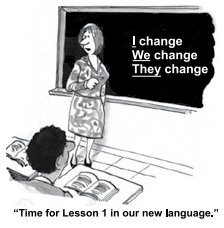
Read the statement from the first paragraph “A glance
through the past century or so of language teaching gives
us an interesting picture of varied interpretations of the
best way to teach a foreign language”. The cartoon below
represents the best way to teach a language according to
Ano: 2025
Banca:
FGV
Órgão:
SEDUC-MT
Prova:
FGV - 2025 - SEDUC-MT - Professor de Educação Básica - Habilitação: Inglês |
Q3439621
Inglês
Texto associado
Leia o texto e responda à próxima questão.
Powerful storm knocks out power to 1.4 million homes in
Brazil’s largest city
SAO PAULO (AP) — Around 1.4 million households in Sao
Paulo, Brazil, were without power on Saturday almost 24 hours
after a brief but powerful storm swept through South America’s
largest metropolis. At least seven people were killed.
Officials in Sao Paulo state said that record winds of up to 67
mph (108 kph) knocked down transmission lines and destroyed
trees, causing severe damage in some parts. The storm also shut
down several airports and interrupted water service in several
areas, according to the state government.
Authorities originally expected to restore power within a few
hours. But several neighborhoods in the metropolitan area, which
is home to 21 million people, were still in the dark on Saturday,
and authorities were urging residents to limit their consumption
of water.
https://apnews.com. Adaptado. Acesso em 24.04.2025
Even before they start reading the text “Powerful storm knocks
out power to 1.4 million homes in Brazil’s largest city”, some
students say they will not be able to understand it. And
immediately mention the words “knock”, “households” and
“swept”, in the headline and the first paragraph.
The literature about teaching reading in a second language mentions a variety of methods and approaches to deal with unknown vocabulary. Materials and teachers may instruct learners to
I. make use of the dictionary: they will not understand the text properly if they do not know all the words in it.
II. look for the pronunciation of the unknown words: the association between sound and spelling always helps comprehension.
III. ignore vocabulary difficulties and focus on grammar: meaning does not derive from words in isolation but from sentence structures.
IV. Pay attention to context and appeal to background knowledge on the subject: making inferences is key to learning a new language.
V. Concentrate on text meaning rather than word meaning: words may be ignored if not essential to the comprehension of the text’s main points.
A teacher interested in developing their students’ use of reading strategies will, in a reading class with the text “Powerful storm knocks out power to 1.4 million homes in Brazil’s largest city”, focus on the instructions given in items
The literature about teaching reading in a second language mentions a variety of methods and approaches to deal with unknown vocabulary. Materials and teachers may instruct learners to
I. make use of the dictionary: they will not understand the text properly if they do not know all the words in it.
II. look for the pronunciation of the unknown words: the association between sound and spelling always helps comprehension.
III. ignore vocabulary difficulties and focus on grammar: meaning does not derive from words in isolation but from sentence structures.
IV. Pay attention to context and appeal to background knowledge on the subject: making inferences is key to learning a new language.
V. Concentrate on text meaning rather than word meaning: words may be ignored if not essential to the comprehension of the text’s main points.
A teacher interested in developing their students’ use of reading strategies will, in a reading class with the text “Powerful storm knocks out power to 1.4 million homes in Brazil’s largest city”, focus on the instructions given in items
Ano: 2025
Banca:
FGV
Órgão:
SEDUC-MT
Prova:
FGV - 2025 - SEDUC-MT - Professor de Educação Básica - Habilitação: Inglês |
Q3439620
Inglês
Texto associado
Leia o texto e responda à próxima questão.
Powerful storm knocks out power to 1.4 million homes in
Brazil’s largest city
SAO PAULO (AP) — Around 1.4 million households in Sao
Paulo, Brazil, were without power on Saturday almost 24 hours
after a brief but powerful storm swept through South America’s
largest metropolis. At least seven people were killed.
Officials in Sao Paulo state said that record winds of up to 67
mph (108 kph) knocked down transmission lines and destroyed
trees, causing severe damage in some parts. The storm also shut
down several airports and interrupted water service in several
areas, according to the state government.
Authorities originally expected to restore power within a few
hours. But several neighborhoods in the metropolitan area, which
is home to 21 million people, were still in the dark on Saturday,
and authorities were urging residents to limit their consumption
of water.
https://apnews.com. Adaptado. Acesso em 24.04.2025
While preparing reading comprehension exercises on the text,
the teacher notes the absolute predominance of verbs in the
simple past. However, this is not a language class, but a reading
one, and the teacher wouldn’t like to deal with the topic “verbs”
in isolation, as followers of structuralism would do. This way, in
trying to articulate reading comprehension and linguistic
knowledge, in a class on the text “Powerful storm knocks out
power to 1.4 million homes in Brazil’s largest city”, the teacher
Ano: 2025
Banca:
FGV
Órgão:
SEDUC-MT
Prova:
FGV - 2025 - SEDUC-MT - Professor de Educação Básica - Habilitação: Inglês |
Q3439617
Inglês
Em uma sala de nono ano com 40 estudantes, o professor está
revisando as preposições de tempo in, on, at, um dos temas da
prova bimestral. Coloca na lousa cinco frases com lacunas, que
devem ser preenchidas com a preposição adequada. Veja a seguir
um quadro com as frases dadas pelo professor, e o número de
estudantes que escolheu cada opção de resposta:
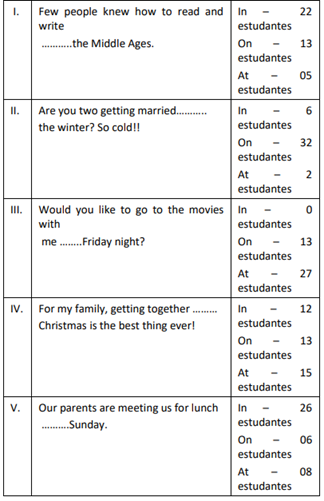
Das intervenções a seguir, que procuram apontar os desvios na execução da tarefa, está correta aquela em que o professor esclarece
Das intervenções a seguir, que procuram apontar os desvios na execução da tarefa, está correta aquela em que o professor esclarece
Ano: 2025
Banca:
FGV
Órgão:
SEDUC-MT
Prova:
FGV - 2025 - SEDUC-MT - Professor de Educação Básica - Habilitação: Inglês |
Q3439616
Inglês
Leia o texto.
Usage and use
The distinction between language use and language usage was first made by Widdowson. He coined the term usage for language which conformed to pre-established paradigms of language. Usage is independent of context, and is related to language correctness.
In contrast, use has to do with the speaker’s intention in producing a particular sentence. For example, the sentence “I don’t know what you mean”, said in a particular context, may imply a request for clarification; the same sentence, said in a different way and in a different context, may be an expression of disbelief.
Most sentences in textbooks and in grammar practices are well-formed sentences. However, can you think of a real-life situation in which a sentence such as “This is my hand” is pronounced?
LEWIS, Michael. The lexical approach. Heinle Cengage, 2010. Adaptado.
Em muitos contextos da escola brasileira permanece forte a herança da tradição estruturalista, focada em usage. Pense em um professor brasileiro formado dentro de tal tradição que, percebendo seus limites para desenvolver a capacidade de o estudante interagir no mundo por meio da língua inglesa, começa a preparar suas aulas sob a ótica de uma abordagem centrada em use. Esse professor, ao final de uma atividade em classe, perguntar-se-ia em primeiro lugar se, em sua aula,
Usage and use
The distinction between language use and language usage was first made by Widdowson. He coined the term usage for language which conformed to pre-established paradigms of language. Usage is independent of context, and is related to language correctness.
In contrast, use has to do with the speaker’s intention in producing a particular sentence. For example, the sentence “I don’t know what you mean”, said in a particular context, may imply a request for clarification; the same sentence, said in a different way and in a different context, may be an expression of disbelief.
Most sentences in textbooks and in grammar practices are well-formed sentences. However, can you think of a real-life situation in which a sentence such as “This is my hand” is pronounced?
LEWIS, Michael. The lexical approach. Heinle Cengage, 2010. Adaptado.
Em muitos contextos da escola brasileira permanece forte a herança da tradição estruturalista, focada em usage. Pense em um professor brasileiro formado dentro de tal tradição que, percebendo seus limites para desenvolver a capacidade de o estudante interagir no mundo por meio da língua inglesa, começa a preparar suas aulas sob a ótica de uma abordagem centrada em use. Esse professor, ao final de uma atividade em classe, perguntar-se-ia em primeiro lugar se, em sua aula,
Ano: 2025
Banca:
FGV
Órgão:
SEDUC-MT
Prova:
FGV - 2025 - SEDUC-MT - Professor de Educação Básica - Habilitação: Inglês |
Q3439612
Inglês
In order to decide on the objectives for the unit on the blog
“Science News for Students”, the teacher resorts to the following
chart on learning strategies.
Learning Strategies
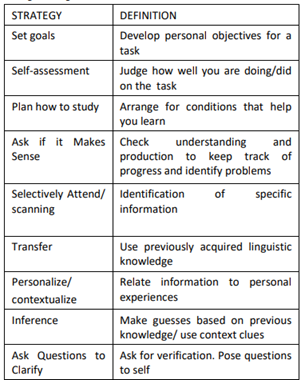
CHAMOT, Anna et al. The learning strategies handbook: creating independent learners. New York: Longman, 1999. Adaptado.
Apart from teaching reading in English, the teacher is also highly concerned with developing their students’ autonomy as learners. Considering that the option for the blog Science News for Students resulted from negotiation between the group and not necessarily from individual interests, the teacher will help promote their students’ autonomy if, for the work with the blog, proposes that they
Learning Strategies
CHAMOT, Anna et al. The learning strategies handbook: creating independent learners. New York: Longman, 1999. Adaptado.
Apart from teaching reading in English, the teacher is also highly concerned with developing their students’ autonomy as learners. Considering that the option for the blog Science News for Students resulted from negotiation between the group and not necessarily from individual interests, the teacher will help promote their students’ autonomy if, for the work with the blog, proposes that they
Ano: 2025
Banca:
FGV
Órgão:
SEDUC-MT
Prova:
FGV - 2025 - SEDUC-MT - Professor de Educação Básica - Habilitação: Inglês |
Q3439609
Inglês
Texto associado
Leia o seguinte texto que corresponde a uma adaptação de um
excerto da Base Nacional Comum Curricular, Brasil, e responda
à próxima questão.
Na perspectiva do ensino de Inglês como Língua Franca, são
acolhidos e legitimados os usos que dela fazem falantes
espalhados no mundo inteiro, com diferentes repertórios
linguísticos e culturais, o que possibilita, por exemplo, questionar
a visão de que o único inglês “correto” – e a ser ensinado – é
aquele falado por estadunidenses ou britânicos. Mais ainda, o
tratamento do inglês como língua franca o desvincula da noção
de pertencimento a um determinado território e,
consequentemente, a culturas típicas de comunidades
específicas, legitimando os usos da língua inglesa em seus
contextos locais. Esse entendimento favorece uma educação
linguística voltada para a interculturalidade, isto é, para o
reconhecimento das (e o respeito às) diferenças, e para a
compreensão de como elas são produzidas nas diversas práticas
sociais de linguagem, o que favorece a reflexão crítica sobre
diferentes modos de ver e de analisar o mundo, o(s) outro(s) e a
si mesmo.
In a certain school in the state of Mato Grosso, the English coordinator determines all English teachers should prepare lessons and activities that incorporate the theme “interculturality”.
Only one of the teachers seems to have adequately understood what the term means, and what BNCC says about ways in which it could be dealt with in the classroom. Mark the alternative describing the proposal by this particular teacher.
Ano: 2025
Banca:
VUNESP
Órgão:
SEDUC-SP
Prova:
VUNESP - 2025 - SEDUC-SP - Professor de Educação Básica II - Inglês - Promoção do QM 2022 |
Q3430828
Inglês
Texto associado
Read the text to answer question:
On January 13, 2025, a bill was signed into law to
regulate students’ use of personal portable electronic devices,
including cell phones, in public and private schools in Brazil.
(Law No. 15,100.) It came into force upon its publication in
the January 14 edition of Brazil’s official gazette.
The law, which applies in elementary, middle, and high
schools, prohibits the use of portable electronic devices by
students during classes, recess, and breaks. It provides that
teachers may allow use of such devices for pedagogical
purposes. The law allows their use in cases of danger or
emergency. It also permits their use for purposes of ensuring
accessibility and inclusion, addressing health conditions, and
ensuring fundamental rights. (Arts. 2, 3.)
The stated purpose of the law is to safeguard the
mental, physical, and psychological health of children and
adolescents. (Art. 1.) It requires schools to develop strategies
to address students’ mental health, including preventing
excessive use of devices and inappropriate content. They
must also offer training for personnel to detect signs of
psychological distress and create spaces to support those
suffering mental distress from the excessive use of electronic
devices. (Art. 4.)
(Eduardo Soares. Brazil: New Law Prohibits Cell Phone
Use in Schools, 2025. Disponível em: https://www.loc.gov/item/globallegal-monitor/2025-02-13/brazil-new-law-prohibits-cell-phone-usein-schools/. Adaptado)
Com relação a Competências Específicas de Língua
Inglesa para o Ensino Fundamental, a Lei no 15.100
reforça o seguinte trecho
Ano: 2025
Banca:
VUNESP
Órgão:
SEDUC-SP
Prova:
VUNESP - 2025 - SEDUC-SP - Professor de Educação Básica II - Inglês - Promoção do QM 2022 |
Q3430826
Inglês
Texto associado
Read the text and answer question:
A language ecosystem describes a holistic environment
that encourages and extends the learning and application of
language beyond the classroom. While an ecosystem is a
simple concept, there are a few things to keep in mind. Here
are quick tips to get you started.
Tip #1. Go on language missions (gather and utilize
resources).
The concept of exploring is at the center of attention here
for good reason. Your mission (should you choose to accept
it) is to find and gather resources that are potential candidates
for your language ecosystem. It is not unlike going shopping
for furniture, in that you want to find items that will match your
personal preference and lifestyle in a natural way. As you
search for items to “add” to your ecosystem, you will want to
consider how well they function in your life or home.
You might be wondering how one begins a search to
find resources. I primarily use search engines, social media,
streaming video, and music to look for resources that might
work. I am not the only one, however, who has learned to
keep an eye out for resources. Since inviting many of my own
friends to learn a language with me, many people now send
me links to things I might like.
Tip #2: Join a language-learning network
Speaking of people, one of the most essential strategies
in forming a language ecosystem is finding the right people
to join you on your journey. I call this “forming a language
learning network.” While fluent speakers are an excellent
resource, I also find that fellow language learners, people
who are learning the language just like me, are more patient
conversation partners. Finally, I often find that people who
share my same interests (say, French cooking, for example),
can be excellent companions for listening and speaking
practice.
(Shane Dixon. The Language Learner Guidebook: Powerful Tools to Help
You Conquer Any Language. Edição do Kindle. Adaptado)
Uma atividade comunicativa usando a proposta de
Dixon é:
Ano: 2025
Banca:
VUNESP
Órgão:
SEDUC-SP
Prova:
VUNESP - 2025 - SEDUC-SP - Professor de Educação Básica II - Inglês - Promoção do QM 2022 |
Q3430820
Inglês
Texto associado
Read the text and answer question:
A language ecosystem describes a holistic environment
that encourages and extends the learning and application of
language beyond the classroom. While an ecosystem is a
simple concept, there are a few things to keep in mind. Here
are quick tips to get you started.
Tip #1. Go on language missions (gather and utilize
resources).
The concept of exploring is at the center of attention here
for good reason. Your mission (should you choose to accept
it) is to find and gather resources that are potential candidates
for your language ecosystem. It is not unlike going shopping
for furniture, in that you want to find items that will match your
personal preference and lifestyle in a natural way. As you
search for items to “add” to your ecosystem, you will want to
consider how well they function in your life or home.
You might be wondering how one begins a search to
find resources. I primarily use search engines, social media,
streaming video, and music to look for resources that might
work. I am not the only one, however, who has learned to
keep an eye out for resources. Since inviting many of my own
friends to learn a language with me, many people now send
me links to things I might like.
Tip #2: Join a language-learning network
Speaking of people, one of the most essential strategies
in forming a language ecosystem is finding the right people
to join you on your journey. I call this “forming a language
learning network.” While fluent speakers are an excellent
resource, I also find that fellow language learners, people
who are learning the language just like me, are more patient
conversation partners. Finally, I often find that people who
share my same interests (say, French cooking, for example),
can be excellent companions for listening and speaking
practice.
(Shane Dixon. The Language Learner Guidebook: Powerful Tools to Help
You Conquer Any Language. Edição do Kindle. Adaptado)
A proposta de construção de um ecossistema tem como
objetivo
Ano: 2025
Banca:
VUNESP
Órgão:
SEDUC-SP
Prova:
VUNESP - 2025 - SEDUC-SP - Professor de Educação Básica II - Inglês - Promoção do QM 2022 |
Q3430813
Inglês
Texto associado
Read the text to answer question:
It is suggested that the field of language teaching has moved away from a reliance on prescriptive methods towards a
more nuanced understanding of the complexities of language learning. For example, Richards and Rodgers (1986) note
that there have been calls to abandon the search for a single
“supermethod” and to instead focus on equipping teachers
with “a repertoire of methods and skills that can be used selectively in different contexts”. This reflects a move away from
the idea that there is one “right” way to teach language, and
towards an approach that values flexibility, adaptability, and a
recognition of the diverse contexts in which language learning
takes place (Richards, 2001).
Realistically speaking, each method has its own advantages and disadvantages; up till now, no method has been
empirically proven the best for all language educators to blindly adopt without discussion. For example, the current great
enthusiasm for (and wide adoption of) the Communicative
Language Teaching (CLT) method in Egypt can be attributed to the failure of the previously adopted method (i.e. the
Grammar-Translation Method) to meet the national language
learning goals. It failed to develop a language learner who can
communicate properly in English. This does not mean that the
CLT will stay forever, especially in this Information and Communication Technology-dominated age (ICT) that has been
changing the nature of language and how it should be taught
(Abdallah, 2011).
(M. Abdallah, 2024. Disponível em:
https://files.eric.ed.gov/fulltext/ED660475.pdf.
Adaptado)
Entre as pistas gráficas presentes no texto, está o uso
de aspas nas palavras “supermethod” e “right”. Considerando-se a discussão presente no texto, é correto afirmar
que o uso de aspas tem por objetivo
Ano: 2025
Banca:
VUNESP
Órgão:
SEDUC-SP
Prova:
VUNESP - 2025 - SEDUC-SP - Professor de Educação Básica II - Inglês - Promoção do QM 2022 |
Q3430812
Inglês
Texto associado
Read the text to answer question:
It is suggested that the field of language teaching has moved away from a reliance on prescriptive methods towards a
more nuanced understanding of the complexities of language learning. For example, Richards and Rodgers (1986) note
that there have been calls to abandon the search for a single
“supermethod” and to instead focus on equipping teachers
with “a repertoire of methods and skills that can be used selectively in different contexts”. This reflects a move away from
the idea that there is one “right” way to teach language, and
towards an approach that values flexibility, adaptability, and a
recognition of the diverse contexts in which language learning
takes place (Richards, 2001).
Realistically speaking, each method has its own advantages and disadvantages; up till now, no method has been
empirically proven the best for all language educators to blindly adopt without discussion. For example, the current great
enthusiasm for (and wide adoption of) the Communicative
Language Teaching (CLT) method in Egypt can be attributed to the failure of the previously adopted method (i.e. the
Grammar-Translation Method) to meet the national language
learning goals. It failed to develop a language learner who can
communicate properly in English. This does not mean that the
CLT will stay forever, especially in this Information and Communication Technology-dominated age (ICT) that has been
changing the nature of language and how it should be taught
(Abdallah, 2011).
(M. Abdallah, 2024. Disponível em:
https://files.eric.ed.gov/fulltext/ED660475.pdf.
Adaptado)
A teacher is going to use this text with the students, and
intends to practice with them the reading strategy called
inference. In order to do this, they will ask their students to
Ano: 2025
Banca:
VUNESP
Órgão:
SEDUC-SP
Prova:
VUNESP - 2025 - SEDUC-SP - Professor de Educação Básica II - Inglês - Promoção do QM 2022 |
Q3430809
Inglês
Texto associado
Read the text to answer question:
CLIL (Content and Language Integrated Learning) is
an approach which is neither language learning nor subject
learning, but an amalgam of both and is linked to the
processes of convergence – the fusion of elements which
may have been previously fragmented, such as subjects in
the curriculum. This is where CLIL is groundbreaking.
To give a parallel example common in recent times, we
can take studies on the environment. A seminal publication
on the subject in the 1960s later led to a need to educate
young people in schools so as to both inform and, perhaps
more crucially, influence behavior. Topics relating to the
environment could already be found in chemistry, economics,
geography, physics, and even psychology. Yet, as climate
change became increasingly worrying, education responded
with the introduction of a new subject: “Environmental studies”.
In order to structure this new subject, teachers of different
disciplines would have needed to climb out of their respective
mindsets grounded in physics, chemistry, geography,
psychology and so on, to explore ways of building an integrated
curriculum, and to develop alternative methodologies by
which to implement it. Climate change is a global and local
phenomenon, so the increasing availability in some countries
of information and communication technologies during
the 1990s provided tools by which to make some of these
methodologies operational.
If we return to languages and CLIL, we have a similar
situation. The late 1990s meant that educational insight was
firmly set on achieving a high degree of language awareness.
Appropriate methodologies were to be used to attain the
best possible results in a way which accommodated diverse
learning styles.
(D. Coyle, P. Hood, D. Marsh. CLIL: content language integrated learning.
Cambridge: Cambridge University, 2010.)
According to the text, CLIL presupposes
Ano: 2025
Banca:
VUNESP
Órgão:
SEDUC-SP
Prova:
VUNESP - 2025 - SEDUC-SP - Professor de Educação Básica II - Inglês - Promoção do QM 2022 |
Q3430802
Inglês
Texto associado
Read the text to answer question:
Language learning styles and strategies are among the
main factors that help determine how – and how well – our
students learn a second or foreign language. The term L2
is used in this text to refer to either a second or a foreign
language, following the tradition in our field.
Learning styles are the general approaches – global or
analytic, auditory or visual – that students use in acquiring
a new language or in learning any other subject. These
styles are “the overall patterns that give general direction to
learning behavior” (Cornett 1983, p. 9). Of great relevance
is this statement: “Learning style is the biologically and
developmentally imposed set of characteristics that make the
same teaching method wonderful for some and terrible for
others” (Dunn and Griggs 1988, p. 3).
Learning strategies are defined as “specific actions,
behaviors, steps, or techniques – such as seeking out
conversation partners, or giving oneself encouragement
to tackle a difficult language task – used by students to
enhance their own learning” (Scarcella and Oxford 1992, p.
63). When the learner consciously chooses strategies that
fit his or her learning style and the L2 task at hand, these
strategies become a useful tool-kit for active, conscious, and
purposeful self-regulation of learning. Learning strategies can
be classified into six types: cognitive, metacognitive, memoryrelated, compensatory, affective, and social.
(M. Celce-Murcia, 2001. Adaptado)
Enquanto estratégias auxiliam a aquisição da língua
estrangeira, outros fatores interferem na aprendizagem.
Um desses fatores é a “transferência negativa” – a
aplicação inadequada de elementos da língua materna
na produção da língua sendo aprendida.
Assinale a alternativa em que pode ser observada transferência negativa na construção da frase.
Assinale a alternativa em que pode ser observada transferência negativa na construção da frase.

 Conheça nossos planos