Questões de Concurso
Sobre ensino da língua estrangeira inglesa em inglês
Foram encontradas 2.181 questões


Choose the correct form:
Mount Everest is the ___ mountain in the world.

Available at: https://www.gocomics.com/pickles/2025/09/23
In online communication, the abbreviation "BTW" is commonly used. What does it stand for?
Read the sentence:
“Our new apartment is not as noisy as our old one.”
Which interpretation is correct?
Considering this shift, what policy change is most crucial for developing communicative competence within the framework of higher education internationalization?
“[…] Brazil faces many challenges to learn foreign languages, be them the language of their parents (heritage languages such as Guarani and other indigenous languages or immigrant languages such as Italian, German, Japanese and Pomeranian, to cite but a few), the language of their neighbors (Spanish), the international language (English) or even appropriations of English such as Brazilian English, whatever that may be. Jenkins proposes the view of English as a multilingual franca as referring to its use in multilingual contexts where most people share the same lingua franca, and in that sense, Finardi proposes that English has the status of an international language, rather than a multilingua franca in Brazil. In a country with more than 200 languages spoken by minorities, the development of multilingualism and the view of English as a multilingua franca in Brazil represent a huge challenge for educational policies and pockets […].”
Considering the theoretical role of ELF (English as a Lingua Franca) and the context described, which statement best describes the essential function that ELF must fulfill to mitigate the national risk of linguistic isolation and strategically facilitate global engagement?
"Far from a nuisance, Troy's waste is an archaeologist's treasure trove. Over nearly 2,000 years, Troy ended up with 15 meters of built-up debris. Archaeologists can see nine major building phases in it, each made up of hundreds of thin layers, which formed as people lived their everyday lives."
An English teacher preparing reading comprehension activities for intermediate Brazilian students analyzes this passage to identify vocabulary and conceptual challenges. Regarding lexical comprehension, idiomatic expressions, and the relationship between linguistic form and archaeological content, which pedagogical analysis is accurate?
An English teacher preparing a lesson on the text "Digital Archeology" for Brazilian high school students wants to design activities that develop critical reading skills, intercultural competence, and linguistic awareness while aligning with Base Nacional Comum Curricular (BNCC) competencies. The teacher plans to explore the text's themes of art, technology, posthumanism, and cultural mobility (artist's international trajectory). When selecting the most pedagogically sound approach that integrates language skills, cultural awareness, and critical thinking as emphasized by BNCC for English language teaching, the teacher should:
"Born in 1964 in Plovdiv, Filip Popov spent several years of his childhood in Germany, where he formed his ideas for unity between art, architecture, design and technology."
An English teacher designing a reading comprehension lesson for intermediate Brazilian students analyzes this biographical sentence to identify potential comprehension obstacles. Regarding vocabulary, syntax, and cultural references that may challenge Brazilian EFL learners, and considering effective scaffolding strategies aligned with communicative language teaching and BNCC principles, which analysis is pedagogically accurate?
Cold Kimchi Tomato Bibim Noodles
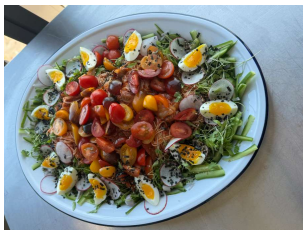
Ingredients
For the sauce
3 tablespoons tomato paste
2 tablespoons gochujang
1 teaspoon kosher salt
1 1/2 tablespoons sesame oil
3 tablespoons apple cider vinegar
3 tablespoons kimchi juice
1 tablespoon honey
1 cup chopped kimchi
For the noodles
150 grams somen noodles
For the toppings
2 Persian cucumbers, sliced into matchsticks
1 shallot, minced
2 cups cherry tomatoes, halved
2 soft-boiled eggs (7 minutes, jammy yolks)
4 radishes, thinly sliced
To finish
Extra sesame oil, for drizzling
2 tablespoons furikake
Handful of cilantro
Directions
•Step 1
An English teacher planning a lesson for Brazilian high school students using this recipe as authentic material wants to analyze the syntactic complexity and verb phrase structures to assess text difficulty level and design appropriate scaffolding activities. Examining sentences like "Bring a pot of water to a rolling boil," "Stir in the chopped kimchi until evenly coated," and "Using tongs, gently mix until each strand is coated," the teacher conducts a syntactic analysis focusing on verb phrase types, clause structures, and non-finite constructions. Regarding the syntactic features that impact text difficulty and pedagogical implications for supporting reading comprehension among intermediate EFL learners, which analysis is syntactically and pedagogically accurate?
De acordo com a BNCC, o ensino da Língua Inglesa no Ensino Fundamental busca desenvolver a competência comunicativa dos estudantes. Isso significa que o foco principal está em:
Segundo a BNCC, o ensino da Língua Inglesa no Ensino Fundamental deve contribuir para:

 Conheça nossos planos