Questões de Vestibular
Nível médio
Foram encontradas 71.618 questões
Resolva questões gratuitamente!
Junte-se a mais de 4 milhões de concurseiros!


Ano: 2024
Banca:
CESPE / CEBRASPE
Órgão:
UNB
Prova:
CESPE / CEBRASPE - 2024 - UNB - Prova de Conhecimentos I - Inglês - 1° dia |
Q3107428
Inglês
Texto associado
The term AI winter refers to a period of reduced funding
in the development of AI. In general, AI has followed a path on
which proponents overstate what is possible, inducing people
with no technology knowledge at all, but lots of money, to make
investments. A period of criticism then follows when AI fails to
meet expectations, and, finally, the reduction in funding occurs.
A number of these cycles have occurred over the years —
all of them devastating to true progress. AI is currently in a new
hype phase because of machine learning, a technology that helps
computers learn from data. Having a computer learn from data
means not depending on a human programmer to set operations
(tasks), but rather deriving them directly from examples that
show how the computer should behave. It’s like educating a baby
by showing it how to behave through example. Machine learning
has pitfalls because the computer can learn how to do things
incorrectly through careless teaching.
Scientists are working on machine learning algorithms,
each one from a different point of view. At this time, the most
successful solution is deep learning, which is a technology that
strives to imitate the human brain. Deep learning is possible
because of the availability of powerful computers, smarter
algorithms, large datasets produced by the digitalization of our
society, and huge investments from businesses such as Google,
Facebook, Amazon, and others that take advantage of this AI
renaissance for their own businesses.
People are saying that the AI winter is over because of
deep learning, and that’s true for now. However, when you look
around at the ways in which people are viewing AI, you can
easily figure out that another criticism phase will eventually
occur unless proponents tone the rhetoric down. AI can do
amazing things, but they’re a mundane sort of amazing.
John Paul Mueller and Luca Massaron. Artificial Intelligence For Dummies.
Hoboken (New Jersey): John Wiley & Sons, 2022
Judge the following items according to the previous text.
With the sentence “AI can do amazing things, but they’re a mundane sort of amazing”, the author indicates that he does not believe in everything AI proponents are saying AI can do.
With the sentence “AI can do amazing things, but they’re a mundane sort of amazing”, the author indicates that he does not believe in everything AI proponents are saying AI can do.
Ano: 2024
Banca:
CESPE / CEBRASPE
Órgão:
UNB
Prova:
CESPE / CEBRASPE - 2024 - UNB - Prova de Conhecimentos I - Inglês - 1° dia |
Q3107427
Inglês
Texto associado
The idea that we might one day be able to construct some
artefact which has a mind in the same sense that we have minds
is not a new one. It has featured in entertaining and frightening
fictions since Mary Shelley first conceived of Frankenstein’s
monster.
In the classic science fiction of the early to mid-twentieth
century, this idea was generally cashed out in terms of
‘mechanical men’ or robots – from the Czech word robata, which
translates roughly as the feudal term corvée, a term which refers
to the unpaid labour provided to one’s liege lord.
In more modern fiction, the idea of a mechanical mind has
given way to the now commonplace notion of a computational
artificial intelligence. The possibility of actually developing
artificial intelligence, however, is not just a question of
sufficiently advanced technology. It is rather a philosophical
question.
Matt Carter. Minds and Computers: an introduction to the philosophy of artficial intelligence. Edinburgh: Edinburgh University Press, 2007 (adapted).
About the preceding text, judge the following item.
From the information given in the second paragraph of the text, it is correct to assume that the origins of the word “robots” had to do with the slavery system.
From the information given in the second paragraph of the text, it is correct to assume that the origins of the word “robots” had to do with the slavery system.
Ano: 2024
Banca:
CESPE / CEBRASPE
Órgão:
UNB
Prova:
CESPE / CEBRASPE - 2024 - UNB - Prova de Conhecimentos I - Inglês - 1° dia |
Q3107426
Inglês
Texto associado
The idea that we might one day be able to construct some
artefact which has a mind in the same sense that we have minds
is not a new one. It has featured in entertaining and frightening
fictions since Mary Shelley first conceived of Frankenstein’s
monster.
In the classic science fiction of the early to mid-twentieth
century, this idea was generally cashed out in terms of
‘mechanical men’ or robots – from the Czech word robata, which
translates roughly as the feudal term corvée, a term which refers
to the unpaid labour provided to one’s liege lord.
In more modern fiction, the idea of a mechanical mind has
given way to the now commonplace notion of a computational
artificial intelligence. The possibility of actually developing
artificial intelligence, however, is not just a question of
sufficiently advanced technology. It is rather a philosophical
question.
Matt Carter. Minds and Computers: an introduction to the philosophy of artficial intelligence. Edinburgh: Edinburgh University Press, 2007 (adapted).
About the preceding text, judge the following item.
The author suggests that the philosophical question behind the development of AI plays a more central role in the AI related debate than the advanced technology it demands.
The author suggests that the philosophical question behind the development of AI plays a more central role in the AI related debate than the advanced technology it demands.
Ano: 2024
Banca:
CESPE / CEBRASPE
Órgão:
UNB
Prova:
CESPE / CEBRASPE - 2024 - UNB - Prova de Conhecimentos I - Inglês - 1° dia |
Q3107425
Inglês
Texto associado
The idea that we might one day be able to construct some
artefact which has a mind in the same sense that we have minds
is not a new one. It has featured in entertaining and frightening
fictions since Mary Shelley first conceived of Frankenstein’s
monster.
In the classic science fiction of the early to mid-twentieth
century, this idea was generally cashed out in terms of
‘mechanical men’ or robots – from the Czech word robata, which
translates roughly as the feudal term corvée, a term which refers
to the unpaid labour provided to one’s liege lord.
In more modern fiction, the idea of a mechanical mind has
given way to the now commonplace notion of a computational
artificial intelligence. The possibility of actually developing
artificial intelligence, however, is not just a question of
sufficiently advanced technology. It is rather a philosophical
question.
Matt Carter. Minds and Computers: an introduction to the philosophy of artficial intelligence. Edinburgh: Edinburgh University Press, 2007 (adapted).
About the preceding text, judge the following item.
The text states that the idea of developing human-like minds in non-human artefacts has been part of fictional production for many decades.
The text states that the idea of developing human-like minds in non-human artefacts has been part of fictional production for many decades.
Ano: 2024
Banca:
CESPE / CEBRASPE
Órgão:
UNB
Prova:
CESPE / CEBRASPE - 2024 - UNB - Prova de Conhecimentos I - Inglês - 1° dia |
Q3107424
Inglês
Texto associado
The idea that we might one day be able to construct some
artefact which has a mind in the same sense that we have minds
is not a new one. It has featured in entertaining and frightening
fictions since Mary Shelley first conceived of Frankenstein’s
monster.
In the classic science fiction of the early to mid-twentieth
century, this idea was generally cashed out in terms of
‘mechanical men’ or robots – from the Czech word robata, which
translates roughly as the feudal term corvée, a term which refers
to the unpaid labour provided to one’s liege lord.
In more modern fiction, the idea of a mechanical mind has
given way to the now commonplace notion of a computational
artificial intelligence. The possibility of actually developing
artificial intelligence, however, is not just a question of
sufficiently advanced technology. It is rather a philosophical
question.
Matt Carter. Minds and Computers: an introduction to the philosophy of artficial intelligence. Edinburgh: Edinburgh University Press, 2007 (adapted).
About the preceding text, judge the following item.
The first sentence of the first paragraph would still keep both its original meaning and its grammar correctness if the word “might” were replaced with can.
The first sentence of the first paragraph would still keep both its original meaning and its grammar correctness if the word “might” were replaced with can.
Ano: 2024
Banca:
CESPE / CEBRASPE
Órgão:
UNB
Prova:
CESPE / CEBRASPE - 2024 - UNB - Prova de Conhecimentos I - Inglês - 1° dia |
Q3107423
Inglês
Texto associado
The idea that we might one day be able to construct some
artefact which has a mind in the same sense that we have minds
is not a new one. It has featured in entertaining and frightening
fictions since Mary Shelley first conceived of Frankenstein’s
monster.
In the classic science fiction of the early to mid-twentieth
century, this idea was generally cashed out in terms of
‘mechanical men’ or robots – from the Czech word robata, which
translates roughly as the feudal term corvée, a term which refers
to the unpaid labour provided to one’s liege lord.
In more modern fiction, the idea of a mechanical mind has
given way to the now commonplace notion of a computational
artificial intelligence. The possibility of actually developing
artificial intelligence, however, is not just a question of
sufficiently advanced technology. It is rather a philosophical
question.
Matt Carter. Minds and Computers: an introduction to the philosophy of artficial intelligence. Edinburgh: Edinburgh University Press, 2007 (adapted).
About the preceding text, judge the following item.
The word “It”, in the beginning of the second sentence of the text, refers to “some artifact which has a mind in the same sense that we have minds”.
The word “It”, in the beginning of the second sentence of the text, refers to “some artifact which has a mind in the same sense that we have minds”.
Ano: 2024
Banca:
CESPE / CEBRASPE
Órgão:
UNB
Prova:
CESPE / CEBRASPE - 2024 - UNB - Prova de Conhecimentos I - Inglês - 1° dia |
Q3107422
Inglês
Texto associado
In January 1818, Mary Shelley anonymously published a
strange little novel that would eventually make her
world-famous. Frankenstein; or, The Modern Prometheus is
the story of a scientist, Victor Frankenstein, who is driven by an
unrelenting “thirst for knowledge,” an ambition to penetrate the
secrets of nature, heaven, and Earth. He works tirelessly to
engineer a sentient being who, upon coming alive, is hideous to
him. Realizing with horror that his plan has gone awry,
Frankenstein flees his creature who in turn angrily chases him to
the end of the Earth and finally destroys him at the novel’s end.
Shelley’s dystopian tale has managed to stay relevant
since its publication. It has a riddling quality that has edified and
entertained readers for centuries, inspiring a range of
interpretations. Recently, it has been making appearances in the
heated debates over generative artificial intelligence, where it
often is evoked as a cautionary tale about the dangers of scientific
overreach. Some worry that in pursuing technologies like AI, we
are recklessly consigning our species to Victor Frankenstein’s
tragic fate. Our wonderchildren, our miraculous machines, might
ultimately destroy us. This fear is an expression of what science
fiction writer Isaac Asimov once called the “Frankenstein
complex.”
Strangely, it’s not only people who are afraid of robots
who are expressing such fears today; it is also some of the people
who are most aggressively at the forefront of technological
innovation. Elon Musk seemed to have had Mary Shelley’s story
in mind when he warned a World Government Summit in Dubai
in 2017 that sometimes “a scientist will get so engrossed in their
work that they don’t really realize the ramifications of what
they’re doing.”
Jennifer Banks. Mary Shelley’s Frankenstein can illuminate the debate over generative AI.
In: Big Think. Internet: (adapted)
Based on the previous text, judge the following item.
According to the text, Elon Musk is someone who is afraid of robots, even though he is one of the leaders of technological innovation.
According to the text, Elon Musk is someone who is afraid of robots, even though he is one of the leaders of technological innovation.
Ano: 2024
Banca:
CESPE / CEBRASPE
Órgão:
UNB
Prova:
CESPE / CEBRASPE - 2024 - UNB - Prova de Conhecimentos I - Inglês - 1° dia |
Q3107421
Inglês
Texto associado
In January 1818, Mary Shelley anonymously published a
strange little novel that would eventually make her
world-famous. Frankenstein; or, The Modern Prometheus is
the story of a scientist, Victor Frankenstein, who is driven by an
unrelenting “thirst for knowledge,” an ambition to penetrate the
secrets of nature, heaven, and Earth. He works tirelessly to
engineer a sentient being who, upon coming alive, is hideous to
him. Realizing with horror that his plan has gone awry,
Frankenstein flees his creature who in turn angrily chases him to
the end of the Earth and finally destroys him at the novel’s end.
Shelley’s dystopian tale has managed to stay relevant
since its publication. It has a riddling quality that has edified and
entertained readers for centuries, inspiring a range of
interpretations. Recently, it has been making appearances in the
heated debates over generative artificial intelligence, where it
often is evoked as a cautionary tale about the dangers of scientific
overreach. Some worry that in pursuing technologies like AI, we
are recklessly consigning our species to Victor Frankenstein’s
tragic fate. Our wonderchildren, our miraculous machines, might
ultimately destroy us. This fear is an expression of what science
fiction writer Isaac Asimov once called the “Frankenstein
complex.”
Strangely, it’s not only people who are afraid of robots
who are expressing such fears today; it is also some of the people
who are most aggressively at the forefront of technological
innovation. Elon Musk seemed to have had Mary Shelley’s story
in mind when he warned a World Government Summit in Dubai
in 2017 that sometimes “a scientist will get so engrossed in their
work that they don’t really realize the ramifications of what
they’re doing.”
Jennifer Banks. Mary Shelley’s Frankenstein can illuminate the debate over generative AI.
In: Big Think. Internet: (adapted)
Based on the previous text, judge the following item.
The last paragraph of the text states that Elon Musk was thinking of Mary Shelley when he declared scientists didn’t realize the ramifications of what they were doing.
The last paragraph of the text states that Elon Musk was thinking of Mary Shelley when he declared scientists didn’t realize the ramifications of what they were doing.
Ano: 2024
Banca:
CESPE / CEBRASPE
Órgão:
UNB
Prova:
CESPE / CEBRASPE - 2024 - UNB - Prova de Conhecimentos I - Inglês - 1° dia |
Q3107420
Inglês
Texto associado
In January 1818, Mary Shelley anonymously published a
strange little novel that would eventually make her
world-famous. Frankenstein; or, The Modern Prometheus is
the story of a scientist, Victor Frankenstein, who is driven by an
unrelenting “thirst for knowledge,” an ambition to penetrate the
secrets of nature, heaven, and Earth. He works tirelessly to
engineer a sentient being who, upon coming alive, is hideous to
him. Realizing with horror that his plan has gone awry,
Frankenstein flees his creature who in turn angrily chases him to
the end of the Earth and finally destroys him at the novel’s end.
Shelley’s dystopian tale has managed to stay relevant
since its publication. It has a riddling quality that has edified and
entertained readers for centuries, inspiring a range of
interpretations. Recently, it has been making appearances in the
heated debates over generative artificial intelligence, where it
often is evoked as a cautionary tale about the dangers of scientific
overreach. Some worry that in pursuing technologies like AI, we
are recklessly consigning our species to Victor Frankenstein’s
tragic fate. Our wonderchildren, our miraculous machines, might
ultimately destroy us. This fear is an expression of what science
fiction writer Isaac Asimov once called the “Frankenstein
complex.”
Strangely, it’s not only people who are afraid of robots
who are expressing such fears today; it is also some of the people
who are most aggressively at the forefront of technological
innovation. Elon Musk seemed to have had Mary Shelley’s story
in mind when he warned a World Government Summit in Dubai
in 2017 that sometimes “a scientist will get so engrossed in their
work that they don’t really realize the ramifications of what
they’re doing.”
Jennifer Banks. Mary Shelley’s Frankenstein can illuminate the debate over generative AI.
In: Big Think. Internet: (adapted)
Based on the previous text, judge the following item.
In the last sentence of the second paragraph, the excerpt “Our wonderchildren, our miraculous machines” refers to the creatures that may be created by AI.
In the last sentence of the second paragraph, the excerpt “Our wonderchildren, our miraculous machines” refers to the creatures that may be created by AI.
Ano: 2024
Banca:
CESPE / CEBRASPE
Órgão:
UNB
Prova:
CESPE / CEBRASPE - 2024 - UNB - Prova de Conhecimentos I - Inglês - 1° dia |
Q3107419
Inglês
Texto associado
In January 1818, Mary Shelley anonymously published a
strange little novel that would eventually make her
world-famous. Frankenstein; or, The Modern Prometheus is
the story of a scientist, Victor Frankenstein, who is driven by an
unrelenting “thirst for knowledge,” an ambition to penetrate the
secrets of nature, heaven, and Earth. He works tirelessly to
engineer a sentient being who, upon coming alive, is hideous to
him. Realizing with horror that his plan has gone awry,
Frankenstein flees his creature who in turn angrily chases him to
the end of the Earth and finally destroys him at the novel’s end.
Shelley’s dystopian tale has managed to stay relevant
since its publication. It has a riddling quality that has edified and
entertained readers for centuries, inspiring a range of
interpretations. Recently, it has been making appearances in the
heated debates over generative artificial intelligence, where it
often is evoked as a cautionary tale about the dangers of scientific
overreach. Some worry that in pursuing technologies like AI, we
are recklessly consigning our species to Victor Frankenstein’s
tragic fate. Our wonderchildren, our miraculous machines, might
ultimately destroy us. This fear is an expression of what science
fiction writer Isaac Asimov once called the “Frankenstein
complex.”
Strangely, it’s not only people who are afraid of robots
who are expressing such fears today; it is also some of the people
who are most aggressively at the forefront of technological
innovation. Elon Musk seemed to have had Mary Shelley’s story
in mind when he warned a World Government Summit in Dubai
in 2017 that sometimes “a scientist will get so engrossed in their
work that they don’t really realize the ramifications of what
they’re doing.”
Jennifer Banks. Mary Shelley’s Frankenstein can illuminate the debate over generative AI.
In: Big Think. Internet: (adapted)
Based on the previous text, judge the following item.
According to the author of the text, Shelley’s novel should be mentioned in debates over AI because it proves things can go very wrong with new technologies.
According to the author of the text, Shelley’s novel should be mentioned in debates over AI because it proves things can go very wrong with new technologies.
Ano: 2024
Banca:
CESPE / CEBRASPE
Órgão:
UNB
Prova:
CESPE / CEBRASPE - 2024 - UNB - Prova de Conhecimentos I - Inglês - 1° dia |
Q3107418
Inglês
Texto associado
In January 1818, Mary Shelley anonymously published a
strange little novel that would eventually make her
world-famous. Frankenstein; or, The Modern Prometheus is
the story of a scientist, Victor Frankenstein, who is driven by an
unrelenting “thirst for knowledge,” an ambition to penetrate the
secrets of nature, heaven, and Earth. He works tirelessly to
engineer a sentient being who, upon coming alive, is hideous to
him. Realizing with horror that his plan has gone awry,
Frankenstein flees his creature who in turn angrily chases him to
the end of the Earth and finally destroys him at the novel’s end.
Shelley’s dystopian tale has managed to stay relevant
since its publication. It has a riddling quality that has edified and
entertained readers for centuries, inspiring a range of
interpretations. Recently, it has been making appearances in the
heated debates over generative artificial intelligence, where it
often is evoked as a cautionary tale about the dangers of scientific
overreach. Some worry that in pursuing technologies like AI, we
are recklessly consigning our species to Victor Frankenstein’s
tragic fate. Our wonderchildren, our miraculous machines, might
ultimately destroy us. This fear is an expression of what science
fiction writer Isaac Asimov once called the “Frankenstein
complex.”
Strangely, it’s not only people who are afraid of robots
who are expressing such fears today; it is also some of the people
who are most aggressively at the forefront of technological
innovation. Elon Musk seemed to have had Mary Shelley’s story
in mind when he warned a World Government Summit in Dubai
in 2017 that sometimes “a scientist will get so engrossed in their
work that they don’t really realize the ramifications of what
they’re doing.”
Jennifer Banks. Mary Shelley’s Frankenstein can illuminate the debate over generative AI.
In: Big Think. Internet: (adapted)
Based on the previous text, judge the following item.
In the last sentence of the first paragraph, “awry” is used to indicate that Victor Frankenstein’s plan went well, as his creature was similar to a human being.
In the last sentence of the first paragraph, “awry” is used to indicate that Victor Frankenstein’s plan went well, as his creature was similar to a human being.
Ano: 2024
Banca:
CESPE / CEBRASPE
Órgão:
UNB
Prova:
CESPE / CEBRASPE - 2024 - UNB - Prova de Conhecimentos I - Inglês - 1° dia |
Q3107417
Inglês
Texto associado
In January 1818, Mary Shelley anonymously published a
strange little novel that would eventually make her
world-famous. Frankenstein; or, The Modern Prometheus is
the story of a scientist, Victor Frankenstein, who is driven by an
unrelenting “thirst for knowledge,” an ambition to penetrate the
secrets of nature, heaven, and Earth. He works tirelessly to
engineer a sentient being who, upon coming alive, is hideous to
him. Realizing with horror that his plan has gone awry,
Frankenstein flees his creature who in turn angrily chases him to
the end of the Earth and finally destroys him at the novel’s end.
Shelley’s dystopian tale has managed to stay relevant
since its publication. It has a riddling quality that has edified and
entertained readers for centuries, inspiring a range of
interpretations. Recently, it has been making appearances in the
heated debates over generative artificial intelligence, where it
often is evoked as a cautionary tale about the dangers of scientific
overreach. Some worry that in pursuing technologies like AI, we
are recklessly consigning our species to Victor Frankenstein’s
tragic fate. Our wonderchildren, our miraculous machines, might
ultimately destroy us. This fear is an expression of what science
fiction writer Isaac Asimov once called the “Frankenstein
complex.”
Strangely, it’s not only people who are afraid of robots
who are expressing such fears today; it is also some of the people
who are most aggressively at the forefront of technological
innovation. Elon Musk seemed to have had Mary Shelley’s story
in mind when he warned a World Government Summit in Dubai
in 2017 that sometimes “a scientist will get so engrossed in their
work that they don’t really realize the ramifications of what
they’re doing.”
Jennifer Banks. Mary Shelley’s Frankenstein can illuminate the debate over generative AI.
In: Big Think. Internet: (adapted)
Based on the previous text, judge the following item.
According to the text, at the end of Mary Shelley’s novel, Doctor Frankenstein kills the monster he created.
According to the text, at the end of Mary Shelley’s novel, Doctor Frankenstein kills the monster he created.
Ano: 2024
Banca:
CESPE / CEBRASPE
Órgão:
UNB
Prova:
CESPE / CEBRASPE - 2024 - UNB - Prova de Conhecimentos I - Inglês - 1° dia |
Q3107416
Inglês
Texto associado
In January 1818, Mary Shelley anonymously published a
strange little novel that would eventually make her
world-famous. Frankenstein; or, The Modern Prometheus is
the story of a scientist, Victor Frankenstein, who is driven by an
unrelenting “thirst for knowledge,” an ambition to penetrate the
secrets of nature, heaven, and Earth. He works tirelessly to
engineer a sentient being who, upon coming alive, is hideous to
him. Realizing with horror that his plan has gone awry,
Frankenstein flees his creature who in turn angrily chases him to
the end of the Earth and finally destroys him at the novel’s end.
Shelley’s dystopian tale has managed to stay relevant
since its publication. It has a riddling quality that has edified and
entertained readers for centuries, inspiring a range of
interpretations. Recently, it has been making appearances in the
heated debates over generative artificial intelligence, where it
often is evoked as a cautionary tale about the dangers of scientific
overreach. Some worry that in pursuing technologies like AI, we
are recklessly consigning our species to Victor Frankenstein’s
tragic fate. Our wonderchildren, our miraculous machines, might
ultimately destroy us. This fear is an expression of what science
fiction writer Isaac Asimov once called the “Frankenstein
complex.”
Strangely, it’s not only people who are afraid of robots
who are expressing such fears today; it is also some of the people
who are most aggressively at the forefront of technological
innovation. Elon Musk seemed to have had Mary Shelley’s story
in mind when he warned a World Government Summit in Dubai
in 2017 that sometimes “a scientist will get so engrossed in their
work that they don’t really realize the ramifications of what
they’re doing.”
Jennifer Banks. Mary Shelley’s Frankenstein can illuminate the debate over generative AI.
In: Big Think. Internet: (adapted)
Based on the previous text, judge the following item.
In the second sentence of the first paragraph, the excerpt “an ambition to penetrate the secrets of nature, heaven, and Earth” can be understood as an explanation for the “unrelenting ‘thirst of knowledge’” that drove Victor Frankenstein.
Ano: 2024
Banca:
COMVEST - UNICAMP
Órgão:
UNICAMP
Prova:
COMVEST - UNICAMP - 2024 - UNICAMP - Vestibular |
Q3107255
Biologia
Em 1913, Alfred Sturtevant – em seu estudo com Drosophila
melanogaster (mosca-das-frutas) – estabeleceu o primeiro mapa
genético capaz de determinar a posição relativa e a ordem de
genes nessa espécie. O mapa genético do terceiro cromossomo
da mosca mostra que os alelos da cor dos olhos (A/a), da cor do
corpo (B/b) e das cerdas (C/c) estão ligados nessa sequência. Na
figura a seguir, encontram-se as quantidades de gametas produzidos por uma mosca macho, considerando apenas o terceiro
cromossomo.
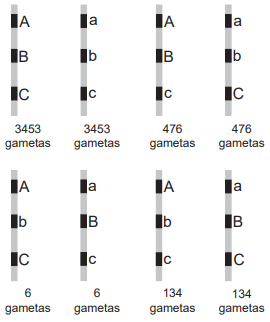
Em vista das informações apresentadas, é correto afirmar que os cromossomos recombinantes apresentam
Em vista das informações apresentadas, é correto afirmar que os cromossomos recombinantes apresentam
Ano: 2024
Banca:
COMVEST - UNICAMP
Órgão:
UNICAMP
Prova:
COMVEST - UNICAMP - 2024 - UNICAMP - Vestibular |
Q3107254
Biologia
Estima-se que mais de dois milhões de espécies habitem os oceanos; entretanto, somente 10% da vida oceânica é conhecida.
Em janeiro de 2024, uma expedição na costa do Chile avaliou
um trecho de 2.900 km2
de montanhas subaquáticas criadas
por atividade vulcânica, o que resultou em uma região única
com correntes marítimas e baixo teor de oxigênio, gerando um
nível elevado de endemismo.
Em menos de um mês, a expedição documentou cem novas espécies animais de profundidade, incluindo corais, esponjas, lagostas, polvos, caravelas, águas-vivas, peixes, camarões, entre outros.
(Adaptado de https://www.nytimes.com/2024/03/10/science/new-species-sea-discove ry.html. Acesso em 02/04/2024.)
Sobre essa expedição marinha, é correto afirmar que os animais
Em menos de um mês, a expedição documentou cem novas espécies animais de profundidade, incluindo corais, esponjas, lagostas, polvos, caravelas, águas-vivas, peixes, camarões, entre outros.
(Adaptado de https://www.nytimes.com/2024/03/10/science/new-species-sea-discove ry.html. Acesso em 02/04/2024.)
Sobre essa expedição marinha, é correto afirmar que os animais
Ano: 2024
Banca:
COMVEST - UNICAMP
Órgão:
UNICAMP
Prova:
COMVEST - UNICAMP - 2024 - UNICAMP - Vestibular |
Q3107253
Biologia
Considera-se que a evolução cria e sustenta a biodiversidade via
mudanças adaptativas em características ecologicamente relevantes. A especiação é um processo contínuo que dá origem à
diversidade biológica, e está intimamente associada a mudanças no fenótipo e à adaptação ao ambiente ecológico.
Assinale a alternativa correta.
Assinale a alternativa correta.
Ano: 2024
Banca:
COMVEST - UNICAMP
Órgão:
UNICAMP
Prova:
COMVEST - UNICAMP - 2024 - UNICAMP - Vestibular |
Q3107252
Biologia
A floração é um processo sensível ao fotoperíodo (período de
luz em um dia) em algumas espécies, que podem ser classificadas como espécies de dia longo e espécies de dia curto. Há
ainda as espécies neutras em relação ao fotoperíodo; no caso, a
floração delas é independente dele.
Na figura a seguir, quatro condições de luminosidade são apresentadas, com as horas de luz indicadas pelas barras brancas e as horas de escuro indicadas pelas barras pretas: I) 8 horas de luz e 16 horas de escuro; II) 12 horas de luz e 12 horas de escuro; III) 16 horas de luz e 8 horas de escuro; e IV) 10 horas de luz e 14 horas de escuro. Para essa última condição (IV), há interrupção do período de escuro pelo fornecimento de luz por 2 horas.
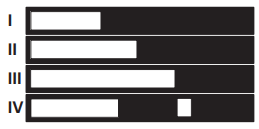
Considerando uma espécie vegetal de dia longo, assinale a alternativa que indica as condições em que haverá floração.
Na figura a seguir, quatro condições de luminosidade são apresentadas, com as horas de luz indicadas pelas barras brancas e as horas de escuro indicadas pelas barras pretas: I) 8 horas de luz e 16 horas de escuro; II) 12 horas de luz e 12 horas de escuro; III) 16 horas de luz e 8 horas de escuro; e IV) 10 horas de luz e 14 horas de escuro. Para essa última condição (IV), há interrupção do período de escuro pelo fornecimento de luz por 2 horas.
Considerando uma espécie vegetal de dia longo, assinale a alternativa que indica as condições em que haverá floração.
Ano: 2024
Banca:
COMVEST - UNICAMP
Órgão:
UNICAMP
Prova:
COMVEST - UNICAMP - 2024 - UNICAMP - Vestibular |
Q3107251
Biologia
A infecção por Covid-19 (SARS-CoV-2) resulta em maior acúmulo de muco nas vias aéreas, o que pode facilitar infecções
fúngicas ou bacterianas em humanos, contribuindo para o aumento da severidade da doença e da mortalidade. A figura I
ilustra o epitélio respiratório normal; a seta aponta uma importante estrutura. O funcionamento dessa estrutura é definido
pela amplitude do movimento em função do tempo. A figura II
demonstra os efeitos da infecção viral e suas alterações estruturais e funcionais nas células epiteliais.
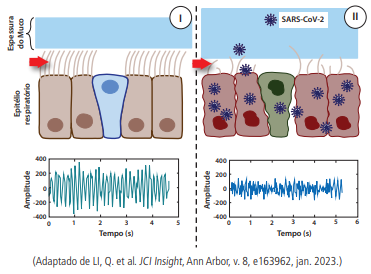
É correto afirmar que as setas indicam
É correto afirmar que as setas indicam
Ano: 2024
Banca:
COMVEST - UNICAMP
Órgão:
UNICAMP
Prova:
COMVEST - UNICAMP - 2024 - UNICAMP - Vestibular |
Q3107250
Biologia
Em mulheres, ocorre a compactação e a inativação de um cromossomo X, formando uma estrutura pequena e densa, chamada de corpúsculo de Barr. Sabe-se que a inativação de um
dos cromossomos X em embriões humanos é um processo fundamental para sua viabilidade.
(Adaptado de https://agencia.fapesp.br/inativacao-do-cromossomo-x-ocorre-mais-cedo- -em-humanos. Acesso em 02/04/2024.)
Assinale a alternativa que preenche corretamente as lacunas no excerto a seguir.
Em humanos, o sexo é determinado pela presença dos cromossomos sexuais X e Y, que são considerados parcialmente (i) _________. A inativação de um cromossomo X é um processo aleatório e foi demonstrado que os (ii) _________ no corpúsculo de Barr são inativos, o que significa que eles não serão (iii) _________. A inativação do cromossomo X é um processo de controle epigenético, que molda o funcionamento do (iv) _________ sem alterá-lo, e iguala a atividade gênica das mulheres à dos homens.
(Adaptado de https://agencia.fapesp.br/inativacao-do-cromossomo-x-ocorre-mais-cedo- -em-humanos. Acesso em 02/04/2024.)
Assinale a alternativa que preenche corretamente as lacunas no excerto a seguir.
Em humanos, o sexo é determinado pela presença dos cromossomos sexuais X e Y, que são considerados parcialmente (i) _________. A inativação de um cromossomo X é um processo aleatório e foi demonstrado que os (ii) _________ no corpúsculo de Barr são inativos, o que significa que eles não serão (iii) _________. A inativação do cromossomo X é um processo de controle epigenético, que molda o funcionamento do (iv) _________ sem alterá-lo, e iguala a atividade gênica das mulheres à dos homens.
Ano: 2024
Banca:
COMVEST - UNICAMP
Órgão:
UNICAMP
Prova:
COMVEST - UNICAMP - 2024 - UNICAMP - Vestibular |
Q3107249
Biologia
Rosana Paulino é uma artista visual brasileira e suas obras têm
foco nas questões sociais, étnicas e de gênero. A obra a seguir foi exposta na 35ª Bienal de São Paulo (2023) e promove
a integração da arte com a natureza brasileira, retratando um
importante ecossistema costeiro.
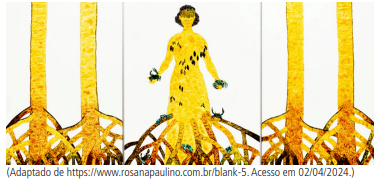
Tendo em vista seus conhecimentos sobre biologia e considerando a obra apresentada, é correto afirmar que
Tendo em vista seus conhecimentos sobre biologia e considerando a obra apresentada, é correto afirmar que
 Conheça nossos planos