Questões de Vestibular
Foram encontradas 75.219 questões
Resolva questões gratuitamente!
Junte-se a mais de 4 milhões de concurseiros!


Ano: 2026
Banca:
VUNESP
Órgão:
UNIVESP
Prova:
VUNESP - 2026 - UNIVESP - Vestibular - Eixos: Licenciatura, Computação e Negócios de Produção |
Q4038094
Biologia
As angiospermas constituem o único grupo de plantas capaz
de produzir frutos, que são estruturas representativas de um
importante sucesso evolutivo. Os frutos se desenvolvem a
partir do ovário e contribuem para a dispersão da espécie
no ambiente, aumentando suas chances de sobrevivência
e propagação. Além disso, a existência de frutos também
possibilitou a
Ano: 2026
Banca:
VUNESP
Órgão:
UNIVESP
Prova:
VUNESP - 2026 - UNIVESP - Vestibular - Eixos: Licenciatura, Computação e Negócios de Produção |
Q4038093
Biologia
A salga de alguns tipos de carne é uma prática humana
antiga, ainda utilizada em determinadas comunidades onde
há ausência ou limitação de refrigeradores. O sal atua na conservação do alimento porque cria um ambiente desfavorável
ao desenvolvimento de organismos decompositores, que não
conseguem sobreviver ou se multiplicar nessas condições,
retardando o processo de deterioração da carne. Esse ambiente é desfavorável porque faz com que esses organismos
Ano: 2026
Banca:
VUNESP
Órgão:
UNIVESP
Prova:
VUNESP - 2026 - UNIVESP - Vestibular - Eixos: Licenciatura, Computação e Negócios de Produção |
Q4038092
Medicina
A palavra “asfixia” vem do grego e significa “interrupção
do pulso”. De acordo com essa tradução, toda morte seria
uma asfixia, o que é verdade, pois o óbito se caracteriza
por uma parada prolongada do coração que leva à morte
das células cerebrais por falta de gás _________, seguida de
um edema no cérebro que, mesmo se o coração voltasse a
funcionar, impediria que o sangue circulasse na cavidade
craniana e irrigasse o cérebro devido ao espaço significativo
então ocupado por este.
(Philippe Boxho. Os mortos também falam, 2025. Adaptado.)
A lacuna do texto é preenchida por:
(Philippe Boxho. Os mortos também falam, 2025. Adaptado.)
A lacuna do texto é preenchida por:
Ano: 2026
Banca:
VUNESP
Órgão:
UNIVESP
Prova:
VUNESP - 2026 - UNIVESP - Vestibular - Eixos: Licenciatura, Computação e Negócios de Produção |
Q4038091
Meio Ambiente
Atualmente, o buraco na camada de ozônio ainda existe.
Ele se forma todos os anos sobre a Antártida, durante a primavera, e se fecha novamente no verão, quando o ar estratosférico das latitudes mais baixas se mistura, permanecendo
assim até a primavera seguinte, quando o ciclo recomeça.
Mas existem evidências de que o buraco está começando
a desaparecer, recuperando-se mais ou menos conforme o
esperado, segundo Solomon. Avaliações científicas indicam
que a camada de ozônio deve retornar aos níveis anteriores
a 1980 em meados do século 21.
(www.bbc.com, 16.05.2022. Adaptado.)
A camada de ozônio da estratosfera, mencionada no excerto, filtra a radiação ultravioleta emitida pelo Sol. A destruição dessa camada relaciona-se diretamente
(www.bbc.com, 16.05.2022. Adaptado.)
A camada de ozônio da estratosfera, mencionada no excerto, filtra a radiação ultravioleta emitida pelo Sol. A destruição dessa camada relaciona-se diretamente
Ano: 2026
Banca:
VUNESP
Órgão:
UNIVESP
Prova:
VUNESP - 2026 - UNIVESP - Vestibular - Eixos: Licenciatura, Computação e Negócios de Produção |
Q4038090
Química
Em um béquer, foram adicionados 45 g de determinado
material no estado líquido, que ocupou o volume de 50 mL.
A tabela apresenta os valores aproximados da densidade (d)
de cinco materiais no estado líquido, medidos a 25 ºC.
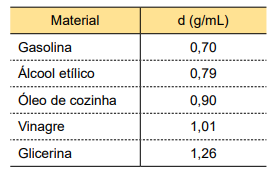
O material adicionado ao béquer foi
O material adicionado ao béquer foi
Ano: 2026
Banca:
VUNESP
Órgão:
UNIVESP
Prova:
VUNESP - 2026 - UNIVESP - Vestibular - Eixos: Licenciatura, Computação e Negócios de Produção |
Q4038089
Química
A reação de dupla troca de iodeto de potássio (KI) com
nitrato de chumbo(II) [Pb(NO3
)2] é curiosa, pois ambas as
substâncias se apresentam em soluções aquosas incolores
e, quando misturadas, formam um sólido amarelo, que é
o iodeto de chumbo(II) (PbI2), conforme a equação não
balanceada:
KI (aq) + Pb(NO3 ) 2 (aq) ➞ PbI 2 (s) + KNO3 (aq)
O resultado da soma dos menores coeficientes inteiros que completam o balanceamento da equação e a função inorgânica à qual pertence o sólido amarelo formado são, respectivamente,
KI (aq) + Pb(NO3 ) 2 (aq) ➞ PbI 2 (s) + KNO3 (aq)
O resultado da soma dos menores coeficientes inteiros que completam o balanceamento da equação e a função inorgânica à qual pertence o sólido amarelo formado são, respectivamente,
Ano: 2026
Banca:
VUNESP
Órgão:
UNIVESP
Prova:
VUNESP - 2026 - UNIVESP - Vestibular - Eixos: Licenciatura, Computação e Negócios de Produção |
Q4038088
Química
Ao planejar uma aula de química, um professor precisava
determinar a substância X que usaria para preparar uma
solução. O professor pesou uma amostra de 30,4 g de
determinada substância, acrescentou água até o volume de
0,5 L e, sabendo que a concentração molar dessa solução
preparada era igual a 0,4 mol/L, ele conseguiu determinar a
substância X. A tabela apresenta algumas substâncias que
poderiam ter sido utilizadas pelo professor e suas respectivas
massas molares:
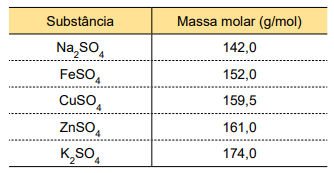
Após realizar os cálculos necessários e consultar a tabela, o professor determinou que a substância X tem a fórmula química:
Após realizar os cálculos necessários e consultar a tabela, o professor determinou que a substância X tem a fórmula química:
Ano: 2026
Banca:
VUNESP
Órgão:
UNIVESP
Prova:
VUNESP - 2026 - UNIVESP - Vestibular - Eixos: Licenciatura, Computação e Negócios de Produção |
Q4038087
Química
A mistura de bicarbonato de sódio (NaHCO3
) com ácido
clorídrico (HCl) libera gás carbônico (CO2
). Quando esse
gás entra em contato com uma solução de hidróxido de sódio
(NaOH), ocorre uma reação química que recebe o nome de
neutralização. Essa reação ocorre porque o gás carbônico
é um
Ano: 2026
Banca:
VUNESP
Órgão:
UNIVESP
Prova:
VUNESP - 2026 - UNIVESP - Vestibular - Eixos: Licenciatura, Computação e Negócios de Produção |
Q4038086
Biologia
A vitamina B3, também chamada de niacina, é uma substância que pode auxiliar no controle do colesterol, diminuindo
o colesterol ruim e aumentando o colesterol bom. A fórmula
estrutural da niacina está representada na figura.
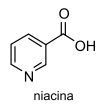
A função oxigenada presente na estrutura da niacina é:
A função oxigenada presente na estrutura da niacina é:
Ano: 2026
Banca:
VUNESP
Órgão:
UNIVESP
Prova:
VUNESP - 2026 - UNIVESP - Vestibular - Eixos: Licenciatura, Computação e Negócios de Produção |
Q4038085
Química
A energia de ativação é a quantidade mínima de energia
para que uma reação química ocorra, ou seja, é a quantidade
mínima de energia de que as moléculas precisam para que
os choques efetivos ocorram, transformando os reagentes
em produtos. A modificação no sistema reacional que permite
a diminuição da energia de ativação é a
Ano: 2026
Banca:
VUNESP
Órgão:
UNIVESP
Prova:
VUNESP - 2026 - UNIVESP - Vestibular - Eixos: Licenciatura, Computação e Negócios de Produção |
Q4038084
Geografia
Um projeto de pesquisa da Universidade de Campinas
(Unicamp) realizou um estudo piloto sobre o centro histórico
do município de Amparo (SP), com o objetivo de desenvolver
novas metodologias de preservação e atualização de dados
sobre conjuntos urbanos tombados no estado de São Paulo.
Durante o trabalho de campo, realizado entre 20 e 24 de
setembro de 2025, pesquisadores da Unicamp e da Universidade de Ferrara atuaram em conjunto no registro e na medição de imóveis que compõem o patrimônio histórico de
Amparo. As equipes utilizaram tecnologias de ponta para
identificar as dimensões dos edifícios e do espaço urbano,
integrando quatro tipos principais de levantamento: escaneamento a laser, fotogrametria, sobrevoos com drone e levantamentos topográficos com estação total.
(Valério Paiva. www.ifch.unicamp.br, 07.10.2025. Adaptado.)
Considerando o objetivo da pesquisa e os principais tipos de levantamento mencionados no excerto, o projeto se baseia no uso
(Valério Paiva. www.ifch.unicamp.br, 07.10.2025. Adaptado.)
Considerando o objetivo da pesquisa e os principais tipos de levantamento mencionados no excerto, o projeto se baseia no uso
Ano: 2026
Banca:
VUNESP
Órgão:
UNIVESP
Prova:
VUNESP - 2026 - UNIVESP - Vestibular - Eixos: Licenciatura, Computação e Negócios de Produção |
Q4038083
Meio Ambiente
O oceanógrafo e geógrafo paulista Marcus Polette tem
avaliado como os efeitos danosos do turismo ocorrem na
costa brasileira desde os anos 1950. Daquela década para
cá, o turismo de sol e praia passou a se desenvolver a partir
de uma estrutura baseada em calçadão, avenida beira-mar
e prédios. “No país, os calçadões foram construídos muitas
vezes em cima das praias, e várias avenidas beira-mar cobriram a vegetação de restinga”. Quanto aos prédios, nem o
céu parece ser o limite. Balneário Camboriú (SC), objeto
de estudo de Polette, é uma cidade famosa por seus vários
edifícios na faixa dos 200 metros de altura e um com mais
de 550 metros em construção, previsto para ser o maior do
mundo.
(Mônica Manir. www.revistapesquisa.fapesp.br, 2025. Adaptado.)
Considerando o modelo de turismo mencionado no excerto, um dos efeitos danosos desse modelo no clima da costa brasileira é
(Mônica Manir. www.revistapesquisa.fapesp.br, 2025. Adaptado.)
Considerando o modelo de turismo mencionado no excerto, um dos efeitos danosos desse modelo no clima da costa brasileira é
Ano: 2026
Banca:
VUNESP
Órgão:
UNIVESP
Prova:
VUNESP - 2026 - UNIVESP - Vestibular - Eixos: Licenciatura, Computação e Negócios de Produção |
Q4038082
Engenharia Ambiental e Sanitária
Observe as transformações sofridas em um trecho do rio Madeira em Porto Velho (RO).
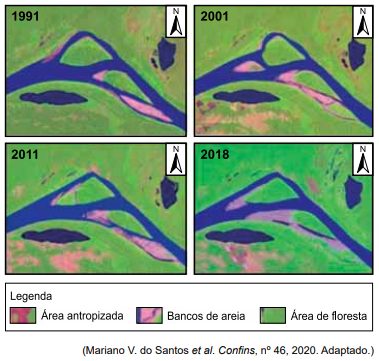
Considerando as transformações apresentadas nas imagens, um dos motivos pelos quais houve consolidação dos bancos de areia no rio Madeira foi
Ano: 2026
Banca:
VUNESP
Órgão:
UNIVESP
Prova:
VUNESP - 2026 - UNIVESP - Vestibular - Eixos: Licenciatura, Computação e Negócios de Produção |
Q4038081
Meio Ambiente
Este é um tratado internacional que busca estabilizar
as concentrações de gases de efeito estufa na atmosfera a
um nível que não inviabilize a vida na Terra. Esse tratado foi
adotado na Cúpula da Terra (Eco-92), encontro sobre meio
ambiente que ocorreu no Rio de Janeiro em 1992. A partir
dela, surgiram as Conferências das Nações Unidas sobre
Mudanças Climáticas (COPs).
(Mariana Vick. www.nexojornal.com.br, 04.11.2025. Adaptado.)
O tratado mencionado no excerto é denominado
(Mariana Vick. www.nexojornal.com.br, 04.11.2025. Adaptado.)
O tratado mencionado no excerto é denominado
Ano: 2026
Banca:
VUNESP
Órgão:
UNIVESP
Prova:
VUNESP - 2026 - UNIVESP - Vestibular - Eixos: Licenciatura, Computação e Negócios de Produção |
Q4038080
Geografia
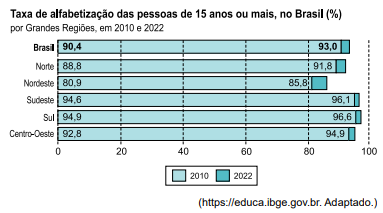
O gráfico mostra que, entre 2010 e 2022,
Ano: 2026
Banca:
VUNESP
Órgão:
UNIVESP
Prova:
VUNESP - 2026 - UNIVESP - Vestibular - Eixos: Licenciatura, Computação e Negócios de Produção |
Q4038079
Economia
O mercado mundial depende da Organização dos
Países Exportadores de Petróleo (OPEP) e de fatores políticos que determinaram grandes crises. A OPEP foi fundada
em setembro de 1960, como resposta direta ao desafio feito
pelas empresas multinacionais de petróleo ao reduzirem
arbitrária e unilateralmente os preços do petróleo cru em
fevereiro de 1959 e em agosto de 1960.
(M. F. Thompson Motta. “A origem da OPEP”. Revista Conjuntura Econômica, 2005. Adaptado.)
Considerando o excerto, entre os principais objetivos da OPEP está
(M. F. Thompson Motta. “A origem da OPEP”. Revista Conjuntura Econômica, 2005. Adaptado.)
Considerando o excerto, entre os principais objetivos da OPEP está
Ano: 2026
Banca:
VUNESP
Órgão:
UNIVESP
Prova:
VUNESP - 2026 - UNIVESP - Vestibular - Eixos: Licenciatura, Computação e Negócios de Produção |
Q4038078
Português
Certo dia, o presidente Roosevelt disse-me que estava
pedindo sugestões, publicamente, sobre como se deveria
chamar esta guerra. Retruquei de pronto: “a Guerra Desnecessária”. Nunca houve guerra mais fácil de impedir do que
esta que acaba de destroçar o que restava do mundo após o
conflito anterior. A tragédia humana atinge seu clímax no fato
de que, após todos os esforços e sacrifícios de centenas de
milhões de pessoas, e após as vitórias da Boa Causa, ainda
não encontramos Paz ou Segurança e estamos sujeitos a
perigos ainda maiores do que aqueles que superamos.
(Winston S. Churchill. Memórias da Segunda Guerra Mundial, 2017.)
Escrito em 1948 por Winston Churchill, ministro britânico durante a Segunda Guerra Mundial, o excerto mostra
(Winston S. Churchill. Memórias da Segunda Guerra Mundial, 2017.)
Escrito em 1948 por Winston Churchill, ministro britânico durante a Segunda Guerra Mundial, o excerto mostra
Ano: 2026
Banca:
VUNESP
Órgão:
UNIVESP
Prova:
VUNESP - 2026 - UNIVESP - Vestibular - Eixos: Licenciatura, Computação e Negócios de Produção |
Q4038077
História
É desnecessário ressaltar o imenso significado da imigração no surgimento de ideologias negadoras do sistema
vigente no país e na adoção de modelos organizatórios pela
classe operária. A crítica a posteriori às concepções anarquistas, predominantes entre os trabalhadores organizados
nos primeiros vinte anos do século XX, não pode obscurecer
sua importância na aparição de novas formas de luta e de
uma visão crítica radical da sociedade.
(Boris Fausto. Trabalho urbano e conflito social: 1890-1920, 2016.)
Ao se referir à realidade da Primeira República brasileira, o excerto destaca
(Boris Fausto. Trabalho urbano e conflito social: 1890-1920, 2016.)
Ao se referir à realidade da Primeira República brasileira, o excerto destaca
Ano: 2026
Banca:
VUNESP
Órgão:
UNIVESP
Prova:
VUNESP - 2026 - UNIVESP - Vestibular - Eixos: Licenciatura, Computação e Negócios de Produção |
Q4038076
História
Vergueiro ofereceu aos imigrantes alemães um acordo.
Eles receberiam seus próprios lotes de pés de café adultos e,
apesar de receberem certa supervisão, seriam mais ou menos
responsáveis pelo cuidado e pela apanha. Segundo o contrato
assinado por eles em Hamburgo antes de embarcar, levariam
os frutos até os terreiros e contribuiriam proporcionalmente ao
beneficiamento. Receberiam cotas em pagamento, correspondentes à metade dos rendimentos da venda da safra, após
dedução dos custos de transporte, impostos e comissão.
(Warren Dean. Rio Claro: um sistema brasileiro de grande lavoura, 1820-1920, 1977. Adaptado.)
Tendo em vista que Vergueiro também custeou as passagens desses trabalhadores com a garantia de ser ressarcido por eles, o excerto descreve
(Warren Dean. Rio Claro: um sistema brasileiro de grande lavoura, 1820-1920, 1977. Adaptado.)
Tendo em vista que Vergueiro também custeou as passagens desses trabalhadores com a garantia de ser ressarcido por eles, o excerto descreve
Ano: 2026
Banca:
VUNESP
Órgão:
UNIVESP
Prova:
VUNESP - 2026 - UNIVESP - Vestibular - Eixos: Licenciatura, Computação e Negócios de Produção |
Q4038075
História
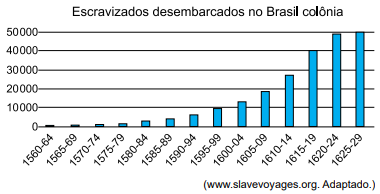
A quantidade de africanos escravizados que desembarcaram no Brasil colônia, nos períodos apresentados no gráfico, está relacionada

 Conheça nossos planos