Foram encontradas 63.949 questões
Resolva questões gratuitamente!
Junte-se a mais de 4 milhões de concurseiros!


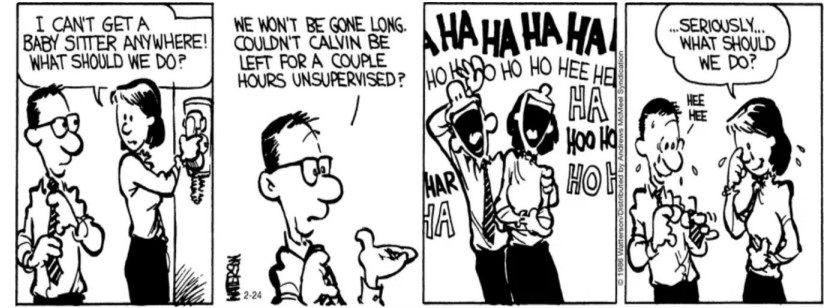
Available at: https://www.gocomics.com/calvinandhobbes/2026/02/24
After the father asks, “Couldn’t Calvin be left for a couple hours unsupervised?”, the parents immediately burst into laughter. This reaction suggests that:
A teacher in the final years of lower secondary education organizes lessons around real-life situations. Students work in small groups to investigate a problem, collect information, discuss possible solutions, and present their findings to the class. The teacher acts mainly as a facilitator, guiding the process rather than delivering long explanations.
This description best represents which teaching approach?
In English pronunciation, the definite article “the” has two possible pronunciations:
• It is pronounced /ðə/ (“thuh”) before consonant sounds.
• It is pronounced /ðiː/ (“thee”) before vowel sounds.
Choose the alternative in which “the” must be pronounced /ðiː/ in all the expressions below.
The base verbs below are all regular verbs:
I. to play
II. to study
III. to stop
IV. to travel
Choose the alternative in which all the verbs are correctly written in the Simple Past tense, respectively.
In the Simple Past tense, the ending -ed can be pronounced as /t/, /d/, or /ɪd/.
Choose the alternative in which all the verbs have their -ed ending pronounced as /t/.
Choose the alternative that correctly completes the sentences below with the appropriate prepositions, respectively.
I. She is waiting ___ the bus stop.
II. There is a clock ___ the wall.
III. My sister works ___ a hospital.
Choose the alternative that correctly completes the sentence. The correct answer must be a possessive pronoun that replaces the noun and avoids repetition.
That house is not ours; it is ______.
Choose the alternative that correctly completes the sentence. The correct answer must express the idea of formal prohibition.
Employees ______ enter the restricted area without proper authorization.
Select the alternative that correctly completes the sentence.
The office closes ______ midnight.
Select the alternative that correctly completes the sentence.
She ______ to Paris three times since 2020.
Read the text to answer question.
The Tipping Point.
Last week at my neighborhood coffee shop, the barista flipped that dreaded tablet toward me. Three tip options glared back: 18%. 22%. 25%. For a $3.50 latte I was picking up. That took thirty seconds to make. I’ve hit my breaking point with tipping culture.
Growing up, tipping was simple: 15–20% for sitdown restaurants, maybe your hairdresser. Now it’s an expected tax on every transaction. The frozen yogurt shop where I serve myself wants 20%. Self-checkout kiosks are asking for tips. This is insane.
When I traveled Europe last summer, I paid exactly what was on the menu. No guilt, no calculations, no awkward pressure. Servers were paid living wages and the service was excellent.
Meanwhile, I’m expected to subsidize corporate America’s refusal to pay fair wages while their CEOs pocket millions in bonuses.
It’s 2025, and American tipping culture has spiraled out of control. It’s hurting workers, stressing customers, and letting profitable businesses guilt-trip their own customers into covering payroll. When I worked retail years ago, my employer paid my full wage. I didn’t expect customers to subsidize my paycheck because my boss decided to pocket the difference. Yet somehow in 2025, we’ve normalized corporations outsourcing their payroll responsibility to guilt-ridden customers. 72% of U.S. adults say tipping is expected in more places today than it was five years ago. But even as Americans say they’re being asked to tip more often, only about a third say it’s extremely or very easy to know whether (34%) or how much (33%) to tip for various services.
[...] The confusion is real and it’s intentional. Companies benefit from our uncertainty because confused customers tend to over-tip rather than risk social judgment.
Murdock, Jeff. Why Is Tipping Culture Out of Control in 2025? Medium. 16 Jun. 2025. Disponível em:<https://medium.com/@frat1309/why-is-tipping-cultureout-of-control-in-2025-im-done-subsidizing-corporategreed-76ba74887b82>
Read the text to answer question.
The Tipping Point.
Last week at my neighborhood coffee shop, the barista flipped that dreaded tablet toward me. Three tip options glared back: 18%. 22%. 25%. For a $3.50 latte I was picking up. That took thirty seconds to make. I’ve hit my breaking point with tipping culture.
Growing up, tipping was simple: 15–20% for sitdown restaurants, maybe your hairdresser. Now it’s an expected tax on every transaction. The frozen yogurt shop where I serve myself wants 20%. Self-checkout kiosks are asking for tips. This is insane.
When I traveled Europe last summer, I paid exactly what was on the menu. No guilt, no calculations, no awkward pressure. Servers were paid living wages and the service was excellent.
Meanwhile, I’m expected to subsidize corporate America’s refusal to pay fair wages while their CEOs pocket millions in bonuses.
It’s 2025, and American tipping culture has spiraled out of control. It’s hurting workers, stressing customers, and letting profitable businesses guilt-trip their own customers into covering payroll. When I worked retail years ago, my employer paid my full wage. I didn’t expect customers to subsidize my paycheck because my boss decided to pocket the difference. Yet somehow in 2025, we’ve normalized corporations outsourcing their payroll responsibility to guilt-ridden customers. 72% of U.S. adults say tipping is expected in more places today than it was five years ago. But even as Americans say they’re being asked to tip more often, only about a third say it’s extremely or very easy to know whether (34%) or how much (33%) to tip for various services.
[...] The confusion is real and it’s intentional. Companies benefit from our uncertainty because confused customers tend to over-tip rather than risk social judgment.
Murdock, Jeff. Why Is Tipping Culture Out of Control in 2025? Medium. 16 Jun. 2025. Disponível em:<https://medium.com/@frat1309/why-is-tipping-cultureout-of-control-in-2025-im-done-subsidizing-corporategreed-76ba74887b82>
Read the text to answer question.
The Tipping Point.
Last week at my neighborhood coffee shop, the barista flipped that dreaded tablet toward me. Three tip options glared back: 18%. 22%. 25%. For a $3.50 latte I was picking up. That took thirty seconds to make. I’ve hit my breaking point with tipping culture.
Growing up, tipping was simple: 15–20% for sitdown restaurants, maybe your hairdresser. Now it’s an expected tax on every transaction. The frozen yogurt shop where I serve myself wants 20%. Self-checkout kiosks are asking for tips. This is insane.
When I traveled Europe last summer, I paid exactly what was on the menu. No guilt, no calculations, no awkward pressure. Servers were paid living wages and the service was excellent.
Meanwhile, I’m expected to subsidize corporate America’s refusal to pay fair wages while their CEOs pocket millions in bonuses.
It’s 2025, and American tipping culture has spiraled out of control. It’s hurting workers, stressing customers, and letting profitable businesses guilt-trip their own customers into covering payroll. When I worked retail years ago, my employer paid my full wage. I didn’t expect customers to subsidize my paycheck because my boss decided to pocket the difference. Yet somehow in 2025, we’ve normalized corporations outsourcing their payroll responsibility to guilt-ridden customers. 72% of U.S. adults say tipping is expected in more places today than it was five years ago. But even as Americans say they’re being asked to tip more often, only about a third say it’s extremely or very easy to know whether (34%) or how much (33%) to tip for various services.
[...] The confusion is real and it’s intentional. Companies benefit from our uncertainty because confused customers tend to over-tip rather than risk social judgment.
Murdock, Jeff. Why Is Tipping Culture Out of Control in 2025? Medium. 16 Jun. 2025. Disponível em:<https://medium.com/@frat1309/why-is-tipping-cultureout-of-control-in-2025-im-done-subsidizing-corporategreed-76ba74887b82>
Read the text to answer question.
The Tipping Point.
Last week at my neighborhood coffee shop, the barista flipped that dreaded tablet toward me. Three tip options glared back: 18%. 22%. 25%. For a $3.50 latte I was picking up. That took thirty seconds to make. I’ve hit my breaking point with tipping culture.
Growing up, tipping was simple: 15–20% for sitdown restaurants, maybe your hairdresser. Now it’s an expected tax on every transaction. The frozen yogurt shop where I serve myself wants 20%. Self-checkout kiosks are asking for tips. This is insane.
When I traveled Europe last summer, I paid exactly what was on the menu. No guilt, no calculations, no awkward pressure. Servers were paid living wages and the service was excellent.
Meanwhile, I’m expected to subsidize corporate America’s refusal to pay fair wages while their CEOs pocket millions in bonuses.
It’s 2025, and American tipping culture has spiraled out of control. It’s hurting workers, stressing customers, and letting profitable businesses guilt-trip their own customers into covering payroll. When I worked retail years ago, my employer paid my full wage. I didn’t expect customers to subsidize my paycheck because my boss decided to pocket the difference. Yet somehow in 2025, we’ve normalized corporations outsourcing their payroll responsibility to guilt-ridden customers. 72% of U.S. adults say tipping is expected in more places today than it was five years ago. But even as Americans say they’re being asked to tip more often, only about a third say it’s extremely or very easy to know whether (34%) or how much (33%) to tip for various services.
[...] The confusion is real and it’s intentional. Companies benefit from our uncertainty because confused customers tend to over-tip rather than risk social judgment.
Murdock, Jeff. Why Is Tipping Culture Out of Control in 2025? Medium. 16 Jun. 2025. Disponível em:<https://medium.com/@frat1309/why-is-tipping-cultureout-of-control-in-2025-im-done-subsidizing-corporategreed-76ba74887b82>
Read the text to answer question.
The Tipping Point.
Last week at my neighborhood coffee shop, the barista flipped that dreaded tablet toward me. Three tip options glared back: 18%. 22%. 25%. For a $3.50 latte I was picking up. That took thirty seconds to make. I’ve hit my breaking point with tipping culture.
Growing up, tipping was simple: 15–20% for sitdown restaurants, maybe your hairdresser. Now it’s an expected tax on every transaction. The frozen yogurt shop where I serve myself wants 20%. Self-checkout kiosks are asking for tips. This is insane.
When I traveled Europe last summer, I paid exactly what was on the menu. No guilt, no calculations, no awkward pressure. Servers were paid living wages and the service was excellent.
Meanwhile, I’m expected to subsidize corporate America’s refusal to pay fair wages while their CEOs pocket millions in bonuses.
It’s 2025, and American tipping culture has spiraled out of control. It’s hurting workers, stressing customers, and letting profitable businesses guilt-trip their own customers into covering payroll. When I worked retail years ago, my employer paid my full wage. I didn’t expect customers to subsidize my paycheck because my boss decided to pocket the difference. Yet somehow in 2025, we’ve normalized corporations outsourcing their payroll responsibility to guilt-ridden customers. 72% of U.S. adults say tipping is expected in more places today than it was five years ago. But even as Americans say they’re being asked to tip more often, only about a third say it’s extremely or very easy to know whether (34%) or how much (33%) to tip for various services.
[...] The confusion is real and it’s intentional. Companies benefit from our uncertainty because confused customers tend to over-tip rather than risk social judgment.
Murdock, Jeff. Why Is Tipping Culture Out of Control in 2025? Medium. 16 Jun. 2025. Disponível em:<https://medium.com/@frat1309/why-is-tipping-cultureout-of-control-in-2025-im-done-subsidizing-corporategreed-76ba74887b82>
Em uma aula do 6º ano, o professor observa que os estudantes costumam brincar de “lutar” imitando personagens de desenhos e jogos digitais. Para transformar essa manifestação espontânea em conteúdo educativo, o professor decide orientar as atividades com base nos elementos pedagógicos presentes no ensino das lutas.
Segundo o trecho fornecido, qual compreensão é necessária para orientar essa prática de forma positiva?
Durante um curso de formação continuada, professores estudam os níveis do planejamento na educação, buscando compreender como cada nível se articula com a prática pedagógica. Para consolidar o aprendizado, a formadora propõe a associação entre as descrições e os níveis correspondentes.
Coluna A – Níveis de Planejamento
1. Planejamento da Escola
2. Planejamento de Ensino
3. Planejamento de Aula
Coluna B – Características
A. Documento de autoria do professor, que organiza objetivos, conteúdos, procedimentos, recursos e avaliação de uma disciplina.
B. Define objetivos e ações específicas de cada aula, considerando faixa etária, ritmo interno da turma e recursos disponíveis.
C. Expressa o posicionamento político e pedagógico da instituição, descrevendo diagnóstico, diretrizes e ações gerais.
Assinale a alternativa que contempla a sequência correta:

 Conheça nossos planos