Questões de Concurso
Sobre linguística e outras ciências – neurolinguística, psicolinguística, sociolinguística em linguística
Foram encontradas 319 questões


A esse respeito, é correto afirmar que essas propostas se aproximam da perspectiva do multiculturalismo
Nesse sentido, é correto afirmar que tal processo está diretamente associado
Considerando essa relação, é correto afirmar que
I.AAVE is a systematic, rule-governed variety of English with its own complex grammar (e.g., habitual "be", copula deletion), and not a collection of random errors or "broken" English.
II.The "Bridge Approach" suggests using AAVE as a bridge to learning Standard English, validating the student's home language while teaching code-switching skills explicitly.
III.Teachers should correct every instance of AAVE in oral communication immediately to prevent fossilization, as acknowledging non-standard dialects in the classroom legitimizes incorrect grammar.
Is/Are correct the statement(s):
De acordo com o assunto tratado, analise as afirmações a seguir e assinale a alternativa CORRETA.
Leia a canção abaixo.
Cuitelinho
Antonio Xando / Paulo Vanzolini
Cheguei na beira do porto
Onde as ondas se espaia
As garça dá meia volta
E senta na beira da praia
E o cuitelinho não gosta
Que o botão de rosa caia, ai, ai, ai
Aí quando eu vim de minha terra
Despedi da parentaia
Eu entrei no Mato Grosso
Dei em terras paraguaia
Lá tinha revolução
Enfrentei fortes bataia, ai, ai, ai
A tua saudade corta
Como aço de navaia
O coração fica aflito
Bate uma, a outra faia
E os óio se enche d'água
Que até a vista se atrapaia, ai, ai, ai
Ao utilizar a canção em sala de aula, o professor deve destacar que o texto apresenta a variação
Leia o texto para responder à questão.
Communicative language competence can be considered as comprising several components: linguistic, sociolinguistic and pragmatic.
Linguistic competences include lexical, phonological, syntactical knowledge and skills and other dimensions of language as system, independently of the sociolinguistic value of its variations and the pragmatic functions of its realisations.
Sociolinguistic competences refer to the sociocultural conditions of language use. Through its sensitivity to social conventions (rules of politeness, norms governing relations between generations, sexes, classes and social groups, linguistic codification of certain fundamental rituals in the functioning of a community), the sociolinguistic component strictly affects all language communication between representatives of different cultures, even though participants may often be unaware of its influence.
Pragmatic competences are concerned with the functional use of linguistic resources (production of language functions, speech acts), drawing on scenarios or scripts of interactional exchanges. It also concerns the mastery of discourse, cohesion and coherence, the identification of text types and forms, irony, and parody. For this component even more than the linguistic component, it is hardly necessary to stress the major impact of interactions and cultural environments in which such abilities are constructed.
(https://www.coe.int/en/web/common-european-framework-
reference-languages. Acesso 17.08.2025. Adaptado)
Nesse contexto, o autor defende que
Ẽmã ũ mĩ ũ tẽtá fag tỹ ver ẽgóro kam kỹ ko tĩ.
Alternantiva tỹ ẽgóro jyjy marca ke ra.
In this case, which strategic action best demonstrates the application of Communicative Competence in an English as a Lingua Franca (ELF) and Interculturality context to resolve the impasse and provide capacity building to the Brazilian team?
Based on the critical perspective that you must go beyond methodology to consider political issues, analyze the following proposed actions and choose the correct alternative.
I. Initiate a mandatory, analytical seminar where students collectively debate how English is used in their field’s research, emphasizing that active engagement is key to preventing selfexclusion from global knowledge. II. Remove the EAP module from the curriculum, respecting the students’ resistance as a political decision to reject linguistic imperialism. III. Focus on improving students' grammar and vocabulary to native standards, dismissing their political arguments as irrelevant to communicative skills. IV. Promote a discussion where the EAP course is reframed to focus on English as a Lingua Franca (ELF), highlighting its use by non-native speakers to publish and circulate Global South research. V. Transfer the course to the History department, arguing that the political issues related to English are not the responsibility of the Internationalization Office.
Considerando os conhecimentos sobre essa área, julgue as afirmativas:
I.A psicolinguística é a ciência que estuda a forma como adquirimos, compreendemos, produzimos e elaboramos a linguagem.
II.A psicolinguística concentra-se na análise dos fatores psicológicos e neurológicos que influenciam a linguagem.
III.A psicolinguística, em relação ao uso da linguagem, procura as formas mais elegantes, formais e abstratas da linguagem.
IV. Na linguística, a unidade mínima de som distintivo é o fonema, enquanto a psicolinguística estuda a linguagem considerando múltiplas unidades de análise, como fonemas, sílabas, palavras e sentenças, dependendo do processo cognitivo envolvido.
É correto o que se afirma em:
Macrossomia fetal: por que alguns bebês nascem com peso acima do normal
Por Redação Pais e Filhos
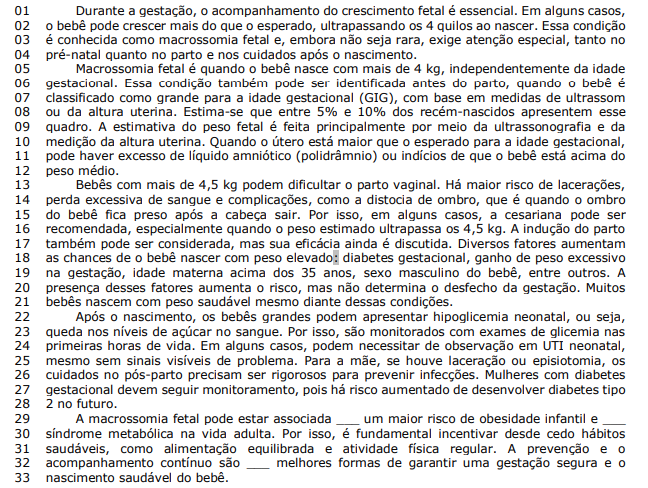
(Disponível em: bebe.abril.com.br/saude/macrossomia-fetal-por-que-alguns-bebes-nascem-com-peso-acimado-normal/?post_type=materias_elegiveis – texto adaptado especialmente para esta prova).
I. Todas as crianças passam pelos mesmos estágios de aquisição linguística na mesma ordem, variando apenas quanto à velocidade de progressão.
II. O estágio em que a criança se encontra é um indicador mais confiável de seu desenvolvimento linguístico do que a idade cronológica.
III. Nos primeiros meses, a comunicação ocorre por meio do balbucio, que pode ser sonoro ou manual no caso de bebês surdos, e pelo choro, indicando sensibilidade às estruturas fonológicas da língua.
Quais estão corretas?
 Conheça nossos planos