Questões de Concurso
Sobre linguística e outras ciências – neurolinguística, psicolinguística, sociolinguística em linguística
Foram encontradas 304 questões


A concepção de língua defendida no texto fundamenta uma prática de ensino de Língua Portuguesa que
Considerando as relações entre Língua Portuguesa, cidadania, diversidade cultural e inclusão, complete corretamente as lacunas.
O reconhecimento da __________ linguística permite compreender a coexistência de diferentes usos da língua como fenômeno constitutivo das comunidades de fala. No espaço escolar, a identificação do __________ linguístico evidencia a atribuição de juízos sociais negativos a determinados usos e a seus falantes. Nesse contexto, a promoção dos __________ linguísticos relaciona o respeito à diversidade de usos às condições de participação social dos sujeitos.
Assinale a alternativa que preenche corretamente as lacunas.
Considerando os aspectos sociolinguísticos aplicados ao ensino de Língua Portuguesa, assinale a alternativa correta.
(__)Intercultural work can help learners understand that communicative practices are influenced by social and cultural contexts.
(__)Students' own cultural experiences can become resources for interaction in English rather than being excluded in favor of cultures traditionally associated with the language.
(__)Exposure to different accents and varieties should be postponed until students have acquired a stable reference variety, since early variation may interfere with communicative competence.
(__)Comparisons between cultural practices should avoid treating entire national or social groups as if they shared identical behaviors and values.
After analyzing the statements, choose the alternative that presents the correct sequence from top to bottom.
I - En el ámbito del aula de lengua adicional, hablar portuñol es hablar mal o cometer errores en español, y refleja las dificultades que enfrentan los estudiantes mientras asimilan el nuevo idioma.
II - El portuñol que se produce en el aula de español derriba tanto el concepto clásico de lengua como el de lengua nacional y, principalmente, la perspectiva monolingüe de la enseñanza de idiomas que estos conceptos promueven.
III - Concebir el portuñol como práctica social en el aula de español implica entenderlo como un desplazamiento constante entre fronteras lingüísticas, ya que los límites lingüísticos se vuelven cada vez más flexibles y permeables, favorecidos por la cercanía entre los dos idiomas.
¿Cuáles están correctas?
KRAMSCH, C. Context and culture in language teaching. Oxford: Oxford University Press, 1993.

La secuencia correcta para rellenar los paréntesis en la columna de la derecha, de arriba a abajo, es
I - Son ejemplos de gestión in Vivo: el Tratado de Asunción, las acciones de las comunidades alóctonas que reivindican espacios en Centros de Lenguas, la lengua materna de inmigrantes en sus espacios (casa, calle, comercio, iglesia etc).
II - Ejemplos de gestión in Vivo: grupos o comunidades de hablantes que hablan una lengua en sus prácticas sociales, adopción de una variedad lingüística específica en determinados dominios, paisajes lingüísticos espontáneos.
III - Son ejemplos de gestión in Vitro: Los estudios lingüísticos como los informes técnicos, documentos y reglas de gobiernos o instituciones, el lenguaje inclusivo adoptado por el Estado o institución, la Política de Lenguas de IFSC.
IV - Otros ejemplos de gestión in Vitro: decisiones oficiales de gobiernos sobre las lenguas oficiales, el Tratado de Asunción, legislaciones como la Ley de Lenguas nº 4251/2010 de Paraguay, la Ley nº 10.436/2002 que reconoce la lengua brasileña de señas (Libras) como lengua de comunicación y expresión, la Declaración de los Derechos Lingüísticos (PEN; UNESCO, 1996) y la Ley nº 6.303/ 2023 sobre la protección de las lenguas indígenas del Estado de Amazonas, Brasil.
¿Cuales están correctos?
Considerando uma abordagem social e cultural da língua, assinale a intervenção adequada.
Brain rot
“Brain rot” is defined as “the supposed deterioration of a person’s mental or intellectual state, especially viewed as the result of overconsumption of material (now particularly online content) considered to be trivial or unchallenging. Also: something characterized as likely to lead to such deterioration”. The term gained new prominence as a term used to capture concerns about the impact of consuming excessive amounts of low-quality online content, especially on social media. The term increased in usage frequency by 230% between 2023 and 2024.
The first recorded use of “brain rot” was found in 1854 in Henry David Thoreau’s book Walden, which reports his experiences of living a simple lifestyle in the natural world. Thoreau criticizes society’s tendency to devalue complex ideas, or those that can be interpreted in multiple ways, in favour of simple ones, and sees this as indicative of a general decline in mental and intellectual effort: “While England endeavours to cure the potato rot, will not any endeavour to cure the brain-rot — which prevails so much more widely and fatally?”
The term has taken on new significance in the digital age. Initially gaining traction on social media platforms, the term is now seeing more widespread use, such as in mainstream journalism, amidst societal concerns about the negative impact of overconsuming online content.
Source: Oxford University Press. Adaptation.
Leia:
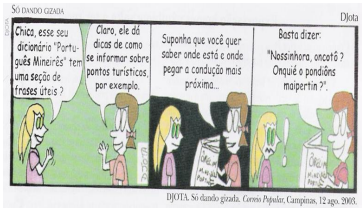
Nota-se que o humor provocado na tirinha acima é movido por uma maneira específica de expressão da linguagem. Sobre isso, pode-se afirmar que a variação empregada no texto se refere a um tipo específico tido como:
A tira a seguir é referência para a questão.

(__)O erro de português deve ser combatido a todo custo, pois existe apenas uma forma correta de falar, que é a norma culta padrão.
(__)A escola deve ensinar a norma culta padrão como uma das variedades da língua, necessária para o acesso a bens culturais e espaços de poder, sem estigmatizar a fala do aluno.
(__)Todas as variedades linguísticas possuem gramática própria e lógica interna, sendo adequadas aos seus respectivos contextos de uso.
(__)O preconceito linguístico é um instrumento de discriminação social, pois desvaloriza os falantes de variedades desprestigiadas.
Após análise, assinale a alternativa que apresenta a sequência correta dos itens acima, de cima para baixo:
Considerando os modelos de compreensão da leitura e o papel da memória de trabalho, assinale a opção que apresenta a análise mais adequada.

 Conheça nossos planos