Questões de Concurso
Sobre voz ativa e passiva | passive and active voice em inglês
Foram encontradas 377 questões


TEXT:
Building Rapport
Establishing strong foundations for teaching and learning
By Stephanie Hirchman
September 2, 2025
How do teachers build rapport with students? I can’t think of a more important question; after all, learning is all about relationships. In fact, I hope the word “rapport” runs through all the blogs I’ve written, like the letters in a stick of rock. However, as the summer holidays draw to a close and with new beginnings in sight, I’m going to focus exclusively on building rapport.
Fostering rapport
Let’s get out the metaphors! If learning is a house, then rapport is the foundation, but because it needs constant maintenance, rapport is also a garden, tended with care on a daily basis. When there is a good rapport, students feel:
• seen – each student is greeted individually, and the teacher makes an eff ort to interact with each one during the lesson.
• confident in the teacher, the course, and themselves - the teacher knows what each student needs and how to deliver it so students make progress. Classroom routines are predictable, fair, and make sense.
• safe – they know the teacher will not embarrass them or expose their sensitivities or weaknesses. Mistakes are dealt with sensitively and treated as learning opportunities.
• accepted – the teacher meets each individual student exactly where they are, without judgment, academically and personally. If someone is called out on their behaviour, this is done in private, and an explanation is given about why this behaviour is unproductive or unacceptable.
Student profiles – the basis for rapport
Whatever your teaching context, you’ve got to get to know each student as an individual. This can be considered as an initial information gathering phase, with several possible pathways.
A good starting point is to test students either before they start the course or in the first few days, making it clear that this is a process that produces information that will help you to plan and them to learn. Try to generate as full a picture as possible, so you have an idea about their abilities in all four skills.
Secondly, you need to conduct a needs analysis, either privately or publicly. You can read more about this process, but bear in mind that a public needs analysis can also serve to make everyone in the class aware of each other’s interests and thus of the rationale for including certain topics, language points, or skills work in the course syllabus.
Finally, use whatever resources you have to identify students with specific learning differences or traumas/triggers. This information may be disclosed at registration, self-disclosed (perhaps at interview) or in a private needs analysis, or tentatively identified through your own observations. Obviously, this information is private, between you and the student (and their parents, if they are under 18).
Classroom activities to build rapport at the start of a course
These rapport-building activities aim to generate information in such a way that students feel well-supported.
In a first lesson, the top priority is to make sure you know everybody’s preferred names and how to pronounce them. I’ve always found it helpful to have small desktop cards with this information on display – at least for a couple of sessions. Why not ask the students to make these themselves, or at least to personalize them? The back of the card could have some classroom language phrases to help prompt students, and there’s also the option of including this useful functional language as an introductory lesson – note that this generates a lot of information about student performance in areas like listening (including following instructions), speaking (including pronunciation) and studentship (including note-taking), facility with vocabulary, grammar and functional language. It can also serve as an introduction to pair and group work and to questioning and correction techniques, and, of course, builds confidence for students to take an active part in lessons.
Rapport thrives on praise
Teachers must remember that students are putting themselves on the line every time they come to class. Every effort carries a risk of failure, and not everyone is robust enough to bounce back easily when this occurs. Praise is the magic ingredient here – individualized, sincere and specific. Even when things have gone a bit wrong, find something that went well. It may be that you’re praising eff ort (“Good try, Haruka, I like that idea, but it isn’t what I’m looking for right now.”) or scaffolding achievement (“That’s a pretty good sentence, Juan, the verb tense is correct. But think again about the subject – should it be singular or plural?”). It may be delivered in written form (“This essay makes some relevant points. You used a lot of new vocabulary and improved your accuracy with punctuation. Next time, put the information into paragraphs.”). And when you make a mistake, as you inevitably will, model a positive reaction – check the information, put it right and thank the person who pointed it out.
Finally, make plenty of space for laughter and smiles, as they not only reduce stress, but have a positive effect on engagement, learning and recall. Rapport really does serve learning.
Adapted from: https://www.linguahouse.com/blog/post/building-rapport Acesso em 18/10/2025
Leia o texto a seguir:
Jobs and Professions
As has been the case for many years, jobs, or forms of employment wherein employees perform a service or duty in exchange for financial compensation, play a prominent role in society. Furthermore, all jobs — even those of seemingly little significance — are important, as they simply wouldn't exist if their specific responsibilities weren't of value to employers (companies or persons that pay others for their work), customers (individuals who pay money for a product or service), and the economy generally.
Teachers, or educational professionals tasked with helping students understand certain subjects and topics, are especially crucial today. In short, teachers help their students to become qualified for their future careers.
Doctors, or medical professionals who specialize in providing health-related assistance to patients, are some of the most respected individuals in America and the world. It's the responsibility of doctors to help those who feel less-than-stellar to determine the underlying health issue(s) and recommend an effective treatment (or remedy to a disease, disorder, or condition).
There are quite a few types of specialty doctors in America (besides MD, which simply means "medical doctor"), all of whom can be referred to simply as "Doctor (Name)." Dentists (mouth/ teeth doctors), dermatologists (skin doctors), and psychiatrists (mental-health doctors) are just a few examples of the many different types of doctors.
Additionally, nurses are medical professionals who help to administer doctor-ordered treatments to patients.
Police officers are law enforcement professionals whose job it is to protect citizens, solve crimes, and assure that rules and regulations are followed. Similarly, firefighters serve the public by responding to fires (and other emergency situations) and using high-tech equipment to extinguish these fires, while bringing any individuals who're in danger to safety.
Farmers maintain fields of crops (or vegetable/fruit plants) and/ or collections of animals with the intention of selling these products as food.
Chefs/cooks prepare meals in professional settings, including restaurants, cafeterias, and other venues wherein food and drink are sold, for customers. Chefs are generally experienced in cooking and managing kitchens.
Waiters bring menus, beverages, meals, and ultimately, the check (or a bill of the foods and drinks purchased in a transaction) to tables in restaurants and other establishments that serve food.
Artists produce art, or works of creative significance, including music, paintings, drawings, poetry, writing, and more.
Fonte: https://pdfcoffee.com/meeting-5-basic-english-for-academic-porposes-pdffree.html. Acessado em 25/08/2025
Which of the following sentences is correctly written in the passive voice and accurately reflects an idea from the text?
I.The past simple tense is used for actions that started and finished in the past.
II.The imperative mood expresses commands or instructions.
III.In the passive voice, the subject performs the action of the verb.
IV.The passive voice is formed by inverting the subject and the object while the verb remains unchanged.
Regarding these statements, select the correct answer:
Laszlo Krasznahorkai Is Awarded Nobel Prize in Literature
Laszlo Krasznahorkai, a Hungarian novelist known for his dystopian themes and relentless prose, with winding sentences that can run on for pages, was awarded the Nobel Prize in Literature on Thursday. The Swedish Academy, which organizes the prize, said at a news conference that Krasznahorkai had received the award “for his compelling and visionary oeuvre that, in the midst of apocalyptic terror, reaffirms the power of art.”
Krasznahorkai (pronounced CRAS-now-hoar-kay), 71, has been a perennial favorite for the Nobel. Hailed as a “master of the apocalypse” by Susan Sontag, Krasznahorkai has long been revered by fellow writers for his idiosyncratic style and bleak narratives that can often be slyly humorous.
He’s also written half a dozen screenplays in collaboration with the Hungarian movie director Bela Tarr, who has adapted several of his novels for the screen. Tarr filmed “The Melancholy of Resistance,” which is among Krasznahorkai’s best-known works, as “Werckmeister Harmonies,” in 2000. The novel, filled with vast sentences, concerns events in a small Hungarian town after a circus arrives with a huge stuffed whale in tow.
Krasznahorkai told The New York Times in 2014 that he had tried to develop an absolutely original style, adding, “I wanted to be free to stray far from my literary ancestors, and not make some new version of Kafka or Dostoyevsky or Faulkner.”
Steve Sem-Sandberg, a member of the committee that awarded the prize, praised Krasznahorkai’s “powerful, musically inspired epic style” at the news conference announcing the Nobel. “It is Krasznahorkai’s artistic gaze, which is entirely free of illusion and which sees through the fragility of the social order, combined with his unwavering belief in the power of art that has motivated the academy to award the prize,” Sem-Sandberg added.
A spokeswoman for Krasznahorkai’s German publisher said in an email on Thursday that the author was not conducting any interviews, although earlier in the day he briefly spoke to Swedish radio: “I’m very happy, thank you,” he said, adding, “I don’t know what’s coming in the future.”
Krasznahorkai was born in Gyula, a small town about 120 miles from Budapest, in 1954. His family’s Jewish roots were kept a secret — his grandfather changed the family name from Korin to Krasznahorkai to assimilate — and Krasznahorkai didn’t know about his Jewish heritage until his father told him when he was 11.
He was a musical prodigy, and worked as a professional musician for several years in his youth, playing piano in a jazz band and singing in a rock group. His father was a lawyer, and his mother worked in the social welfare ministry. Inspired by Kafka, an author he revered, he planned to study law and was fascinated by criminal psychology, but ended up studying Hungarian language and literature.
After school, Krasznahorkai undertook military service but, he has said in interviews, deserted the army after being punished for insubordination. He then took on odd jobs — including working as a miner and as a night watchman for 300 cows, a post that allowed him to read work by Dostoyevsky and Malcolm Lowry’s “Under the Volcano,” a book he called his “bible.”
When he began writing, his aim was to complete one book, then pursue a career in music. At the time he published his first short story, artists and writers were subject to censorship under Hungary’s Communist regime, and he was taken in for questioning by the police, who interrogated him about his anti-Communist views and took away his passport.
Krasznahorkai was undeterred. In 1985, he published his subversive debut novel, “Satantango,” about life in a poor, crumbling hamlet, which was a literary sensation in Hungary. “Nobody, myself included, could understand how it was possible to publish ‘Satantango’ because it’s anything but an unproblematic novel for the Communist system,” he said in a 2018 Paris Review interview.
“He doesn’t deal with grand politics, he’s dealing with the experiences of people who live within societies that are decaying and falling apart,” said the poet George Szirtes, who translated “Satantango” and several other works by Krasznahorkai. Tarr filmed an adaptation, which lasts for over seven hours, in 1994. In an interview on Thursday he recalled reading the book in one night and asking if he could turn it into a movie, only to find the author annoyed to be woken up during Easter holidays. The novel was filled with “these poor people, these miserable people,” Tarr said, but Krasznahorkai gave them a rare “dignity.”
Szirtes said that Krasznahorkai never expected his books — filled with endless clauses and sub-clauses — to catch on with a wide international audience. “The books can look daunting in some ways, simply because there is no break in them,” Szirtes said. In recent decades, Krasznahorkai has received a stream of accolades outside his home country. In 2015, he won the Man Booker International Prize, which at the time was awarded for an author’s entire body of work rather than a specific novel.
In the United States, New Directions has published a dozen of his books in translation, and more are forthcoming, including “Zsömle Is Gone,” a satire about an elderly retired electrician living in the countryside who believes he’s a descendant of Hungarian royalty. Barbara Epler, the publisher of New Directions, said one of the most striking things about Krasznahorkai’s work is his ability to weave unexpected humor into bleak stories. “What’s amazing is its anti-gravitational element — all this darkness and within it, an escalating, incredibly deadpan hilarity,” she said.
The Nobel Prize is literature’s major honor, and typically the capstone to a writer’s career. Past recipients have included the authors Saul Bellow and Toni Morrison, the playwright Harold Pinter and, in 2016, Bob Dylan. Krasznahorkai had featured among bookmakers’ favorites to win the prize for many years. He is the second Hungarian to receive the literature Nobel after Imre Kertész, a novelist and Holocaust survivor, in 2002.
While Krasznahorkai’s work has often been praised for its political overtones, he has rejected the idea that he’s writing political allegories. “I never want to write some political novels,” he told The New York Times in 2014. “My resistance against the Communist regime was not political. It was against a society.”
Krasznahorkai isn’t comfortable being cast as a social or political prognosticator. He has said he’s never felt at ease discussing his work, and doesn’t see himself as “part of literary life.” “Writing, for me, is a totally private act,” he told The Paris Review. “I’m ashamed to speak about my literature — it’s the same as if you were to ask me about my most private secrets.”
Adapted from: https://www.nytimes.com/2025/10/09/
Laszlo Krasznahorkai Is Awarded Nobel Prize in Literature
Laszlo Krasznahorkai, a Hungarian novelist known for his dystopian themes and relentless prose, with winding sentences that can run on for pages, was awarded the Nobel Prize in Literature on Thursday. The Swedish Academy, which organizes the prize, said at a news conference that Krasznahorkai had received the award “for his compelling and visionary oeuvre that, in the midst of apocalyptic terror, reaffirms the power of art.”
Krasznahorkai (pronounced CRAS-now-hoar-kay), 71, has been a perennial favorite for the Nobel. Hailed as a “master of the apocalypse” by Susan Sontag, Krasznahorkai has long been revered by fellow writers for his idiosyncratic style and bleak narratives that can often be slyly humorous.
He’s also written half a dozen screenplays in collaboration with the Hungarian movie director Bela Tarr, who has adapted several of his novels for the screen. Tarr filmed “The Melancholy of Resistance,” which is among Krasznahorkai’s best-known works, as “Werckmeister Harmonies,” in 2000. The novel, filled with vast sentences, concerns events in a small Hungarian town after a circus arrives with a huge stuffed whale in tow.
Krasznahorkai told The New York Times in 2014 that he had tried to develop an absolutely original style, adding, “I wanted to be free to stray far from my literary ancestors, and not make some new version of Kafka or Dostoyevsky or Faulkner.”
Steve Sem-Sandberg, a member of the committee that awarded the prize, praised Krasznahorkai’s “powerful, musically inspired epic style” at the news conference announcing the Nobel. “It is Krasznahorkai’s artistic gaze, which is entirely free of illusion and which sees through the fragility of the social order, combined with his unwavering belief in the power of art that has motivated the academy to award the prize,” Sem-Sandberg added.
A spokeswoman for Krasznahorkai’s German publisher said in an email on Thursday that the author was not conducting any interviews, although earlier in the day he briefly spoke to Swedish radio: “I’m very happy, thank you,” he said, adding, “I don’t know what’s coming in the future.”
Krasznahorkai was born in Gyula, a small town about 120 miles from Budapest, in 1954. His family’s Jewish roots were kept a secret — his grandfather changed the family name from Korin to Krasznahorkai to assimilate — and Krasznahorkai didn’t know about his Jewish heritage until his father told him when he was 11.
He was a musical prodigy, and worked as a professional musician for several years in his youth, playing piano in a jazz band and singing in a rock group. His father was a lawyer, and his mother worked in the social welfare ministry. Inspired by Kafka, an author he revered, he planned to study law and was fascinated by criminal psychology, but ended up studying Hungarian language and literature.
After school, Krasznahorkai undertook military service but, he has said in interviews, deserted the army after being punished for insubordination. He then took on odd jobs — including working as a miner and as a night watchman for 300 cows, a post that allowed him to read work by Dostoyevsky and Malcolm Lowry’s “Under the Volcano,” a book he called his “bible.”
When he began writing, his aim was to complete one book, then pursue a career in music. At the time he published his first short story, artists and writers were subject to censorship under Hungary’s Communist regime, and he was taken in for questioning by the police, who interrogated him about his anti-Communist views and took away his passport.
Krasznahorkai was undeterred. In 1985, he published his subversive debut novel, “Satantango,” about life in a poor, crumbling hamlet, which was a literary sensation in Hungary. “Nobody, myself included, could understand how it was possible to publish ‘Satantango’ because it’s anything but an unproblematic novel for the Communist system,” he said in a 2018 Paris Review interview.
“He doesn’t deal with grand politics, he’s dealing with the experiences of people who live within societies that are decaying and falling apart,” said the poet George Szirtes, who translated “Satantango” and several other works by Krasznahorkai. Tarr filmed an adaptation, which lasts for over seven hours, in 1994. In an interview on Thursday he recalled reading the book in one night and asking if he could turn it into a movie, only to find the author annoyed to be woken up during Easter holidays. The novel was filled with “these poor people, these miserable people,” Tarr said, but Krasznahorkai gave them a rare “dignity.”
Szirtes said that Krasznahorkai never expected his books — filled with endless clauses and sub-clauses — to catch on with a wide international audience. “The books can look daunting in some ways, simply because there is no break in them,” Szirtes said. In recent decades, Krasznahorkai has received a stream of accolades outside his home country. In 2015, he won the Man Booker International Prize, which at the time was awarded for an author’s entire body of work rather than a specific novel.
In the United States, New Directions has published a dozen of his books in translation, and more are forthcoming, including “Zsömle Is Gone,” a satire about an elderly retired electrician living in the countryside who believes he’s a descendant of Hungarian royalty. Barbara Epler, the publisher of New Directions, said one of the most striking things about Krasznahorkai’s work is his ability to weave unexpected humor into bleak stories. “What’s amazing is its anti-gravitational element — all this darkness and within it, an escalating, incredibly deadpan hilarity,” she said.
The Nobel Prize is literature’s major honor, and typically the capstone to a writer’s career. Past recipients have included the authors Saul Bellow and Toni Morrison, the playwright Harold Pinter and, in 2016, Bob Dylan. Krasznahorkai had featured among bookmakers’ favorites to win the prize for many years. He is the second Hungarian to receive the literature Nobel after Imre Kertész, a novelist and Holocaust survivor, in 2002.
While Krasznahorkai’s work has often been praised for its political overtones, he has rejected the idea that he’s writing political allegories. “I never want to write some political novels,” he told The New York Times in 2014. “My resistance against the Communist regime was not political. It was against a society.”
Krasznahorkai isn’t comfortable being cast as a social or political prognosticator. He has said he’s never felt at ease discussing his work, and doesn’t see himself as “part of literary life.” “Writing, for me, is a totally private act,” he told The Paris Review. “I’m ashamed to speak about my literature — it’s the same as if you were to ask me about my most private secrets.”
Adapted from: https://www.nytimes.com/2025/10/09/
I - I had my room cleaned.
II- Tom had his car washed.
III- She had the electrician look at her broken light.
IV- I have cleaned my house.
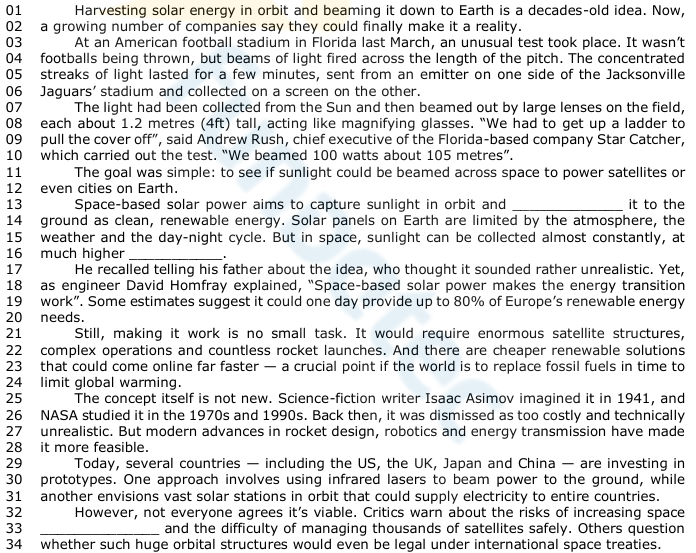

I. The verb form “could finally make” (l. 02) expresses a future possibility.
II. The sentence “The light had been collected from the Sun” (l. 07) is in the passive voice.
III. The clause “whether such huge orbital structures would even be legal” (l. 34) expresses a condition.
Which ones are correct?
Read the text below and answer question
Plan to test Liberian schoolchildren for drugs blocked
October 17th, 2025
By Moses Kollie Garzeawu
Monrovia, Liberia, Africa
Liberia's Education Ministry has blocked controversial plans to introduce mandatory drug testing in all of the country's schools.
Speaking to local media, the interim head of the Liberia Drug Enforcement Agency (LDEA), Fitzgerald Biago, said school testing would help address the growing problem of drug abuse.
The announcement sparked a mixed response. Some thought it would help tackle the scourge of drugs, while others saw it as an invasion of privacy, or feared it would cost too much.
Last year, President Joseph Boakai declared drug and substance abuse a national emergency and a recent EU-backed report estimated that one in five young Liberians take drugs.
However, the Education Ministry said it was not aware of any plans to test students and added that such a decision needed to be based on concrete evidence and properly thought through.
Assistant minister in charge of students Sona Toure-Sesay told the BBC that this kind of plan required proper research. "Let's assume we are made aware of the proposed initiatives by the LDEA, it will require us to conduct research and review case studies from other countries where this has been successful," she said.
Toure-Sesay also noted that testing could affect students. "What happens to students who test positive? What are the social services in place for them? Some of them might be bullied even after returning, and it may affect their overall educational performances."
She added that a multi-sectoral committee on drug and substance abuse had been set up, headed by the Health Ministry. Along with strengthening health clubs in schools, she said that this would help to reduce the prevalence of drugs among students.
President Boakai dismissed the leadership of the LDEA in August this year, and recently appointed Biago, a former senior police officer, as interim head of the agency.
Taken from:
https://www.bbc.com/news/articles/c0mxz3x1lr7o
Consider the following sentence about the Liberian schools:
They have rebuilt a lot of schools in Monrovia.
Choose the correct sentence rewritten in the passive voice:
“The committee will not release the findings before the journal has accepted the article for publication.”
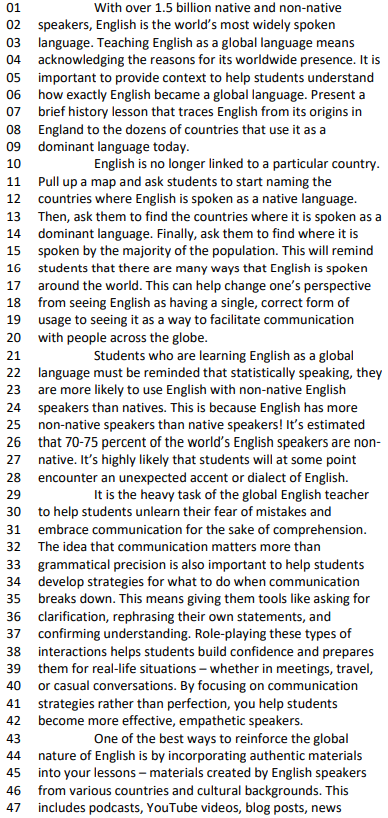
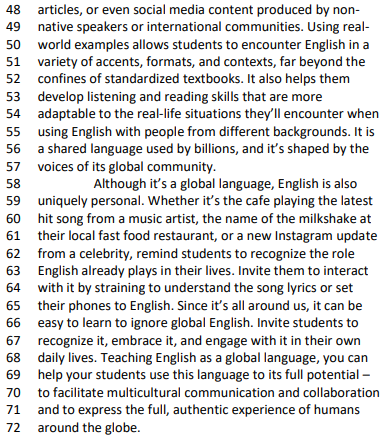
(__)In the passive voice, the object of an active sentence becomes the subject of the passive sentence.
(__)Only transitive verbs that take an object can form a passive construction.
(__)In English, the passive voice is formed by using the main verb in the -ing form after the verb to be.
(__)Passive structures are always incorrect in academic writing and should be completely avoided.
Mark the alternative that shows the correct sequence, from top to bottom.

 Conheça nossos planos