Questões de Concurso Sobre voz ativa e passiva | passive and active voice em inglês

Foram encontradas 373 questões

Q3351457 Inglês
Which of the following sentences correctly uses the passive voice?
Alternativas
Q3199447 Inglês
Which of the following sentences is in the passive voice? 
Alternativas
Q3180910 Inglês
Which of the following sentences is written in the passive voice?
Alternativas
Q3143766 Inglês
The sentence “[...] if the AI tool is actually designed for education specifically.” (6º§) is an example of a sentence in the: 
Alternativas
Q3116485 Inglês

NO MAN'S LAND


Mystery of world's only stretch of unclaimed land with NO laws that farmer tried to seize to make daughter a princess


Hidden deep in the African desert lies one of the strangest pieces of land on Earth — not for its beauty, wealth, or strategic value, but because no country wants it.


Bir Tawil is a 2,060-square-kilometre patch of barren desert between Egypt and Sudan, which remains an unusual geopolitical anomaly after decades of being unclaimed.


Those daring to go there face a tough journey, driving through remote desert roads past relics of gold mines and, at times, crossing paths with armed gangs and bandits.


Bir Tawil has long been a quirky favourite for small, often tongue-in-cheek, self-declared "countries" - usually founded by ordinary people across the globe.


With no laws, the land has even drawn would-be "kings," including a US dad who trekked there to fulfil his young daughter's wish of becoming a princess.


Jeremiah Heaton, a Virginia farmer, planted a flag and declared Bir Tawil the "Kingdom of North Sudan" so that his daughter Emily could have a royal title. While the move had no legal bearing, it sparked global interest and debate over land claims and the nature of sovereignty. 


As the dad tells it, Emily had casually asked if she could be a princess, and Heaton, wanting to make her dream come true, started looking for a way to make that happen. While most parents might have gently explained the impracticality of such a request, Heaton took it as a challenge. He began researching unclaimed land where he could theoretically establish a kingdom for Emily, at the time aged six.


In June 2014, Heaton headed to northeastern Africa, reaching Bir Tawil after a challenging journey through the desert. With a homemade blue flag bearing a crown symbol and the name "Heaton," he ceremoniously planted it in the sand, declaring Bir Tawil the "Kingdom of North Sudan" and himself its king. He immediately proclaimed Emily to be a princess, therefore "granting" her the royal title she had wished for.


In 2017, Suyash Dixit, an IT entrepreneur from Indore, India, also claimed Bir Tawil as his own, naming it the "Kingdom of Dixit." After a challenging journey across the desert, he planted a flag, declared himself king, and even "appointed" his father as prime minister. He posted his claim and experience on social media, where it garnered significant attention and sparked a wave of jokes and memes.


There are rumours, though largely unsubstantiated, that Bir Tawil contains hidden gold deposits.


While Egypt and Sudan have both had ancient ties to gold mining, particularly in the Nubian Desert, Bir Tawil itself is rarely studied or mined. These rumours, however, have attracted a few treasure hunters and adventurers over the years, hoping to uncover hidden riches in the desert.


Some have even joked about Bir Tawil as a potential "backup homeland" for populations affected by natural disasters. While obviously impractical, the idea underscores the paradox of unclaimed land in a time when territorial disputes are common.


Despite several stunts and theories, Bir Tawil remains unclaimed due to a unique border dispute between Egypt and Sudan.


The journey to Bir Tawil is lengthy and can take anywhere from two days to a week, depending on the starting point, route, and conditions. Due to its isolation and extreme desert environment, the journey requires careful planning, local knowledge, and permission from authorities in Egypt or Sudan.


Most travellers begin in Aswan, Egypt, or Khartoum, Sudan, as these are the nearest large cities with transportation infrastructure. From Aswan, the trip typically involves a long desert drive heading southward toward the Egypt-Sudan border.


Both countries monitor the border area closely, with visitors needing permits and a good guide familiar with the region. Egypt, in particular, restricts movement near the border, especially in sensitive zones close to the Hala'ib Triangle.


The trip to Bir Tawil from either Egypt or Sudan covers hundreds of kilometres across remote, rugged desert terrain. Explorers often follow dirt tracks used by nomadic tribes, miners, or military patrols, though few roads are mapped or maintained. The drive can take days and usually involves off-road vehicles capable of handling deep sand and rough trails.


There are no towns, water sources, or services along the way, so travellers must bring ample water, food, fuel, and spare parts. And to make matters worse, armed gangs, smugglers, and bandits often prey upon those venturing in the desert, particularly along less-monitored routes.


The origins of this unclaimed desert stretch back to British colonial rule in the late 19th and early 20th centuries, when overlapping boundary lines inadvertently left Bir Tawil in a legal limbo.


In 1899, while both Egypt and Sudan were under British administration, a formal border was established along the 22nd parallel north. This placed Bir Tawil, an arid and resource-poor patch of desert, in Egyptian territory, while a more valuable area, the Hala'ib Triangle, was assigned to Sudan.


But in 1902, the British changed the boundary to fit the local tribes' movements, putting Bir Tawil in Sudan instead and giving Egypt control over the fertile Hala'ib Triangle.


When Egypt and Sudan became independent, each country wanted the Hala'ib Triangle because it has good land and access to the Red Sea.


Egypt claims it based on the 1899 line, while Sudan uses the 1902 line to support its claim. Bir Tawil, a barren desert with no resources, has no value to either country.


To claim the Hala'ib Triangle, each country must reject Bir Tawil — because they can't claim both under their chosen boundary line. So by claiming Hala'ib, they essentially "give away" Bir Tawil, leaving it unwanted.


The territory is therefore unclaimed because Egypt and Sudan only want the valuable land next to it, not Bir Tawil itself.


For now, Bir Tawil endures as a strange relic of colonial history and an unlikely symbol of modern-day geopolitics — a land still ungoverned and, in all likelihood, destined to remain unclaimed.


Source:

https://www.thesun.co.uk/news/30658172/bir-tawil-land-that-bel ongs-to-no-nation/ (adapted)


https://www.thesun.co.uk/news/30658172/bir-tawil-land-that-belongs-to-no-nation/

Choose the sentence that correctly describes Bir Tawil's status using the passive voice.
Alternativas
Q3110403 Inglês
In the sentence, "She had been working on the project for months before the deadline was extended," which of the following options best describes the linguistic structures used and their function within the context?
Alternativas
Q3106463 Inglês
O texto seguinte servirá de base para responder à quesão.


ASTEROID WARNING Elon Musk's web of satellites make it harder to detect dangerous near-Earth asteroids, scientists warn

Elon Musk's web of satellites makes it harder to detect dangerous near-Earth asteroids, scientists have warned.

The number of satellites orbiting Earth has soared from just a few hundred in 1986 to 10,000 today.

Another tenfold increase is expected over the coming decade - much of it driven by Musk's Starlink network.

Starlink is a fleet of satellites which brings internet to people with little or no signal - including troops in Ukraine.

But more than 100 astronomers have now warned against launching more "megaconstellations" of satellites.

The boffins said clogging up the Earth's orbit with satellites could block their telescopes' view of outer space.

Professor Robert McMillan told Space: "Artificial satellites, even those invisible to the naked eye, can obstruct astronomical observations.

"These observations help detect asteroids and understand our place in the universe.

"The potentially long-term environmental harms of deploying tens of thousands of satellites are still unclear."

Light streaks from Starlink have dazzled a California telescope which scans the sky for exploding stars and dangerous near-Earth asteroids.

A study found that Musk's satellites could stop the Zwicky Transient Facility picking up asteroids coming from the sun.

Around one in five snaps from the huge telescope have been affected, Scientific American reports.

Expert Przemek Mróz said: "We don't expect Starlink satellites to affect non-twilight images.

"But if the satellite constellation of other companies goes into higher orbits, this could cause problems for non-twilight observations."

Co-author Tom Prince said: "There is a small chance that we would miss an asteroid or another event hidden behind a satellite streak."

https://www.thesun.co.uk/tech/31609240/elon-musk-satellites-asteroidsscientists/

Which of the following sentences uses the passive voice?
Alternativas
Q3077534 Inglês
Na voz passiva, a frase “Students didn’t do their homework”, fica da seguinte forma: 
Alternativas
Q3077136 Inglês
A frase “He sells cars” na voz passiva, é:
Alternativas
Q3071293 Inglês
What the Paris Olympics opening ceremony really meant

The opening ceremony of the Olympic Games traditionally offers the host city the opportunity to celebrate sporting excellence and international unity while also presenting to the world a flattering portrait of its own nation, informed by its own culture. [...]

[...] Entitled ‘Ça ira’ (‘It’ll be all right’), the show garnered mixed reviews in the French press. It was described variously as magical or catastrophic, as an astonishing apotheosis or a distressing accumulation of kitsch. Lady Gaga performed up and down a flight of stairs, dressed in feathers. The French singer Philippe Katerine, covered in blue body paint and dressed up as Bacchus, reclined in a platter of fruit. A threesome blossomed in the Bibliothèque Nationale. Decapitated figures of Marie-Antoinette holding their singing heads appeared at the windows of the Conciergerie. A floating piano was set on fire. The ceremony was conceived over two years by a committee made up of historian Patrick Boucheron (a member of the prestigious research institute, the Collège de France), the scriptwriter Fanny Herrero (creator of the Netflix series 10 Pour Cent/Call My Agent), the novelist Leïla Slimani (winner of the Goncourt literary prize for her novel Chanson douce/Lullaby), and the dramatist Damien Gabriac, who were all assembled in 2022 by the event’s master of ceremonies, theatre director Thomas Jolly. to co-write the script of their celebration of France. 

[...]

The man behind Le Puy du Fou is entrepreneur and politician Philippe de Villiers. Although de Villiers briefly served as Secretary of State for Culture under Socialist President François Mitterand, he is currently a member of French nationalist party Reconquête!, whose leader is the far-right firebrand Eric Zemmour. De Villiers is a Christian traditionalist who has expressed hostility towards Islam and has maintained that during the French Revolution a political ‘genocide’ was perpetrated against the Royalist people of Vendée.

It was therefore important for Jolly and his team firmly to distance their own project from Le Puy du Fou and to offer instead, as Jolly said: ‘the opposite of a virile, heroic and providential history’, of ‘an ode to grandeur’ or to the ‘manifestation of force’. Besides de Villiers’ theme park, another anti-model may have been the opening ceremony of the 2023 Rugby World Cup. Hosted by the popular actor Jean Dujardin and featuring a playful celebration of traditional French life, it was criticised for portraying a nostalgic and ‘rancid’ version of France. To be sure, at a time when France is politically and culturally riven, it would have seemed important to tell a national story that would unite rather than divide. In contrast, Jolly aimed for a celebration of ‘planetary multi-ethnicity’. But was it not in hindsight a mistake, a missed opportunity, to throw out, for fear that it might be politically toxic, anything that might be perceived as a celebration of French history, or the shared heritage that binds all French people together? 

Patrick Boucheron, the historian in Jolly’s team, has declared his ‘resistance’ to the idea of a ‘roman national’, the strengthening story a nation collectively weaves about itself – the word roman meaning in this instance at once a narrative and a romance. Boucheron favours instead a decentring of national consciousness and a deconstruction of national history. There was always a danger in rejecting historical greatness for ideological reasons. Louis XIV and Napoleon Bonaparte – both absent from the celebration – really do belong to all French; including them in the narrative would not have made it reactionary. Meanwhile Jolly’s desire systematically to foreground pop culture in order not to appear elitist often felt parochial. What is the long-term cultural significance of Nicky Doll, Paloma and Piche, stars of the reality show Drag Race France? Was the performance of John Lennon’s song Imagine really, as a sports historian declared in the newspaper Libération, ‘heavy with meaning’ because of its nature as a ‘political and cultural allegory’?

Wasn’t it also a pity not to celebrate France’s contemporary achievements, especially the rebuilding of Notre-Dame after its devastation by fire, and the Grand Paris Express transport network being developed for better integration of central Paris and its banlieues?

But above all, what was missing from the show, with rare exceptions – such as the sight of the Olympic cauldron rising into the sky tethered to a gigantic hot air balloon – was beauty. This signalled a lack of cultural confidence on the part of the ceremony’s storytellers. It was telling, for example, that Marcel Proust, one of France’s most exceptional writers, was featured as a caricatured carnival head, alongside Little Red Riding Hood and Marcel Marceau. Nor was placing the ceremony under the auspices of ‘Ça ira’, a 1790 anthem of the French Revolution as familiar to the French as the Marseillaise, an expression of intellectual confidence. Like the Marseillaise, ‘Ça ira’ is a call to violence – an ode to the systematic hanging of aristocrats from lamp-posts – and insisting, as Jolly did, that it can be reframed as a message of hope and of ‘union and unity within diversity’ is meaningless.

Ultimately, whether any of this landed with its audience remains doubtful. In spite of the driving rain, the French enjoyed the show’s wackiness, the party atmosphere, the excitement and anticipation of the Games. And the Games themselves were a wonderful success. But a message was sent nevertheless. And now that the Olympic truce is over, Emmanuel Macron must once again face up to a divided nation


In: https://engelsbergideas.com/notebook/what-the-paris-olympics-openingceremony-reallymeant/?gad_source=1&gclid=CjwKCAjwuMC2BhA7EiwAmJKRrLbi3d14OiB6WRug_hjU2I-75FCfTsQ0RitnqNM3GJxOqz9UCUlUBoCZ4IQAvD_BwE
Assinale a alternativa que apresenta uma frase na voz passiva:
Alternativas
Q3056726 Inglês

Read the text and answer the question.


Scientists store entire human genome on ‘memory crystal’ that could survive billions of years

By Rosa Rahimi, CNN. Published 7:53 AM EDT, Fri September 20, 2024


Q26_27.png (318×180)

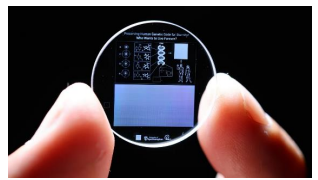
The crystal features a visual key, intended to explain what it contains to whoever finds it. University of Southampton/PA 


Scientists in the United Kingdom have stored the entire human genome on a “5D memory crystal,” in the hope that it could be used in the future as a blueprint to bring humanity back from extinction.


The crystal, which was developed by a team of researchers at the University of Southampton’s Optoelectronics Research Centre, could also be used to create a record of plant and animal species faced with extinction.


It can hold up to 360 terabytes of information for billions of years and can withstand extreme conditions, including freezing, fires, direct impact force, cosmic radiation and temperatures of up to 1,000 degrees Celsius, the university said in a press statement published Thursday.


In 2014, the crystal was awarded the Guinness World Record for “most durable digital storage material.” Kazansky’s team used ultra-fast lasers to inscribe the human genome data into voids as small as 20 nanometers (a nanometer is about one-billionth of a meter).


They describe the data storage on the crystal as 5D because the information is translated into five different dimensions of its nanostructures — their height, length, width, orientation and position.


“The 5D memory crystal opens up possibilities for other researchers to build an everlasting repository of genomic information from which complex organisms like plants and animals might be restored should science in the future allow,” said Peter Kazansky, a professor of optoelectronics, who led the team at Southampton.


The team had to consider who – or what – would retrieve the information, so far off into the future.


It could be an intelligence (species or machine) – or it could be found in a future so distant that no frame of reference would exist for it. To help whoever finds it, the researchers included a visual key.


“The visual key inscribed on the crystal gives the finder knowledge of what data is stored inside and how it could be used,” said Kazansky.


“Their work is super impressive,” said Thomas Heinis, who leads research on DNA storage at Imperial College London and was not involved in the study. However, he says questions remain about how such data could be read in the future.


“What Southampton presents probably has a higher durability, however, this begs the question: what for? Future generations? Sure, but how will they know how to read the crystal? How will they know how to build the device to read the crystal? Will the device be available in hundreds of years?” he added. “I can barely connect my 10-year-old iPod and listen to what I listened back then.”


For now, the crystal is stored in the Memory of Mankind archive, a time capsule within a salt cave in Austria.


In 2018, Kazansky and his team used the memory crystal technology to store Isaac Asimov’s “Foundation” trilogy of science fiction books, which were then launched into space aboard a Tesla Roadster. The technology has also been used to store major documents from human history, including the Universal


Declaration of Human Rights and the Magna Carta. Earlier this year, scientists revealed a plan to safeguard Earth’s species in a cryogenic biorepository on the moon, intended to save species in the event of a disaster on our home planet.


https://edition.cnn.com/2024/09/20/science/human-genome-crystal-intl-scli/index.html 

Which option correctly rewrites the sentence below in the active voice, clearly identifying the subject performing the action?

"The crystal, which was developed by a team of researchers at the University of Southampton’s Optoelectronics Research Centre, could also be used to create a record of plant and animal species faced with extinction.” 
Alternativas
Q3035581 Inglês

Read the text III to answer the question.


TEXT III 


A new report into world education shows Finland has the best system. The global study is called "The Learning Curve" and is from the British magazine "The Economist". It aims to help governments provide a better education to students. The 52-page report looked at the education system in 50 countries. Researchers analysed millions of statistics on exam grades, literacy rates, attendance, and university graduation rates. Asia did well in the report, with South Korea, Hong Kong, Japan and Singapore finishing second, third, fourth and fifth. The United States came 17th in the study, while Mexico, Brazil and Indonesia filled the bottom three positions in the top 50. 

The Learning Curve reported on five things that education leaders should remember. The first is that spending lots of money on schools and teachers does not always mean students will learn. Second is that "good teachers are essential to high-quality education". The report said teachers should be "treated as the valuable professionals they are, not as technicians in a huge, educational machine". Numbers three and four are that a country's culture must have a strong focus on the importance of education, and parents have a key part to play. Finally, countries need to "educate for the future, not just the present." The report said: "Many of today's job titles…simply did not exist 20 years ago."


Sources:

http://www.timeshighereducation.co.uk/story.asp?sectioncode=26&storycode=421944&c=1 http://thelearningcurve.pearson.com/content/download/bankname/components/filename/FINAL%20LearningCurve_Final.pdf 3

Which of the following is the correct passive voice form of the sentence, The report said: "Many of today's job titles…simply did not exist 20 years ago"?
Alternativas
Q3028598 Inglês
Text I: 'Quiet quitting' isn't really quitting


    Clocking out at 5 p.m. on the dot, only doing your assigned daily tasks, limiting chats with colleagues and not working overtime. These are the distinctive features of "quiet quitting," a term coined to describe how people are approaching their jobs and professional lives differently to manage burnout.

    The phrase, which isn't actually intended to lead to a resignation, exploded into the popular lexicon in 2022 when a TikTok video went viral. The creator, Zaid Khan, said in the video "I recently learned about this term 'quiet quitting,' where you're not outright quitting your job, but you're quitting the idea of going above and beyond." Nonetheless, “quiet quitting” is a misnomer, at least according to Karen K. Ho, a freelance business and culture reporter. She said that the term doesn't account for the fact that people are watching their grocery bills, fuel costs and housing prices go up, often without so much as a salary increase. "You're literally stagnating as a result of not earning more, not being promoted – and that's why a lot of people are leaving jobs," she completed.

   While the words "quiet quitting" are loaded, evoking images of a slacker or ne'er-do-well for some, others say that the approach frees up time to spend with family and friends or to take care of oneself. In short, it's a renewed commitment to life beyond the workplace. On the other hand, the term “quiet quitting” has also received criticism, even from those who generally favor the idea behind it.

   However, while the term "quiet quitting" may be a new invention, the mentality behind it is not. The phrase "work to rule," for example, describes a labor action in which employees strictly perform the work laid out in their contract, without taking on additional work. In 2020, the COVID-19 pandemic triggered a major economic movement, The Great Resignation, which saw people leaving their jobs or switching professions in droves, as they re-evaluated their relationship with work during a lifechanging health crisis.

  A May 2022 survey by RBC Insurance suggested that more than one-third of recently retired Canadians aged 55-75 had retired sooner than they planned. Another third decided to retire sooner because of the pandemic. Moreover, Statistics Canada reported that the third quarter of 2021 saw a 60% increase in job vacancies compared to pre-pandemic levels in the country.

    Both Quiet Quitting and The Great Resignation indicate a marked cultural shift from the early and mid-2010s when "hustle culture" paved the way to "grinding" and "girl-bossing" – two ideas that prioritized work over everything else, with the belief that such effort made employees more desirable to managers, therefore helping them climb up the corporate ladder faster and generating more income.

    In addition, it is important to highlight that employees have been re-evaluating how much time they spend commuting, working overtime and generally investing in low-pay, low-reward jobs. It seems they have realized that they work in systems where they are constantly immersed in a hustle culture – which has been repeatedly shown to be only beneficial for corporations and their managers, through bonuses, through increased productivity, through increased revenue and profits and the like.

    Furthermore, some employees are advocating for policies, benefits and working conditions that strengthen work-life balance. But critics say it doesn't work as well as it should, with a glaring loophole that allows employers to take advantage by vaguely wording their policies.


Adapted from: https://www.cbc.ca/news/business/quiet-quitting-workerdisengagement-1.6560226 Last Updated: August 25, 2022
Which of the sentences below is in the passive voice?
Alternativas
Q3024625 Inglês
Who wants a therapist who’s robotic? But a robot therapist?


Imagine feeling overwhelmed and in need of someone to talk to, but no one is available. You have no idea what to do, who to talk to and what to say. Chatbot AI is your new best friend. Essentially, it can take over basic human interaction and problems, answering even the most absurd questions. An artificial intelligence chatbot provides support and guidance. But there are some aspects that AI can not replace, things like having a physical person in front of you. Still, you feel a bit better knowing you have some support. The 1980s were referred to as the rapid “AI boom.” Joseph Weizenbaum, a professor at the Massachusetts Institute of Technology, developed the first chatbot to simulate an entertaining human conversation. He envisioned it as taking on the persona of a psychotherapist. Its original purpose was “to make machines use language, form abstractions and concepts, solve the kinds of problems now reserved for humans and improve themselves.” Ideally, a user would input a message on an electric typewriter linked to a mainframe, and shortly after, the “psychotherapist” would respond. Decades later, in 2017, chatbots finally became recognized as a stable form of communication. Because of continuous innovations in technology, chatbots have been created as a type of artificial intelligence application that poses as a sort of digital friend that you can lean on. 
“…chatbots have been created as a type of artificial…” Which verb tense is expressed in “Have been created”?
Alternativas
Q3012914 Inglês

Choose the sentence with the correct transformation to passive voice:


"The team won the championship after months of rigorous training and strategizing."

Alternativas
Q2628560 Inglês

Village’s Amateur Archaeologists Find Lost Tudor Palace


  1. When a group of amateur archaeologists set out to find the buried remains of a Tudor palace
  2. in their Northamptonshire village five years ago, they knew the odds were against them. “Many
  3. of us were brought up in the village, and you hear about this lost palace, and wonder whether
  4. it’s a myth or real. So we just wanted to find it”, said Chris Close, the chair of the Collyweston
  5. Historical and Preservation Society (Chaps) which made the discovery of the Palace of
  6. Collyweston in a back garden this year. “But we’re a bunch of amateurs. We had no money, no
  7. expertise, no plans, no artist impressions to go off, and nothing remaining of the palace. It was
  8. naivety and just hard work that has led us to it”.
  9. The site was found using geophysical surveys and ground-penetrating radar. Various
  10. attempts had been made in the 1980s and 90s to find Collyweston Palace, the home of Henry
  11. VII’s mother, Lady Margaret Beaufort. However, without the advantage of modern technology,
  12. none had succeeded. The palace was famous during the 15th century and several historic events
  13. took place there. The pre-wedding celebrations of Margaret Tudor to James IV of Scotland in
  14. 1503 took place in the palace, and Henry VIII is recorded as holding court there on 16 and 17
  15. October 1541. By the mid-17th century, it had fallen into disrepair, and until the Chaps dig
  16. uncovered the palace walls in March, there was very little remaining evidence of its existence.
  17. “A number of things have only really come to light as we’ve done this project”, said Close.
  18. “As you do more and more research, and various different records start to become unearthed,
  19. we realized Collyweston had privy councils being run from here, which is of massive national
  20. importance”. Historians from the University of York helped verify the group’s findings and identify
  21. the palace through some uncovered stone moldings, and will work with Chaps on more
  22. excavations to further reveal the structure and conserve it for the future.
  23. The Chaps team, which comprises more than 80 members ranging from teenagers to people
  24. in their 70s and 80s, first set out their plan to find the palace in March 2018, using “local folktales
  25. and hearsay” to help refine their search area. They carried out geophysical surveys and used
  26. ground-penetrating radar (GPR) to help reveal the location of the palace walls, before securing
  27. permission from homeowners to excavate in gardens. “We’ve done it all on an absolute
  28. shoestring”, said Close. “We’ve basically done an £80,000-£90,000 project for roughly £13,000.
  29. For us, being a little society, to have achieved this with no money, or expertise, or plans, I think
  30. it’s something that the whole society should be proud of”.

(Available at: https://www.theguardian.com/science/2023/dec/06/tudor-collyweston-palace-northamptonshire-found-in-garden-by-amateur-archeologists - text especially adapted for this test).

The sentence “Many of us were brought up in the village” (l. 02-03) is in the simple past and passive voice. Which sentence below is also an example of a simple past passive structure?

Alternativas
Q2579256 Inglês

O texto seguinte servirá de base para responder às questões de 1 a 9.


Valdivia Figurines and the appeal of 'the oldest'


(1º§) The logo for the Ecuadorian Ministry of Culture website is about my favourite thing of the afternoon which is saying a lot since I spent much of the day reading about giant Olmec heads. Three Valdivia Figurines in the colours of the Ecuadorian flag? I am sold! Golly, I love Valdivia figurines for all the right and all the wrong reasons.

(2º§) There are two things that can easily be said about Valdivia figurines: they are VERY Ecuadorian and they are VERY looted. The first explains why they appear prominently on the Ministry of Culture website (and on stencilled graffiti around Quito circa 2007). Ancient Ecuador has played second fiddle to Ancient Peru since the early days of archaeology. The Valdivia culture, however, represents something that Peru doesn't have, 'the oldest'. Everyone loves 'the oldest', national pride, etc. etc.

(3º§) Who else loves 'the oldest'? Collectors and Museums. If the Valdivia pottery sequence is the oldest in the new world, collectors want a slice of that pie. Heck, even better than some junky pottery, the Valdivia made interesting figurines: lovely ladies that look good on stark black backgrounds in auction catalogues. They are part of 'the oldest' yet they also look good.

(4º§) Valdivia sites are famously looted and Valdivia figurines are famously faked. A few years back I started doing some initial work into looting in Ecuador (which led to fieldwork in Quito and the cloud forest that didn't really go anywhere as of yet) and I, like anyone else going down that road, came across Bruhns and Hammond's 1983 Journal of Field Archaeology piece 'A Visit to Valdivia'. Knowing nothing at all about Ecuador at the time, I had never heard of Valdivia, a wonder since the only Ecuadorian archaeology books that Cambridge owns are a few by the late Betty Meggars and Emilio Estrada from the 1950s and 1960s which link uber-ancient Ecuador to Jomon Period Japan (yeah...I know). As Bruhns and Hammond relate, Meggars detected faking at Valdivia immediately after the start of her excavations: practical jokers who discovered a market for their copies. As the market for the pieces grew, the presumed fakes get more and more elaborate and fanciful...and Valdivia sites were just looted to pieces.

(5º§) So really with Valdivia we are left with a situation where we don't know what is real. It is directly comparable to the Cycladic Figurine problem: the corpus is mostly looted, it contains tons of forms not found in the limited archaeological excavations that have been conducted, and we intellectual consumers of artefacts don't know what to believe. To me Valdivia figurines are the perfect looting Catch 22: they warrant study so that the interested public can learn about 'the oldest', but they can't be studied because collectors wanted 'the oldest' so sites were looted and buckets of fakes were produced.

(6º§) In 2007 I bought a fake Valdivia figurine in Otavalo which now stands in a Spondylus shell on my counter and watches me cook. The fella selling it to me told me it was real. I knew it wasn't but made to put it back saying something along the lines that law breaking makes me sick. He quickly agreed that it wasn't real and cut his asking price by a ton. Que Sera. Three cheers, Ecuadorian Ministry of Culture, your logo is the best.


https://www.anonymousswisscollector.com/2012/09/valdivia-figurines-a

nd-appeal-of-oldest.html

Which sentence in the text contains a passive construction?

Alternativas
Q2574476 Inglês
Julgue o item a seguir.

The passive voice cannot be used in all verb tenses, even if it fits the required structure. It is composed of the verb 'to be' followed by the main verb in the past continuous form.
Alternativas
Q2560593 Inglês
The sentence that contains a verb form in the passive voice is:
Alternativas
Q2558749 Inglês
Identify the correct sentence in the passive voice:
Alternativas
Respostas
181: D
182: B
183: B
184: B
185: D
186: A
187: A
188: A
189: A
190: D
191: C
192: A
193: B
194: D
195: C
196: A
197: D
198: E
199: B
200: C