Questões de Concurso
Sobre voz ativa e passiva | passive and active voice em inglês
Foram encontradas 377 questões


The grammatically accurate passive construction expressing epistemic possibility is:
Text 10A2-III
As the world keeps warming and electricity bills take center stage in national politics, the data center boom will drive up USA carbon emissions and electricity costs. But a few simple policies could help bring both emissions and prices back down. That‟s the message of a new analysis from the Union of Concerned Scientists released Wednesday, which models a variety of scenarios for how to fuel the coming artificial intelligence boom. The USA is poised to see a 60 to 80 percent increase in electricity demand through 2050, with data centers alone making up more than half of the increase by the end of this decade, the analysis finds. If policies stay the same as they currently are—with attacks on renewable energy being embedded into regulatory regimes and few significant national policies restricting carbon emissions from power plants—we could see between a 19 and 29 percent increase in CO emissions from USA power plants tied just to the energy needs of data centers over the next 10 years. There are answers, though: Bringing back tax credits for wind and solar energy, even if data centers eat up a significant chunk of new demand for electricity, would cut CO emissions by more than 30 percent over the next decade. They could also make wholesale electricity costs go down by about 4 percent by 2050, after a slight rise over the next decade. Power plants are the second-largest source of greenhouse gas emissions in the USA, making up about a quarter of the country‟s overall emissions. Last year, emissions from the USA power sector rose slightly, marking the first increase since 2023; commercial buildings like data centers, a separate analysis released last week from the Rhodium Group found, were the main drivers of that demand.
Internet:http://www.wired.com/
“The field of Second Language Acquisition has also been questioned with regard to its dependence on native speaker standards as the measuring rod that determines successful learning.”
The choice of the passive voice in the excerpt serves to:
I. A voz passiva é frequentemente utilizada quando o agente da ação é desconhecido, irrelevante ou inferível pelo contexto discursivo.
II. Verbos ditransitivos podem originar duas construções passivas distintas, conforme o objeto direto ou indireto seja promovido à posição de sujeito.
III. O agente da passiva, introduzido pela preposição by, é um elemento obrigatório e sempre expresso nas construções em voz passiva.
IV. Verbos de estado que expressam posse, medida ou relação estática, como have (posse) e fit (tamanho), não são normalmente empregados em construções de voz passiva.
Assinale a alternativa que apresenta somente a(s) proposição(ões) CORRETA(S):
TEXT 1
The Decolonial Option in English Teaching: Can the Subaltern Act?
In this reflective article that straddles the personal and the professional, the author shares his critical thoughts on the impact of the steady stream of discourse on the native speaker/nonnative speaker (NS/NNS) inequity in the field of TESOL. His contention is that more than a quarter century of the discoursal output has not in any significant way altered the ground reality of NNS subordination. Therefore, he further contends, it is legitimate to ask what the discourse has achieved, where it has fallen short, why it has fallen short, and what needs to be done. Drawing insights from the works of Gramsci (1971) on hegemony and subalternity, and Mignolo (2010) on decoloniality, the author characterizes the NNS community as a subaltern community and argues that, if it wishes to effectively disrupt the hegemonic power structure, the only option open to it is a decolonial option which demands resultoriented action, not just “intellectual elaboration.” Accordingly, he presents the contours of a five-point plan of action for the consideration of the subaltern community. He claims that only a collective, concerted, and coordinated set of actions carries the potential to shake the foundation of the hegemonic power structure and move the subaltern community forward.
Excerpt extracted and adapted from: KUMARAVADIVELU, Bala. The decolonial option in English teaching: Can the subaltern act? TESOL Quarterly, [S.l.], v. 50, n. 1, p. 66–85, 2016. DOI: 10.1002/tesq.202. Available in: https://doi.org/10.1002/tesq.202.
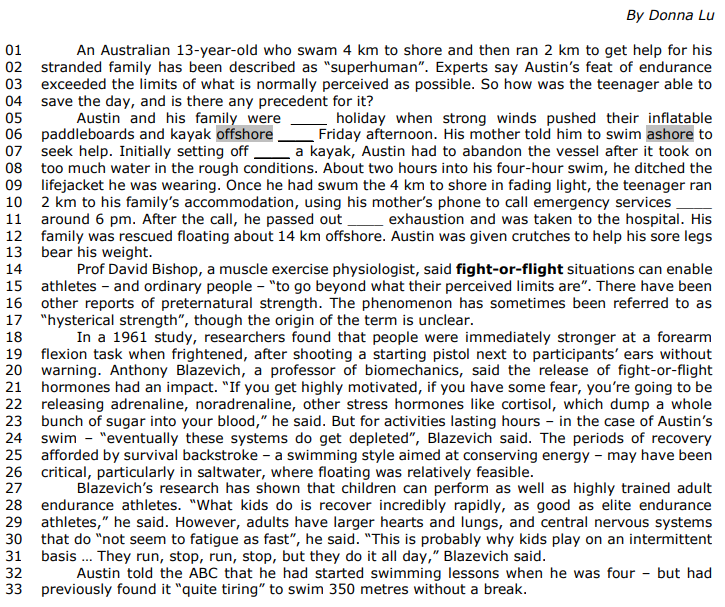
( ) In the sentence “An Australian 13-year-old who swam 4 km to shore” (l. 01), the relative pronoun “who” could be replaced by “that” without changing the meaning.
( ) The sentence “In a 1961 study, researchers found that people were immediately stronger” (l. 18) could be rewritten using the present perfect tense without any change in meaning.
( ) In the sentence “Once he had swum the 4 km to shore in fading light” (l. 09), the verb tense used expresses an action completed before another action in the past.
( ) In the sentence “His family was rescued floating about 14 km offshore” (l. 11-12), the verb form indicates an action performed by the subject “his family”.
The correct order of filling in the parentheses, from top to bottom, is:
Read the text below and answer the questions:
New beginnings in Wrocław: The refugee students building brighter futures
Eighteen-year-old Daria hopes to begin studying psychology at the university in Wroclaw, Poland in the autumn. She already knows what career she wants to pursue: working with formerly incarcerated individuals to support their reintegration into society.
“I want to help people start a new life after having made mistakes,” Daria says. “I believe everyone deserves a chance to change, and I want to support them.” Three years ago, it wasn’t clear that Daria would be able to study psychology at all – or even graduate from secondary school. In early 2022, with the escalation of the war in Ukraine, she was forced to leave her home of Kryvyi Rih in central Ukraine for Wroclaw, together with her mother and younger brother.
Daria was one of hundreds of Ukrainians who ended up at the same high school in Wroclaw. Wrocław’s multicultural identity has long been a source of pride, and the school is no different: out of its 1,500 students, 500 are from Ukraine. There are also students from Belarus, Kyrgyzstan and Kenya, among other countries.
Still, the transition to life in a different country, while being separated from loved ones who remained in Ukraine, was not easy. In the first few months, Daria herself needed psychological support.
Eighteen-year-old Daria hopes to study psychology at university. If that doesn’t work out, she is also considering game design as a backup plan, inspired by her strong interest in video games.
Eighteen-year-old Daria hopes to study psychology at university. If that doesn’t work out, she is also considering game design as a backup plan, inspired by her strong interest in video games.
Fortunately, she found support from the educators and staff at her school. This included the school psychologist, who is Polish but speaks Ukrainian. Her teachers also helped. “They genuinely do everything they can to help us adapt,” Daria says.
“They show us that they are learning together with us – they’re not pretending to know everything. They make mistakes too, they apologize, and everything feels very natural and supportive.”
For 18-year-old Kamila, who graduated from the same high school this year, the language barrier was the greatest challenge. “You don’t immediately understand what the teachers are saying, and you have to ask several times,” she says. “They couldn’t really explain either, because they didn’t speak Ukrainian. That was very hard for me.”
Kamila recalls that during her first months at the new secondary school, she had little time for her hobbies – she spent nearly all her free time learning Polish and keeping up with school assignments. Kamila recalls that during her first months at the new secondary school, she had little time for her hobbies – she spent nearly all her free time learning Polish and keeping up with school assignments.
Subjects like physics and biology were especially difficult because of the complex technical vocabulary. “I had to learn every term from scratch,” says Kamila, who came from IvanoFrankivsk, western Ukraine, with her family in 2022.
Learning Polish wasn’t only key to succeeding in school, but to feeling connected. “Only after I overcame the language barrier I did start participating in extracurricular activities at school,” Kamila explains. “It was important for me to build friendships with Polish students too.”
Despite these difficulties, Kamila now dreams of becoming a translator and is currently learning English and German in addition to Polish.
Seventeen-year-old Sofia, another graduate of the high school, shares this love of language. She studies English, Polish and German. “Aside from languages, I also love history,” she says.
Seventeen-year-old Sofia, who graduated this year from a secondary school in Wrocław, dreams of a career as a translator. She has applied to several universities in Wrocław to pursue her studies.
Seventeen-year-old Sofia, who graduated this year from a secondary school in Wrocław, dreams of a career as a translator. She has applied to several universities in Wrocław to pursue her studies.
Sofia’s passion for history deepened her connection to Wrocław, one of Poland’s oldest and most culturally rich cities. “I really like Wrocław, and right now I think that if my future is in Poland, it will be in this city,” she says.
Like many of her peers, Sofia’s first steps in a new country were filled with fear and uncertainty.
“At the beginning, it was a bit scary – a different country, a different culture, a different language,” she recalls. “But there were actually many kind people who were ready to help. Thanks to them, I managed to adapt, and now I feel quite good living here.”
As well as graduating with honors from her school in Ukraine, in Wroclaw, Sofia received the red stripe distinction, a special recognition for outstanding academic results in Polish schools. She also earned a scholarship for being the top-performing student in the school last year.
Seventeen-year-old Sofia and her mother, Tetiana. The family plans to stay in Poland, as Sofia sees her future in this country.
Sofia and her mother, Tetiana. The family plans to stay in Poland, as Sofia sees her future in this country.
Her family has recently decided to stay in Poland.
“Our daughter sees her future here, and we are ready to support her decision,” her mother Tetiana says.
These stories are a powerful reminder of the resilience and potential of young people when they are given the right opportunities and support.
As we mark International Youth Day, UNICEF celebrates youth like Daria, Kamila and Sofia – who, despite the trauma of war and displacement, are building their futures through education, courage, and determination.
UNICEF, in partnership with local governments and civil society, remains committed to ensuring that every young person has access to quality education and support, no matter their background or circumstances.
This work for refugee children and caregivers from Ukraine in Poland is made possible thanks to the generous support of the Bureau of Population, Refugees, and Migration of the US Department of State (PRM) and the Government of the Republic of Korea and the Government of Japan.
Source: https://www.unicef.org/eca/stories/new-beginnings-in-Wroclaw
Examine the sentence: "These stories are a powerful reminder of the resilience and potential of young people when they are given the right opportunities and support." The verb construction reflects a particular voice and grammatical structure.
Which analysis correctly characterizes this construction?
Identify the correct passive voice transformation for the following sentence:
"The pedagogical coordinator will have finalized the new curriculum by next Monday."
Text I
African schools gear up for the AI revolution
The emergence of cheap or free AI tools is being eagerly embraced by those with smartphones and the ability to get online. As governments and legislators struggle to get their heads around the implications of this powerful technology and work out how to bring in regulations for its safe use, millions of people are enjoying its ability to save time, helping them to transforming raw data into essays, exam answers, or, with a bit more work, even videos and podcasts.
Even in developing countries where electricity and internet access is limited (it’s estimated that over 570 million people in Africa lack electricity), there is enthusiasm for the potential of AI. In the Democratic Republic of the Congo (DRC), for example, a nation riven by internal conflict, poverty and vast inequality, educators are seeing the impact of AI. “It is obvious that our country is lagging behind in terms of new technologies for one reason or another,” says Benjamin Sivanzire, a teacher in Beni, North Kivu Province. “Many parts of the DRC do not even have traditional methods of communication, or even radio or television.” However, even though Mr. Sivanzire and his students are not yet able to make use of AI in their classes, they are seeing it being used in the wider culture, often in a negative way, to manipulate public opinion. The teacher underlines the importance of educating people to distinguish between verifiable information and lies. “There are videos created by artificial intelligence that show images that are not real and have been created for propaganda purposes,” he explains.
One concern that is frequently raised is the extent to which the development of AI tools is concentrated in the hands of a relatively small group of people. Farida Shahid, the independent Special Rapporteur on the right to education, shares these concerns. “AI algorithms are being made by individuals who often sit in a particular location, such as Silicon Valley, where the people who make and test them have their own biases,” she says. “Often the algorithms don’t do well at recognizing people with dark skin. They also have great problems with people who are autistic and don’t like looking into cameras. “Another example is the UK where, recently, an AI program was used to grade exam papers. This led to decisions that were biased against people from certain ethnic backgrounds. We really need to look at this issue more closely, starting with the human rights perspective, and I think that’s where the U.N. role comes in: if you increasingly rely on AI as the source of verification, you’re going to have problems because you are using a framework which privileges white males, and doesn’t reflect the whole gamut of people’s lives and experiences”.
The urgent need to expand the developer talent base has been identified by the UN as central to ensuring that a wide variety of voices are heard in the “EdTech” (educational technology) space. Shafika Isaacs, the head of technology and AI at the UN agency for science, technology and education (UNESCO), says that the number of African EdTech startups has been mushrooming in recent years, with entrepreneurs experimenting with the AIenabled digital tools which could support learning and teaching across many different contexts, including in African languages, and local dialects. “I’ve personally engaged with a startup that matches high school students to career pathways, including choosing the right university, community college or even entrepreneurship program. They have seen strong results because of their focus on children in underprivileged contexts and schools. Tech startups have also looked at developing AI-enabled mobile apps, including chat bots, that can support teachers in teaching literacy or teaching mathematics. “The challenge is that there’s often a disconnect between the public education system and tech startups. We need educators to be proactive in engaging with those developing tools, and we encourage students and teachers to learn how to create and design technologies that are relevant to their linguistic and cultural contexts.”
Many African governments are keen to adopt national AI strategies and integrate AI into their national policies on technologies in education. In Côte d’Ivoire, where AI is already being widely used in the private sector, Mariatou Koné, the Minister of Education, says that the country’s education system is undergoing a transformation, following a 2022 review which recommended a digitalization strategy. “We have put in place initiatives to ensure that everyone is aware of the issue of AI. It can provide individual learning programs, and help struggling students to improve,” said Ms. Koné. “However, we are worried about potential abuses. We have to be able to protect personal data and ensure that learners are aware of the potential dangers.” The Minister agrees that, in order to guard against bias, the pool of engineers building AI tools needs to be expanded. “We need the right tools, adapted to the African context, to the Ivorian context. We have our own history, our own heritage. If we create our own industry, it has to be adapted to the realities of Côte d’Ivoire.”
Available at: https://news.un.org/en/story/2025/01/1159621. Retrieved on: January 6, 2026. Adapted.
Active: “People share misinformation on social media every day.”
"The floods destroyed half of the homes in her village."
(__)The Present Perfect tense is used to describe actions that happened at a specific time in the past, always requiring the use of precise dates like 'last Friday at 2 PM'.
(__)Prefixes and suffixes are used in English to change the meaning or the word class of a base word, such as adding '-ness' to an adjective to form a noun.
(__)The use of modal verbs like 'can', 'must' and 'should' allows the speaker to express different degrees of possibility, obligation and advice in a conversation.
(__)Passive voice is formed by using the verb 'to be' and the past participle of the main verb, focusing more on the action itself than on the person who performed it.
After the analysis, choose the alternative that presents the correct sequence:
Read the following text and answer the next five question.
The implications of a rapidly changing information ecosystem on how governments communicate
Public communication does not happen in a vacuum: the context in which it occurs is core to understanding the challenges and opportunities it faces. Indeed, the analysis of its role for policy and governance mechanisms is made urgent by shifts in the information ecosystem that have transformed the function over the past decade and raised important implications for democracy. The technological revolution that has connected the world through social media has given rise to online social movements and simplified the creation and sharing of content and data. Such changes have also facilitated, however, the spread of mis- and disinformation, contributed to undermining the role of traditional information gatekeepers, and have fundamentally changed how governments communicate. Whereas until the early 2000s a so-called “one-to-many” model of communication prevailed, this has shifted today to a “many-to-many” model. Anyone can be both a producer and a consumer of information, and anybody with an internet connection has the potential to engage with and influence public debates.
Traditionally, governments had largely relied on traditional media to amplify official messages to reach citizens. With the advent of digital channels, this approach has gradually lost its primacy to direct institution-to-individual communication via online platforms that bypass traditional media. This shift has also enabled a broader scope for governments to communicate about more diverse policy issues targeted to more specific audiences, as traditional media tend to concentrate on “newsworthy” subjects and political affairs, often under-reporting less mainstream issues. The unprecedented volumes of data that promise to make communication ever more precise, combined with the direct, unmediated access to vast and diverse publics, are some of the opportunities and challenges that have emerged.
At the same time, digital platforms have altered patterns in eople’s consumption of information and raised demands on their attention. The latter has become a resource that technology companies sell to advertisers. In turn, the design of online platforms and their algorithms, and the massive increase in the volume of information served to increase competition for what content people pay attention to, while making focus more superficial. As governments compete with all other information sources for the public’s attention, cognitive and psychological factors such as information overload can undermine the efficacy of even well-crafted content.
Online and social media have also heightened the pace at which information travels, accelerated the news cycle, and enabled a wider range of actors to drive discussions on policy issues. Taken together, digital technologies have produced a complex information ecosystem that has made it more challenging for official messages to “cut through the noise”. Cumulatively, these changes require considerable adjustments to practices, public officials’ skills, and even to how communication is organised, if governments are to make the most of the digital transformation and ensure it can promote better governance. […]
The ability for governments to use the communication function to promote constructive democratic spaces is critically threatened by widespread mis- and disinformation. When falsehoods spread extensively and rapidly on issues of public policy, official messages are drowned out, creating significant challenges for public communicators to get key information out to all groups in society. Whether in the context of elections, health crises, migration or climate change, mis- and disinformation cast evidence and facts into doubt, sow distrust, and work against policy goals.
Adapted from: https://www.oecd.org/content/dam/oecd/en/publications/ reports/2021/12/oecd-report-on-public-communication_b74311bc/22f8031c-en.pdf
The verb phrase in “official messages are drowned out” (5th paragraph) is in the:
Consider the following pair of sentences:
Active:
“Researchers conducted the experiment carefully.”
Passive:
“The experiment was conducted carefully (by researchers).”
Point the alternative that describes the functional difference between the active and passive constructions:
Consider the sentences below:
The committee rejected the proposal after a long discussion.
The proposal, after a long discussion, was rejected.
After a long discussion, the proposal faced rejection.
Analyze the three statements considering voice, syntactic structure, systemic-functional grammar (theme/rheme), and changes in informational focus. Mark the correct alternative:

 Conheça nossos planos