Questões de Concurso Sobre voz ativa e passiva | passive and active voice em inglês

Foram encontradas 377 questões

Q2297184 Inglês
TEXT:

Mistakes help you learn
Maija Kozlova
May 19, 2021


It is not uncommon for English language lessons to favour communication over accuracy: real life is nothing like a classroom! In real-life situations, when you make a mistake in the language you are learning, context provides ample information as to what the intended message is. In fact, most of the time, impeccable accuracy is not needed at all! “Don’t worry about making mistakes,” I used to tell my English language students. “Communicating is the most important thing!”


While making mistakes when trying to master a language might seem counter-intuitive, letting learners freely communicate and negotiate meaning is key to success. A learner who communicates a lot while making a few mistakes is much more likely to develop confidence for dealing with real-life situations than a learner who communicates very little because they’re afraid of making any. In communicative language teaching, for example, the teacher is tasked with both encouraging the learner to express themselves and with providing corrective feedback in a way that is not obstructive to communication. 


This means that if a learner says, “I go swimming last night,” it is much more effective to respond with, “Oh, that’s nice, you went swimming. What did you do after?” rather than, “No! You went swimming! Use past simple for past events!” – the former encourages the learner to continue their narrative while the latter is much more likely to make the learner stop in their tracks, re-evaluate the context, and think twice before expressing themselves again in the future, for the fear of making a mistake again. Teachers need to be careful not to parrot back everything the students say in this manner, of course, but the technique can be an effective method of acknowledging the content of a student’s response, while also providing feedback on accuracy.


The importance of the freedom to make mistakes in language learning is also supported by research in psychology, which suggests that learners who try a task without having mastered it completely experience improved retention of new information. A similar experiment in the context of language learning also indicates that the process of making mistakes activates a greater network of related knowledge in the brain, which leads to superior learning outcomes.


It is believed that the key to help learners feel relaxed and ready for communicating freely in the classroom is authenticity. This means that there should be both a real communicative need for a learner to speak and the authentic reaction from those around to what the learner has said.


Here are a few ways of how such authentic communicative interactions can be practiced in the classroom: 


• surround learners with the English language – encourage them to speak to you and each other in English;

• don’t worry about diverging from topics that are not strictly covered in your lesson plan;

• model communication by telling your students stories and anecdotes about your own life and encourage them to do the same;

• let your learners have fun with English – give them colloquial expressions to try and ask them to share some expressions

; • do not overcorrect – make a note of errors and cover it in subsequent lessons;

• avoid the temptation to turn what was intended as speaking practice into a full-on grammar lesson.


While easier said than done, especially when the outcome of an exam is at stake, it is worth remembering that people that our learners might come to interact with outside of the classroom are driven by the natural desire to understand the people they communicate with. This is especially powerful when practiced in the context of a classroom. They set the learners up for success in real-life communication. In other words, when communication is the goal, mistakes are secondary, and that’s real life, isn’t it?


Adapted from: https://wwwcambridgeenglish.org/blog/mistakes-help-you-learnfreedom-to-fail-in-games-and-language-learning/
A sentença que contém uma forma verbal na voz passiva é:
Alternativas
Q2291639 Inglês
READ TEXT I AND ANSWER QUESTION

Text I

English Language Learning In Brazil

        According to the BNCC1 , learning English enables students to engage and participate in a globalized and pluralistic world. It allows students to develop a critical mindset and exercise their citizenship rights while expanding the possibilities of interaction and mobility. In this sense, the BNCC outlines three critical implications for the English curriculum. The first is the globalized nature of English, in which the concepts of language, territory and culture are reconsidered since English speakers are no longer found only in countries where English is the official language. The second implication concerns broadening the definition of literacy, bringing the concept of “multi-literacies” to the Brazilian curriculum as students expand their linguistic knowledge, and English becomes a symbolic asset for Brazilians to express themselves in a different language. Finally, the third implication concerns different teaching approaches, which implies embracing the culture and traditions of the language, not only the formal grammatical standards, breaking with aspects related to “correctness”, “accuracy”, and “proficiency”.

        […]

        Even in a challenging context, it is clear that Brazil has made significant progress by approving a new and flexible curriculum for upper secondary schools and putting English mandatory in the standard part of the curriculum. However, major efforts are still required to ensure the smooth implementation of this reform, which the pandemic and the difficulties in coordination across the national and subnational levels have already hindered. 

1BNCC: Base Nacional Comum Curricular

Adapted from: https://www.thedialogue.org/analysis/english-language-learning-inbrazil/

 
The excerpt “major efforts are still required” (2nd paragraph) is in the
Alternativas
Q2267404 Inglês
Which sentence is in the Passive Voice? Choose the CORRECT answer.
Alternativas
Q2240735 Inglês
The following excerpts from the text were adapted and they are all in passive voice, EXCEPT for: 
Alternativas
Q2206406 Inglês
“The Little Prince”, now, is a movie

Alex Weiss

    An all-time favourite children’s book, The Little Prince by Antoine de Saint-Exupéry has been turned into a beautifully animated movie — and it’s finally being released. The inspiring lessons, timeless story, and beautiful quotes from The Little Prince make this a perfect choice for an on-screen adaptation. At one point or another, your parents read this book to you when you were a child, and then you picked it up later on in life, realising how incredibly important this small book truly is.
The sentence in bold type in the text is in the 
Alternativas
Q2204958 Inglês
Text I

What is English as a Lingua Franca?

      ‘English’, as a language, has for some time been seen as a global phenomenon and, therefore, as no longer defined by fixed territorial, cultural and social functions. At the same time, people using English around the world have been shaping it and adapting it to their contexts of use and have made it relevant to their socio-cultural settings. English as a Lingua Franca, or ELF for short, is a field of research interest that was born out of this tension between the global and the local, and it originally began as a ramification of the World Englishes framework in order to address the international, or, rather, transnational perspective on English in the world. The field of ELF very quickly took on a nature of its own in its attempt to address the communication, attitudes, ideologies in transnational contexts, which go beyond the national categorisations of World Englishes (such as descriptions of Nigerian English, Malaysian English and other national varieties). ELF research, therefore, has built on World Englishes research by focusing on the diversity of English, albeit from more transnational, intercultural and multilingual perspectives.
      ELF is an intercultural medium of communication used among people from different socio-cultural and linguistic backgrounds, and usually among people from different first languages. Although it is possible that many people who use ELF have learnt it formally as a foreign language, at school or in an educational institution, the emphasis is on using rather than on learning. And this is a fundamental difference between ELF and English as a Foreign Language, or EFL, whereby people learn English to assimilate to or emulate native speakers. In ELF, instead, speakers are considered language users in their own right, and not failed native speakers or deficient learners of English. Some examples of typical ELF contexts may include communication among a group of neuroscientists, from, say, Belgium, Brazil and Russia, at an international conference on neuroscience, discussing their work in English, or an international call concerning a business project between Chinese and German business experts, or a group of migrants from Syria, Ethiopia and Iraq discussing their migration documents and requirements in English. The use of English will of course depend on the linguistic profile of the participants in these contexts, and they may have another common language at their disposal (other than English), but today ELF is the most common medium of intercultural communication, especially in transnational contexts.
        So, research in ELF pertains to roughly the same area of research as English as a contact language and English sociolinguistics. However, the initial impetus to conducting research in ELF originated from a pedagogical rationale – it seemed irrelevant and unrealistic to expect learners of English around the world to conform to native norms, British or American, or even to new English national varieties, which would be only suitable to certain socio-cultural and geographical locations. So, people from Brazil, France, Russia, Mozambique, or others around the world, would not need to acquire the norms originated and relevant to British or American English speakers, but could orientate themselves towards more appropriate and relevant ways of using English, or ELF. Researchers called for “closing a conceptual gap” between descriptions of native English varieties and new empirical and analytical approaches to English in the world. With the compilation of a number of corpora, ELF empirical research started to explore how English is developing, emerging and changing in its international uses around the world. Since the empirical corpus work started, research has expanded beyond the pedagogical aim, to include explorations of communication in different domains of expertise (professional, academic, etc.) and in relation to other concepts and research, such as culture, ideology and identity.

Adapted from https://www.gold.ac.uk/glits-e/ back-issues/english-as-a-lingua-franca/

In the opening sentence, the verb phrase in “‘English’, as a language, has for some time been seen” is in the
Alternativas
Q2201492 Inglês

Read the sentences from the text given and tick the alternative with the passive voice structure.


I. This realization can be used to your advantage as a teacher.

II. It exposes them to different ways of thinking.

III. They are being given appropriate materials and practice for their own needs.

Alternativas
Q2184935 Inglês
Text: The importance of the PowerPoint as a classroom resource
(Text adapted from Teachers: 5 Tips for Creating Great PowerPoint Presentations, retrieved

   PowerPoint is a resource developed by Microsoft and released initially in 1990. It is mainly used in professional meeting presentations all over the world.
    One of these professions is in educational area: teacher.
    PowerPoint presentation is spread among teachers because it is different from lecturing or teaching with a textbook; it is also a way of sharing content with students.
    To produce a PowerPoint correctly, teachers need to know how to put the slides together, it can be an effective way of reinforcing content to students so that they are better able to retain it. Otherwise, teachers can print and distribute the PowerPoint presentation or post it online, so students can go back and access it as reference material. However, if it is not put together correctly, a PowerPoint presentation can disengage and make students bored.
   To develop PowerPoint presentation is simple and it can also provide a fun time noticed by its characteristics: basic, simple, and not distracting, it can be focused on keywords; for instance, always be sure to include a summary slide of what the presentation is intending to accomplish as well as a table of contents on the different topics that will be covered in the program. The summary slide serves as the main topic and what students should learn after viewing the presentation. Then, at the end of the PowerPoint presentation, teachers should include another summary slide, going over everything that was just covered and, again, highlighting the main point.

Bottom line
    PowerPoint presentations need to have a purpose and the teacher must make sure that the purpose is understood.

Add pictures
    Teachers can reinforce the content with pictures, charts, symbols, and other images. In fact, sometimes it’s better to have more pictures than text in a PowerPoint presentation, because images work to reinforce a content main point.
     Teachers typically will just share it with their classes, so they can pull images straight from the Internet. However, for teachers who are making more public and widespread presentations, copyright law needs to be considered (Brazil Information Access Law nº 12.527; Art. 31; paragraph 3; item II). 

Add video
      Pictures can help to reinforce a main point or support content, as well as videos. Some research affirm that students enjoy watching videos and retain information from them well, especially if the video is engaging, interesting and informative. Teachers can embed videos right from YouTube or from their desktops to complement a PowerPoint presentation.

Practice
      Nothing turns off a class like a poorly put together PowerPoint presentation, so teachers should always be sure to do a quick rehearsal before they present it to the class. While testing it, make sure all the images load up on the slides, videos load up properly and audio works, too. Also, it’s important for teachers to make sure that there’s a way to connect their computer, or upload anything that’s storing the PowerPoint presentation, to a larger TV monitor or projector screen so the whole class does not have to huddle around a computer screen to view it. Teachers should also make sure that any text can be read and understood. Be sure that the color scheme is good.

Make it fun
    A PowerPoint presentation can be an innovative way of teaching. It’s a more interesting and engaging way for students to learn than the typical lecture. Teachers should embrace this teaching resource and have fun with it. Throw in some jokes, possibly some funny pictures and be sure to get creative with presentations.

      As we previously noted, the more students enjoy a lecture, presentation, or activity, the more likely they are to retain information. 
Read the fragments from the text and tick the alternative that is not a passive voice structure.
Alternativas
Q2184916 Inglês
A questão foi desenvolvida em língua inglesa e/ou língua portuguesa oficial do Brasil. 
Notice the passive voice structure in this sentence: “These themes were codified into pictures” (by the educators). Now choose the alternative with the correct passive voice structure.
Alternativas
Q2174631 Inglês
Which sentence is in the Passive Voice? Choose the CORRECT answer.
Alternativas
Q2170185 Inglês
Marque a alternativa correta quanto às formas de voz passiva:
Alternativas
Q2170184 Inglês
Observe o período abaixo e assinale a alternativa que corresponde à voz passiva dessa construção:
They should have locked the jewels in a safe.

Alternativas
Q2104176 Inglês
Instruction: answer question based on the following text.

The consecration of the Coronation Oil 


(Available in: https://www.royal.uk/consecration-coronation-oil – text specially adapted for this test). 
The sentence “The olives were pressed just outside Bethlehem” (l. 07-08) is in the passive voice. Choose the option that shows the sentence correctly rewritten in the active voice, using the same verb tense. Note that “people” was added to adjust the excerpt to the active voice structure. 
Alternativas
Q2095727 Inglês
Instruction: answer question based on the following text.


What is Quality Assurance?


Available at: https://www.glassdoor.com/Job-Descriptions/Quality-Assurance.htm
Find the sentence with the passive voice structure in the same verb tense as “products made by the company” (line 03).
Alternativas
Q2074616 Inglês

Cybersecurity: An overview of cyber challenges facing the nation, and actions needed


Federal agencies and the nation’s critical infrastructure — such as energy, transportation systems, communications, and financial services — depend on Information Technology (IT) systems to carry out operations and process essential data. However, the risks to these IT systems are increasing—including insider threats from witting or unwitting employees, escalating and emerging threats from around the globe, and the emergence of new and more destructive attacks. Rapid developments in new technologies, such as artificial intelligence, the Internet of Things, and ubiquitous Internet and cellular connectivity, can also introduce security issues. Over 28,000 security incidents were reported by federal civilian agencies to the Department of Homeland Security in FY 2019.

Additionally, since many government IT systems contain vast amounts of personally identifiable information (PII), federal agencies must protect the confidentiality, integrity, and availability of this information—and effectively respond to data breaches and security incidents. Likewise, the trend in the private sector of collecting extensive and detailed information about individuals needs appropriate limits.

To highlight the importance of these issues, Government Accountability Office (GAO) has designated information security as a government-wide high-risk area since 1997. This high-risk area was expanded in 2003 to include the protection of critical cyber infrastructure and, in 2015, to include protecting the privacy of PII.

GAO has made about 3,300 recommendations to federal agencies to address cybersecurity shortcomings—and we reported that more than 750 of these had not been fully implemented as of December 2020. We designated 67 as priority, meaning that we believe they warrant priority attention from heads of key departments and agencies.

Adapted from: https://www.gao.gov/cybersecurity. Available on November 16th, 2022

Which of the sentences from the text presented below is in the Passive Voice?
Alternativas
Q4242890 Inglês

Instruction: answer the question based on the following text.



Txt._2.png (770×585)


Which of the following excerpts from the article is in the passive voice? 
Alternativas
Q4155792 Inglês
Leia o texto a seguir para responder à questão.

One of the objectives of the project, Re-imagining Multilingualisms, was to reimagine. The term ‘reimagining’ is something extremely important because imagining and being creative are not things we are used to doing in the academy, not in Linguistics at least! We believe that we are empiricists, that we only look at facts and we make conclusions. We are pseudo-scientists. We make conclusions about what we observe, and we think that what we observe has got nothing to do with what we imagine. On the contrary, it has everything to do with what we imagine. So, when we analyse things ideologically, what is ideology? It’s exactly an imagination which has been naturalised and institutionalised. And so, whenever we look at the world, we’re looking at it from the eyes of a particular learned knowledge, an ideology. When we are asked to be able to imagine things, it’s a point of being able to break out of our established learning and looking for something new. Imagining is extremely important in the learning process. If it doesn’t happen, there is no learning. This is one of the important things of Freirean pedagogy. For example, he made the distinction between what he called ‘banking pedagogies’ or ‘transmission pedagogies’ where there’s just reproduction and repetition, and ‘transformative pedagogies’, what he called ‘liberatory pedagogies’, which is where creativity is involved, where you break the simple linearity of repetition and transmission. So how does this work? How do you promote creativity? It is by breaking what previously seemed natural and normal.

(MENEZES DE SOUZA, 2019, p. 9, ênfase no original) MENEZES DE SOUZA, L. M. Decolonial pedagogies, multilingualism and literacies. Multilingual Margins, vol. 6 (1), 2019. p. 9-13. 
Considering the linguistic elements in the text, 
Alternativas
Q4139722 Inglês

Instruction: Answer the question based on the following text. The highlighted excerpt from the text is quoted in the question.


How gender bends gender 


(Available in: https://www.languagemagazine.com/2022/03/16/how-gender-bends-meaning/ – text especially

adapted for this test).

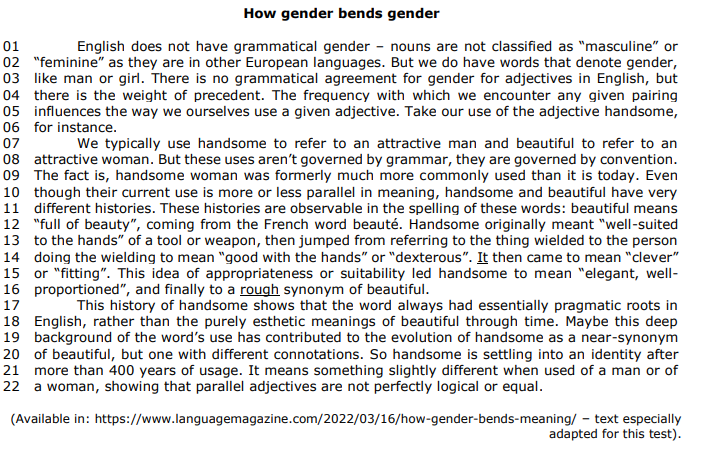
“But these uses aren’t governed by grammar, they are governed by convention”. The underlined structures are in the:
Alternativas
Q4006643 Inglês
Which sentence is in the Passive Voice? Choose the CORRECT answer.
Alternativas
Q4004152 Inglês
The passive construction can be quite useful, especially when a writer chooses to use it in order to emphasize one thing over another as it is the case of the headlines. Read the headlines below.
I. 6 N.Y.C. Landlords Prosecuted for Overcharging Tenants (The New York Times Oct. 20)
II. How Being Denied an Abortion Affects Women (The New York Times Oct. 20)
III. Charles W. Duncan Jr., Energy Secretary in Oil Crisis, Is Dead at 96 (The New York Times Oct. 20)
IV. Will Smith Film ‘Emancipation’ Will Be Released in December (The New York Times Oct 3)
V. Elon Musk Offered to Buy Twitter at a Lower Price in Recent Talks (The New York Times Oct 6)
Choose the only alternative that has headlines with the passive voice.

Alternativas
Respostas
241: D
242: C
243: D
244: A
245: D
246: D
247: D
248: B
249: A
250: C
251: A
252: B
253: C
254: C
255: B
256: E
257: D
258: C
259: B
260: B