Questões de Concurso
Sobre voz ativa e passiva | passive and active voice em inglês
Foram encontradas 377 questões


Read the text and answer the following questions
American man stolen as a baby in Chile meets mother at 42
By CNN's Rafael Romo
Published 3:05 AM EDT, Sat September 9, 2023
Jimmy Lippert Thyden says he always knew he was adopted. He also knew that he had been born not in the United States, but in Chile. Raised in Virginia by very loving and committed adoptive parents, he says he never lacked anything. The 42-year-old who served in the US Marines is now an attorney who is married and has two young daughters.
“I was told that I was given up for adoption out of love,” Thyden said. “Given by a mother who loved me and wanted the best for me: a life full of opportunity, education and meaning.”
That all started to change in 2012 when his adoptive mother gave him his adoption paperwork as he was preparing to deploy to Afghanistan. Thyden says that when he started looking closely at the adoption files, he found out that there were many discrepancies and inconsistencies.
There was one document that said he had no known father or mother. Another provided the name of a biological mother and her address. A third document specified the baby had no living relatives, and a fourth stated that he had been given up for adoption days after birth. Yet another document said he had been given up for adoption when he was two years old.
Thyden says it was not until a few months ago, when his wife read about the case of Scott Lieberman, that he became actively engaged in uncovering the truth about his adoption.
As CNN reported in May, Lieberman, the 42-yearold American from San Francisco, had also been adopted from Chile and had recently found out that he had been stolen as a baby. That’s how Thyden learned about “Nos Buscamos” (We Search for Each Other), a Chilean non-profit organization devoted to helping people stolen as babies find their biological parents and families.
During the dictatorship of General Augusto Pinochet, from 1973 to 1990, many babies were funneled to adoption agencies. Some of the children came from rich families, who in many cases gave up babies born out of wedlock. Other babies from poorer backgrounds were simply stolen.
Chilean officials say the number of stolen babies could be in the thousands, but the country’s investigation into the controversial adoptions has languished. Some who took part in the illegal adoptions have died. Many clinics or hospitals where the babies were allegedly stolen no longer exist.
After reaching out to “Nos Buscamos,” Thyden says he got an email the next day from its director, Constanza del Río, who told him to call her right away. With the help of MyHeritage, an online genealogy company, Thyden got a match within a few weeks. When the match came back, del Río says she knew the next step was making a phone call to María Angélica González, 69, a woman who had believed for decades her son had died shortly after being born.
“She could not believe it. She thought it was a joke in poor taste because she had been told her premature baby boy had died,” del Río said. Del Río says González had been told the baby’s body had been disposed of in the trash. During the Pinochet dictatorship, when several thousand people were killed and disappeared, asking too many questions or protesting in a loud way could be dangerous. (Chile will mark the 50th anniversary of the coup that brought Pinochet to power on September 11.)
Learning the truth has been bittersweet for Thyden. He’s happy to finally know his true origins but sad about what his biological mother went through.
After three agonizing months, he was finally able to travel to Chile to give his biological mother the hug that had to wait for 42 years. When they met in the southern city of Valdivia in mid-August, he was finally able to utter the words he had been rehearsing for weeks. “Hola, mamá!,” he said when they finally embraced.
Thyden says that learning the truth has also been painful because his adoptive parents were also lied to and victimized. He says his adoptive parents first contacted an adoption agency in Virginia and specifically asked to adopt a child the right way, through a reputable agency, something that they put in writing.
“It’s not wasted on me that I recognize that I’m blessed in the fact that I have loving families on both sides of the equator. Are those things that I did because of where I was or are those things that I did because they are at the core of who I am?,” said Thyden, who pointed out that he says “mom” or “mother” when he’s speaking about his American adoptive mother and “mamá” when he refers to his Chilean, biological mother.
In the end, he says, the wisdom about what happened to him came from his five-year-old daughter, who told him if a bad thing hadn’t happened, she wouldn’t be here. And her father, she told him, has not one but two families who love him deeply.
(Adapted from www.cnn.com)
Regarding American man stolen as a baby in Chile meets mother at 42 text, read the following sentences and select the one that uses the passive form in its structure.
I - Jimmy Lippert Thyden says he always knew he was adopted.
II - The 42-year-old who served in the US Marines is now an attorney who is married and has two young daughters.
III - I was told that I was given up for adoption out of love.
IV - He became actively engaged in uncovering the truth about his adoption.
V - During the dictatorship of General Augusto Pinochet, from 1973 to 1990, many babies were funneled to adoption agencies.
VI - Lieberman, the 42-year-old American from San Francisco, had also been adopted from Chile.
Mark the correct alternative:
Answer questions according to TEXT.
About passive voice, analyze the sentences e choose the right option:
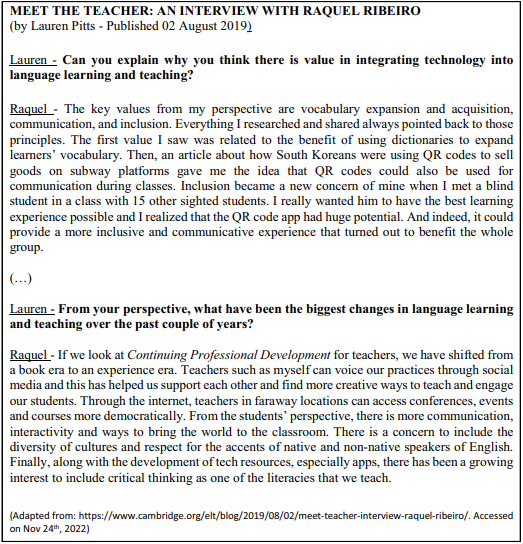
I- Sometimes, the agent isn’t necessary;
II- We can change the ‘verb to be’ by ‘got’, without change the meaning;
III- If we put the sentence ‘The Cartoon Introduction to Climate Change was first published in 2014’ in active voice the subject would be Yoram and Grady;
Text 1
Green shoppers around the world
If you want to be a responsible consumer, think about not just how much you buy, but also about what’s good for the planet. Green Shoppers United is an international non-profit organization for the promotion of responsible consumerism.
Labels
Read the labels. Some...................the ingredients that manufacturers use in products, such as cosmetics or toiletries, can damage the environment. Some ingredients are only used...................make things prettier, or more colorful, but they might also be harmful. Don’t buy things that contain substances that harm you or the world you live................... For example, research shows a potential link...................the preservatives called parabens, often found in beauty products, and some types of cancer.
Transport
In today’s global economy, it is easier for companies to buy products and materials where they’re cheap, and transport them over enormous distances to get them to customers. If you can, buy things locally. The local food movement has grown steadily in recent years, and it’s often possible to track down locally grown, or produced, products, rather than those that have been transported long distances. If we stop buying goods that have had to fly over continents to get to us, companies may stop transporting them around unnecessarily. A bargain may cost you less personally, but the real price we pay for it in the long run may turn out to be too high, as jet fuel continues to pollute our environment.
Environment
Responsible consumers recycle to reduce waste, and its negative impact on our environment. A lot of the plastic packaging we use for food and drink is recyclable, but not all of it. The most common packaging materials are still non-recyclable polyethylene and PVC. Seventy million tons are used every year. Look at the recycling labels carefully. Manufacturers should use recyclable plastics, like PET, wherever possible. Some have also begun using lighter materials, for example, 30% lighter PET plastic for drinks bottles, to reduce the amount of plastic waste. Transporting lighter materials is cheaper, and uses less fuel, too – so the solution may actually benefit everyone.
Packaging
We’ve all purchased products wrapped in foil, then sealed in a bag, and then put in a box. Why? Write to companies that you think produce wasteful packaging. Ask them to think about what’s really necessary. Make them realize they can save money by using less packaging and, at the same time, help save our planet.
Consumers
A lot of us expect products these days to be more environmentally friendly. However, research has shown that we don’t want to pay more, and we don’t want to compromise on the quality of products, either. For example, one manufacturer recently had to switch back to less environmental packaging of potato chips, just because customers didn’t like the noise their “green” bags made when they were opened! Think about the effects of your shopping choices. Buy less to save the world, and join our effort to make shopping greener!
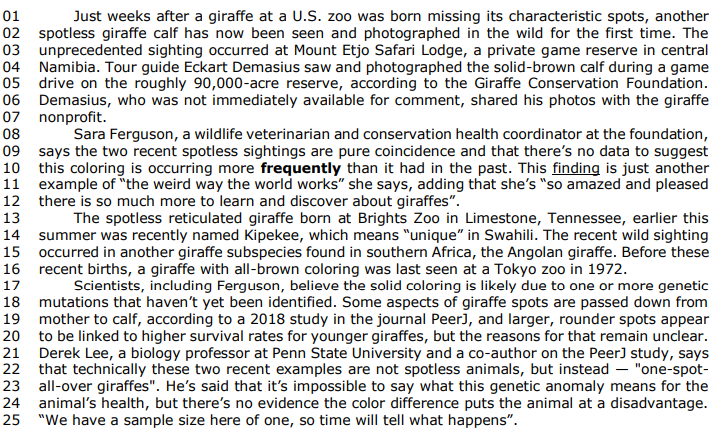
“The local food movement has grown steadily in recent years, and it’s often possible to track down locally grown, or produced, products, rather than those that have been transported long distances.”
We can infer that the underlined words are being used in which verb tenses?
Analyze the following expression and answer the question
Fonte:https://www.amazon.com.br/Light-Has-Been-BrokenSupernatural-ebook/acesso em: 06 de out de 2023.
The Rise of the “Bike Bus” Movement
01 On Earth Day* 2022, Sam Balto, a physical education teacher in Portland, convinced a few
02 dozen parents to send their kids to school on their bikes and posted the first in a series of videos
03 that turned his “bike bus” into a viral sensation. Balto has continued documenting his weekly
04 bike buses with joyous videos that show students rolling to school while he blasts music from an
05 eclectic collection of artists, including AC/DC, Metallica, and OneRepublic. Over time, these
06 boisterous bike buses have grown to more than 150 kids. “The more these kids practice riding
07 bikes, the more confident they become. And now they want to keep riding on non-bike bus days,
08 and even on rainy days!” said Balto.
09 Balto’s bike bus is much more than a fad. His TikTok and Twitter videos have raked in
10 millions of views, inspiring similar initiatives in New York, New Jersey, Florida, Utah, Ohio, and
11 Texas. Bike buses previously existed in European cities such as Barcelona and London, but new
12 ones in cities like Cape Town are now joining the trend. Nancy Pullen-Seufert, the director of the
13 National Center for Safe Routes to School, said biking and walking to school have myriad benefits,
14 including “improving air quality, improving safety for walkers and bicyclists, increasing physical
15 activity, and making it easier for school buses and others who can’t actively travel to school to
16 arrive to school on time.”
17 Balto has also triggered real political change by working with lawmakers to pass a so-called
18 “Bike Bus Bill”, that was signed into law by Oregon Governor Tina Kotek in August. “The bill
19 brings flexibility so school districts can now use student transportation funds, which were
20 previously only for school buses, to pay for crossing guards or adults to lead walking school buses
21 or bike buses. It’s awesome.” Balto said. And he is not the only bike bus leader driving positive
22 change in Oregon… Last year, Megan Ramey, who has been organizing a bike bus ___ 2020, was
23 named the Safe Routes to School Manager at Hood River County School District and since then,
24 she has secured nearly $11 million in funding to make it safer for kids to walk and bike to school.
25 “I feel like I'm in a cash-grabbing machine. We just got $7 million to create an off-road trail to
26 the high school. This means kids will be able to bike to high school on a green trail instead of a
27 car-centered road,” said Ramey.
28 Nearly 90% of kids walked to school in 1969. Half a century later, in 2017, that number
29 had fallen to just 10%. That year, a third of students took the school bus and more than half
30 were driven in a private vehicle. This has led to more pollution, with researchers finding that
31 toxic car fumes have an adverse effect on attention, reasoning, and academic performance
32 among school children. In New York, the Open Schools Program has helped increase biking and
33 walking in the 65 schools that restricted traffic during drop-off and pick-up times this year, said
34 Sabina Sethi Unni, who works at Open Plans, a non-profit that supports the shift to walkable
35 cities. “This program makes kids more comfortable with walking and biking at a young age. When
36 they get older, they will be cyclists instead of car users,” said Unni.
(Available in: https://www.distilled.earth/p/the-rise-of-the-bike-bus-movement – text especially adapted for this test).
*Earth Day: a day in April designated for promoting concern for the environment (Merriam-Webster).
Mark the sentence below that shows the adapted excerpt “Balto has triggered real political change (…)” (l. 17) correctly rewritten in the passive voice, in the same verb tense.
Choose the sentence in the passive voice.
A frase “The fruits are being sold by my son” na voz ativa fica:
Read the Text I and answer the question that follow it.
Text I
Correspondence
Human genome editing: potential seeds of conflict
Recently, The Lancet published an important declaration regarding the necessity of regulating and legislating for human genome editing. We agree with their opinions that the human genome editing technology and resulting research can have both positive and negative effects on human society. The use of genome editing for research and commercial purposes has sparked debates in both biological and political realms. However, most of them have mainly focused on the effects of human genome editing on the patients themselves, and little attention has been paid to their offspring.
Several films, such as Gattaca and Gundam SEED, have addressed the conflicts that arise from human genome editing. Such conflicts not only exist within the generation who have experienced editing but are also transmitted to their offspring. For example, in these films, the offspring of people without genome editing felt a sense of unfairness regarding the inferiority of their physical (or other non-edited domains) status, whereas the offspring of people with genome editing grew up in a biased, discriminated against, and ostracized environment. They could have lived in peace with a strong and well regulated government; however, when the tenuous grip of government weakens, jealousy and resentment can lead to ruins. Although these scenes still exist in films, they might become increasingly plausible in decades to come. Using the concept of preparedness, access, countermeasures, tools, and trust, we should prepare legitimate human genome editing, establish access to deal with imminent or potential discrimination, develop countermeasures and tools for prevention and resolution of conflict, and entrust future generations with the responsibility to use them wisely.
Bing-Yan Zeng, Ping-Tao Tseng, *Chih-Sung Liang
Adapted from: www.thelancet.com, vol. 401, June 24, 2023 at
https://www.thelancet.com/action/showPdf?pii=S0140-6736%2823%2901084-X

 Conheça nossos planos