Questões de Concurso
Sobre voz ativa e passiva | passive and active voice em inglês
Foram encontradas 377 questões


The structure "has been broken" is in the:
Mark the correct alternative
Text 04
However, teachers and teachers in training need to be able to use approaches and methods flexibly and creatively based on their own judgment and experience. In the process, they should be encouraged to transform and adapt the methods they use to make them their own. Training in the techniques and procedures of a specific method is probably essential for novice teachers entering teaching, because it provides them with the confidence they will need to face learners and it provides techniques and strategies for presenting lessons. In the early stages, teaching is largely a matter of applying procedures and techniques developed by others. An approach or a predetermined method, with its associated activities, principles, and techniques, may be an essential starting point for an inexperienced teacher, but it should be seen only as that. As the teacher gains experience and knowledge, he or she will begin to develop an individual approach or personal method of teaching, one that draws on an established approach or method but that also uniquely reflects the teacher's individual beliefs, values, principles, and experiences. This may not lead to abandonment of the approach or method the teacher started out using but will lead to a modification of it as the teacher adds, modifies, and adjusts the approach or method to the realities of the classroom.
(Source: Jack C. Richards. Approaches and Methods in Language Teaching (Cambridge Language Teaching Library) (Locais do Kindle 3227-3233). Edição do Kindle).
Based on the previous text, judge the following item.
In the second paragraph, the sentence “Language teaching
was suspended by local education boards at one in five
primary schools in January 2021 due to Covid-19” is in the
passive voice and could be correctly rewritten as Due to
Covid-19, local education boards suspended language
teaching at one in five primary schools in January 2021.
Music Enabling Cognitive Work
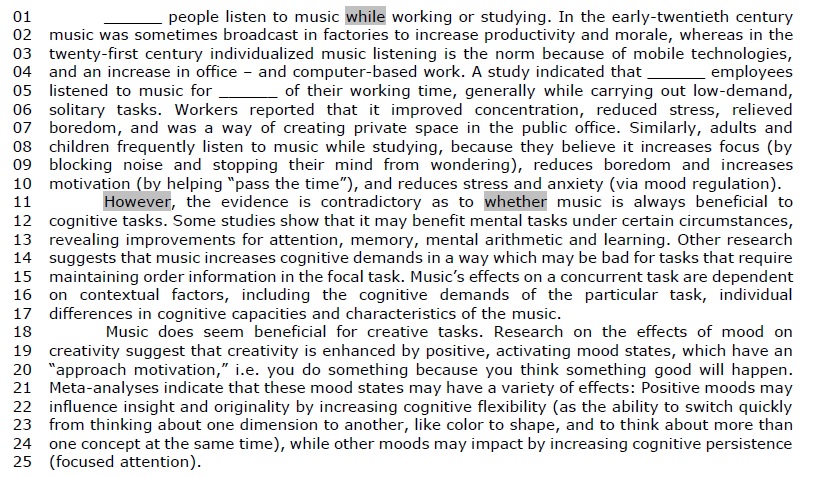
(Avaliable in: ASHLEY, R. and TIMMERS, R. (Editors) The Routledge Companion to Music Cognition. New York:
Routledge, 2017 – text adapted specially for this test).
(l. 01-02): I. “Music was sometimes broadcast” is in the simple present, in a passive voice structure.
II. The adverb “sometimes” could be replaced by “rarely” with no changes in meaning.
III. The word “increase” could be translated as “aumentar”.
Which ones are correct?
1. The underlined words in the sentence “This long, pointed stick was first used as a weapon…” is an example of active voice in the past tense.
2. The words in bold “they” and “their”, in the text, are being used as a personal pronoun and a possessive adjective, respectively.
3. The negative form of the following sentence: “Do exercises for your arms, legs, back, and neck…” is “Don’t exercise your arms, legs, back, and neck…”.
4. The word ‘properly’ in “it’s important to warm up properly before practicing the javelin.” is an adverb that means correctly or satisfactorily.
Choose the alternative which contains the correct sentences.
The Amazon Forest
The Amazon is often called the lungs of the earth and produces 20% of the world’s oxygen. For this reason, many people are trying to stop deforestation in the rainforest. Brazil, for example, is working hard to help the rainforest survive.
A few years ago, the Brazilian government put forward a plan called ARPA (Amazon Region Protected Areas). It had the support of many international agencies, including the World Bank, and the German Development Bank, KfW. The main aim was to build new areas of protected rainforest, maintain areas of the rainforest that hadn’t yet been destroyed, and stop deforestation. Deforestation contributes greatly to global warming because carbon dioxide is released into the atmosphere when trees get cut down and burned.
One of the first areas to be recognized as part of ARPA was the Tumucumaque Mountains National Park. It is 38,800 km2 and is the same size as Switzerland, a small country in Central Europe. It’s the world’s largest protected tropical national park, and the second largest national park. It is home to certain species of jaguar, eagle, and lizard, which can only survive in the rainforest. Many of these species are under threat from climate change and deforestation.
In order to work in the park, conservationists need
a reliable map. However, no map existed, and they
didn’t have enough knowledge to make one on their
own. They came up with the idea of involving local
tribes to help them, combining modern and ancient
methods to produce a map. The tribes learned to use
global positioning system handsets (GPS), in conjunction with their local knowledge of the area, which
included fishing and hunting grounds, and places of
historical or mythical importance. Aerial photos were
a 20useful aid in the process as well. This method of
map-making is now the key to the future of rainforests,
in Brazil and the rest of the world too.
Text 4A1-I
President Joe Biden predicted Thursday that student loan borrowers will start receiving relief – which is currently on hold over a court challenge – within weeks, projecting confidence that his administration will win the challenge. “We’re going to win that case. I think in the next two weeks you’re going to see those checks going out”, Biden told a TV news correspondent.
The Biden administration started taking student debt forgiveness applications on October 14 and officials have said it could take weeks to process and grant relief. Eligible borrowers won’t be receiving actual checks. Instead, they will see up to a $ 20,000 reduction in their student debt balances. The Department of Education has told borrowers who are eligible for automatic debt relief, without filing an application, not to expect the debt cancellation before November 14.
A federal appeals court put a temporary hold on the administration’s student loan forgiveness program last week, which barred the government from canceling loans covered under the new policy while the court considers a challenge brought by six Republican-led states. The Biden administration is also facing lawsuits from Arizona Attorney General Mark Brnovich, and conservative groups such as the Job Creators Network Foundation and the Cato Institute.
Biden’s student loan forgiveness program, first announced in August, aims to deliver debt relief to millions of borrowers before federal student loan payments resume in January after a nearly three-year, pandemic-related pause.
The President made his comments during an interview with a local TV station network during his visit to Syracuse, New York, to tout a new deal on semiconductor manufacturing. With less than two weeks until the midterm elections Biden took questions on the economy, his message to voters, and the stalled student debt relief program. President Joe Biden is canceling some federal student loan debt, making a once pie-in-the-sky idea a reality. The application officially opened Monday, allowing low- and middle-class federal student loan borrowers to apply for up to $ 20,000 in debt relief.
https: <www.edition.cnn.com> (adapted).
Read the text and choose the best alternative for the questions that follow
THE FLIPPED CLASSROOM FOR ENGLISH LANGUAGE TEACHING
What is it?
The flipped classroom concept Flipped learning is a form of blended instruction that mixes ''synchronous‘ learning with 'asynchronous‘ independent study. Synchronous learning usually takes place in real time in a physical classroom, though it can also take place in a virtual classroom online. Asynchronous learning is more independent. Content is usually accessed through some form of digital platform. Students can choose when they work, so whilst they can ask questions and share ideas with teachers and classmates, feedback may be delayed.
In a flipped learning model, independent study is used to input core ideas, concepts, or language prior to group study time. In group study time, students focus on practical tasks that enable them to develop a deeper understanding of their new knowledge and extend their skills. The traditional model of a classroom – where students receive input, then complete practice tasks for homework – is therefore 'flipped‘. Video, text, and audio input Video is commonly used as an input medium for self-study as it is accessible and allows students to stop and re-watch content as needed. Text and audio can also be used to develop content knowledge and ensure students are fully prepared for the synchronous class
What does it mean for the ELT classroom?
One of the key benefits of flipped learning is that it gives students more responsibility for their own learning. Outside the classroom, students are able to work at their own pace, whilst lessons become more student-centred. More importantly, it allows the teacher to dedicate more classroom time to practical, engaging, and interactive activities and projects.
Flipped learning means that appropriate amounts of time are given to introducing, clarifying, and practising new language. Language input is taught or revised during the pre-class learning stage, allowing more time for the students to practise interacting with the language in the classroom and to actively develop all of their language skills. Teachers are able to plan more effective lessons which meet the needs of their learners by focusing on additional language input, language revision, and language practice as required.
With more time spent producing language in class through speaking, writing, and project work, teachers have more opportunities to observe their students using the language and identify their strengths and weaknesses. This allows them to adapt the pace and content of their input accordingly, ensuring lessons are personalized and tasks are differentiated for each individual student.
In taking more responsibility for their own learning, students develop more effective independent study skills as they look for solutions and solve problems. This independence can lead to improved self-esteem and, in turn, higher levels of engagement.
What are the challenges?
Students may need support adjusting to flipped learning since it requires high levels of motivation and self-regulation. They might also need time management tips to help them allocate enough time to work through the pre-class materials. However, since the teacher can never assume that all students will arrive for lessons fully ready for the language practice stage, a certain amount of reviewing and revision should be built into every lesson, allowing for further clarification and peer teaching. In time, students should see the benefits of being prepared for lessons.
Some students may struggle to understand the input for the lesson without teacher or peer support. The teacher needs to be especially careful to ensure the materials they give are scaffolded well enough that all students gain the knowledge they need to complete the active tasks in the classroom.
Flipped learning requires teachers to take on more of an observational, supportive role and respond to individual students‘ needs, so further training and support may be needed as they experiment with this new approach.
There are currently relatively few professionally produced materials available which support the learning of English using a flipped model. Depending on what is available, teachers might need to acquire the skills and knowledge to source or produce high-quality, engaging materials for themselves. Rather than starting from scratch, teachers can look for videos that are appropriate for their learners and supplement them with engaging videos of their own as they build up a bank of resources over time.
Teachers need to be able to monitor students during the asynchronous preparation stage to gauge whether they can cope with the practice-orientated tasks in the classroom. To do this, teachers may need to allow extra time for accessing a learning management system (LMS) so they can stay up to date with student progress.
How can this be implemented?
Realistic expectations Whilst careful planning will go some way to ensuring success, be aware that establishing a successful flipped classroom may take time. For the first few classes, you may have students turning up unprepared. If you respond by reverting back to the way you taught previously, then it‘s unlikely that your classroom will flip. Keep persevering with the classes you planned until students adjust to the new way of learning and their new responsibilities. It takes time to create a new habit.
When preparing the asynchronous input, think about it in terms of bite-sized chunks of learning. The optimum length for a video clip is around two and a half minutes. If you can‘t cover what the students need to know in that time, then break down the input into shorter videos. Students are more likely to watch two short videos than one long video.
Passively watching or reading content doesn‘t provide an engaging learning experience, and it‘s easy for students to tune out. So, once you have created your content – whether it‘s text, audio, or video – be sure to design tasks to engage the students and guide them towards the learning outcomes. These could be comprehension-checking tasks or note-taking tasks, or you could establish forums to enable peer interaction around the content. Asking students to create something, like a role-play or short piece of writing, can be a great way for students to show what they have understood.
If you decide to create video content, make use of visuals to help convey meaning. It‘s easy to stand in front of the camera and talk, but that doesn‘t make for interesting or engaging viewing. It‘s far more effective to combine visuals with your words, as you would with your whiteboard in the classroom. An easy way to do this is to use presentation software to build the visuals and then record a voiceover. Most standard presentation applications offer this functionality.
Building your videos into an LMS will help you to monitor and understand how each student is using the content. You can also use it to build interactive materials that guide students‘ understanding of the content and which give them feedback on what they are learning.
If your classroom has desks in rows, think about how you can rearrange the furniture so that the room is more conducive to group work. For instance, put tables into blocks for students to work in small groups. Make sure that you leave enough space to move between the tables to monitor the work students are doing and to give support when they need it. Think about how and when you intervene in activities and provide correction and support. Be a good listener, make notes of any problems or new language your students need to do the activities more effectively, and set aside time to deal with these issues.
Adapted from: https://jcj.uj.edu.pl/documents/15103613/146115492/oup-focus-flipped-classroom.pdf/362253c0-07ca-4361-a1da-d740018255e6 (Accessed on
01.24.2022)
Leia o texto a seguir e responda a questão.
“He remembered the time he had hooked one of a pair of marlin. The male fish always let the female fish feed first and the hooked fish, the female, made a wild, panic-stricken, despairing fight that soon exhausted her, and all the time the male had stayed with her, crossing the line and circling with her on the surface.
He had stayed so close that the old man was afraid he would cut the line with his tail which was sharp as a scythe and almost of that size and shape. When the old man had gaffed her and clubbed her, holding the rapier bill with its sandpaper edge and clubbing her across the top of her head until her colour turned to a colour almost like the backing of mirrors, and then, with the boy’s aid, hoisted her aboard, the male fish had stayed by the side of the boat.
Then, while the old man was clearing the lines and preparing the harpoon, the male fish jumped high into the air beside the boat to see where the female was and then went down deep, his lavender wings, that were his pectoral fins, spread wide and all his wide lavender stripes showing. He was beautiful, the old man remembered, and he had stayed.”
HEMINGWAY, Ernest. The Old Man and the Sea.
Eua: Hueber Verlag, 1952. 108 p.
“Then, while the old man was clearing the lines and preparing the harpoon”
Assinale a alternativa que apresenta, corretamente, a frase acima em sua forma de voz passiva:
Fonte: https://english.elpais.com/spain/2021-10-05/how-lava-from-the-la-palma-volcano-turned-a-beloved-beach-into-the-newest-territory-on-earth.html
É possível afirmar que o trecho “The platform that has been formed by the molten rock off the coast of the Spanish Canary Island”:

I. In S1, the word “number” is a noun. II. In S2, the word “how” is an adverb. III. S1 is written in active voice, and S2 is written in passive voice.
Which statements are correct?
 EASTWOOD, John. A basic English grammar exercises.
 Text II
Pollution

 Conheça nossos planos