Questões de Concurso
Sobre voz ativa e passiva | passive and active voice em inglês
Foram encontradas 377 questões


The grandmother __________ that her grandson _________ in the school.
I- is told – was taken good care of II- was telled – was taken good care of III- has told – taken good care of IV- was told – had been taken good care of
Check the correct alternative:
“Why did the student do such a mistake?”
In the Passive voice:
“Joana told John to give up smoking.”
INSTRUCTIONS: Read the following text carefully and then choose the correct alternatives that answer the questions.
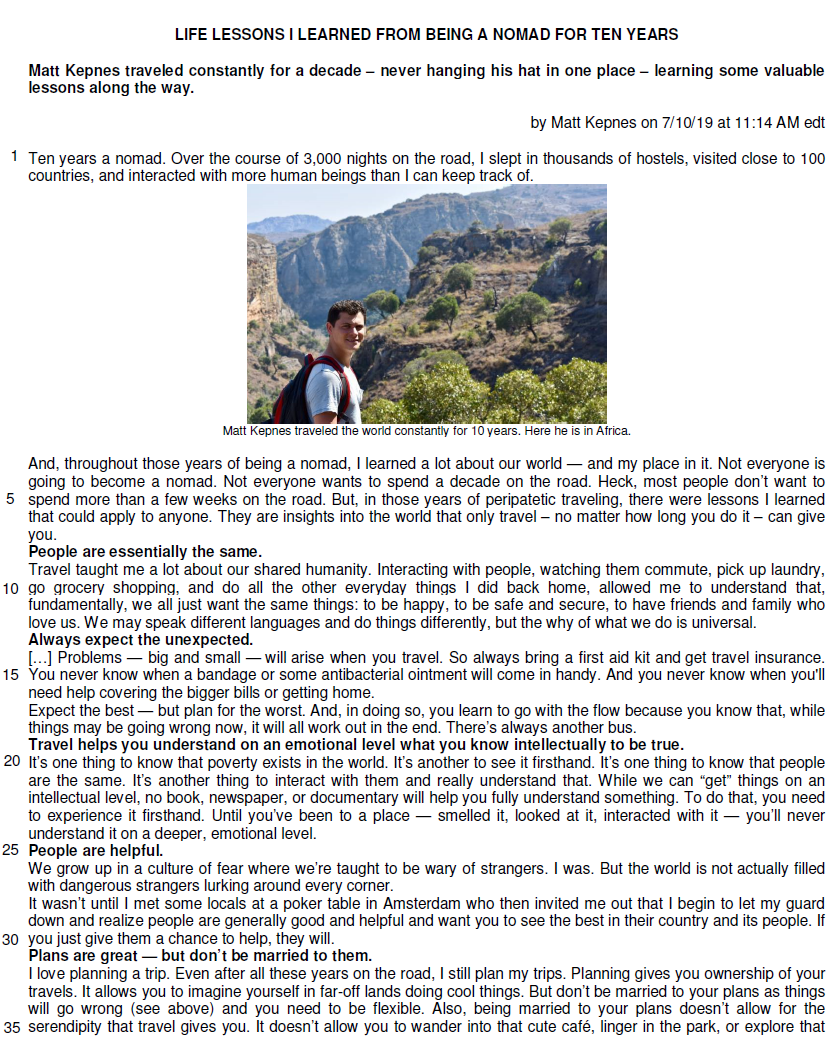
Source:<https://www.newsweek.com/9-life-lessons-matt-kepnes-learned-being-nomad-ten-years-1448511>
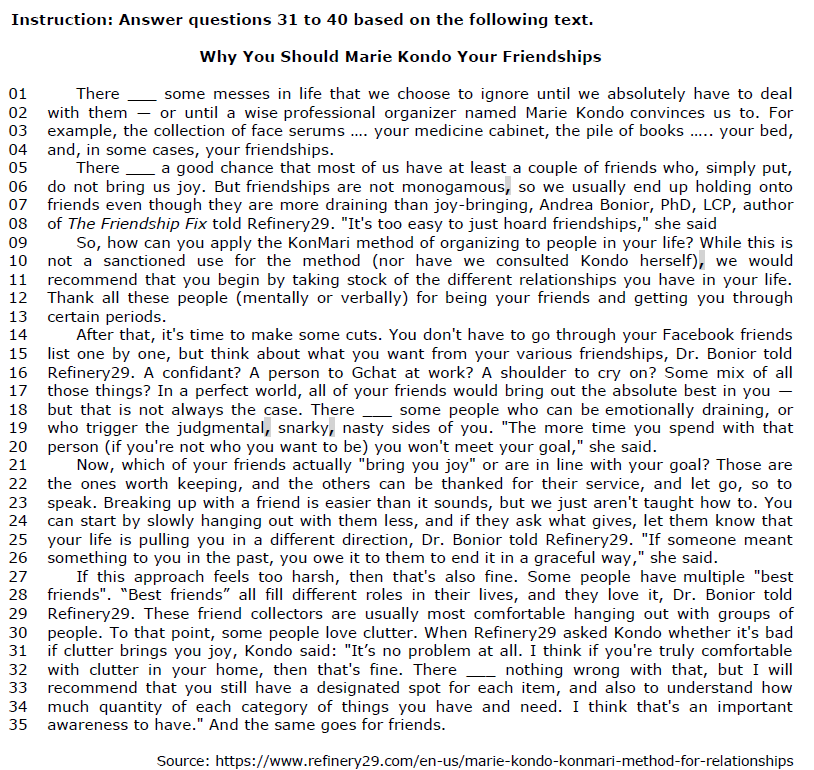
“Some people have multiple "best friends". “Best friends” all fill different roles in their lives, (l.27-28)”. To avoid the repetition of ‘best friends’, it would be necessary to:
I. Change the second occurrence of “Best friends” to ‘who’. II. Only change the full stop to a semi-colon. III. Convert the second sentence to passive voice.
Which ones are correct?
While at home in Ireland my poor mother wept bitter tears at the thought of her daughter with the university education serving hamburgers to pop stars.
I had been working there about six months the night I met James. It was a Friday night, which was traditionally the night the OJs frequented our restaurant. “OJ” standing, of course, for Office Jerks.
At five o’clock every Friday, like graves disgorging their dead, offices all over the center of London liberated their staffs for the weekend so that hordes of pale, cheapsuited clerks descended on us.
It was de rigueur for us waitresses to stand around sneering disdainfully at the besuited clientele, shaking our heads in disbelieving pity at the attire, hairstyles, etc., of the poor customers.
On the night in question, James and three of his colleagues sat in my section and I attended to their needs in my normal irresponsible and slapdash fashion. I paid them almost no attention whatsoever, barely listened to them as I took their order and certainly made no eye contact with them. If I had I might have noticed that one of them (yes, James, of course) was very handsome, in a black-haired, green-eyed, five-foottenish kind of way. I should have looked beyond the suit and seen the soul of the man.
Oh, shallowness, thy name is Clare.
But I wanted to be out back with the other waitresses, drinking beer and smoking and talking about sex. Customers were an unwelcome interference.
“Can I have my stake very rare?” asked one of the men.
“Um,” I said vaguely. I was even more uninterested than usual because I had noticed a book on the table. It was a really good book, one that I had read myself.
I loved books. And I loved reading. And I loved men who read. I loved a man who knew his existentialism from his magi-realism.And I had spent the last six months working with people who could just about manage to read Stage magazine (laboriously mouthing the words silently as they did so). I suddenly realized, with a pang, how much I missed the odd bit of intelligent conversation.
Suddenly the people at this table stopped being mere irritants and took on some sort of identity for me.
“Who owns this book?” I asked abruptly, interrupting the order placing.
The table of four men were startled. I had spoken to them! I had treated them almost as if they were human!
“I do,” said James, and as my blue eyes met his green eyes across his mango daiquiri, that was it, the silvery magic dust was sprinkled on us. In that instant something wonderful happened. From the moment we really looked at each other, we both knew we had met someone special.
I maintained that we fell in love immediately.
He maintained nothing of the sort, and said that I was a romantic fool. He claimed it took at least thirty seconds longer for him to fall in love with me.
First of all he had to establish that I had read the book in question also. Because he thought that I must be some kind of not-so-bright model or singer if I was working there. You know, the same way that I had written him off as some kind of subhuman clerk. Served me right.
KEYES, Marian. Watermelon. New York: Perennial,
HarperCollins, 2002 (Edited).
Consider the following sentence, taken from the text and simplified for better practice: “At five o’clock every Friday, offices all over the center of London liberated their staffs.”
Choose the alternative which presents the correct form of the sentence in the passive voice:
Instruction: Answer question based on the following text.
Matilda: an extra-ordinary bookworm! – Lesson Plan

Source: https://www.roalddahl.com/docs/MatildaLessonPlan201_1567179949.pdf
Column 1 1. Active voice. 2. Passive voice.
Column 2 ( ) the book that they have chosen (l.05-06). ( ) Matilda has read (page 12) into a genre (l. 18-19). ( ) One of the cards has been left blank for children (l.19). ( ) how they have been inspired by reading Matilda […] (l.42).
The correct order of filling in the parenthesis, from the top to the bottom, is:
I. He ______ a new job last week. II. The father _____ his son to go to sleep. III. Her purse______ at the party last night.
Mark the CORRECT arswer.
How monks helped invent sign language
For millennia people with hearing impairments encountered marginalization because it was believed that language could only be learned by hearing the spoken word. Ancient Greek philosopher Aristotle, for example, asserted that “Men that are deaf are in all cases also dumb.” Under Roman law people who were born deaf were denied the right to sign a will as they were “presumed to understand nothing; because it is not possible that they have been able to learn to read or write.”
Pushback against such ideas began in the 16th-century, with the creation of the first formal sign language for the hearing impaired, by Pedro Ponce de León, a Spanish Benedictine monk. His idea to use sign language was not a completely new one. Native Americans used hand gestures to communicate with other tribes and to facilitate trade with Europeans. Benedictine monks had used them to convey messages during their daily periods of silence. Inspired by the latter practice, Ponce de León adapted the gestures used in his monastery to create a method for teaching the deaf to communicate, paving the way for systems now used all over the world.
Building on Ponce de León’s work, another Spanish cleric and linguist, Juan Pablo Bonet, proposed that deaf people learn to pronounce words and progressively construct meaningful phrases. Bonet’s approach combined oralism – using sounds to communicate – with sign language. The system had its challenges, especially when learning the words for abstract terms, or intangible forms such as conjunctions like “for,” “nor,” or “yet.”
In 1755 the French Catholic priest Charles-Michel de l’Épée established a more comprehensive method for educating the deaf, which culminated in the founding of the first public school for deaf children, in Paris. Students came to the institute from all over France, bringing signs they had used to communicate with at home. Insistent that sign language needed to be a complete language, his system was complex enough to express prepositions, conjunctions, and other grammatical elements.
Épée’s standardized sign language quickly spread across Europe and to the United States. In 1814 Thomas Gallaudet went to France to learn Épée’s language system. Three years later, Gallaudet established the American School for the Deaf in his hometown in Connecticut. Students from across the United States attended, and they brought signs they used to communicate with at home.American Sign Language became a combination of these signs and those from French Sign Language.
Thanks to the development of formal sign languages, people with hearing impairment can access spoken language in all its variety. The world’s many modern signing systems have different rules for pronunciation, word order, and grammar. New visual languages can even express regional accents to reflect the complexity and richness of local speech.
(Ines Anton Rayas. www.nationalgeographic.com. 28.05.2019. Adaptado)
We’re having the house painted next week.
In the passive sentence above, we can understand that:
I. We are not going to paint the house ourselves;
II. Someone else will paint it;
III. The emphasis is on who is painting the house.
Indicate the correct alternative according to the context.
How can you stop your kids viewing harmful web content?
As concerns grow about the effect of harmful social media content on our children, we look at what tools are available for parents to regulate what kids see and how long they spend online.
The struggle to prise them away from a life spent online is a familiar one for many beleaguered parents. Our youngsters spend hours on Instagram chasing "likes" - and often coming up against cyber-bullying - or playing games, obsessing about YouTube influencers or surfing between different "friendship groups" on WhatsApp.
So how can we keep them safe from harmful content?
Content filtering software has been around for many years, but parents have often been too tech-shy to work it properly. And it often required children to hand over their passwords - a potential cause of family rows.
But now a new generation of digital parental controls has arrived on the market, promising to help parents take back control more easily.
- • UK plans social media and internet watchdog
Circle with Disney, Koala Safe and Ikydz, for example, are systems that claim to be able to control every digital device in your home with a few taps on a smartphone app. use, but is ?
The new products work by connecting to your existing household wi-fi router. In the case of Circle you plug in the white cube - clearly inspired by the Apple school of design - and it immediately lists every connected phone, laptop, tablet, and so on in your home, and offers a variety of ways to control them. (…)
(…) Anne Longfield, the Children's Commissioner for England, thinks it is good parenting to set limits.
"The internet can be a great resource, but it can also be the wild west for children. We wouldn't think it was OK to drop our children off in the park at night if they were younger," she says.
"In the same way we shouldn't think it is OK for them to roam the internet without any guidance or restrictions."
There are disadvantages with these latest filtering devices, though. Some don't work once your child's phone leaves the home and is no longer on home wi-fi. And they won't all work if the wi-fi is switched off and the internet is accessed via mobile data. Other products are also incompatible with some UK routers.
Source: https://www.bbc.com/news/business-47853554(adapted) Access: APRIL 18th,,2019
TEXT II
What to Know About the Controversy Surrounding the Movie Green Book
Depending on who you ask, Green Book is either the pinnacle of movie magic or a whitewashing sham.
The film, which took home the prize for Best Picture at the 91st Academy Awards, as well as honors for Mahershala Ali as Best Supporting Actor and Nick Vallelonga, Brian Currie and Peter Farrelly for Best Original Screenplay, depicts the burgeoning friendship between a black classical pianist and his ItalianAmerican driver as they travel the 1960s segregated South on a concert tour. But while Green Book was an awards frontrunner all season, its road to Oscar night was riddled with missteps and controversies over its authenticity and racial politics.
Green Book is about the relationship between two real-life people: Donald Shirley and Tony “Lip” Vallelonga. Shirley was born in 1927 and grew up in a well-off black family in Florida, where he emerged as a classical piano prodigy: he possessed virtuosic technique and a firm grasp of both classical and pop repertoire. He went on to perform regularly at Carnegie Hall— right below his regal apartment—and work with many prestigious orchestras, like the Chicago Symphony and the New York Philharmonic. But at a time when prominent black classical musicians were few and far between due to racist power structures, he never secured a spot in the upper echelons of the classical world. (African Americans still only make up 1.8 percent of musicians playing in orchestras nationwide, according to a recent study.)
Vallelonga was born in 1930 to working-class Italian parents and grew up in the Bronx. As an adult he worked as a bouncer, a maître d’ and a chauffeur, and he was hired in 1962 to drive Shirley on a concert tour through the Jim Crow South. The mismatched pair spent one and a half years together on the road — though it’s condensed to just a couple of months in the film — wriggling out of perilous situations and learning about each other’s worlds. Vallelonga would later become an actor and land a recurring role on The Sopranos.
In the 1980s, Vallelonga’s son, Nick, approached his father and Shirley about making a movie about their friendship. For reasons that are now contested, Shirley rebuffed these requests at the time. […]
(Source: from http://time.com/5527806/green-book-movie-controversy/)
INSTRUCTIONS: Read the text carefully and then answer the questions from 33 to 38 by choosing the correct alternative.
Brazil corruption scandals: All you need to know
For the past three years, Brazil has been gripped by a scandal which started with a state-owned oil company and grew to encapsulate people at the very top of business - and even presidents.
On the face of it, it is a straightforward corruption scandal - albeit one involving millions of dollars in kickbacks and more than 80 politicians and members of the business elite.
But as the tentacles of the investigation dubbed Operation Car Wash fanned out, other scandals emerged.
It has led to some of those who have found themselves accused claiming they are the victims of political plots, designed to bar them from office.
What is Operation Car Wash?
Operation Car Wash began in March 2014 as an investigation into allegations that Brazil's biggest construction firms overcharged state-oil company Petrobras for building contracts.
Investigators accused directors at the firm - named the world's most ethical oil and gas company in 2008 - of skimming the extra money off the top as a bribe for awarding the contract.
Which is bad enough - but then the Workers' Party found itself dragged into the corruption scandal amid allegations of having funneled some of these funds to pay off politicians and buy their votes and help with political campaigns.
Among those accused in the scandal were dozens of politicians, and Luiz Inacio Lula da Silva - the country's extremely popular former president, known affectionately as "Lula".
In the sentence: ''For the past three years, Brazil has been gripped by a scandal…'' the underlined expression is:
The sentence below uses a specific grammar structure, which one? Choose the CORRECT answer.
“The office was cleaned yesterday.”

 Conheça nossos planos