Questões de Concurso
Sobre voz ativa e passiva | passive and active voice em inglês
Foram encontradas 377 questões


O texto seguinte servirá de base para responder às questões de 1 a 9.
Valdivia Figurines and the appeal of 'the oldest'
(1º§) The logo for the Ecuadorian Ministry of Culture website is about my favourite thing of the afternoon which is saying a lot since I spent much of the day reading about giant Olmec heads. Three Valdivia Figurines in the colours of the Ecuadorian flag? I am sold! Golly, I love Valdivia figurines for all the right and all the wrong reasons.
(2º§) There are two things that can easily be said about Valdivia figurines: they are VERY Ecuadorian and they are VERY looted. The first explains why they appear prominently on the Ministry of Culture website (and on stencilled graffiti around Quito circa 2007). Ancient Ecuador has played second fiddle to Ancient Peru since the early days of archaeology. The Valdivia culture, however, represents something that Peru doesn't have, 'the oldest'. Everyone loves 'the oldest', national pride, etc. etc.
(3º§) Who else loves 'the oldest'? Collectors and Museums. If the Valdivia pottery sequence is the oldest in the new world, collectors want a slice of that pie. Heck, even better than some junky pottery, the Valdivia made interesting figurines: lovely ladies that look good on stark black backgrounds in auction catalogues. They are part of 'the oldest' yet they also look good.
(4º§) Valdivia sites are famously looted and Valdivia figurines are famously faked. A few years back I started doing some initial work into looting in Ecuador (which led to fieldwork in Quito and the cloud forest that didn't really go anywhere as of yet) and I, like anyone else going down that road, came across Bruhns and Hammond's 1983 Journal of Field Archaeology piece 'A Visit to Valdivia'. Knowing nothing at all about Ecuador at the time, I had never heard of Valdivia, a wonder since the only Ecuadorian archaeology books that Cambridge owns are a few by the late Betty Meggars and Emilio Estrada from the 1950s and 1960s which link uber-ancient Ecuador to Jomon Period Japan (yeah...I know). As Bruhns and Hammond relate, Meggars detected faking at Valdivia immediately after the start of her excavations: practical jokers who discovered a market for their copies. As the market for the pieces grew, the presumed fakes get more and more elaborate and fanciful...and Valdivia sites were just looted to pieces.
(5º§) So really with Valdivia we are left with a situation where we don't know what is real. It is directly comparable to the Cycladic Figurine problem: the corpus is mostly looted, it contains tons of forms not found in the limited archaeological excavations that have been conducted, and we intellectual consumers of artefacts don't know what to believe. To me Valdivia figurines are the perfect looting Catch 22: they warrant study so that the interested public can learn about 'the oldest', but they can't be studied because collectors wanted 'the oldest' so sites were looted and buckets of fakes were produced.
(6º§) In 2007 I bought a fake Valdivia figurine in Otavalo which now stands in a Spondylus shell on my counter and watches me cook. The fella selling it to me told me it was real. I knew it wasn't but made to put it back saying something along the lines that law breaking makes me sick. He quickly agreed that it wasn't real and cut his asking price by a ton. Que Sera. Three cheers, Ecuadorian Ministry of Culture, your logo is the best.
https://www.anonymousswisscollector.com/2012/09/valdivia-figurines-a
nd-appeal-of-oldest.html
Which sentence in the text contains a passive construction?
The passive voice cannot be used in all verb tenses, even if it fits the required structure. It is composed of the verb 'to be' followed by the main verb in the past continuous form.
I - There’s __ great restaurant nearby. II - ___ next part will be next month, time and venue TBA. III - Is there anybody here?
Read Text I and answer question.
Text I
How to have a healthier relationship with your phone
A few years ago, a Google employee sent an email to thousands of her co-workers: What if for six weeks straight, you spent one night per week without technology? The email was from Laura Mae Martin, Google’s executive productivity adviser, a role that, among other things, was created to help staff members foster healthier relationships with their gadgets and apps. After she sent the note, Ms. Martin was flooded with responses from coworkers eager for a respite from some of the very products they helped build. Thousands of employees have since participated in the annual “No-Tech Tuesday Night Challenge,” said Ms. Martin.
The problem she was trying to solve isn’t unique to Google workers. One survey found that Americans say they spend too much time on their phones. But dramatic solutions – a digital detox, a phone downgrade or a complete exit from social media – may feel impractical.
Is it possible to have a healthy relationship with technology while still using it daily? Fortunately, according to experts, the answer is a resounding ‘yes’ and here are a few things you can try:
First, start with one simple question.
You know that urge you get to reach for your phone without realizing it? And then, before you know it, you’re an hour into a social media binge? If you want to peacefully coexist with technology, you need to get a handle on those impulses, said Richard J. Davidson, the founder and director of the Center for Healthy Minds at the University of Wisconsin-Madison. According to him, people should start by noticing when they have an urge to lift their phone or open social media on their browser window. By becoming conscious of what you’re about to do, you’re interrupting an automatic behavior and awakening the part of your brain that governs self-control, he added. As one research article suggests, awareness of your actions can help you rein in bad habits.
Secondly, take the “mobile” out of your mobile devices.
Dr. Anna Lembke, a professor of psychiatry and addiction medicine at Stanford University School of Medicine, said one of the biggest problems with smartphones is what she calls “texting while running to catch a bus.” Using our devices while we’re on the move – walking from meeting to meeting, taking a child to school or catching a bus – prevents us from being more engaged in our lives, Dr. Lembke said.
One way to create harmony with technology is to limit your phone use when you’re on the move. Headed out for a walk? Turn off your notifications. Going to grab a coffee? Leave your phone on your desk. If you’re feeling brave, try powering down your phone while in transit. It won’t buzz with notifications, text messages or phone calls, which Dr. Lembke said could help you focus on the world around you.
Last of all, make technology work for you.
One thing experts agree on: To forge a healthy relationship with technology, you need to be in control of it and not the other way around. Think about your gadgets as tools that you decide how to use.
“Make it work for you, not against you; whether it’s an email program or your dishwasher, it’s the intention behind how you’re using it that really makes the big difference”, said Ms. Martin, the productivity expert at Google.
(Adapted from:
https://www.nytimes.com/2024/03/21/well/social-media-phone-addiction.html)
Poor Things – Emma Stone transfixes in Lanthimos’s thrilling carnival of oddness
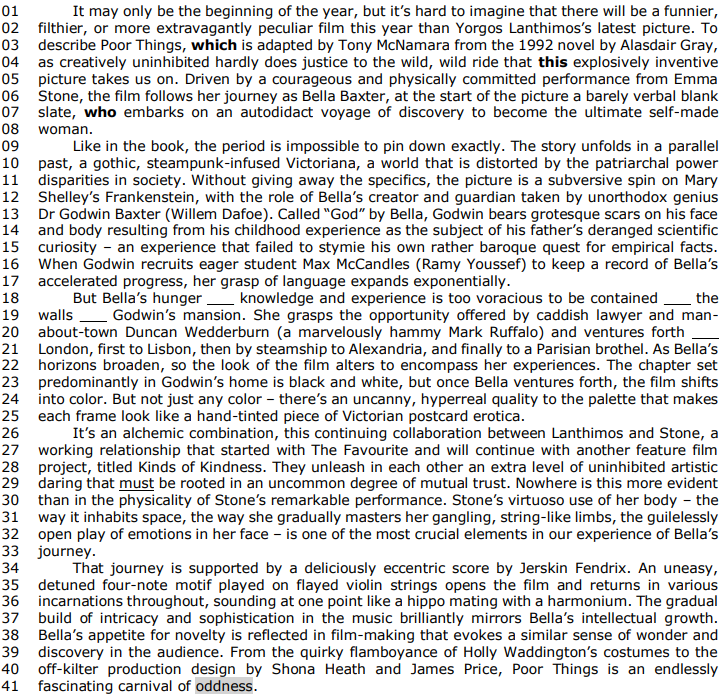
(Available at: www.theguardian.com/film/2024/jan/14/poor-things-review-yorgos-lanthimos-emma-stonefrankenstein – text specially adapted for this test).
TEXT I
Is English language teaching for you? A guide to a new career
Marie Therese Swabey
June 14, 2021
Whether you’re just starting out or thinking of a career change, teaching English as a foreign language is one of the most rewarding professional journeys you can embark on.
In English language teaching, there is a lot of career potential. As you develop your skills and take on more responsibilities, you can enjoy a long-term career. Many professionals become senior teachers or teacher trainers, or move into management or materials writing.
Why become an English language teacher?
There are lots of reasons you might want to become an English language teacher. For a start, you can make a real difference in people’s lives. According to a 2019 survey by Wall Street English, 18% of professionals who have learned English report that they feel happier at work; 12% say they feel happier in general; and half of English speakers earn 25% more because of their language skills.
Moreover, English language teaching is an immensely flexible profession. You can decide whether to take a public or private job, or offer lessons on your own. Your working conditions are flexible too. You might prefer to work in a local school or academy, but many English language teaching jobs also allow you to work online from home. And if you’re feeling adventurous, there are lots of opportunities to live and work abroad, in a new country and culture. If you do travel further afield, you might even learn a new language of your own.
English language teaching is a career that encourages creativity. You’ll become an expert at designing lessons and making learning materials to meet the needs of your students. Best of all ... it’s fun! You spend your day with interesting, engaging people who are keen to learn. What could be better than that?
What do English language teachers do every day?
It probably goes without saying that language educators teach students English on a day-to-day basis. But there are plenty of other aspects to the job as well.
English language teachers assess their learners through quick tests and official exams. They use this information to define learning objectives, and then plan courses and classes that meet their students’ needs.
Language teachers use a range of coursebooks and English language teaching materials, including a variety of audio, visual and digital tools. At the same time, they find and create teaching and learning materials of their own.
In the process of developing learners’ reading, listening, speaking andwriting abilities, teachers also help students develop confidence in presenting and communicating ideas. Furthermore, language teachers encourage students to develop important 21st century skills, such as creativity, collaboration, leadership, autonomous learning and adaptability. These skills are transferable and will help learners in many areas throughout their lives.
What do you need to become an English language teacher?
Being a good English teacher requires more than just being able to speak the language fluently. You’ll also need a comprehensive knowledge of English grammar, pronunciation and vocabulary, combined with excellent communication skills. Teachers of young learners will also need to have an understanding of how to teach engaging, effective classes to children.
It helps if you are comfortable speaking in front of other people, managing groups of learners, and able to plan and organise your time. And it’s important to have a friendly, sympathetic nature and a good degree of cultural sensitivity. After all, you’ll be working with people from all over the world and all walks of life.
Where can you teach?
There are opportunities to teach the English language almost everywhere. For example, you can teach English in an Englishspeaking country such as the UK, the US, Canada, Australia, New Zealand or Ireland. You’ll find many private and public programmes and classes for people who have come to work or study, and who need to improve their English.
Alternatively, you can teach English in schools and universities in countries where English is the official language – but not always how people communicate on a daily basis. Nigeria, Malta, India and Sierra Leone are examples. You might also prefer to teach in non-English-speaking countries, where you’ll have the opportunity to immerse yourself in the local culture and learn a new language too.
In terms of teaching environments, there are opportunities to teach in private academies, public schools, universities, offices, private homes and online.
Who do you teach?
There is an extensive list of people who want to learn to speak English. Many teachers start out with a variety of class types to find out which they like best. Your options include (but are not limited to):
- • adults in private groups or one-to-one classes
- • adults in language schools, colleges or universities
- • professionals such as business people, medical professionals, pilots, etc. who require English for a specific purpose
- • students who are preparing for an official exam
- • people who have moved to an English-speaking country and need to improve their English
- • young learners in one-to-one classes or groups, or online
- • young learners in private language schools, or in secondary/ primary schools.
Adapted from: https://www.cambridgeenglish.org/blog/is-english-language-teachingfor-you. Accessed on May 2, 2024
What is Validity?
by Evelina Galaczi
July 17th, 2020
The fundamental concept to keep in mind when creating any assessment is validity. Validity refers to whether a test measures what it aims to measure. For example, a valid driving test should include a practical driving component and not just a theoretical test of the rules of driving. A valid language test for university entry, for example, should include tasks that are representative of at least some aspects of what actually happens in university settings, such as listening to lectures, giving presentations, engaging in tutorials, writing essays, and reading texts.
Validity has different elements, which we are now going to look at
in turn.
Test Purpose – Why am I testing?
We can never really say that a test is valid or not valid. Instead, we can say that a test is valid for a particular purpose. There are several reasons why you might want to test your students. You could be trying to check their learning at the end of a unit, or trying to understand what they know and don't know. Or, you might want to use a test to place learners into groups based on their ability, or to provide test takers with a certificate of language proficiency. Each of these different reasons for testing represents a different test purpose.
The purpose of the test determines the type of test you're going
to produce, which in turn affects the kinds of tasks you're going
to choose, the number of test items, the length of the test, and so
on. For example, a test certifying that doctors can practise in an
English-speaking country would be different from a placement test
which aims to place those doctors into language courses.
Test Takers – Who am I testing?
It’s also vital to keep in mind who is taking your test. Is it primary
school children or teenagers or adults? Or is it airline pilots or
doctors or engineers? This is an important question because the
test has to be appropriate for the test takers it is aimed for. If your
test takers are primary school children, for instance, you might
want to give them more interactive tasks or games to test their
language ability. If you are testing listening skills, for example,
you might want to use role plays for doctors, but lectures or
monologues with university students.
Test Construct – What am I testing?
Another key point is to consider what you want to test. Before
designing a test, you need to identify the ability or skill that the test
is designed to measure – in technical terms, the ‘test construct’.
Some examples of constructs are: intelligence, personality,
anxiety, English language ability, pronunciation. To take
language assessment as an example, the test construct could be
communicative language ability, or speaking ability, or perhaps
even a construct as specific as pronunciation. The challenge is
to define the construct and find ways to elicit it and measure it;
for example, if we are testing the construct of fluency, we might
consider features such as rate of speech, number of pauses/
hesitations and the extent to which any pauses/hesitations cause
strain for a listener.
Test Tasks – How am I testing?
Once you’ve defined what you want to test, you need to decide how
you’re going to test it. The focus here is on selecting the right test
tasks for the ability (i.e. construct) you're interested in testing. All
task types have advantages and limitations and so it’s important to
use a range of tasks in order to minimize their individual limitations
and optimize the measurement of the ability you’re interested in.
The tasks in a test are like a menu of options that are available to
choose from, and you must be sure to choose the right task or the
right range of tasks for the ability you're trying to measure.
Test Reliability - How am I scoring?
Next it’s important to consider how to score your test. A test needs
to be reliable and to produce accurate scores. So, you’ll need to
make sure that the scores from a test reflect a learner's actual
ability. In deciding how to score a test, you’ll need to consider
whether the answers are going to be scored as correct or incorrect
(this might be the case for multiple–choice tasks, for example) or
whether you might use a range of marks and give partial credit,
as for example, in reading or listening comprehension questions.
In speaking and writing, you’ll also have to decide what criteria
to use (for example, grammar, vocabulary, pronunciation, essay, organisation in writing, and so on). You’ll also need to make sure
that the teachers involved in speaking or writing assessment have
received some training, so that they are marking to (more or less)
the same standard.
Test Impact - How will my test help learners?
The final – and in many ways most important – question to ask yourself is how the test is benefitting learners. Good tests engage learners in situations similar to ones that they might face outside the classroom (i.e. authentic tasks), or which provide useful feedback or help their language development by focusing on all four skills (reading, listening, writing, speaking). For example, if a test has a speaking component, this will encourage speaking practice in the classroom. And if that speaking test includes both language production (e.g. describe a picture) and interaction (e.g. discuss a topic with another student), then preparing for the test encourages the use of a wide range of speaking activities in the classroom and enhances learning.
Adapted from: https://www.cambridgeenglish.org/blog/what-is-validity. Acesso em:
15 dez. 2023.
Read Text I and answer the fourteen questions that follow it
Text I The “literacy turn” in education: reexamining
what it means to be literate
In response to the phenomena of mass migration and the emergence of digital communications media that defined the last decade of the 20th century, the New London Group (NLG) called for a broader view of literacy and literacy teaching in its 1996 manifesto, A Pedagogy of Multiliteracies: Designing Social Futures. The group argued that literacy pedagogy in education must (1) reflect the increasing cultural and linguistic diversity of the contemporary globalized world, and (2) account for the new kinds of texts and textual engagement that have emerged in the wake of new information and multimedia technologies. In order to better capture the plurality of discourses, languages, and media, they proposed the term ‘multiliteracies’.
Within the NLG’s pedagogy of multiliteracies, language and
other modes of communication are viewed as dynamic resources
for meaning making that undergo constant changes in the
dynamics of language use as learners attempt to achieve their
own purposes. Within this broader view of literacy and literacy
teaching, learners are no longer “users as decoders of language”
but rather “designers of meaning.” Meaning is not viewed as
something that resides in texts; rather, deriving meaning is
considered an active and dynamic process in which learners
combine and creatively apply both linguistic and other semiotic
resources (e.g., visual, gesture, sound, etc.) with an awareness of
“the sets of conventions connected with semiotic activity [...] in a
given social space” (NLG, 1996, p. 74).
Grounded within the view that learning develops in social,
cultural, and material contexts as a result of collaborative
interactions, NLG argued that instantiating literacy-based
teaching in classrooms calls on the complex integration and
interaction of four pedagogical components that are neither
hierarchical nor linear and can at times overlap: situated practice,
overt instruction, critical framing, and transformed practice. […]
Although the NLG’s pedagogy of multiliteracies was
conceived as a “statement of general principle” (1996, p. 89) for
schools, the group’s call for educators to recognize the diversity
and social situatedness of literacy has had a lasting impact on
foreign language (FL) teaching and learning. The reception of the
group’s work along with that of other scholars from critical
pedagogy appeared at a time when the field was becoming less
solidly anchored in theories of L2 acquisition and more interested
in the social practice of FL education itself. In the section that
follows, we describe the current state of FL literacy studies as it
has developed in recent years, before finally turning to some very
recent emerging trends that we are likely to see develop going
forward.
(Adapted from: https://www.colorado.edu/center/altec/sites/default/files/ attachedfiles/moving_toward_multiliteracies_in_foreign_language_teaching.pdf)
From Pink being given a giant wheel of Brie to Harry Syles getting pelled in the face by a mystery object, disruptive music and theatre shows seems to be on the rise.
Text 22A4-II
Over the past few years, Peruvian authorities have tried to find ways to manage increasing visitor numbers to the popular site which often had long lines and overcrowding, leaving many tourists unable to enter. Machu Picchu was awarded UNESCO World Heritage status in 1983 and is described by the awarding body as probably the most amazing urban creation of the Inca Empire at its height. It added its giant walls, terraces, and ramps “seem as if they have been cut naturally” into the continuous rock escarpments. The citadel, 130 km from Cusco, was built in the 15th as a religious sanctuary for the Incas at an altitude of 2,490 meters.
However, UNESCO also highlighted the challenges faced by the site, which it says requires more stringent management. “Tourism itself represents a double-edged sword by providing economic benefits but also by resulting in major cultural and ecological impacts,” said UNESCO. “The strongly increasing number of visitors to the historic sanctuary of Machu Picchu must be matched by an adequate management regulating access, diversifying the offer, and efforts to fully understand and minimize impacts. A larger appropriate and increasing share of the significant tourism revenues could be reinvested in planning and management.”.
Internet: <https://www.thenationalnews.com> (adapted).
Dutch government bans phones in schools The Dutch government has announced a ban ______01 mobile phones, tablets, and smartwatches in classrooms starting ______02 January 1, 2024.
The aim is to reduce distractions ______03 lessons and promote better concentration and studying opportunities for students. ______04, devices
_______________05 if they are specifically required for digital skills lessons, for medical reasons, or students with disabilities.
Education Minister Robbert Dijkgraaf ______06 that ______07 mobile phones are a significant part of ______08 lives, they are not suitable for the classroom, and scientific research ______09 this view.
The ban is the result of an agreement between the ministry, schools, and related organizations. Schools have the flexibility to implement the ban in their way, but if the desired outcomes ______10 achieved by the summer of 2024, legal rules ______11 enforced.
Source: https://www.newsinlevels.com/products/dutch government-bans-phones-in-schools-level-3/.
Birthday’s origin
In ancient Rome, there was the habit of celebrating the birthday of a person. There weren’t parties like we know today, but cakes were prepared and offers were made. Then, the habits of wishing happy birthday, giving gifts and lighting candles became popular as a way to protect the birthday person from devils and ensure good things to the next year in the person’s life. The celebrations only became popular like we know today after fourteen centuries, in a collective festival performed in Germany.
Fonte:
https://www.wizard.com.br/idiomas/textos-sem-ingles-para-iniciantes/
In the sentence “There weren’t parties like we know today, but cakes were prepared and offers ___________.”, the appropriate verb form for the ellipsis is

 Conheça nossos planos