Questões de Concurso
Sobre vocabulário | vocabulary em inglês
Foram encontradas 3.120 questões


TEXT
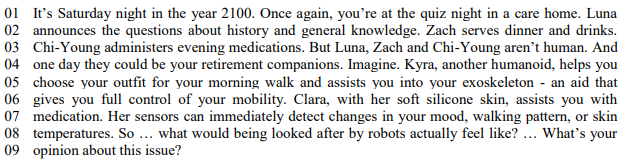
Adapted from: BBC Ideas and The Open University (2026) Would you want to be cared for by a robot when you are older? [video]. Instagram. Available at: https://www.instagram.com/reel/DX_03WVle-- /?igsh=MXhhdHJ4NzlpeGE5dA%3D%3D. (Accessed: May 31, 2026).
ANSWER QUESTION ACCORDING TO THE TEXT ABOVE.
TEXT
Adapted from: BBC Ideas and The Open University (2026) Would you want to be cared for by a robot when you are older? [video]. Instagram. Available at: https://www.instagram.com/reel/DX_03WVle-- /?igsh=MXhhdHJ4NzlpeGE5dA%3D%3D. (Accessed: May 31, 2026).
ANSWER QUESTION ACCORDING TO THE TEXT ABOVE.
False cognates are words with similar spelling or pronunciation in two languages, but with distinct meanings in current use. Regarding false cognates between English and Portuguese, mark T for the true statements and F for the false statements:
(__)The word "actually", in English, means "in fact" or "in truth", differing from the Portuguese word "atualmente".
(__)The word "pretend", in English, means "to feign" or "to simulate", differing from the Portuguese verb "pretender".
(__)The word "parents", in English, corresponds to relatives in general, including uncles and cousins, in equivalent use to the Portuguese term "parentes".
(__)The word "college", in English, corresponds to "colégio" in the sense of a secondary school of Basic Education, in equivalent use to the Portuguese term.
After analysis, choose the alternative that presents the correct sequence of the items above, from top to bottom:
Based on the preceding text, judge the following item.
The expression 'wear and tear' (second paragraph) is used in the text to describe the gradual physical damage caused by repeated childbirths.
About the previous text, judge the following item.
In the fragment "growing acceptance of technologies that blur the line between biology and machines" (second paragraph), the expression "blur the line" is used figuratively to indicate increasing integration between technological and biological systems.
Texto 7
Lesson plan:
Aims:
1. to listen for the main idea of the text and for specific information.. to guess vocabulary from context and learn new vocabulary.
3. to discuss reations to the lyrics of a song.
4. to write a letter to a penfriend.
5. to develop critical thinking skills (making inferences, analysing).
6. to foster learner independence and cooperative learning.
Green, C.; Tanner, R. Tasks for Teacher Education: a reflective approach, Harlow, UK: Addison Wesley Longman Publishing. 1998. p. 78. [Adaptado].
“A fruta da longevidade tem conquistado o mercado consumidor e já marca presença na gastronomia local – uma frutinha nativa do norte da Europa está sendo produzida com sucesso nas terras de Morro Reuter. Pequena no tamanho, mas grande no sabor, colorido e valor nutricional, é conhecida como a fruta da longevidade (é rica em antioxidantes, ferro, cálcio, potássio, entre outros)”.
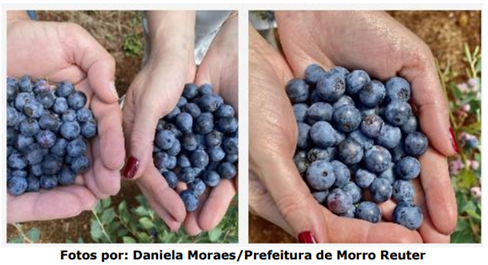
De acordo com o site Meio Sustentável (https://meiosustentavel.com.br/), no inglês, blueberry é uma fruta pequena e redonda que tem muitas sementes, que cresce em arbustos baixos, tem uma coloração azul pouco comum, muito rica em antioxidantes, fibras e vitamina C, além de ser uma fonte natural de antocianinas, que são substâncias anti-inflamatórias e anticancerígenas. Essa fruta é muito comum em dietas de emagrecimento por ter poucas calorias e por ser facilmente incluída, já que vai bem em sucos, iogurtes e até pura. Os textos dispostos acima se referem à fruta chamada:
BRASILEIRO
In the sentence:
“People spend more time connected to screens...” the word “screens” refers to:
“Requirements of the several countries vary regarding clearance of a ship”
Esta mensagem informa que as exigências dos países podem variar, em relação
The fílm is characterized as a ______ entry in the action genre, though it ultrmately suffers from a _______ narratíve structure that prevents its concepts from reaching their fu/l potential.
Fill in the blanks CORRECTLY and respectively:
Para responder à questão, leia o texto abaixo.
Lord of the Plants:
Death Metal Eco-Baron Rewilds Irish Estate
Randal Plunkett, the 21st Baron of Dunsany, strides out of his Irish castle in a T-shirt bearing the name of death metal band "Cannibal Corpse" in bloody lettering.
In the distance, a russet-coloured stag appears for a moment, before dissolving into the 750 acres (300 hectares) of ancestral estate Plunkett has surrendered to the wilderness -- almost half of his lands.
"I felt a sort of sense of duty towards the environment here," said Plunkett, perched on a decaying tree trunk sprouting a clutch of mushrooms.
"I'm a caretaker of this estate for this generation and the estate is not just the castle, it's also the land but it's also the environment," the aristocrat told AFP, his mane of shoulder-length hair rippling in the breeze.
Eight years ago, death metal fan Plunkett, whose family have presided over Dunsany Castle northwest of Dublin for nine centuries, began his "radical" rewilding project.
The 38-year-old vegan, an unlikely successor to ancestors depicted in sober portraits lining the walls of the grey stone castle, evicted livestock and dismissed lawnmowers to allow nature to take its course.
Now, the results are plain. The ultra-rare pine marten has been spotted. Otters and red deer thrive.
Skies are jammed with birds: buzzards, red kites, peregrine falcons, sparrowhawks, kestrels and snipes.
Plunkett says a woodpecker has been sighted in the area for the first time in a century.
Beyond the castle crenellations, the lawn is transformed into a swirling morass of 23 species of grass, fizzing with insect life.
Plunkett lends a hand here and there -- planting 2,500 trees last year was no small feat -- but mostly he is hands-off.
"As I watched it, I began to understand what the land was doing," he said after trudging across a field of knotted undergrowth in a faux leather jacket.
"It became a rewilding project," he said, as two Jack Russell terriers named Beavis and Butt-head gambol around his vegan-friendly Doc Martens boots.
Fonte: https://www.theyouthtimes.com/news-details/21284/
Para responder à questão, leia o texto abaixo.
Lord of the Plants:
Death Metal Eco-Baron Rewilds Irish Estate
Randal Plunkett, the 21st Baron of Dunsany, strides out of his Irish castle in a T-shirt bearing the name of death metal band "Cannibal Corpse" in bloody lettering.
In the distance, a russet-coloured stag appears for a moment, before dissolving into the 750 acres (300 hectares) of ancestral estate Plunkett has surrendered to the wilderness -- almost half of his lands.
"I felt a sort of sense of duty towards the environment here," said Plunkett, perched on a decaying tree trunk sprouting a clutch of mushrooms.
"I'm a caretaker of this estate for this generation and the estate is not just the castle, it's also the land but it's also the environment," the aristocrat told AFP, his mane of shoulder-length hair rippling in the breeze.
Eight years ago, death metal fan Plunkett, whose family have presided over Dunsany Castle northwest of Dublin for nine centuries, began his "radical" rewilding project.
The 38-year-old vegan, an unlikely successor to ancestors depicted in sober portraits lining the walls of the grey stone castle, evicted livestock and dismissed lawnmowers to allow nature to take its course.
Now, the results are plain. The ultra-rare pine marten has been spotted. Otters and red deer thrive.
Skies are jammed with birds: buzzards, red kites, peregrine falcons, sparrowhawks, kestrels and snipes.
Plunkett says a woodpecker has been sighted in the area for the first time in a century.
Beyond the castle crenellations, the lawn is transformed into a swirling morass of 23 species of grass, fizzing with insect life.
Plunkett lends a hand here and there -- planting 2,500 trees last year was no small feat -- but mostly he is hands-off.
"As I watched it, I began to understand what the land was doing," he said after trudging across a field of knotted undergrowth in a faux leather jacket.
"It became a rewilding project," he said, as two Jack Russell terriers named Beavis and Butt-head gambol around his vegan-friendly Doc Martens boots.
Fonte: https://www.theyouthtimes.com/news-details/21284/
Column 1:
(1) Ancestral.
(2) Knotted.
(3) Rewilding.
(4) Ultra-rare.
Column 2:
( ) undergrowth.
( ) project.
( ) estate.
( ) pine marten.
Which alternative CORRECTLY fills in the parentheses above, from top to bottom?
Para responder à questão, leia o texto abaixo.
Lord of the Plants:
Death Metal Eco-Baron Rewilds Irish Estate
Randal Plunkett, the 21st Baron of Dunsany, strides out of his Irish castle in a T-shirt bearing the name of death metal band "Cannibal Corpse" in bloody lettering.
In the distance, a russet-coloured stag appears for a moment, before dissolving into the 750 acres (300 hectares) of ancestral estate Plunkett has surrendered to the wilderness -- almost half of his lands.
"I felt a sort of sense of duty towards the environment here," said Plunkett, perched on a decaying tree trunk sprouting a clutch of mushrooms.
"I'm a caretaker of this estate for this generation and the estate is not just the castle, it's also the land but it's also the environment," the aristocrat told AFP, his mane of shoulder-length hair rippling in the breeze.
Eight years ago, death metal fan Plunkett, whose family have presided over Dunsany Castle northwest of Dublin for nine centuries, began his "radical" rewilding project.
The 38-year-old vegan, an unlikely successor to ancestors depicted in sober portraits lining the walls of the grey stone castle, evicted livestock and dismissed lawnmowers to allow nature to take its course.
Now, the results are plain. The ultra-rare pine marten has been spotted. Otters and red deer thrive.
Skies are jammed with birds: buzzards, red kites, peregrine falcons, sparrowhawks, kestrels and snipes.
Plunkett says a woodpecker has been sighted in the area for the first time in a century.
Beyond the castle crenellations, the lawn is transformed into a swirling morass of 23 species of grass, fizzing with insect life.
Plunkett lends a hand here and there -- planting 2,500 trees last year was no small feat -- but mostly he is hands-off.
"As I watched it, I began to understand what the land was doing," he said after trudging across a field of knotted undergrowth in a faux leather jacket.
"It became a rewilding project," he said, as two Jack Russell terriers named Beavis and Butt-head gambol around his vegan-friendly Doc Martens boots.
Fonte: https://www.theyouthtimes.com/news-details/21284/
Regarding the description of Randal Plunkett's lifestyle and its relationship to his family history, read the following excerpt:
Plunkett is described as an ___________ successor to his family lineage, as his modern choices represent a ___________ of the traditional aristocratic image maintaíned by his ancestors.
Fill in the blanks CORRECTLY and respectively:
Para responder à questão, leia o texto abaixo.
Lord of the Plants:
Death Metal Eco-Baron Rewilds Irish Estate
Randal Plunkett, the 21st Baron of Dunsany, strides out of his Irish castle in a T-shirt bearing the name of death metal band "Cannibal Corpse" in bloody lettering.
In the distance, a russet-coloured stag appears for a moment, before dissolving into the 750 acres (300 hectares) of ancestral estate Plunkett has surrendered to the wilderness -- almost half of his lands.
"I felt a sort of sense of duty towards the environment here," said Plunkett, perched on a decaying tree trunk sprouting a clutch of mushrooms.
"I'm a caretaker of this estate for this generation and the estate is not just the castle, it's also the land but it's also the environment," the aristocrat told AFP, his mane of shoulder-length hair rippling in the breeze.
Eight years ago, death metal fan Plunkett, whose family have presided over Dunsany Castle northwest of Dublin for nine centuries, began his "radical" rewilding project.
The 38-year-old vegan, an unlikely successor to ancestors depicted in sober portraits lining the walls of the grey stone castle, evicted livestock and dismissed lawnmowers to allow nature to take its course.
Now, the results are plain. The ultra-rare pine marten has been spotted. Otters and red deer thrive.
Skies are jammed with birds: buzzards, red kites, peregrine falcons, sparrowhawks, kestrels and snipes.
Plunkett says a woodpecker has been sighted in the area for the first time in a century.
Beyond the castle crenellations, the lawn is transformed into a swirling morass of 23 species of grass, fizzing with insect life.
Plunkett lends a hand here and there -- planting 2,500 trees last year was no small feat -- but mostly he is hands-off.
"As I watched it, I began to understand what the land was doing," he said after trudging across a field of knotted undergrowth in a faux leather jacket.
"It became a rewilding project," he said, as two Jack Russell terriers named Beavis and Butt-head gambol around his vegan-friendly Doc Martens boots.
Fonte: https://www.theyouthtimes.com/news-details/21284/

 Conheça nossos planos