Questões de Concurso
Sobre vocabulário | vocabulary em inglês
Foram encontradas 3.120 questões


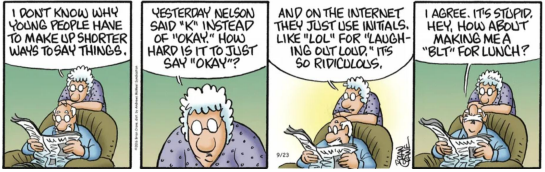
Available at: https://www.gocomics.com/pickles/2025/09/23
In online communication, the abbreviation "BTW" is commonly used. What does it stand for?
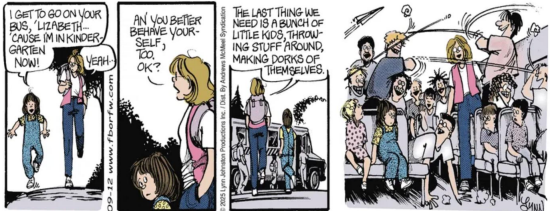
Available at: http://gocomics.com/forbetterorforworse/2025/09/12
The little girl is excited because she gets to ride the school bus for the first time. Her older sister warns her to behave, but once they are on the bus, the situation is chaotic.
In the comic, the word “dorks” refers to:
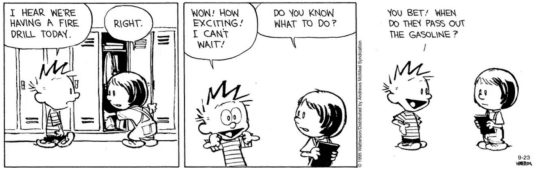
Available at: https://www.gocomics.com/calvinandhobbes/2025/09/23
In the comic strip, Calvin misunderstands the meaning of "fire drill." What is the humorous effect of his interpretation?
For question, consider the following text.
South Korea’s President Yoon Suk Yeol _____1 investigated _____ 2 to declare martial law. Prosecutors accuse him _____3 insurrection.
Former Defense Minister Kim Yong-hyun, who resigned, is barred from _____4 the country.
Yoon’s impeachment is being debated. While his party, the People Power Party (PPP), opposes it, some members voted _____5 his martial law order. Party leader Han Dong-hun called Yoon’s actions unconstitutional but warned that impeachment could create chaos. If impeached, the Prime Minister would lead _____ 6 elections in 60 days.
Amid the controversy, Yoon accepted Defense Minister Kim’s resignation and nominated Choi Byung-hyuk as his replacement. Several _____ 7 ministers plan to resign. Yoon’s martial law lasted only hours after lawmakers in an emergency vote repealed it, even blocking troops from entering parliament.
Source: <https://www.newsinlevels.com/products/southkorea-political-crisis-level-3/>
A new William Hope Hodgson blog
Welcome to Hodgsoniana, a new blog
about the life and works of author William Hope Hodgson (1877–1918). The aim
of this blog is to provide a home for articles and new research on Hodgson,
details of Hodgson-related happenings, and just generally act as an up-to-date
(hopefully) resource that’s open to anyone interested in this remarkable
literary figure. At time of writing, there is a lack of other active websites
covering this subject, which is why starting a blog seemed a worthwhile
endeavour. At the very least, it gives me a place to post some Hodgson-related
thoughts and findings I’ve been meaning to write up! My hope is that others may
be moved to contribute also.
Before going any further, I want to
recognise the work of the late Hodgson scholar Sam Gafford, and in particular
his excellent Hodgson blog williamhopehodgson.wordpress.com. I first stumbled
upon Sam’s blog back in 2016, and his work opened my eyes to the depths and
complexities of Hodgson’s history and writings. I entered into brief
correspondence with Sam at that time, and his enthusiasm and encouragement were
key factors in starting me on the path of pursuing my own Hodgson studies.
Sam Gafford sadly passed away in
2019, leaving his site dormant. It remains a valuable treasure trove of
information, and I will certainly aspire to follow Sam’s example in exploring
and documenting all matters Hodgson.
2027 will see the 150th anniversary
of William Hope Hodgson’s birth. There is still much to discuss regarding his
work, and many areas of his life remain obscure and in need of further
investigation. I hope this site can help in encouraging and chronicling such
efforts.
Source: https://hodgsoniana.wordpress.com/2025/06/22/a-new-william-hope-hodgson-blog/
access on 28 february 2026.
A new William Hope Hodgson blog
Welcome to Hodgsoniana, a new blog
about the life and works of author William Hope Hodgson (1877–1918). The aim
of this blog is to provide a home for articles and new research on Hodgson,
details of Hodgson-related happenings, and just generally act as an up-to-date
(hopefully) resource that’s open to anyone interested in this remarkable
literary figure. At time of writing, there is a lack of other active websites
covering this subject, which is why starting a blog seemed a worthwhile
endeavour. At the very least, it gives me a place to post some Hodgson-related
thoughts and findings I’ve been meaning to write up! My hope is that others may
be moved to contribute also.
Before going any further, I want to
recognise the work of the late Hodgson scholar Sam Gafford, and in particular
his excellent Hodgson blog williamhopehodgson.wordpress.com. I first stumbled
upon Sam’s blog back in 2016, and his work opened my eyes to the depths and
complexities of Hodgson’s history and writings. I entered into brief
correspondence with Sam at that time, and his enthusiasm and encouragement were
key factors in starting me on the path of pursuing my own Hodgson studies.
Sam Gafford sadly passed away in
2019, leaving his site dormant. It remains a valuable treasure trove of
information, and I will certainly aspire to follow Sam’s example in exploring
and documenting all matters Hodgson.
2027 will see the 150th anniversary
of William Hope Hodgson’s birth. There is still much to discuss regarding his
work, and many areas of his life remain obscure and in need of further
investigation. I hope this site can help in encouraging and chronicling such
efforts.
Source: https://hodgsoniana.wordpress.com/2025/06/22/a-new-william-hope-hodgson-blog/
access on 28 february 2026.
A new William Hope Hodgson blog
Welcome to Hodgsoniana, a new blog
about the life and works of author William Hope Hodgson (1877–1918). The aim
of this blog is to provide a home for articles and new research on Hodgson,
details of Hodgson-related happenings, and just generally act as an up-to-date
(hopefully) resource that’s open to anyone interested in this remarkable
literary figure. At time of writing, there is a lack of other active websites
covering this subject, which is why starting a blog seemed a worthwhile
endeavour. At the very least, it gives me a place to post some Hodgson-related
thoughts and findings I’ve been meaning to write up! My hope is that others may
be moved to contribute also.
Before going any further, I want to
recognise the work of the late Hodgson scholar Sam Gafford, and in particular
his excellent Hodgson blog williamhopehodgson.wordpress.com. I first stumbled
upon Sam’s blog back in 2016, and his work opened my eyes to the depths and
complexities of Hodgson’s history and writings. I entered into brief
correspondence with Sam at that time, and his enthusiasm and encouragement were
key factors in starting me on the path of pursuing my own Hodgson studies.
Sam Gafford sadly passed away in
2019, leaving his site dormant. It remains a valuable treasure trove of
information, and I will certainly aspire to follow Sam’s example in exploring
and documenting all matters Hodgson.
2027 will see the 150th anniversary
of William Hope Hodgson’s birth. There is still much to discuss regarding his
work, and many areas of his life remain obscure and in need of further
investigation. I hope this site can help in encouraging and chronicling such
efforts.
Source: https://hodgsoniana.wordpress.com/2025/06/22/a-new-william-hope-hodgson-blog/
access on 28 february 2026.
A new William Hope Hodgson blog
Welcome to Hodgsoniana, a new blog
about the life and works of author William Hope Hodgson (1877–1918). The aim
of this blog is to provide a home for articles and new research on Hodgson,
details of Hodgson-related happenings, and just generally act as an up-to-date
(hopefully) resource that’s open to anyone interested in this remarkable
literary figure. At time of writing, there is a lack of other active websites
covering this subject, which is why starting a blog seemed a worthwhile
endeavour. At the very least, it gives me a place to post some Hodgson-related
thoughts and findings I’ve been meaning to write up! My hope is that others may
be moved to contribute also.
Before going any further, I want to
recognise the work of the late Hodgson scholar Sam Gafford, and in particular
his excellent Hodgson blog williamhopehodgson.wordpress.com. I first stumbled
upon Sam’s blog back in 2016, and his work opened my eyes to the depths and
complexities of Hodgson’s history and writings. I entered into brief
correspondence with Sam at that time, and his enthusiasm and encouragement were
key factors in starting me on the path of pursuing my own Hodgson studies.
Sam Gafford sadly passed away in
2019, leaving his site dormant. It remains a valuable treasure trove of
information, and I will certainly aspire to follow Sam’s example in exploring
and documenting all matters Hodgson.
2027 will see the 150th anniversary
of William Hope Hodgson’s birth. There is still much to discuss regarding his
work, and many areas of his life remain obscure and in need of further
investigation. I hope this site can help in encouraging and chronicling such
efforts.
Source: https://hodgsoniana.wordpress.com/2025/06/22/a-new-william-hope-hodgson-blog/
access on 28 february 2026.
A new William Hope Hodgson blog
Welcome to Hodgsoniana, a new blog
about the life and works of author William Hope Hodgson (1877–1918). The aim
of this blog is to provide a home for articles and new research on Hodgson,
details of Hodgson-related happenings, and just generally act as an up-to-date
(hopefully) resource that’s open to anyone interested in this remarkable
literary figure. At time of writing, there is a lack of other active websites
covering this subject, which is why starting a blog seemed a worthwhile
endeavour. At the very least, it gives me a place to post some Hodgson-related
thoughts and findings I’ve been meaning to write up! My hope is that others may
be moved to contribute also.
Before going any further, I want to
recognise the work of the late Hodgson scholar Sam Gafford, and in particular
his excellent Hodgson blog williamhopehodgson.wordpress.com. I first stumbled
upon Sam’s blog back in 2016, and his work opened my eyes to the depths and
complexities of Hodgson’s history and writings. I entered into brief
correspondence with Sam at that time, and his enthusiasm and encouragement were
key factors in starting me on the path of pursuing my own Hodgson studies.
Sam Gafford sadly passed away in
2019, leaving his site dormant. It remains a valuable treasure trove of
information, and I will certainly aspire to follow Sam’s example in exploring
and documenting all matters Hodgson.
2027 will see the 150th anniversary
of William Hope Hodgson’s birth. There is still much to discuss regarding his
work, and many areas of his life remain obscure and in need of further
investigation. I hope this site can help in encouraging and chronicling such
efforts.
Source: https://hodgsoniana.wordpress.com/2025/06/22/a-new-william-hope-hodgson-blog/
access on 28 february 2026.
According to the text, Sam Gafford’s blog is “a valuable treasure trove of information”. Which alternative best replaces the expression? Mark T (True) or F (false).
( ) A cornucopia of data.
( ) A fount of erudition.
( ) A repository of trivia.
( ) A cache of insights.
A new William Hope Hodgson blog
Welcome to Hodgsoniana, a new blog
about the life and works of author William Hope Hodgson (1877–1918). The aim
of this blog is to provide a home for articles and new research on Hodgson,
details of Hodgson-related happenings, and just generally act as an up-to-date
(hopefully) resource that’s open to anyone interested in this remarkable
literary figure. At time of writing, there is a lack of other active websites
covering this subject, which is why starting a blog seemed a worthwhile
endeavour. At the very least, it gives me a place to post some Hodgson-related
thoughts and findings I’ve been meaning to write up! My hope is that others may
be moved to contribute also.
Before going any further, I want to
recognise the work of the late Hodgson scholar Sam Gafford, and in particular
his excellent Hodgson blog williamhopehodgson.wordpress.com. I first stumbled
upon Sam’s blog back in 2016, and his work opened my eyes to the depths and
complexities of Hodgson’s history and writings. I entered into brief
correspondence with Sam at that time, and his enthusiasm and encouragement were
key factors in starting me on the path of pursuing my own Hodgson studies.
Sam Gafford sadly passed away in
2019, leaving his site dormant. It remains a valuable treasure trove of
information, and I will certainly aspire to follow Sam’s example in exploring
and documenting all matters Hodgson.
2027 will see the 150th anniversary
of William Hope Hodgson’s birth. There is still much to discuss regarding his
work, and many areas of his life remain obscure and in need of further
investigation. I hope this site can help in encouraging and chronicling such
efforts.
Source: https://hodgsoniana.wordpress.com/2025/06/22/a-new-william-hope-hodgson-blog/
access on 28 february 2026.
A new William Hope Hodgson blog
Welcome to Hodgsoniana, a new blog
about the life and works of author William Hope Hodgson (1877–1918). The aim
of this blog is to provide a home for articles and new research on Hodgson,
details of Hodgson-related happenings, and just generally act as an up-to-date
(hopefully) resource that’s open to anyone interested in this remarkable
literary figure. At time of writing, there is a lack of other active websites
covering this subject, which is why starting a blog seemed a worthwhile
endeavour. At the very least, it gives me a place to post some Hodgson-related
thoughts and findings I’ve been meaning to write up! My hope is that others may
be moved to contribute also.
Before going any further, I want to
recognise the work of the late Hodgson scholar Sam Gafford, and in particular
his excellent Hodgson blog williamhopehodgson.wordpress.com. I first stumbled
upon Sam’s blog back in 2016, and his work opened my eyes to the depths and
complexities of Hodgson’s history and writings. I entered into brief
correspondence with Sam at that time, and his enthusiasm and encouragement were
key factors in starting me on the path of pursuing my own Hodgson studies.
Sam Gafford sadly passed away in
2019, leaving his site dormant. It remains a valuable treasure trove of
information, and I will certainly aspire to follow Sam’s example in exploring
and documenting all matters Hodgson.
2027 will see the 150th anniversary
of William Hope Hodgson’s birth. There is still much to discuss regarding his
work, and many areas of his life remain obscure and in need of further
investigation. I hope this site can help in encouraging and chronicling such
efforts.
Source: https://hodgsoniana.wordpress.com/2025/06/22/a-new-william-hope-hodgson-blog/
access on 28 february 2026.
A new William Hope Hodgson blog
Welcome to Hodgsoniana, a new blog
about the life and works of author William Hope Hodgson (1877–1918). The aim
of this blog is to provide a home for articles and new research on Hodgson,
details of Hodgson-related happenings, and just generally act as an up-to-date
(hopefully) resource that’s open to anyone interested in this remarkable
literary figure. At time of writing, there is a lack of other active websites
covering this subject, which is why starting a blog seemed a worthwhile
endeavour. At the very least, it gives me a place to post some Hodgson-related
thoughts and findings I’ve been meaning to write up! My hope is that others may
be moved to contribute also.
Before going any further, I want to
recognise the work of the late Hodgson scholar Sam Gafford, and in particular
his excellent Hodgson blog williamhopehodgson.wordpress.com. I first stumbled
upon Sam’s blog back in 2016, and his work opened my eyes to the depths and
complexities of Hodgson’s history and writings. I entered into brief
correspondence with Sam at that time, and his enthusiasm and encouragement were
key factors in starting me on the path of pursuing my own Hodgson studies.
Sam Gafford sadly passed away in
2019, leaving his site dormant. It remains a valuable treasure trove of
information, and I will certainly aspire to follow Sam’s example in exploring
and documenting all matters Hodgson.
2027 will see the 150th anniversary
of William Hope Hodgson’s birth. There is still much to discuss regarding his
work, and many areas of his life remain obscure and in need of further
investigation. I hope this site can help in encouraging and chronicling such
efforts.
Source: https://hodgsoniana.wordpress.com/2025/06/22/a-new-william-hope-hodgson-blog/
access on 28 february 2026.
A new William Hope Hodgson blog
Welcome to Hodgsoniana, a new blog
about the life and works of author William Hope Hodgson (1877–1918). The aim
of this blog is to provide a home for articles and new research on Hodgson,
details of Hodgson-related happenings, and just generally act as an up-to-date
(hopefully) resource that’s open to anyone interested in this remarkable
literary figure. At time of writing, there is a lack of other active websites
covering this subject, which is why starting a blog seemed a worthwhile
endeavour. At the very least, it gives me a place to post some Hodgson-related
thoughts and findings I’ve been meaning to write up! My hope is that others may
be moved to contribute also.
Before going any further, I want to
recognise the work of the late Hodgson scholar Sam Gafford, and in particular
his excellent Hodgson blog williamhopehodgson.wordpress.com. I first stumbled
upon Sam’s blog back in 2016, and his work opened my eyes to the depths and
complexities of Hodgson’s history and writings. I entered into brief
correspondence with Sam at that time, and his enthusiasm and encouragement were
key factors in starting me on the path of pursuing my own Hodgson studies.
Sam Gafford sadly passed away in
2019, leaving his site dormant. It remains a valuable treasure trove of
information, and I will certainly aspire to follow Sam’s example in exploring
and documenting all matters Hodgson.
2027 will see the 150th anniversary
of William Hope Hodgson’s birth. There is still much to discuss regarding his
work, and many areas of his life remain obscure and in need of further
investigation. I hope this site can help in encouraging and chronicling such
efforts.
Source: https://hodgsoniana.wordpress.com/2025/06/22/a-new-william-hope-hodgson-blog/
access on 28 february 2026.
RICHARDS, J. C. & RODGERS, T. Approaches and methods in language teaching. New York: Cambridge University Press, 2001. P. 33
The word “bewildered” expressed in the text may be replaced, without changing the meaning, by the word

 Conheça nossos planos