Questões de Concurso
Sobre tradução | translation em inglês
Foram encontradas 656 questões


Qual a profissão do turista?
By Dow Jones Business News
January 31, 2013
Brazil’s unemployment rate for 2012 fell to 5.5%, down from the previous record low of 6.0% recorded last year, the Brazilian Institute of Geography and Statistics, or IBGE, said Thursday. In December, unemployment fell to 4.6% compared with 4.9% in November, besting the previous record monthly low of 4.7% registered in December 2011, the IBGE said
The 2012 average unemployment rate was in line with the 5.5% median estimate of economists polled by the local Estado news agency. Analysts had also pegged December’s unemployment rate at 4.4%.
Brazil’s unemployment rate remains at historically low levels despite sluggish economic activity. Salaries have also been on the upswing in an ominous sign for inflation - a key area of concern for the Brazilian Central Bank after a series of interest rate cuts brought local interest rates to record lows last year. Inflation ended 2012 at 5.84%.
The average monthly Brazilian salary retreated slightly to 1,805.00 Brazilian reais ($908.45) in December, down from the record high BRL1,809.60 registered in November, the IBGE said. Wages trended higher in 2012 as employee groups called on Brazilian companies and the government to increase wages and benefits to counter higher local prices. Companies were also forced to pay more to hire and retain workers because of the country’s low unemployment.
The IBGE measures unemployment in six of Brazil’s largest metropolitan areas, including São Paulo, Rio de Janeiro, Salvador, Belo Horizonte, Recife and Porto Alegre. Brazil’s unemployment rate, however, is not fully comparable to jobless rates in developed countries as a large portion of the population is either underemployed or works informally without paying taxes. In addition, workers not actively seeking a job in the month before the survey don’t count as unemployed under the IBGE’s methodology. The survey also doesn’t take into account farm workers.
(www.nasdaq.com. Adaptado)

De acordo com o texto, quando se usa TI para habilitar mudanças organizacionais, é necessário ponderar o risco e as recompensas que podem surgir a partir dessas mudanças.
O termo stakeholders refere-se a gerentes de projeto.
De acordo com o texto, a governança em TI deve ser vista como uma disciplina autônoma, independente da estratégia da governança corporativa.
A governança de TI tem como objetivos principais garantir que investimentos em TI gerem o que o texto chama de “business value” e reduzir os riscos associados com a TI. Esses objetivos podem ser atingidos por meio da implementação de uma estrutura organizacional com papéis bem definidos para a responsabilidade da informação, os processos de negócios, as aplicações e a infraestrutura.
De acordo com o texto, a responsabilidade por sistemas críticos deve ser concentrada no administrador do projeto.
A adoção de melhores práticas no desenvolvimento de projetos de TI tem evitado a ocorrência de falhas nesses projetos, permitindo que a grande maioria dos projetos satisfaçam todos os objetivos definidos pelas empresas.

O sentido de indisputable no trecho acima, em português, é:

Assinale a seguir a alternativa que traz, corretamente, essa proibição quanto ao estacionamento, em Inglês:

No texto, “overburdened” significa:
DREW OLANOFF JOSH CONSTINE, COLLEEN TAYLOR, INGRID LUNDEN
Tuesday, January 15th, 2013
Today at Facebook’s press event, Mark Zuckerberg, CEO of Facebook, announced its latest product, called Graph Search.
Zuckerberg made it very clear that this is not web search, but completely different.
He explained the difference between web search and Graph Search. “Web search is designed to take any open-ended query and give
you links that might have answers.” Linking things together based on things that you’re interested in is a “very hard technical problem,”
according to Zuckerberg.
Graph Search is designed to take a precise query and give you an answer, rather than links that might provide the answer.” For
example, you could ask Graph Search “Who are my friends that live in San Francisco?”
Zuckerberg says that Graph Search is in “very early beta.” People, photos, places and interests are the focus for the first iteration of the
product.
Facebook Graph Search is completely personalized. Tom Stocky of the search team explains he gets unique results for a search of
“friends who like Star Wars and Harry Potter.” Then, “If anyone else does this search they get a completely different set of results. ...C...
someone had the same set of friends as me, the results would be different [because we have different relationships with our friends].”
You can also use Graph Search for recruiting. Stocky says if he was looking for people to join the team at Facebook, he could search
for NASA Ames employees who are friends with people at Facebook. “If I wanted to reach out and recruit them, I could see who their friends
are at Facebook. To refine them I can look for people who wrote they are “founders.”
Photos is another big part of Graph Search. Results are sorted by engagement so you see the ones with the most likes and comments
at the top. For example, Lars Rasmussen, Facebook engineer, searched for “photos of my friends taken at National Parks.” He got a gorgeous
page of photos from Yosemite, Machu Pichu, and other parks.
(Adapted from http://techcrunch.com/2013/01/15/facebook-announces-its-third-pillar-graph-search/)
No texto, “latest” significa
By Michelle Singletary, Published: January 15, 2013
It’s not nice to tell people “I told you so.” But if anybody has the right to say that, it’s Nina E. Olson, the national taxpayer advocate.
Olson recently submitted her annual report to Congress and top on her list of things that need to be fixed is the complexity of the tax
code, which she called the most serious problem facing taxpayers.
Let’s just look at the most recent evidence of complexity run amok. The Internal Revenue Service had to delay the tax-filing season so it
could update forms and its programming to accommodate recent changes made under the American Taxpayer Relief Act. The IRS won’t start
processing individual income tax returns until Jan. 30. Yet one thing remains unchanged − the April 15 tax deadline.
Because of the new tax laws, the IRS also had to release updated income-tax withholding tables for 2013. These replace the tables
issued Dec. 31. Yes, let’s just keep making more work for the agency that is already overburdened. Not to mention the extra work for
employers, who have to use the revised information to correct the amount of Social Security tax withheld in 2013. And they have to make that
correction in order to withhold a larger Social Security tax of 6.2 percent on wages, following the expiration of the payroll tax cut in effect for
2011 and 2012.
Oh, and there was the near miss with the alternative minimum tax that could have delayed the tax filing season to late March. The AMT
was created to target high-income taxpayers who were claiming so many deductions that they owed little or no income tax. Olson and many
others have complained for years that the AMT wasn’t indexed for inflation.
“Many middle- and upper-middle-class taxpayers pay the AMT, while most wealthy taxpayers do not, and thousands of millionaires pay
..A.. income tax at all,” Olson said.
As part of the recent “fiscal cliff” deal, the AMT is now fixed, a move that the IRS was anticipating. It had already decided to program its
systems on the assumption that an AMT patch would be passed, Olson said. Had the agency not taken the risk, the time it would have taken to
update the systems “would have brought about the most chaotic filing season in memory,” she said in her report.
The tax code contains almost 4 million words. Since 2001, there have been about 4,680 changes, or an average of more than one
change a day. What else troubles Olson? Here’s what:
− Nearly 60 percent of taxpayers hire paid preparers, and another 30 percent rely on commercial software to prepare their returns.
− Many taxpayers don’t really know how their taxes are computed and what rate of tax they pay.
− The complex code makes tax fraud ..B.. to detect.
− Because the code is so complicated, it creates an impression that many taxpayers are not paying their fair share. This reduces trust
in the system and perhaps leads some people to cheat. Who wants to be the sucker in this game? So someone might not declare
all of his income, rationalizing that millionaires get to use the convoluted code to greatly reduce their tax liability.
− In fiscal year 2012, the IRS received around 125 million calls. But the agency answered only about two out of three calls from
people trying to reach a live person, and those taxpayers had to wait, on average, about 17 minutes to get through.
“I hope 2013 brings about fundamental tax simplification,” Olson pleaded in her report. She urged Congress to reassess the need for
the tax breaks we know as income exclusions, exemptions, deductions and credits. It’s all these tax advantage breaks that complicate the
code. If done right, and without reducing revenue, tax rates could be substantially lowered in exchange for ending tax breaks, she said.
(Adapted from http://js.washingtonpost.com/business/economy/for-taxpayer-advocate-a-familiar-refrain/2013/01/15/a10327ce-5f59-
11e2-b05a-605528f6b712_story.html)
No texto, “overburdened” significa
If It's for Sale, His Lines Sort It
By MARGALIT FOX
It was born on a beach six decades ago, the product of a pressing need, an intellectual spark and the sweep of a young man's
fingers through the sand.
The result adorns almost every product of contemporary life, including groceries, wayward luggage and, if you are a
traditionalist, the newspaper you are holding.
The man on the beach that day was a mechanical-engineer-in-training named N. Joseph Woodland. With that transformative
stroke of his fingers − yielding a set of literal lines in the sand − Mr. Woodland, who died on Sunday at 91, conceived the modern bar
code.
Mr. Woodland was a graduate student when he and a classmate, Bernard Silver, created a technology, based on a printed
series of wide and narrow striations, that encoded consumer-product information for optical scanning.
Their idea, developed in the late 1940s and patented 60 years ago this fall, turned out to be ahead of its time, and the two men
together made only $15,000 from it, when they sold their patent to Philco. But the curious round symbol they devised would ultimately
give rise to the universal product code, or U.P.C., as the staggeringly prevalent rectangular bar code (it graces tens of millions of
different items) is officially known.
Here is part of the story behind the invention:
To represent information visually, he realized, he would need a code. The only code he knew was the one he had learned in the
Boy Scouts.
What would happen, Mr. Woodland wondered one day, if Morse code, with its elegant simplicity and limitless combinatorial
potential, were adapted graphically? He began trailing his fingers idly through the sand.
“What I'm going to tell you sounds like a fairy tale," Mr. Woodland told Smithsonian magazine in 1999. “I poked my four fingers
into the sand and for whatever reason − I didn't know − I pulled my hand toward me and drew four lines. I said: 'Golly! Now I have four
lines, and they could be wide lines and narrow lines instead of dots and dashes.' "
That consequential pass was merely the beginning. “Only seconds later," Mr. Woodland continued, “I took my four fingers − they
were still in the sand − and I swept them around into a full circle."
Mr. Woodland favored the circular pattern for its omnidirectionality: a checkout clerk, he reasoned, could scan a product without
regard for its orientation.
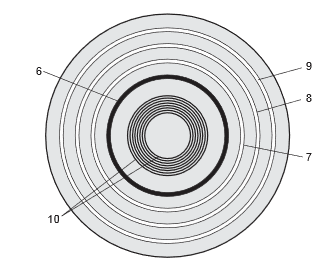
But that method − a variegated bull's-eye of wide and narrow bands −, which depended on an immense scanner equipped with
a 500-watt light, was expensive and unwieldy, and it languished for years.
The two men eventually sold their patent to Philco for $15,000 − all they ever made from their invention.
By the time the patent expired at the end of the 1960s, Mr. Woodland was on the staff of I.B.M., where he worked from 1951
until his retirement in 1987.
Over time, laser scanning technology and the advent of the microprocessor made the bar code viable. In the early 1970s, an
I.B.M. colleague, George J. Laurer, designed the familiar black-and-white rectangle, based on the Woodland-Silver model and drawing
on Mr. Woodland's considerable input.
(Adapted from http://www.nytimes.com/2012/12/13/business/n-josep...
&emc=edit_th_20121214&_r=0)
De acordo com o texto,
If It’s for Sale, His Lines Sort It
By MARGALIT FOX
It was born on a beach six decades ago, the product of a pressing need, an intellectual spark and the sweep of a young man’s
fingers through the sand.
The result adorns almost every product of contemporary life, including groceries, wayward luggage and, if you are a
traditionalist, the newspaper you are holding.
The man on the beach that day was a mechanical-engineer-in-training named N. Joseph Woodland. With that transformative
stroke of his fingers − yielding a set of literal lines in the sand − Mr. Woodland, who died on Sunday at 91, conceived the modern bar
code.
Mr. Woodland was a graduate student when he and a classmate, Bernard Silver, created a technology, based on a printed
series of wide and narrow striations, that encoded consumer-product information for optical scanning.
Their idea, developed in the late 1940s and patented 60 years ago this fall, turned out to be ahead of its time, and the two men
together made only $15,000 from it, when they sold their patent to Philco. But the curious round symbol they devised would ultimately
give rise to the universal product code, or U.P.C., as the staggeringly prevalent rectangular bar code (it graces tens of millions of
different items) is officially known.

Here is part of the story behind the invention:
To represent information visually, he realized, he would need a code. The only code he knew was the one he had learned in the
Boy Scouts.
What would happen, Mr. Woodland wondered one day, if Morse code, with its elegant simplicity and limitless combinatorial
potential, were adapted graphically? He began trailing his fingers idly through the sand.
“What I’m going to tell you sounds like a fairy tale,” Mr. Woodland told Smithsonian magazine in 1999. “I poked my four fingers
into the sand and for whatever reason − I didn’t know − I pulled my hand toward me and drew four lines. I said: ‘Golly! Now I have four
lines, and they could be wide lines and narrow lines instead of dots and dashes.’ ”
That consequential pass was merely the beginning. “Only seconds later,” Mr. Woodland continued, “I took my four fingers − they
were still in the sand − and I swept them around into a full circle.”
Mr. Woodland favored the circular pattern for its omnidirectionality: a checkout clerk, he reasoned, could scan a product without
regard for its orientation.
But that method − a variegated bull’s-eye of wide and narrow bands −, which depended on an immense scanner equipped with
a 500-watt light, was expensive and unwieldy, and it languished for years.
The two men eventually sold their patent to Philco for $15,000 − all they ever made from their invention.
By the time the patent expired at the end of the 1960s, Mr. Woodland was on the staff of I.B.M., where he worked from 1951
until his retirement in 1987.
Over time, laser scanning technology and the advent of the microprocessor made the bar code viable. In the early 1970s, an
I.B.M. colleague, George J. Laurer, designed the familiar black-and-white rectangle, based on the Woodland-Silver model and drawing
on Mr. Woodland’s considerable input.
(Adapted from http://www.nytimes.com/2012/12/13/business/n-joseph-woodland-inventor-of-the-bar-code-dies-at-91.html?nl=todaysheadlines
&emc=edit_th_20121214&_r=0)
Dentro do contexto, a tradução correta para o significado de “it languished for years” é
What Is the Definition of Online Banking?
The brick-and-mortar bank is the bank customers may use for banking. It is the bank where customers go to deposit checks, withdraw money, transfer money, and it's also the bank used to pay bills by mail. Brick-and-mortar banks ..A.. . Today's world of banking is more efficient. With online banking, customers rarely need to walk into a bank. Most of their banking is available through their computer.
Online banking is also called brick-to-click banking, according to bankrate.com, as well as electronic banking or Internet banking. It is a bank that gives customers the option of using checks, depositing money and transferring money at their physical location, or the option to do most of their banking on their computer. They can log on to their site and transfer between accounts, pay bills, use automatic deposits and check balances in all their accounts. If they need cash, they can make withdrawals using their ATM card or debit card. The only time they may need to enter an actual bank is to deposit a paper check or see a loan officer.
History
According to "Banking and Finance on the Internet," a book edited by Mary J. Cronin, online banking was first introduced in the early 1980s when four New York banks − Citibank, Chase Manhattan, Chemical and Manufacturers Hanover − offered home banking services. The systems were quite ..B.. to use and did not prove to be very popular. In the U.K., it was Nottingham Building Society that in 1983 offered the first electronic home banking system.
How it Works
In order to use e-banking, customers need access to a personal computer and Internet connection. When they register for ebanking, they are asked to provide a login name and password. Additionally, each time they want to access their account they might be required to answer a security question, which minimizes the risk of someone else accessing their account.
Features
Online banking allows customers to access their bank account from their computer 24 hours a day. With a password and a secure system, they can view all their accounts, move their money around, open new accounts, pay loans, access past months, print off transactions and electronically pay bills. With an ATM card, they have 24-hour access to ATMs across the country. With a debit card, they can pay bills at any store instead of writing a check. The bank automatically deducts from their checking account.
Virtual Banking
Besides the brick-to-click banks, there are virtual banks that do not have a physical location or personnel. They offer the same services as a regular bank and must follow the same federal guidelines. ....CONJUNCTION ... they do not have the overhead of buildings and personnel, they can offer better deals on loans and higher returns on savings.
Advantages of E-Banking
For customers, convenience is probably the main advantage, because it allows them to access their accounts whenever they want, and perform transactions from the comfort of their home. Almost equally important is ubiquity, because e-banking is available from any internet-connected computer anywhere in the world. For banks, e-banking means lower operating costs, as they need fewer branches and staff. Last but not least, it means new revenue opportunities, because e-banking attracts new, usually higher-income clients.
Disadvantages of E-Banking
For customers, it takes time to learn how to use e-banking facilities and, more importantly, to trust their bank's website and stop worrying about security issues. For banks, it means investing more in equipment and highly trained staff to run the website and necessary software.
(Adapted from http://www.ehow.com)

 Conheça nossos planos