Questões de Concurso
Sobre tradução | translation em inglês
Foram encontradas 656 questões


Q135821
Inglês

In the text,
“It may be argued that economic and cultural globalisation has given rise to a collective sensitivity to risk” (l.16-17) can be correctly translated as Pode-se argumentar que a globalização econômica e cultural tem dado origem a um risco de sensibilidade coletiva.
“It may be argued that economic and cultural globalisation has given rise to a collective sensitivity to risk” (l.16-17) can be correctly translated as Pode-se argumentar que a globalização econômica e cultural tem dado origem a um risco de sensibilidade coletiva.
Q135820
Inglês
In the text,
“The potential health effects of exposure to electromagnetic fields continue to await scientific clarification” (l.9-11) can be correctly translated as Os potenciais efeitos da exposição a campos eletromagnéticos sobre a saúde continuam aguardando esclarecimentos científicos.
“The potential health effects of exposure to electromagnetic fields continue to await scientific clarification” (l.9-11) can be correctly translated as Os potenciais efeitos da exposição a campos eletromagnéticos sobre a saúde continuam aguardando esclarecimentos científicos.
Ano: 2009
Banca:
FCC
Órgão:
TRT - 7ª Região (CE)
Prova:
FCC - 2009 - TRT - 7ª Região (CE) - Analista Judiciário - Tecnologia da Informação |
Q128172
Inglês

O trecho, tracking the disputed results, conforme empregado no texto, pode ser traduzido por
Ano: 2009
Banca:
FCC
Órgão:
TRT - 7ª Região (CE)
Prova:
FCC - 2009 - TRT - 7ª Região (CE) - Analista Judiciário - Tecnologia da Informação |
Q128171
Inglês
No texto, o significado de hummed é
Ano: 2009
Banca:
CESPE / CEBRASPE
Órgão:
TCE-RN
Provas:
CESPE - 2009 - TCE-RN - Assessor Técnico de Informática
|
CESPE - 2009 - TCE-RN - Inspetor de Controle Externo - Tecnologia da Informação |
Q123247
Inglês

Judge the following iten according to the text above.
The extract “companies have to do what they have to do” (L.2) can be correctly translated into Portuguese as companhias fazem o que têm de fazer.
Ano: 2009
Banca:
CESPE / CEBRASPE
Órgão:
TCE-RN
Provas:
CESPE - 2009 - TCE-RN - Assessor Técnico de Informática
|
CESPE - 2009 - TCE-RN - Inspetor de Controle Externo - Tecnologia da Informação |
Q123246
Inglês
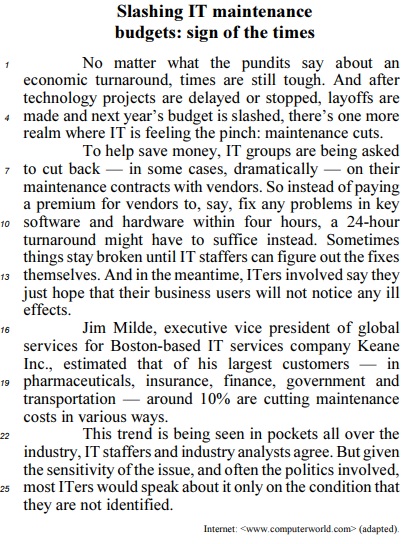
Judge the following item according to the text.
The word “trend”, in “This trend is being seen in pockets all over the industry” (L.22-23), can be correctly translated into Portuguese as tendência.
Q77868
Inglês
Texto associado
Para responder às questões de números 46 a 50, considere o texto abaixo.


O trecho American leadership has been sorely lacking for the past eight years significa que a liderança americana
Q77852
Inglês
Texto associado
Para responder às questões de números 32 a 45, considere o texto abaixo.


Considerando o sentido do texto, a melhor tradução para This marks a new departure é:
Q77848
Inglês
Texto associado
Para responder às questões de números 26 a 31, considere o texto abaixo.

O verbo warns, no texto, indica
Ano: 2009
Banca:
FCC
Órgão:
MPE-SE
Prova:
FCC - 2009 - MPE-SE - Analista do Ministério Público – Especialidade Análise de Sistemas |
Q42866
Inglês
Texto associado
Title:_____________
January 26, 2009
By John C. Dvorak
It's no coincidence that the computer industry peaked around the year 2000, went into a serious decline, stabilized at the low point a couple of years ago, and has since collapsed again.
A confluence of reasons is responsible for this, but when it comes to the industry bringing this on itself, one major event may have taken down the entire business.
I'm speaking about the announcement of the Itanium processor. This continues to be one of the great fiascos of the last 50 years, and not because Intel blew too much money on its development or that the chip performed poorly and will never be widely adopted. It was the reaction and subsequent consolidation in the industry that took place once this grandiose chip was preannounced.
We heard that HP, IBM, Dell, and even Sun Microsystems would use these chips and discontinue anything else they were developing. This included Sun making noise about dropping the SPARC chip for this thing - sight unseen. I say "sight unseen" because it would be years before the chip was even prototyped. The entire industry just took Intel at its word that Itanium would work as advertised in a PowerPoint presentation.
Because this chip was supposed to radically change the way computers work and become the driving force behind all systems in the future, one promising project after another was dropped. Why? Because Itanium was the future for all computing. Why bother wasting money on good ideas that didn't include it?
The failure of this chip to do anything more than exist as a niche processor sealed the fate of Intel - and perhaps the entire industry, since from 1997 to 2001 everyone waited for the messiah of chips to take us all to the next level.
It did that all right. It took us to the next level. But we didn't know that the next level was below us, not above.
(Adapted from PCMAG.COM)
January 26, 2009
By John C. Dvorak
It's no coincidence that the computer industry peaked around the year 2000, went into a serious decline, stabilized at the low point a couple of years ago, and has since collapsed again.
A confluence of reasons is responsible for this, but when it comes to the industry bringing this on itself, one major event may have taken down the entire business.
I'm speaking about the announcement of the Itanium processor. This continues to be one of the great fiascos of the last 50 years, and not because Intel blew too much money on its development or that the chip performed poorly and will never be widely adopted. It was the reaction and subsequent consolidation in the industry that took place once this grandiose chip was preannounced.
We heard that HP, IBM, Dell, and even Sun Microsystems would use these chips and discontinue anything else they were developing. This included Sun making noise about dropping the SPARC chip for this thing - sight unseen. I say "sight unseen" because it would be years before the chip was even prototyped. The entire industry just took Intel at its word that Itanium would work as advertised in a PowerPoint presentation.
Because this chip was supposed to radically change the way computers work and become the driving force behind all systems in the future, one promising project after another was dropped. Why? Because Itanium was the future for all computing. Why bother wasting money on good ideas that didn't include it?
The failure of this chip to do anything more than exist as a niche processor sealed the fate of Intel - and perhaps the entire industry, since from 1997 to 2001 everyone waited for the messiah of chips to take us all to the next level.
It did that all right. It took us to the next level. But we didn't know that the next level was below us, not above.
(Adapted from PCMAG.COM)
No texto, a expressão it would be years before the chip was even prototyped significa que
Ano: 2009
Banca:
FCC
Órgão:
MPE-SE
Prova:
FCC - 2009 - MPE-SE - Analista do Ministério Público – Especialidade Análise de Sistemas |
Q42862
Inglês
Texto associado
January 23, 2009
Worm Infects Millions of Computers Worldwide
By JOHN MARKOFF
A new digital plague has hit the Internet, infecting millions of personal and usiness computers in what seems to be the first step of a multistage attack. The world's eading computer security experts do not yet know who programmed the infection, or what the next stage will be.
In recent weeks a worm, a malicious software program, has swept through corporate, educational and public computer networks around the world. Known as Conficker or Downandup, it is spread by a recently discovered Microsoft Windows vulnerability, by guessing network passwords and by hand-carried consumer gadgets like USB keys.
Experts say it is the infection since the Slammer worm exploded through the Internet in January 2003, and it may have infected as many as nine million personal computers around the world.
Worms like Conficker not only ricochet around the Internet at lightning speed, they harness infected computers into unified systems called botnets, which can then accept programming instructions from their clandestine masters.
Many computer users may not notice that their machines have been infected, and computer security researchers said they were waiting for the instructions to materialize, to determine what impact the botnet will have on PC users. It might operate in the background, using the infected computer to send spam or infect other computers, or it might steal the PC user's personal information.
Microsoft rushed an emergency patch to defend the Windows operating systems against this vulnerability in October, yet the worm has continued to spread even as the level of warnings has grown in recent weeks.
Earlier this week, security researchers at Qualys, a Silicon Valley security firm, estimated that about 30 percent of Windows-based computers attached to the Internet remain vulnerable to infection because they have not been updated with the patch, despite the fact that it was made available in October.
Unraveling the program has been particularly challenging because it comes with encryption mechanisms that hide its internal workings from those seeking to disable it.
The program uses an elaborate shell-game-style technique to permit someone to command it remotely. Each day it generates a new list of 250 domain names. Instructions from any one of these domain names would be obeyed. To control the botnet, an attacker would need only to register a single domain to send instructions to the botnet globally, greatly complicating the task of law enforcement and security companies trying to intervene and block the activation of the botnet.
Several computer security firms said that although Conficker appeared to have been written from scratch, it had parallels to the work of a suspected Eastern European criminal gang that has profited by sending programs known as "scareware" to personal computers that seem to warn users of an infection and ask for credit card numbers to pay for bogus antivirus software that actually further infects their computer.
One intriguing clue left by the malware authors is that the first version of the program checked to see if the computer had a Ukrainian keyboard layout. If it found it had such a keyboard, it would not infect the machine, according to Phillip Porras, a security investigator at SRI International who has disassembled the program to determine how it functioned.
(Adapted from The New York Times)
Worm Infects Millions of Computers Worldwide
By JOHN MARKOFF
A new digital plague has hit the Internet, infecting millions of personal and usiness computers in what seems to be the first step of a multistage attack. The world's eading computer security experts do not yet know who programmed the infection, or what the next stage will be.
In recent weeks a worm, a malicious software program, has swept through corporate, educational and public computer networks around the world. Known as Conficker or Downandup, it is spread by a recently discovered Microsoft Windows vulnerability, by guessing network passwords and by hand-carried consumer gadgets like USB keys.
Experts say it is the
infection since the Slammer worm exploded through the Internet in January 2003, and it may have infected as many as nine million personal computers around the world.Worms like Conficker not only ricochet around the Internet at lightning speed, they harness infected computers into unified systems called botnets, which can then accept programming instructions from their clandestine masters.
Many computer users may not notice that their machines have been infected, and computer security researchers said they were waiting for the instructions to materialize, to determine what impact the botnet will have on PC users. It might operate in the background, using the infected computer to send spam or infect other computers, or it might steal the PC user's personal information.
Microsoft rushed an emergency patch to defend the Windows operating systems against this vulnerability in October, yet the worm has continued to spread even as the level of warnings has grown in recent weeks.
Earlier this week, security researchers at Qualys, a Silicon Valley security firm, estimated that about 30 percent of Windows-based computers attached to the Internet remain vulnerable to infection because they have not been updated with the patch, despite the fact that it was made available in October.
Unraveling the program has been particularly challenging because it comes with encryption mechanisms that hide its internal workings from those seeking to disable it.
The program uses an elaborate shell-game-style technique to permit someone to command it remotely. Each day it generates a new list of 250 domain names. Instructions from any one of these domain names would be obeyed. To control the botnet, an attacker would need only to register a single domain to send instructions to the botnet globally, greatly complicating the task of law enforcement and security companies trying to intervene and block the activation of the botnet.
Several computer security firms said that although Conficker appeared to have been written from scratch, it had parallels to the work of a suspected Eastern European criminal gang that has profited by sending programs known as "scareware" to personal computers that seem to warn users of an infection and ask for credit card numbers to pay for bogus antivirus software that actually further infects their computer.
One intriguing clue left by the malware authors is that the first version of the program checked to see if the computer had a Ukrainian keyboard layout. If it found it had such a keyboard, it would not infect the machine, according to Phillip Porras, a security investigator at SRI International who has disassembled the program to determine how it functioned.
(Adapted from The New York Times)
Segundo o texto,
Ano: 2009
Banca:
FCC
Órgão:
MPE-SE
Prova:
FCC - 2009 - MPE-SE - Analista do Ministério Público – Especialidade Análise de Sistemas |
Q42861
Inglês
Texto associado
January 23, 2009
Worm Infects Millions of Computers Worldwide
By JOHN MARKOFF
A new digital plague has hit the Internet, infecting millions of personal and usiness computers in what seems to be the first step of a multistage attack. The world's eading computer security experts do not yet know who programmed the infection, or what the next stage will be.
In recent weeks a worm, a malicious software program, has swept through corporate, educational and public computer networks around the world. Known as Conficker or Downandup, it is spread by a recently discovered Microsoft Windows vulnerability, by guessing network passwords and by hand-carried consumer gadgets like USB keys.
Experts say it is theinfection since the Slammer worm exploded through the Internet in January 2003, and it may have infected as many as nine million personal computers around the world.
Worms like Conficker not only ricochet around the Internet at lightning speed, they harness infected computers into unified systems called botnets, which can then accept programming instructions from their clandestine masters.
Many computer users may not notice that their machines have been infected, and computer security researchers said they were waiting for the instructions to materialize, to determine what impact the botnet will have on PC users. It might operate in the background, using the infected computer to send spam or infect other computers, or it might steal the PC user's personal information.
Microsoft rushed an emergency patch to defend the Windows operating systems against this vulnerability in October, yet the worm has continued to spread even as the level of warnings has grown in recent weeks.
Earlier this week, security researchers at Qualys, a Silicon Valley security firm, estimated that about 30 percent of Windows-based computers attached to the Internet remain vulnerable to infection because they have not been updated with the patch, despite the fact that it was made available in October.
Unraveling the program has been particularly challenging because it comes with encryption mechanisms that hide its internal workings from those seeking to disable it.
The program uses an elaborate shell-game-style technique to permit someone to command it remotely. Each day it generates a new list of 250 domain names. Instructions from any one of these domain names would be obeyed. To control the botnet, an attacker would need only to register a single domain to send instructions to the botnet globally, greatly complicating the task of law enforcement and security companies trying to intervene and block the activation of the botnet.
Several computer security firms said that although Conficker appeared to have been written from scratch, it had parallels to the work of a suspected Eastern European criminal gang that has profited by sending programs known as "scareware" to personal computers that seem to warn users of an infection and ask for credit card numbers to pay for bogus antivirus software that actually further infects their computer.
One intriguing clue left by the malware authors is that the first version of the program checked to see if the computer had a Ukrainian keyboard layout. If it found it had such a keyboard, it would not infect the machine, according to Phillip Porras, a security investigator at SRI International who has disassembled the program to determine how it functioned.
(Adapted from The New York Times)
Worm Infects Millions of Computers Worldwide
By JOHN MARKOFF
A new digital plague has hit the Internet, infecting millions of personal and usiness computers in what seems to be the first step of a multistage attack. The world's eading computer security experts do not yet know who programmed the infection, or what the next stage will be.
In recent weeks a worm, a malicious software program, has swept through corporate, educational and public computer networks around the world. Known as Conficker or Downandup, it is spread by a recently discovered Microsoft Windows vulnerability, by guessing network passwords and by hand-carried consumer gadgets like USB keys.
Experts say it is the
infection since the Slammer worm exploded through the Internet in January 2003, and it may have infected as many as nine million personal computers around the world.Worms like Conficker not only ricochet around the Internet at lightning speed, they harness infected computers into unified systems called botnets, which can then accept programming instructions from their clandestine masters.
Many computer users may not notice that their machines have been infected, and computer security researchers said they were waiting for the instructions to materialize, to determine what impact the botnet will have on PC users. It might operate in the background, using the infected computer to send spam or infect other computers, or it might steal the PC user's personal information.
Microsoft rushed an emergency patch to defend the Windows operating systems against this vulnerability in October, yet the worm has continued to spread even as the level of warnings has grown in recent weeks.
Earlier this week, security researchers at Qualys, a Silicon Valley security firm, estimated that about 30 percent of Windows-based computers attached to the Internet remain vulnerable to infection because they have not been updated with the patch, despite the fact that it was made available in October.
Unraveling the program has been particularly challenging because it comes with encryption mechanisms that hide its internal workings from those seeking to disable it.
The program uses an elaborate shell-game-style technique to permit someone to command it remotely. Each day it generates a new list of 250 domain names. Instructions from any one of these domain names would be obeyed. To control the botnet, an attacker would need only to register a single domain to send instructions to the botnet globally, greatly complicating the task of law enforcement and security companies trying to intervene and block the activation of the botnet.
Several computer security firms said that although Conficker appeared to have been written from scratch, it had parallels to the work of a suspected Eastern European criminal gang that has profited by sending programs known as "scareware" to personal computers that seem to warn users of an infection and ask for credit card numbers to pay for bogus antivirus software that actually further infects their computer.
One intriguing clue left by the malware authors is that the first version of the program checked to see if the computer had a Ukrainian keyboard layout. If it found it had such a keyboard, it would not infect the machine, according to Phillip Porras, a security investigator at SRI International who has disassembled the program to determine how it functioned.
(Adapted from The New York Times)
O Conficker, segundo o texto,
Ano: 2009
Banca:
FCC
Órgão:
MPE-SE
Prova:
FCC - 2009 - MPE-SE - Analista do Ministério Público – Especialidade Análise de Sistemas |
Q42860
Inglês
Texto associado
January 23, 2009
Worm Infects Millions of Computers Worldwide
By JOHN MARKOFF
A new digital plague has hit the Internet, infecting millions of personal and usiness computers in what seems to be the first step of a multistage attack. The world's eading computer security experts do not yet know who programmed the infection, or what the next stage will be.
In recent weeks a worm, a malicious software program, has swept through corporate, educational and public computer networks around the world. Known as Conficker or Downandup, it is spread by a recently discovered Microsoft Windows vulnerability, by guessing network passwords and by hand-carried consumer gadgets like USB keys.
Experts say it is theinfection since the Slammer worm exploded through the Internet in January 2003, and it may have infected as many as nine million personal computers around the world.
Worms like Conficker not only ricochet around the Internet at lightning speed, they harness infected computers into unified systems called botnets, which can then accept programming instructions from their clandestine masters.
Many computer users may not notice that their machines have been infected, and computer security researchers said they were waiting for the instructions to materialize, to determine what impact the botnet will have on PC users. It might operate in the background, using the infected computer to send spam or infect other computers, or it might steal the PC user's personal information.
Microsoft rushed an emergency patch to defend the Windows operating systems against this vulnerability in October, yet the worm has continued to spread even as the level of warnings has grown in recent weeks.
Earlier this week, security researchers at Qualys, a Silicon Valley security firm, estimated that about 30 percent of Windows-based computers attached to the Internet remain vulnerable to infection because they have not been updated with the patch, despite the fact that it was made available in October.
Unraveling the program has been particularly challenging because it comes with encryption mechanisms that hide its internal workings from those seeking to disable it.
The program uses an elaborate shell-game-style technique to permit someone to command it remotely. Each day it generates a new list of 250 domain names. Instructions from any one of these domain names would be obeyed. To control the botnet, an attacker would need only to register a single domain to send instructions to the botnet globally, greatly complicating the task of law enforcement and security companies trying to intervene and block the activation of the botnet.
Several computer security firms said that although Conficker appeared to have been written from scratch, it had parallels to the work of a suspected Eastern European criminal gang that has profited by sending programs known as "scareware" to personal computers that seem to warn users of an infection and ask for credit card numbers to pay for bogus antivirus software that actually further infects their computer.
One intriguing clue left by the malware authors is that the first version of the program checked to see if the computer had a Ukrainian keyboard layout. If it found it had such a keyboard, it would not infect the machine, according to Phillip Porras, a security investigator at SRI International who has disassembled the program to determine how it functioned.
(Adapted from The New York Times)
Worm Infects Millions of Computers Worldwide
By JOHN MARKOFF
A new digital plague has hit the Internet, infecting millions of personal and usiness computers in what seems to be the first step of a multistage attack. The world's eading computer security experts do not yet know who programmed the infection, or what the next stage will be.
In recent weeks a worm, a malicious software program, has swept through corporate, educational and public computer networks around the world. Known as Conficker or Downandup, it is spread by a recently discovered Microsoft Windows vulnerability, by guessing network passwords and by hand-carried consumer gadgets like USB keys.
Experts say it is the
infection since the Slammer worm exploded through the Internet in January 2003, and it may have infected as many as nine million personal computers around the world.Worms like Conficker not only ricochet around the Internet at lightning speed, they harness infected computers into unified systems called botnets, which can then accept programming instructions from their clandestine masters.
Many computer users may not notice that their machines have been infected, and computer security researchers said they were waiting for the instructions to materialize, to determine what impact the botnet will have on PC users. It might operate in the background, using the infected computer to send spam or infect other computers, or it might steal the PC user's personal information.
Microsoft rushed an emergency patch to defend the Windows operating systems against this vulnerability in October, yet the worm has continued to spread even as the level of warnings has grown in recent weeks.
Earlier this week, security researchers at Qualys, a Silicon Valley security firm, estimated that about 30 percent of Windows-based computers attached to the Internet remain vulnerable to infection because they have not been updated with the patch, despite the fact that it was made available in October.
Unraveling the program has been particularly challenging because it comes with encryption mechanisms that hide its internal workings from those seeking to disable it.
The program uses an elaborate shell-game-style technique to permit someone to command it remotely. Each day it generates a new list of 250 domain names. Instructions from any one of these domain names would be obeyed. To control the botnet, an attacker would need only to register a single domain to send instructions to the botnet globally, greatly complicating the task of law enforcement and security companies trying to intervene and block the activation of the botnet.
Several computer security firms said that although Conficker appeared to have been written from scratch, it had parallels to the work of a suspected Eastern European criminal gang that has profited by sending programs known as "scareware" to personal computers that seem to warn users of an infection and ask for credit card numbers to pay for bogus antivirus software that actually further infects their computer.
One intriguing clue left by the malware authors is that the first version of the program checked to see if the computer had a Ukrainian keyboard layout. If it found it had such a keyboard, it would not infect the machine, according to Phillip Porras, a security investigator at SRI International who has disassembled the program to determine how it functioned.
(Adapted from The New York Times)
Segundo o texto, sabe-se que o Conficker
Ano: 2009
Banca:
FCC
Órgão:
MPE-SE
Prova:
FCC - 2009 - MPE-SE - Analista do Ministério Público – Especialidade Análise de Sistemas |
Q42858
Inglês
Texto associado
January 23, 2009
Worm Infects Millions of Computers Worldwide
By JOHN MARKOFF
A new digital plague has hit the Internet, infecting millions of personal and usiness computers in what seems to be the first step of a multistage attack. The world's eading computer security experts do not yet know who programmed the infection, or what the next stage will be.
In recent weeks a worm, a malicious software program, has swept through corporate, educational and public computer networks around the world. Known as Conficker or Downandup, it is spread by a recently discovered Microsoft Windows vulnerability, by guessing network passwords and by hand-carried consumer gadgets like USB keys.
Experts say it is theinfection since the Slammer worm exploded through the Internet in January 2003, and it may have infected as many as nine million personal computers around the world.
Worms like Conficker not only ricochet around the Internet at lightning speed, they harness infected computers into unified systems called botnets, which can then accept programming instructions from their clandestine masters.
Many computer users may not notice that their machines have been infected, and computer security researchers said they were waiting for the instructions to materialize, to determine what impact the botnet will have on PC users. It might operate in the background, using the infected computer to send spam or infect other computers, or it might steal the PC user's personal information.
Microsoft rushed an emergency patch to defend the Windows operating systems against this vulnerability in October, yet the worm has continued to spread even as the level of warnings has grown in recent weeks.
Earlier this week, security researchers at Qualys, a Silicon Valley security firm, estimated that about 30 percent of Windows-based computers attached to the Internet remain vulnerable to infection because they have not been updated with the patch, despite the fact that it was made available in October.
Unraveling the program has been particularly challenging because it comes with encryption mechanisms that hide its internal workings from those seeking to disable it.
The program uses an elaborate shell-game-style technique to permit someone to command it remotely. Each day it generates a new list of 250 domain names. Instructions from any one of these domain names would be obeyed. To control the botnet, an attacker would need only to register a single domain to send instructions to the botnet globally, greatly complicating the task of law enforcement and security companies trying to intervene and block the activation of the botnet.
Several computer security firms said that although Conficker appeared to have been written from scratch, it had parallels to the work of a suspected Eastern European criminal gang that has profited by sending programs known as "scareware" to personal computers that seem to warn users of an infection and ask for credit card numbers to pay for bogus antivirus software that actually further infects their computer.
One intriguing clue left by the malware authors is that the first version of the program checked to see if the computer had a Ukrainian keyboard layout. If it found it had such a keyboard, it would not infect the machine, according to Phillip Porras, a security investigator at SRI International who has disassembled the program to determine how it functioned.
(Adapted from The New York Times)
Worm Infects Millions of Computers Worldwide
By JOHN MARKOFF
A new digital plague has hit the Internet, infecting millions of personal and usiness computers in what seems to be the first step of a multistage attack. The world's eading computer security experts do not yet know who programmed the infection, or what the next stage will be.
In recent weeks a worm, a malicious software program, has swept through corporate, educational and public computer networks around the world. Known as Conficker or Downandup, it is spread by a recently discovered Microsoft Windows vulnerability, by guessing network passwords and by hand-carried consumer gadgets like USB keys.
Experts say it is the
infection since the Slammer worm exploded through the Internet in January 2003, and it may have infected as many as nine million personal computers around the world.Worms like Conficker not only ricochet around the Internet at lightning speed, they harness infected computers into unified systems called botnets, which can then accept programming instructions from their clandestine masters.
Many computer users may not notice that their machines have been infected, and computer security researchers said they were waiting for the instructions to materialize, to determine what impact the botnet will have on PC users. It might operate in the background, using the infected computer to send spam or infect other computers, or it might steal the PC user's personal information.
Microsoft rushed an emergency patch to defend the Windows operating systems against this vulnerability in October, yet the worm has continued to spread even as the level of warnings has grown in recent weeks.
Earlier this week, security researchers at Qualys, a Silicon Valley security firm, estimated that about 30 percent of Windows-based computers attached to the Internet remain vulnerable to infection because they have not been updated with the patch, despite the fact that it was made available in October.
Unraveling the program has been particularly challenging because it comes with encryption mechanisms that hide its internal workings from those seeking to disable it.
The program uses an elaborate shell-game-style technique to permit someone to command it remotely. Each day it generates a new list of 250 domain names. Instructions from any one of these domain names would be obeyed. To control the botnet, an attacker would need only to register a single domain to send instructions to the botnet globally, greatly complicating the task of law enforcement and security companies trying to intervene and block the activation of the botnet.
Several computer security firms said that although Conficker appeared to have been written from scratch, it had parallels to the work of a suspected Eastern European criminal gang that has profited by sending programs known as "scareware" to personal computers that seem to warn users of an infection and ask for credit card numbers to pay for bogus antivirus software that actually further infects their computer.
One intriguing clue left by the malware authors is that the first version of the program checked to see if the computer had a Ukrainian keyboard layout. If it found it had such a keyboard, it would not infect the machine, according to Phillip Porras, a security investigator at SRI International who has disassembled the program to determine how it functioned.
(Adapted from The New York Times)
De acordo com o texto,
Ano: 2009
Banca:
FCC
Órgão:
SEFAZ-SP
Prova:
FCC - 2009 - SEFAZ-SP - Agente Fiscal de Rendas - Prova 1 |
Q41008
Inglês

No texto, infere-se que rather than red ink significa
Ano: 2008
Banca:
ITCO
Órgão:
CEFET-Cuiabá-MT
Prova:
ITCO - 2008 - CEFET-Cuiabá-MT - Professor - Língua Portuguesa e Inglesa |
Q2934932
Inglês
Sobre as tiras, marque a alternativa correta.
Ano: 2008
Banca:
FDRH
Órgão:
IGP-RS
Provas:
FDRH - 2008 - IGP-RS - Perito Químico Forense - Química
|
FDRH - 2008 - IGP-RS - Perito Criminal |
Q196899
Inglês

The best translation for the words live interactions (line 07), relatives (line 07), and evergrowing list (line 15), respectively, is expressed in the alternative:
Ano: 2007
Banca:
FCC
Órgão:
Câmara dos Deputados
Provas:
FCC - 2007 - Câmara dos Deputados - Analista Legislativo - Médico - Medicina de Emergência
|
FCC - 2007 - Câmara dos Deputados - Analista Legislativo - Médico - Área Psiquiatria |
FCC - 2007 - Câmara dos Deputados - Analista Legislativo - Médico - Área Medicina do Trabalho |
Q2256301
Inglês
Texto associado
Malnutrition is directly responsible for 300,000 deaths per year in children younger than 5 years in developing countries and contributes indirectly to over half the deaths in childhood worldwide.
The adverse effects of malnutrition include physical and developmental manifestations. Poor weight gain and slowing of linear growth occur. Impairment of immunologic functions in these ....(16)... mimics those observed in children with AIDS, predisposing them to opportunistic and other typical childhood infections. Children who are chronically malnourished exhibit behavioral changes, including irritability, apathy and decreased social responsiveness, anxiety, and attention deficits. In addition, infants and young children who have malnutrition frequently demonstrate developmental delay or permanent cognitive deficits. The degree of delay and deficit depends on the severity and duration of nutritional compromise and the age at which malnutrition occurs. In general, nutritional insults at younger ages will have worse outcomes. ...(17)... death from malnutrition in the United States is rare, in developing countries, more than 50% of the 10 million deaths each year are either directly or indirectly secondary to malnutrition in children younger than 5 years.
Children are most vulnerable to the effects of malnutrition in infancy and early childhood. Premature infants have special nutritional needs that are not met with traditional feeding recommendations; they require fortified human milk or specially designed preterm formula until later in infancy. Children are susceptible to malnutrition for differing reasons. During adolescence, self-imposed dietary restrictions contribute to the incidence of nutritional deficiencies.
(Adapted from http://www.emedicine.com/PED/topic1360.htm)
Segundo o texto,
Ano: 2007
Banca:
FCC
Órgão:
Câmara dos Deputados
Provas:
FCC - 2007 - Câmara dos Deputados - Analista Legislativo - Enfermeiro - Enfermagem Geral
|
FCC - 2007 - Câmara dos Deputados - Analista Legislativo - Enfermeiro - Enfermagem do Trabalho |
FCC - 2007 - Câmara dos Deputados - Analista Legislativo - Enfermeiro - Enfermagem de Emergência |
Q2255348
Inglês
Texto associado
Instruções: A questão refere-se ao
texto apresentado abaixo.
Atenção: Para responder a questão escolha, dentre as cinco alternativas, aquela que,
apropriadamente, completa a oração levando em
conta o texto como um todo.
Malnutrition is directly responsible for 300,000 deaths
per year in children younger than 5 years in developing
countries and contributes indirectly to over half the deaths in
childhood worldwide.
The adverse effects of malnutrition include physical and
developmental manifestations. Poor weight gain and slowing of
linear growth occur. Impairment of immunologic functions in
these .....(15)..... mimics those observed in children with AIDS,
predisposing them to opportunistic and other typical childhood
infections. Children who are chronically malnourished exhibit
behavioral changes, including irritability, apathy and decreased
social responsiveness, anxiety, and attention deficits. In
addition, infants and young children who have malnutrition
frequently demonstrate developmental delay or permanent
cognitive deficits. The degree of delay and deficit depends on
the severity and duration of nutritional compromise and the age
at which malnutrition occurs. In general, nutritional insults at
younger ages will have worse outcomes. .....(16)..... death from
malnutrition in the United States is rare, in developing countries,
more than 50% of the 10 million deaths each year are either
directly or indirectly secondary to malnutrition in children
younger than 5 years.
Children are most vulnerable to the effects of
malnutrition in infancy and early childhood. Premature infants
have special nutritional needs that are not met with traditional
feeding recommendations; they require fortified human milk or
specially designed preterm formula until later in infancy. Children
are susceptible to malnutrition for differing reasons. During
adolescence, self-imposed dietary restrictions contribute to the
incidence of nutritional deficiencies.
(Adapted from http://www.emedicine.com/PED/topic1360.htm)
No texto acima, a melhor tradução para compromise é
Ano: 2007
Banca:
CESPE / CEBRASPE
Órgão:
TCU
Prova:
CESPE - 2007 - TCU - Analista de Controle Externo - Comum a todos |
Q26575
Inglês

The Portuguese word for public biddings is alienações.

 Conheça nossos planos