Questões de Concurso Sobre inglês
Foram encontradas 25.994 questões


Ano: 2026
Banca:
COPEVE-UFAL
Órgão:
IFAL
Prova:
COPEVE-UFAL - 2026 - IFAL - Professor EBTT - Língua Inglesa |
Q3953928
Inglês
lt is often a delicate decision as to how to provide learners with feedback on their errors when their attention is primarily focused on
the content of what they are saying, rather than on the way they are saying it. Interrupting learners ‘in full flight’ to give them corrections
seems to run counter to the need to let them experience autonomy. If the teacher is constantly intervening to assist their performance,
whether by providing unknown words or correcting their errors, they can hardly be said to be self-regulating. And it may have the
counterproductive effect of inhibiting fluency by forcing learners’ attention on to accuracy. Nevertheless, many teachers feel
uncomfortable about ‘letting errors go’, even in fluency activities, and there is support for the view that maintaining a focus on form –
that is, on formal accuracy – is good for learners in the long run. lt is important, therefore, that such a focus should be effected at
minimal cost to the speaker’s sense of being in control. What is agreed is that in cases of correction of oral fluency, the teacher’s
corrections, while explicit, are unobtrusive, and these are picked up by the learners with no real loss of fluency: ln the above extract,
the teacher's interventions should be economical and effective, and the conversational flow should not threatened. However, it could be
argued that such overt monitoring deprives the learners of opportunities to take more responsibility for their own monitoring and selfrepair. This is especially the case with regard to their mistakes, as opposed to their errors. By mistake is meant the learners’
momentary failure to apply what they already know, due mainly to the demands of online processing. An error, on the other hand,
represents a gap in the speaker’s knowledge of the system. Mistakes can usually be self-corrected, but errors cannot. A deft hint to the
learner that they have used a present verb form instead of a past one, for example, may be all that is needed to encourage selfcorrection. And self-correction, even if prompted by the teacher, is one step nearer self-regulation and the ultimate goal of full
autonomy. Sometimes, however, the learner’s message is simply unintelligible, and some kind of more obtrusive intervention is
necessary to repair the breakdown. ln this case, an intervention that is perceived by the learner as repair is likely to be less inhibiting
than one that is perceived of as correction. Repair is facilitative, while correction can be construed negatively, as judgmental. In
repairing, the teacher's intervention takes the form of a conversational repair, one that is consistent with the meaning-orientation of the
interaction
THORNBURY, Scott. How to Teach Speaking. Cambridge: Longman, 2005, pp. 91-2. (Adapted).
One of the main problems when dealing with oral fluency is to know if a student should be corrected when interacting or after it. After reading this passage about feedback and correction in fluency, select the alternative that agrees with the point of view discussed in the passage.
THORNBURY, Scott. How to Teach Speaking. Cambridge: Longman, 2005, pp. 91-2. (Adapted).
One of the main problems when dealing with oral fluency is to know if a student should be corrected when interacting or after it. After reading this passage about feedback and correction in fluency, select the alternative that agrees with the point of view discussed in the passage.
Ano: 2026
Banca:
COPEVE-UFAL
Órgão:
IFAL
Prova:
COPEVE-UFAL - 2026 - IFAL - Professor EBTT - Língua Inglesa |
Q3953927
Inglês
In the book titled Literacies by Mary Kalantzis and Bill Cope, the authors mention the roles of teachers and students facing the
challenges of reading in a technological environment. According to the authors, “Communication is rapidly changing. With the rise of
new technologies and media, the way we make and transmit meaning is shifting significantly”. For this reason the profile of students
have changed considerably from passive actors in the reading and interpreting information to more active meaning-makers,
considering the various forms of access to information. New media environment “focuses not only on reading and writing, but also on
other modes of communication, including oral, visual, audio, gestural and spatial”.
Below you will find a list of actions related to reading and interpreting texts both in the new and old environments. Read the actions and decide which action relates to which kind of environment. Then choose the correct alternative that corresponds to the right choice.
1. Appreciating texts of prestige ‘literary’ value must be the rule for right interpretation.
2. Innovations, risk-taking and diversity in meaning-making are aspects to be regarded by teachers.
3. It must be considered that a wide and diverse range of texts exists and should be valued.
4. Reading means decoding messages transmitted by written texts.
5. Teaching students to read means dealing solely with canonic British and American production.
6. The fundamentals of literacy should be understanding messages beyond messages.
7. The many social languages and variations in communication must be considered.
8. There are multiple forms of reading a word in multimodal communication.
9. Understanding and using correct spelling and grammar is good communication.
10. We should read only standard, educated English used in homogeneous situations.
KALANTZIS, Mary; COPE, Bill. Literacies. Melbourne: CUP, 2012, p.19. (Adapted).
Below you will find a list of actions related to reading and interpreting texts both in the new and old environments. Read the actions and decide which action relates to which kind of environment. Then choose the correct alternative that corresponds to the right choice.
1. Appreciating texts of prestige ‘literary’ value must be the rule for right interpretation.
2. Innovations, risk-taking and diversity in meaning-making are aspects to be regarded by teachers.
3. It must be considered that a wide and diverse range of texts exists and should be valued.
4. Reading means decoding messages transmitted by written texts.
5. Teaching students to read means dealing solely with canonic British and American production.
6. The fundamentals of literacy should be understanding messages beyond messages.
7. The many social languages and variations in communication must be considered.
8. There are multiple forms of reading a word in multimodal communication.
9. Understanding and using correct spelling and grammar is good communication.
10. We should read only standard, educated English used in homogeneous situations.
KALANTZIS, Mary; COPE, Bill. Literacies. Melbourne: CUP, 2012, p.19. (Adapted).
Ano: 2026
Banca:
COPEVE-UFAL
Órgão:
IFAL
Prova:
COPEVE-UFAL - 2026 - IFAL - Professor EBTT - Língua Inglesa |
Q3953926
Inglês
Even if a foreign language student is an able decoder in English, the level of effort required to read for meaning in real time
academic situations can be a monumental task. Look how author Richard Rodriguez (1982) describes his own reading in English as a
new language: “Most books, of course, I barely understood. While reading Plato’s Republic, I needed to keep looking at the book jacket
to remind myself what the text was about”. One might ask how Rodriguez could be reading a book at such an advanced level in
English but still not reading with comprehension. How could he read and yet not read? And what is it that makes reading in a new
language so overwhelming? Perhaps part of the answer can be found in the less extensive listening vocabulary upon which foreign
language students can draw when reading written words, they have never seen before. Part of it may result from incomplete
knowledge of the syntax and grammar patterns of English. When we struggle with sentences in a new language, reading takes a great
deal of cognitive energy. As a result, retaining the gist of the previous sentences in a paragraph or of previous paragraphs in working
memory is hard to do as we move through a text. Even when decoding is no longer very effortful, it is still much harder to move
along through a text and construct meaning from it as we read in a new language. We might describe this as a real-time “delay”,
which has to do with discursive practices. When the rate of processing discursive meaning from text can’t “catch up” with the rate
of our decoding, the result may be the strange phenomenon of decoding but not comprehending, as lamented by Richard
Rodriguez above.
LEMS, Kristin; MILLER, Leah D.; SORO, Tenema M. Teaching Reading to English Language Learners. Insights from Linguistics. New York and London: 2010, pp. 171-2. (Adapted).
The excerpt discusses what the author calls ‘real-time delay’ in English as a foreign language students’ reading ability. After reading this passage, choose the best alternative that may define this real-time delay.
LEMS, Kristin; MILLER, Leah D.; SORO, Tenema M. Teaching Reading to English Language Learners. Insights from Linguistics. New York and London: 2010, pp. 171-2. (Adapted).
The excerpt discusses what the author calls ‘real-time delay’ in English as a foreign language students’ reading ability. After reading this passage, choose the best alternative that may define this real-time delay.
Ano: 2026
Banca:
COPEVE-UFAL
Órgão:
IFAL
Prova:
COPEVE-UFAL - 2026 - IFAL - Professor EBTT - Língua Inglesa |
Q3953925
Inglês
1._______________ familiar with diverse research methods in social sciences.
2._______________ speech acts associated with racist ideologies in different sociolinguistic situations and samples, including films, news, music, daily interactions and textbooks.
3._______________ through some samples of cultural and sociolinguistic contexts such as academia to identify stigmatized markers of racist cultural linguistic materiality.
4._______________ that antiracist fight is possible through reflecting, relating, comparing and contrasting different perspectives.
5._______________ on their own linguistic awareness development and agency throughout the course.
MAGRO, José L. Language and Antiracism. An Antiracist Approach to Teaching Language in the USA. Jackson: Multilingual Matters, 2023. (Adapted).
The items mentioned have to do with the outcomes of a foreign language class of which objective is to teach L2 language viewing antiracist practices. The verbs “become”; “identify”; “go”; “demonstrate”; “reflect”, have been extracted from the items. After reading the topics, choose the alternative that presents the verbs that fit the items, respectively.
2._______________ speech acts associated with racist ideologies in different sociolinguistic situations and samples, including films, news, music, daily interactions and textbooks.
3._______________ through some samples of cultural and sociolinguistic contexts such as academia to identify stigmatized markers of racist cultural linguistic materiality.
4._______________ that antiracist fight is possible through reflecting, relating, comparing and contrasting different perspectives.
5._______________ on their own linguistic awareness development and agency throughout the course.
MAGRO, José L. Language and Antiracism. An Antiracist Approach to Teaching Language in the USA. Jackson: Multilingual Matters, 2023. (Adapted).
The items mentioned have to do with the outcomes of a foreign language class of which objective is to teach L2 language viewing antiracist practices. The verbs “become”; “identify”; “go”; “demonstrate”; “reflect”, have been extracted from the items. After reading the topics, choose the alternative that presents the verbs that fit the items, respectively.
Ano: 2026
Banca:
COPEVE-UFAL
Órgão:
IFAL
Prova:
COPEVE-UFAL - 2026 - IFAL - Professor EBTT - Língua Inglesa |
Q3953924
Inglês
CHAPTER 2
Adult Literacy and Popular Libraries
To speak of adult literacy and popular libraries is to speak of the problems of reading and writing: not reading and writing words in and of themselves, as if the reading and writing of words did not imply another reading, anterior to and simultaneous with the first, the reading itself. The critical comprehension of literacy, which involves the equally critical comprehension of reading, demands the critical comprehension of reading, demands the critical comprehension of the library. However, upon speaking of a critical vision, authenticated in a practice of the same critical form of literacy, I not only recognize but also emphasize the existence of a contrary practice, an understanding that, in an essay published a long time ago, I called naive.
It would be tiresome to insist on points referred to on other occasions when I discussed the problems of literacy. Nevertheless, at the risk of repeating myself, I will try to clarify or reclarify what I call the critical practice and understanding of literacy, as opposed to the naive and so-called “astute” practice and understanding. The naive and astute, while identical from the objective point of view, differentiate themselves with respect to the subjectivity of their agents.
The myth of the neutrality of education — which leads to the negation of the political nature of the educational process, regarding it only as a task we do in the service of humanity in the abstract sense — is the point of departure for our understanding of the fundamental differences between a naive practice, an astute practice, and a truly critical practice.
From the critical point of view, it is as impossible to deny the political nature of the educational process as it is to deny the educational character of the political act. This does not mean, however, that the political nature of the educational process and the educational character of the political act drain the understanding of that process and this act. Just as a neutral education that claims to be at the service of humanity, of human beings in general, is impossible, so is a political practice devoid of educational meaning. FREIRE, Paulo; MACEDO, Maldonado. Literacy: Reading the Word and the World. London: Routledge, 2005, p. 46. (Adapted).
After reading this excerpt from chapter 2 of the book titled Literacy: Reading the Word and the World, select the correct alternative that completes the sentence: Reading is
Adult Literacy and Popular Libraries
To speak of adult literacy and popular libraries is to speak of the problems of reading and writing: not reading and writing words in and of themselves, as if the reading and writing of words did not imply another reading, anterior to and simultaneous with the first, the reading itself. The critical comprehension of literacy, which involves the equally critical comprehension of reading, demands the critical comprehension of reading, demands the critical comprehension of the library. However, upon speaking of a critical vision, authenticated in a practice of the same critical form of literacy, I not only recognize but also emphasize the existence of a contrary practice, an understanding that, in an essay published a long time ago, I called naive.
It would be tiresome to insist on points referred to on other occasions when I discussed the problems of literacy. Nevertheless, at the risk of repeating myself, I will try to clarify or reclarify what I call the critical practice and understanding of literacy, as opposed to the naive and so-called “astute” practice and understanding. The naive and astute, while identical from the objective point of view, differentiate themselves with respect to the subjectivity of their agents.
The myth of the neutrality of education — which leads to the negation of the political nature of the educational process, regarding it only as a task we do in the service of humanity in the abstract sense — is the point of departure for our understanding of the fundamental differences between a naive practice, an astute practice, and a truly critical practice.
From the critical point of view, it is as impossible to deny the political nature of the educational process as it is to deny the educational character of the political act. This does not mean, however, that the political nature of the educational process and the educational character of the political act drain the understanding of that process and this act. Just as a neutral education that claims to be at the service of humanity, of human beings in general, is impossible, so is a political practice devoid of educational meaning. FREIRE, Paulo; MACEDO, Maldonado. Literacy: Reading the Word and the World. London: Routledge, 2005, p. 46. (Adapted).
After reading this excerpt from chapter 2 of the book titled Literacy: Reading the Word and the World, select the correct alternative that completes the sentence: Reading is
Ano: 2026
Banca:
COPEVE-UFAL
Órgão:
IFAL
Prova:
COPEVE-UFAL - 2026 - IFAL - Professor EBTT - Língua Inglesa |
Q3953923
Inglês
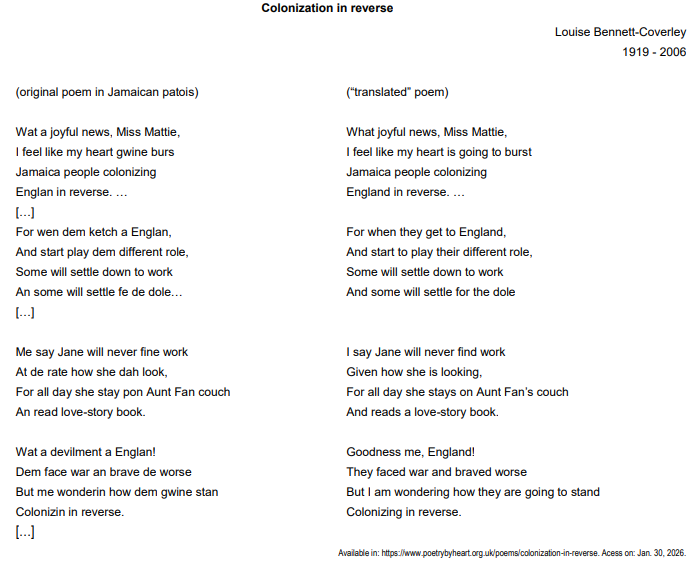
From a decolonial perspective, select the correct interpretation of the poem.
Ano: 2026
Banca:
IGEDUC
Órgão:
Prefeitura de Serraria - PB
Prova:
IGEDUC - 2026 - Prefeitura de Serraria - PB - Professor Fundamental II - Inglês |
Q3953472
Inglês
A distinção entre 'Phrasal Verbs' e 'Prepositional Verbs' é
crucial para a sintaxe correta. Acerca desses verbos,
marque V, para as afirmativas verdadeiras, e F, para as
falsas.
(__) Em 'Phrasal Verbs' separáveis, se o objeto for um pronome pessoal, ele deve vir obrigatoriamente entre o verbo e a partícula.
(__) 'Prepositional Verbs' são inseparáveis, ou seja, a preposição deve seguir imediatamente o verbo.
(__) O significado de um 'Phrasal Verb' é frequentemente idiomático e não dedutível pelas partes individuais.
(__) Verbos frasais intransitivos, como 'wake up', exigem obrigatoriamente um objeto direto para terem sentido.
Após análise, assinale a alternativa que apresenta a sequência CORRETA dos itens acima, de cima para baixo:
(__) Em 'Phrasal Verbs' separáveis, se o objeto for um pronome pessoal, ele deve vir obrigatoriamente entre o verbo e a partícula.
(__) 'Prepositional Verbs' são inseparáveis, ou seja, a preposição deve seguir imediatamente o verbo.
(__) O significado de um 'Phrasal Verb' é frequentemente idiomático e não dedutível pelas partes individuais.
(__) Verbos frasais intransitivos, como 'wake up', exigem obrigatoriamente um objeto direto para terem sentido.
Após análise, assinale a alternativa que apresenta a sequência CORRETA dos itens acima, de cima para baixo:
Ano: 2026
Banca:
IGEDUC
Órgão:
Prefeitura de Serraria - PB
Prova:
IGEDUC - 2026 - Prefeitura de Serraria - PB - Professor Fundamental II - Inglês |
Q3953471
Inglês
O uso de adjetivos substantivados (Nominalized
Adjectives) permite referir-se a grupos de pessoas.
Assim, analise as afirmativas a seguir.
I. Adjetivos como 'rich' e 'poor', quando precedidos pelo artigo 'the', referem-se a toda a classe e requerem verbo no plural.
II. Adjetivos de nacionalidade terminados em '-ch' ou '-sh' (ex: The French) seguem a mesma regra de pluralização coletiva.
III. É gramaticalmente correto adicionar 's' ao final de adjetivos substantivados (ex: The poors) para indicar plural.
IV. Esses adjetivos podem ser usados no singular para se referir a um único indivíduo (ex: The poor is hungry).
Assinale a alternativa que apresenta somente as proposições CORRETAS:
I. Adjetivos como 'rich' e 'poor', quando precedidos pelo artigo 'the', referem-se a toda a classe e requerem verbo no plural.
II. Adjetivos de nacionalidade terminados em '-ch' ou '-sh' (ex: The French) seguem a mesma regra de pluralização coletiva.
III. É gramaticalmente correto adicionar 's' ao final de adjetivos substantivados (ex: The poors) para indicar plural.
IV. Esses adjetivos podem ser usados no singular para se referir a um único indivíduo (ex: The poor is hungry).
Assinale a alternativa que apresenta somente as proposições CORRETAS:
Ano: 2026
Banca:
IGEDUC
Órgão:
Prefeitura de Serraria - PB
Prova:
IGEDUC - 2026 - Prefeitura de Serraria - PB - Professor Fundamental II - Inglês |
Q3953469
Inglês
O Sintagma Nominal (Noun Phrase) pode ser expandido
através de pré-modificadores e pós-modificadores.
Assim, analise as afirmativas a seguir.
I. A pós-modificação pode ser realizada por 'Relative Clauses' ou 'Prepositional Phrases'.
II. O núcleo do sintagma nominal concorda em número com o verbo da oração, independentemente dos modificadores.
III. Em uma sequência de substantivos (Noun + Noun), o primeiro substantivo atua como modificador do segundo.
IV. Artigos e demonstrativos funcionam como determinantes e precedem os adjetivos na estrutura do sintagma.
Assinale a alternativa que apresenta somente a(s) proposição(ões) CORRETA(S):
I. A pós-modificação pode ser realizada por 'Relative Clauses' ou 'Prepositional Phrases'.
II. O núcleo do sintagma nominal concorda em número com o verbo da oração, independentemente dos modificadores.
III. Em uma sequência de substantivos (Noun + Noun), o primeiro substantivo atua como modificador do segundo.
IV. Artigos e demonstrativos funcionam como determinantes e precedem os adjetivos na estrutura do sintagma.
Assinale a alternativa que apresenta somente a(s) proposição(ões) CORRETA(S):
Ano: 2026
Banca:
IGEDUC
Órgão:
Prefeitura de Serraria - PB
Prova:
IGEDUC - 2026 - Prefeitura de Serraria - PB - Professor Fundamental II - Inglês |
Q3953468
Inglês
O ensino de Inglês Instrumental (ESP) foca nas necessidades específicas do aprendiz em sua área de atuação. Considerando os princípios do ESP, assinale a alternativa CORRETA.
Ano: 2026
Banca:
IGEDUC
Órgão:
Prefeitura de Serraria - PB
Prova:
IGEDUC - 2026 - Prefeitura de Serraria - PB - Professor Fundamental II - Inglês |
Q3953467
Inglês
A voz passiva é um recurso estilístico e gramatical
fundamental, especialmente em gêneros acadêmicos e
jornalísticos. Assim, analise as afirmativas a seguir.
I. A voz passiva é frequentemente utilizada quando o agente da ação é desconhecido, irrelevante ou inferível pelo contexto discursivo.
II. Verbos ditransitivos podem originar duas construções passivas distintas, conforme o objeto direto ou indireto seja promovido à posição de sujeito.
III. O agente da passiva, introduzido pela preposição by, é um elemento obrigatório e sempre expresso nas construções em voz passiva.
IV. Verbos de estado que expressam posse, medida ou relação estática, como have (posse) e fit (tamanho), não são normalmente empregados em construções de voz passiva.
Assinale a alternativa que apresenta somente a(s) proposição(ões) CORRETA(S):
I. A voz passiva é frequentemente utilizada quando o agente da ação é desconhecido, irrelevante ou inferível pelo contexto discursivo.
II. Verbos ditransitivos podem originar duas construções passivas distintas, conforme o objeto direto ou indireto seja promovido à posição de sujeito.
III. O agente da passiva, introduzido pela preposição by, é um elemento obrigatório e sempre expresso nas construções em voz passiva.
IV. Verbos de estado que expressam posse, medida ou relação estática, como have (posse) e fit (tamanho), não são normalmente empregados em construções de voz passiva.
Assinale a alternativa que apresenta somente a(s) proposição(ões) CORRETA(S):
Ano: 2026
Banca:
IGEDUC
Órgão:
Prefeitura de Serraria - PB
Prova:
IGEDUC - 2026 - Prefeitura de Serraria - PB - Professor Fundamental II - Inglês |
Q3953466
Inglês
A comunicação mediada por computador (CMC)
introduziu novas convenções linguísticas no inglês.
Acerca das características do 'Internet English', marque
V, para as afirmativas verdadeiras, e F, para as falsas.
(__) O uso de acrônimos como 'ASAP' e 'LOL' funciona como marcador de pertencimento ao grupo e economia de tempo.
(__) A 'Flaming' refere-se à prática de interação hostil e agressiva em fóruns ou seções de comentários.
(__) A linguagem digital elimina completamente as regras de polidez (netiquette) em favor da velocidade.
(__) O inglês usado em chats é considerado um híbrido que mescla características da fala e da escrita.
Após análise, assinale a alternativa que apresenta a sequência CORRETA dos itens acima, de cima para baixo:
(__) O uso de acrônimos como 'ASAP' e 'LOL' funciona como marcador de pertencimento ao grupo e economia de tempo.
(__) A 'Flaming' refere-se à prática de interação hostil e agressiva em fóruns ou seções de comentários.
(__) A linguagem digital elimina completamente as regras de polidez (netiquette) em favor da velocidade.
(__) O inglês usado em chats é considerado um híbrido que mescla características da fala e da escrita.
Após análise, assinale a alternativa que apresenta a sequência CORRETA dos itens acima, de cima para baixo:
Ano: 2026
Banca:
IGEDUC
Órgão:
Prefeitura de Serraria - PB
Prova:
IGEDUC - 2026 - Prefeitura de Serraria - PB - Professor Fundamental II - Inglês |
Q3953465
Inglês
A morfologia derivacional permite a criação de novas
palavras através de afixos. Considerando os processos
de formação de palavras, assinale a alternativa
CORRETA.
Ano: 2026
Banca:
IGEDUC
Órgão:
Prefeitura de Serraria - PB
Prova:
IGEDUC - 2026 - Prefeitura de Serraria - PB - Professor Fundamental II - Inglês |
Q3953464
Inglês
A distinção entre substantivos contáveis e incontáveis
(Countable and Uncountable Nouns) afeta diretamente a
concordância verbal e o uso de determinantes. Com
base nas regras morfológicas e sintáticas dos
substantivos, assinale a alternativa CORRETA.
Ano: 2026
Banca:
IGEDUC
Órgão:
Prefeitura de Serraria - PB
Prova:
IGEDUC - 2026 - Prefeitura de Serraria - PB - Professor Fundamental II - Inglês |
Q3953463
Inglês
Os atos de fala (speech acts) em inglês são
frequentemente realizados através de verbos modais,
que carregam força ilocucionária. Assim, analise as
afirmativas a seguir.
I. O modal 'should' é primariamente utilizado para expressar conselhos ou recomendações (advice).
II. A estrutura 'used to' refere-se a hábitos do passado que não mais ocorrem no presente.
III. O verbo modal 'must' na negativa (mustn't) expressa uma ausência de obrigação ou necessidade.
IV. 'Can' e 'May' podem ambos ser utilizados para pedir permissão, sendo 'May' mais formal.
Assinale a alternativa que apresenta somente a(s) proposição(ões) CORRETA(S):
I. O modal 'should' é primariamente utilizado para expressar conselhos ou recomendações (advice).
II. A estrutura 'used to' refere-se a hábitos do passado que não mais ocorrem no presente.
III. O verbo modal 'must' na negativa (mustn't) expressa uma ausência de obrigação ou necessidade.
IV. 'Can' e 'May' podem ambos ser utilizados para pedir permissão, sendo 'May' mais formal.
Assinale a alternativa que apresenta somente a(s) proposição(ões) CORRETA(S):
Ano: 2026
Banca:
IGEDUC
Órgão:
Prefeitura de Serraria - PB
Prova:
IGEDUC - 2026 - Prefeitura de Serraria - PB - Professor Fundamental II - Inglês |
Q3953461
Inglês
A competência leitora em língua inglesa envolve níveis
de processamento que vão da decodificação básica à
interpretação crítica. Acerca dos níveis de compreensão
textual, marque V, para as afirmativas verdadeiras, e F,
para as falsas.
(__) A compreensão literal foca na localização de informações explicitamente declaradas na superfície do texto.
(__) A compreensão inferencial exige que o leitor combine pistas textuais com seu conhecimento de mundo.
(__) A compreensão lexical independe do contexto, baseando-se apenas no significado dicionarizado das palavras.
(__) A compreensão apreciativa envolve a reação emocional e estética do leitor ao estilo e conteúdo do autor.
Após análise, assinale a alternativa que apresenta a sequência CORRETA dos itens acima, de cima para baixo:
(__) A compreensão literal foca na localização de informações explicitamente declaradas na superfície do texto.
(__) A compreensão inferencial exige que o leitor combine pistas textuais com seu conhecimento de mundo.
(__) A compreensão lexical independe do contexto, baseando-se apenas no significado dicionarizado das palavras.
(__) A compreensão apreciativa envolve a reação emocional e estética do leitor ao estilo e conteúdo do autor.
Após análise, assinale a alternativa que apresenta a sequência CORRETA dos itens acima, de cima para baixo:
Ano: 2026
Banca:
IGEDUC
Órgão:
Prefeitura de Serraria - PB
Prova:
IGEDUC - 2026 - Prefeitura de Serraria - PB - Professor Fundamental II - Inglês |
Q3953460
Inglês
O posicionamento dos advérbios na sentença em Inglês
pode alterar o foco ou a gramaticalidade da frase,
dependendo da classe do advérbio. Acerca das regras
de sintaxe adverbial, marque V, para as afirmativas
verdadeiras, e F, para as falsas.
(__) Advérbios de frequência definidos, como daily e weekly, são geralmente posicionados no final da oração, especialmente quando indicam periodicidade de ações.
(__) O advérbio 'enough' deve ser posicionado antes do adjetivo ou advérbio que ele modifica, como em 'enough good'.
(__) Advérbios de modo terminados em -ly podem ser posicionados na oração, inclusive na posição medial, entre o sujeito e o verbo principal, conforme a estrutura da frase.
(__) A posição inicial é vedada para advérbios de conexão (connecting adverbs) como 'however' e 'furthermore'.
Após análise, assinale a alternativa que apresenta a sequência CORRETA dos itens acima, de cima para baixo:
(__) Advérbios de frequência definidos, como daily e weekly, são geralmente posicionados no final da oração, especialmente quando indicam periodicidade de ações.
(__) O advérbio 'enough' deve ser posicionado antes do adjetivo ou advérbio que ele modifica, como em 'enough good'.
(__) Advérbios de modo terminados em -ly podem ser posicionados na oração, inclusive na posição medial, entre o sujeito e o verbo principal, conforme a estrutura da frase.
(__) A posição inicial é vedada para advérbios de conexão (connecting adverbs) como 'however' e 'furthermore'.
Após análise, assinale a alternativa que apresenta a sequência CORRETA dos itens acima, de cima para baixo:
Ano: 2026
Banca:
IGEDUC
Órgão:
Prefeitura de Serraria - PB
Prova:
IGEDUC - 2026 - Prefeitura de Serraria - PB - Professor Fundamental II - Inglês |
Q3953459
Inglês
As preposições em inglês apresentam desafios devido à
sua polissemia e uso idiomático. Considerando o uso
padrão das preposições de tempo e lugar, assinale a
alternativa CORRETA.
Ano: 2026
Banca:
IGEDUC
Órgão:
Prefeitura de Serraria - PB
Prova:
IGEDUC - 2026 - Prefeitura de Serraria - PB - Professor Fundamental II - Inglês |
Q3953458
Inglês
A distinção entre a modalidade oral e escrita do inglês
envolve variações na complexidade gramatical e na
densidade lexical. Assim, analise as afirmativas a seguir.
I. A escrita acadêmica tende a apresentar elevada densidade lexical, com uso recorrente de nominalizações para condensar informações e relações conceituais.
II. A fala espontânea caracteriza-se pelo uso frequente de estruturas coordenadas, repetições e marcadores discursivos, como hesitadores (fillers).
III. A escrita, especialmente em gêneros acadêmicos, tende a apresentar maior complexidade sintática, com uso mais frequente de subordinação e cláusulas embutidas, enquanto a fala organiza-se de forma incremental e mais coordenada.
IV. A escrita apresenta maior uso de pronomes pessoais e de deícticos espaciais do que a fala presencial, em razão da necessidade de referência imediata ao contexto situacional.
Assinale a alternativa que apresenta somente a(s) proposição(ões) CORRETA(S):
I. A escrita acadêmica tende a apresentar elevada densidade lexical, com uso recorrente de nominalizações para condensar informações e relações conceituais.
II. A fala espontânea caracteriza-se pelo uso frequente de estruturas coordenadas, repetições e marcadores discursivos, como hesitadores (fillers).
III. A escrita, especialmente em gêneros acadêmicos, tende a apresentar maior complexidade sintática, com uso mais frequente de subordinação e cláusulas embutidas, enquanto a fala organiza-se de forma incremental e mais coordenada.
IV. A escrita apresenta maior uso de pronomes pessoais e de deícticos espaciais do que a fala presencial, em razão da necessidade de referência imediata ao contexto situacional.
Assinale a alternativa que apresenta somente a(s) proposição(ões) CORRETA(S):
Ano: 2026
Banca:
IGEDUC
Órgão:
Prefeitura de Serraria - PB
Prova:
IGEDUC - 2026 - Prefeitura de Serraria - PB - Professor Fundamental II - Inglês |
Q3953457
Inglês
Os pronomes relativos introduzem orações que
funcionam como adjetivos complexos, modificando
substantivos. Acerca das 'Relative Clauses', marque V,
para as afirmativas verdadeiras, e F, para as falsas.
(__) O pronome 'whose' é utilizado para indicar posse, substituindo adjetivos possessivos como 'his', 'her' ou 'its'.
(__) Em orações restritivas (defining), o pronome relativo objeto pode ser omitido (Zero Relative Pronoun).
(__) O pronome 'which' é utilizado exclusivamente para referir-se a pessoas em contextos formais.
(__) As orações explicativas (non-defining) fornecem informações adicionais e devem vir entre vírgulas.
Após análise, assinale a alternativa que apresenta a sequência CORRETA dos itens acima, de cima para baixo:
(__) O pronome 'whose' é utilizado para indicar posse, substituindo adjetivos possessivos como 'his', 'her' ou 'its'.
(__) Em orações restritivas (defining), o pronome relativo objeto pode ser omitido (Zero Relative Pronoun).
(__) O pronome 'which' é utilizado exclusivamente para referir-se a pessoas em contextos formais.
(__) As orações explicativas (non-defining) fornecem informações adicionais e devem vir entre vírgulas.
Após análise, assinale a alternativa que apresenta a sequência CORRETA dos itens acima, de cima para baixo:

 Conheça nossos planos