Questões de Concurso Sobre inglês
Foram encontradas 25.994 questões


Ano: 2026
Banca:
AMEOSC
Órgão:
Prefeitura de Santa Helena - SC
Prova:
AMEOSC - 2026 - Prefeitura de Santa Helena - SC - Professor com Licenciatura Plena em Língua Portuguesa e Estrangeira (Inglês) |
Q3965341
Inglês
Verb tenses in English indicate not only the time of an
action but also its aspect, showing whether it is a
completed fact or a continuous process. Analyze the
following statements:
I.The Present Perfect is used to describe actions that happened at an unspecified time in the past or that have a connection with the present moment.
II.The Future with "going to" is typically used for spontaneous decisions made at the exact moment of speaking, without any prior plan or evidence.
III.The Past Continuous is used to describe an action that was in progress at a specific time in the past, often interrupted by another event.
Choose the alternative that presents the CORRECT statement(s):
I.The Present Perfect is used to describe actions that happened at an unspecified time in the past or that have a connection with the present moment.
II.The Future with "going to" is typically used for spontaneous decisions made at the exact moment of speaking, without any prior plan or evidence.
III.The Past Continuous is used to describe an action that was in progress at a specific time in the past, often interrupted by another event.
Choose the alternative that presents the CORRECT statement(s):
Ano: 2026
Banca:
AMEOSC
Órgão:
Prefeitura de Santa Helena - SC
Prova:
AMEOSC - 2026 - Prefeitura de Santa Helena - SC - Professor com Licenciatura Plena em Língua Portuguesa e Estrangeira (Inglês) |
Q3965335
Inglês
The development of language competencies assumes
the integration of the four basic skills (listening, speaking,
reading, and writing) in meaningful contexts of language
use. Analyze the following statements:
I.The development of critical reading skills involves the student's ability to identify biases, the author's intentions, and the socio-historical context of the text.
II. Written production should be approached as a process-oriented activity, involving stages such as planning, drafting, revising, and rewriting according to the proposed text genre.
III. Listening is a passive process of phonetic decoding that does not require the use of prior knowledge or inferencing by the learner.
Choose the alternative that presents the CORRECT statement(s):
I.The development of critical reading skills involves the student's ability to identify biases, the author's intentions, and the socio-historical context of the text.
II. Written production should be approached as a process-oriented activity, involving stages such as planning, drafting, revising, and rewriting according to the proposed text genre.
III. Listening is a passive process of phonetic decoding that does not require the use of prior knowledge or inferencing by the learner.
Choose the alternative that presents the CORRECT statement(s):
Ano: 2026
Banca:
AMEOSC
Órgão:
Prefeitura de Santa Helena - SC
Prova:
AMEOSC - 2026 - Prefeitura de Santa Helena - SC - Professor com Licenciatura Plena em Língua Portuguesa e Estrangeira (Inglês) |
Q3965334
Inglês
Subject−verb agreement in English requires the verb to
match the subject in person and number, especially in
the third person singular of the simple present. With
regard to the rules of subject−verb agreement, select the
CORRECT alternative.
Ano: 2026
Banca:
AMEOSC
Órgão:
Prefeitura de Santa Helena - SC
Prova:
AMEOSC - 2026 - Prefeitura de Santa Helena - SC - Professor com Licenciatura Plena em Língua Portuguesa e Estrangeira (Inglês) |
Q3965333
Inglês
Grammatical categories such as pronouns and articles
are essential for reference and determination in English
discourse. With regard to the use of these grammatical
categories, select the CORRECT alternative.
Ano: 2026
Banca:
AMEOSC
Órgão:
Prefeitura de Santa Helena - SC
Prova:
AMEOSC - 2026 - Prefeitura de Santa Helena - SC - Professor com Licenciatura Plena em Língua Portuguesa e Estrangeira (Inglês) |
Q3965332
Inglês
English morphosyntax analyzes how words are
categorized and how they function within a sentence to
convey meaning. Concerning word classes and their
functions, mark the CORRECT alternative.
Ano: 2026
Banca:
AMEOSC
Órgão:
Prefeitura de Santa Helena - SC
Prova:
AMEOSC - 2026 - Prefeitura de Santa Helena - SC - Professor com Licenciatura Plena em Língua Portuguesa e Estrangeira (Inglês) |
Q3965329
Inglês
The English verbal system is divided into regular and
irregular verbs, based on how they form the past simple
and the past participle. Regarding this topic, mark T
(True) or F (False) for each statement:
(__)Regular verbs form their past tense by adding the suffix "-ed" to the base form, following specific spelling rules for verbs ending in "-y" or consonant-vowel-consonant.
(__)Irregular verbs follow a predictable pattern of vowel mutation, allowing the speaker to determine the past form of any unknown verb by analogy with the verb "to go."
(__)Some irregular verbs have the same form for the infinitive, the simple past, and the past participle, such as the verbs "put," "cut," and "set."
(__)The past tense of the verb "to read" is spelled differently from the present tense to indicate the change in pronunciation from /ri:d/ to /red/ in formal registers.
After analyzing the statements, choose the alternative that presents the CORRECT sequence of the items above, from top to bottom:
(__)Regular verbs form their past tense by adding the suffix "-ed" to the base form, following specific spelling rules for verbs ending in "-y" or consonant-vowel-consonant.
(__)Irregular verbs follow a predictable pattern of vowel mutation, allowing the speaker to determine the past form of any unknown verb by analogy with the verb "to go."
(__)Some irregular verbs have the same form for the infinitive, the simple past, and the past participle, such as the verbs "put," "cut," and "set."
(__)The past tense of the verb "to read" is spelled differently from the present tense to indicate the change in pronunciation from /ri:d/ to /red/ in formal registers.
After analyzing the statements, choose the alternative that presents the CORRECT sequence of the items above, from top to bottom:
Ano: 2026
Banca:
AMEOSC
Órgão:
Prefeitura de Santa Helena - SC
Prova:
AMEOSC - 2026 - Prefeitura de Santa Helena - SC - Professor com Licenciatura Plena em Língua Portuguesa e Estrangeira (Inglês) |
Q3965328
Inglês
Sentence structure in English follows a predominant
Subject-Verb-Object (SVO) order, but can be modified for
emphasis or to establish textual cohesion. Analyze the
following statements:
I.In questions, the auxiliary verb (do, does, did, have) or a modal verb must generally be placed before the subject, except when the "wh-word" is the subject itself.
II.Connectors such as "however" and "nevertheless" are used to introduce a result that logically follows from the previous sentence, acting as synonyms for "so."
III.The position of adverbs of frequency, such as "always" or "never," is typically before the main verb but after the verb "to be" in simple tenses.
Choose the alternative that presents the CORRECT statement(s):
I.In questions, the auxiliary verb (do, does, did, have) or a modal verb must generally be placed before the subject, except when the "wh-word" is the subject itself.
II.Connectors such as "however" and "nevertheless" are used to introduce a result that logically follows from the previous sentence, acting as synonyms for "so."
III.The position of adverbs of frequency, such as "always" or "never," is typically before the main verb but after the verb "to be" in simple tenses.
Choose the alternative that presents the CORRECT statement(s):
Ano: 2026
Banca:
FUVEST
Órgão:
USP
Prova:
FUVEST - 2026 - USP - Técnico de Laboratório (Especialidade: Mecânica) |
Q3964427
Inglês
Texto associado
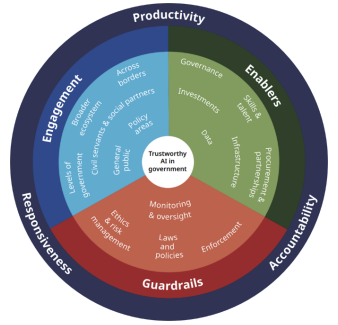
Building Trustworthy AI in Government: Enablers, Guardrails,
and Engagement
Governments are starting to use AI in areas like public
services, tax work, and disaster response. When it works well,
AI can help people get answers faster, spot problems earlier,
and support better decisions. As a result, AI can improve
productivity, responsiveness, and accountability in
government.
However, many public AI projects stay in small pilots. This
happens because governments often lack skills, good data,
modern digital systems, and clear ways to measure impact.
These gaps can also increase risk aversion, so teams avoid
innovation even when the potential benefits are high.
The OECD proposes a simple way to understand
“trustworthy AI in government”: a framework with three
connected pillars. In the figure, the goal is in the centre. Around
it, the three pillars explain what governments must build and
do, so they can reach the public value goals shown on the
outer ring (productivity, responsiveness and accountability).
Enablers are the foundations. They include strong
governance, quality data, and digital infrastructure, as well as
skills and talent in the civil service. They also require
purposeful investment, smart public procurement, and
partnerships with non-government actors, so that AI systems
can be built and used reliably.
Guardrails are the safety systems that guide AI use. They
include ethics and risk management, transparency duties, and
monitoring and oversight bodies that can check results over
time. They can also be non-binding guidance or binding laws
and policies, along with enforcement measures. Tools like
impact assessment and auditing help keep these guardrails
practical. Still, guardrails should be proportionate: not every
rule fits every use case, or progress may stop.
Engagement means involving the people who are affected.
This includes working across levels of government, across
policy areas, and with the broader ecosystem (civil society,
businesses and researchers). It also includes citizens and civil
servants, and sometimes collaboration across borders.
Engagement pushes governments to design user-centred
systems, listen to concerns, and make necessary adjustments.
The main message is that trust is “unlocked” by the right
mix. If enablers are weak, AI cannot scale. If guardrails are
missing, harms grow. If engagement is shallow, solutions may
look efficient but feel unfair, and trust can fall.
(Adapted from oecd.org on February 22, 2026)
Considere o trecho “Guardrails are the safety systems that
guide AI use.” (5º parágrafo). Sem alterar o sentido original do
texto, a palavra “guide” pode ser substituída por
Ano: 2026
Banca:
FUVEST
Órgão:
USP
Prova:
FUVEST - 2026 - USP - Técnico de Laboratório (Especialidade: Mecânica) |
Q3964426
Inglês
Texto associado
Building Trustworthy AI in Government: Enablers, Guardrails,
and Engagement
Governments are starting to use AI in areas like public
services, tax work, and disaster response. When it works well,
AI can help people get answers faster, spot problems earlier,
and support better decisions. As a result, AI can improve
productivity, responsiveness, and accountability in
government.
However, many public AI projects stay in small pilots. This
happens because governments often lack skills, good data,
modern digital systems, and clear ways to measure impact.
These gaps can also increase risk aversion, so teams avoid
innovation even when the potential benefits are high.
The OECD proposes a simple way to understand
“trustworthy AI in government”: a framework with three
connected pillars. In the figure, the goal is in the centre. Around
it, the three pillars explain what governments must build and
do, so they can reach the public value goals shown on the
outer ring (productivity, responsiveness and accountability).
Enablers are the foundations. They include strong
governance, quality data, and digital infrastructure, as well as
skills and talent in the civil service. They also require
purposeful investment, smart public procurement, and
partnerships with non-government actors, so that AI systems
can be built and used reliably.
Guardrails are the safety systems that guide AI use. They
include ethics and risk management, transparency duties, and
monitoring and oversight bodies that can check results over
time. They can also be non-binding guidance or binding laws
and policies, along with enforcement measures. Tools like
impact assessment and auditing help keep these guardrails
practical. Still, guardrails should be proportionate: not every
rule fits every use case, or progress may stop.
Engagement means involving the people who are affected.
This includes working across levels of government, across
policy areas, and with the broader ecosystem (civil society,
businesses and researchers). It also includes citizens and civil
servants, and sometimes collaboration across borders.
Engagement pushes governments to design user-centred
systems, listen to concerns, and make necessary adjustments.
The main message is that trust is “unlocked” by the right
mix. If enablers are weak, AI cannot scale. If guardrails are
missing, harms grow. If engagement is shallow, solutions may
look efficient but feel unfair, and trust can fall.
(Adapted from oecd.org on February 22, 2026)
Considere o trecho “These gaps can also increase risk
aversion, so teams avoid innovation even when the potential
benefits are high.” (2º parágrafo)
A expressão “risk aversion” pode ser corretamente compreendida como:¬
A expressão “risk aversion” pode ser corretamente compreendida como:¬
Ano: 2026
Banca:
FUVEST
Órgão:
USP
Prova:
FUVEST - 2026 - USP - Técnico de Laboratório (Especialidade: Mecânica) |
Q3964425
Inglês
Texto associado
Building Trustworthy AI in Government: Enablers, Guardrails,
and Engagement
Governments are starting to use AI in areas like public
services, tax work, and disaster response. When it works well,
AI can help people get answers faster, spot problems earlier,
and support better decisions. As a result, AI can improve
productivity, responsiveness, and accountability in
government.
However, many public AI projects stay in small pilots. This
happens because governments often lack skills, good data,
modern digital systems, and clear ways to measure impact.
These gaps can also increase risk aversion, so teams avoid
innovation even when the potential benefits are high.
The OECD proposes a simple way to understand
“trustworthy AI in government”: a framework with three
connected pillars. In the figure, the goal is in the centre. Around
it, the three pillars explain what governments must build and
do, so they can reach the public value goals shown on the
outer ring (productivity, responsiveness and accountability).
Enablers are the foundations. They include strong
governance, quality data, and digital infrastructure, as well as
skills and talent in the civil service. They also require
purposeful investment, smart public procurement, and
partnerships with non-government actors, so that AI systems
can be built and used reliably.
Guardrails are the safety systems that guide AI use. They
include ethics and risk management, transparency duties, and
monitoring and oversight bodies that can check results over
time. They can also be non-binding guidance or binding laws
and policies, along with enforcement measures. Tools like
impact assessment and auditing help keep these guardrails
practical. Still, guardrails should be proportionate: not every
rule fits every use case, or progress may stop.
Engagement means involving the people who are affected.
This includes working across levels of government, across
policy areas, and with the broader ecosystem (civil society,
businesses and researchers). It also includes citizens and civil
servants, and sometimes collaboration across borders.
Engagement pushes governments to design user-centred
systems, listen to concerns, and make necessary adjustments.
The main message is that trust is “unlocked” by the right
mix. If enablers are weak, AI cannot scale. If guardrails are
missing, harms grow. If engagement is shallow, solutions may
look efficient but feel unfair, and trust can fall.
(Adapted from oecd.org on February 22, 2026)
No 5º parágrafo, ao afirmar que “Still, guardrails should be
proportionate: not every rule fits every use case, or progress
may stop. ”, o texto defende que as regras para o uso da IA
devem
Ano: 2026
Banca:
FUVEST
Órgão:
USP
Prova:
FUVEST - 2026 - USP - Técnico de Laboratório (Especialidade: Mecânica) |
Q3964424
Inglês
Texto associado
Building Trustworthy AI in Government: Enablers, Guardrails,
and Engagement
Governments are starting to use AI in areas like public
services, tax work, and disaster response. When it works well,
AI can help people get answers faster, spot problems earlier,
and support better decisions. As a result, AI can improve
productivity, responsiveness, and accountability in
government.
However, many public AI projects stay in small pilots. This
happens because governments often lack skills, good data,
modern digital systems, and clear ways to measure impact.
These gaps can also increase risk aversion, so teams avoid
innovation even when the potential benefits are high.
The OECD proposes a simple way to understand
“trustworthy AI in government”: a framework with three
connected pillars. In the figure, the goal is in the centre. Around
it, the three pillars explain what governments must build and
do, so they can reach the public value goals shown on the
outer ring (productivity, responsiveness and accountability).
Enablers are the foundations. They include strong
governance, quality data, and digital infrastructure, as well as
skills and talent in the civil service. They also require
purposeful investment, smart public procurement, and
partnerships with non-government actors, so that AI systems
can be built and used reliably.
Guardrails are the safety systems that guide AI use. They
include ethics and risk management, transparency duties, and
monitoring and oversight bodies that can check results over
time. They can also be non-binding guidance or binding laws
and policies, along with enforcement measures. Tools like
impact assessment and auditing help keep these guardrails
practical. Still, guardrails should be proportionate: not every
rule fits every use case, or progress may stop.
Engagement means involving the people who are affected.
This includes working across levels of government, across
policy areas, and with the broader ecosystem (civil society,
businesses and researchers). It also includes citizens and civil
servants, and sometimes collaboration across borders.
Engagement pushes governments to design user-centred
systems, listen to concerns, and make necessary adjustments.
The main message is that trust is “unlocked” by the right
mix. If enablers are weak, AI cannot scale. If guardrails are
missing, harms grow. If engagement is shallow, solutions may
look efficient but feel unfair, and trust can fall.
(Adapted from oecd.org on February 22, 2026)
No 5º parágrafo do texto, a palavra “guardrails” é usada em
sentido figurado. Ela se refere, mais diretamente, a:
Ano: 2026
Banca:
FUVEST
Órgão:
USP
Prova:
FUVEST - 2026 - USP - Técnico de Laboratório (Especialidade: Mecânica) |
Q3964423
Inglês
Texto associado
Building Trustworthy AI in Government: Enablers, Guardrails,
and Engagement
Governments are starting to use AI in areas like public
services, tax work, and disaster response. When it works well,
AI can help people get answers faster, spot problems earlier,
and support better decisions. As a result, AI can improve
productivity, responsiveness, and accountability in
government.
However, many public AI projects stay in small pilots. This
happens because governments often lack skills, good data,
modern digital systems, and clear ways to measure impact.
These gaps can also increase risk aversion, so teams avoid
innovation even when the potential benefits are high.
The OECD proposes a simple way to understand
“trustworthy AI in government”: a framework with three
connected pillars. In the figure, the goal is in the centre. Around
it, the three pillars explain what governments must build and
do, so they can reach the public value goals shown on the
outer ring (productivity, responsiveness and accountability).
Enablers are the foundations. They include strong
governance, quality data, and digital infrastructure, as well as
skills and talent in the civil service. They also require
purposeful investment, smart public procurement, and
partnerships with non-government actors, so that AI systems
can be built and used reliably.
Guardrails are the safety systems that guide AI use. They
include ethics and risk management, transparency duties, and
monitoring and oversight bodies that can check results over
time. They can also be non-binding guidance or binding laws
and policies, along with enforcement measures. Tools like
impact assessment and auditing help keep these guardrails
practical. Still, guardrails should be proportionate: not every
rule fits every use case, or progress may stop.
Engagement means involving the people who are affected.
This includes working across levels of government, across
policy areas, and with the broader ecosystem (civil society,
businesses and researchers). It also includes citizens and civil
servants, and sometimes collaboration across borders.
Engagement pushes governments to design user-centred
systems, listen to concerns, and make necessary adjustments.
The main message is that trust is “unlocked” by the right
mix. If enablers are weak, AI cannot scale. If guardrails are
missing, harms grow. If engagement is shallow, solutions may
look efficient but feel unfair, and trust can fall.
(Adapted from oecd.org on February 22, 2026)
No trecho “These gaps can also increase risk aversion”,
presente no segundo parágrafo, a expressão “these gaps”
refere-se, principalmente,
Ano: 2026
Banca:
FUVEST
Órgão:
USP
Prova:
FUVEST - 2026 - USP - Técnico de Laboratório (Especialidade: Mecânica) |
Q3964422
Inglês
Texto associado
Building Trustworthy AI in Government: Enablers, Guardrails,
and Engagement
Governments are starting to use AI in areas like public
services, tax work, and disaster response. When it works well,
AI can help people get answers faster, spot problems earlier,
and support better decisions. As a result, AI can improve
productivity, responsiveness, and accountability in
government.
However, many public AI projects stay in small pilots. This
happens because governments often lack skills, good data,
modern digital systems, and clear ways to measure impact.
These gaps can also increase risk aversion, so teams avoid
innovation even when the potential benefits are high.
The OECD proposes a simple way to understand
“trustworthy AI in government”: a framework with three
connected pillars. In the figure, the goal is in the centre. Around
it, the three pillars explain what governments must build and
do, so they can reach the public value goals shown on the
outer ring (productivity, responsiveness and accountability).
Enablers are the foundations. They include strong
governance, quality data, and digital infrastructure, as well as
skills and talent in the civil service. They also require
purposeful investment, smart public procurement, and
partnerships with non-government actors, so that AI systems
can be built and used reliably.
Guardrails are the safety systems that guide AI use. They
include ethics and risk management, transparency duties, and
monitoring and oversight bodies that can check results over
time. They can also be non-binding guidance or binding laws
and policies, along with enforcement measures. Tools like
impact assessment and auditing help keep these guardrails
practical. Still, guardrails should be proportionate: not every
rule fits every use case, or progress may stop.
Engagement means involving the people who are affected.
This includes working across levels of government, across
policy areas, and with the broader ecosystem (civil society,
businesses and researchers). It also includes citizens and civil
servants, and sometimes collaboration across borders.
Engagement pushes governments to design user-centred
systems, listen to concerns, and make necessary adjustments.
The main message is that trust is “unlocked” by the right
mix. If enablers are weak, AI cannot scale. If guardrails are
missing, harms grow. If engagement is shallow, solutions may
look efficient but feel unfair, and trust can fall.
(Adapted from oecd.org on February 22, 2026)
A frase “If engagement is shallow, solutions may look efficient
but feel unfair, and trust can fall”, no último parágrafo, sugere
que a principal consequência de um engajamento fraco é
Ano: 2026
Banca:
FUVEST
Órgão:
USP
Prova:
FUVEST - 2026 - USP - Médico (Especialidade: Medicina Intensiva) |
Q3964177
Inglês
Texto associado
Texto para questão
How do we measure attention?
Attention, broadly defined, is the ability to direct the
mind on a specific task, says Gloria Mark, author of Attention
Span: A Groundbreaking Way to Restore Balance, Happiness
and Productivity. There are two main types of attention, Mark
explains. Involuntary attention is automatic—it’s what allows us
to react to a loud noise or a jarringly bright light. Focalized
attention, by contrast, is the ability to concentrate on a specific
task. This latter type is what scientists measure when
researching attention spans.
Since the early 2000s, Mark has tracked focalized
attention by observing how long people remain on a task
before switching to something else—such as checking email
or opening a new browser tab. At first, Mark used in-person
observations— researchers shadowed employees throughout
the office. In recent years, she has tracked attention spans
using software that monitors people’s computers.
“Data from our first study, in 2003, revealed that people
spent an average of 2.5 minutes on something before turning
their attention to a different task,” she says, “Our most recent
study done over the past five years shows that the figure has
gone down to 40 seconds.” The measure doesn’t capture how
long people can focus under ideal conditions, Mark notes,
meaning shorter attention spans don’t reflect a permanent loss
of attention capacity, but changes in how often people break
their focus in daily life.
National Geographic. Jan 21, 2026. Adaptado.
Em relação ao contexto em que se insere, o termo “figure”
(último parágrafo) pode ser substituído, sem prejuízo do
sentido original, por qual das palavras a seguir?
Ano: 2026
Banca:
FUVEST
Órgão:
USP
Prova:
FUVEST - 2026 - USP - Médico (Especialidade: Medicina Intensiva) |
Q3964176
Inglês
Texto associado
Texto para questão
How do we measure attention?
Attention, broadly defined, is the ability to direct the
mind on a specific task, says Gloria Mark, author of Attention
Span: A Groundbreaking Way to Restore Balance, Happiness
and Productivity. There are two main types of attention, Mark
explains. Involuntary attention is automatic—it’s what allows us
to react to a loud noise or a jarringly bright light. Focalized
attention, by contrast, is the ability to concentrate on a specific
task. This latter type is what scientists measure when
researching attention spans.
Since the early 2000s, Mark has tracked focalized
attention by observing how long people remain on a task
before switching to something else—such as checking email
or opening a new browser tab. At first, Mark used in-person
observations— researchers shadowed employees throughout
the office. In recent years, she has tracked attention spans
using software that monitors people’s computers.
“Data from our first study, in 2003, revealed that people
spent an average of 2.5 minutes on something before turning
their attention to a different task,” she says, “Our most recent
study done over the past five years shows that the figure has
gone down to 40 seconds.” The measure doesn’t capture how
long people can focus under ideal conditions, Mark notes,
meaning shorter attention spans don’t reflect a permanent loss
of attention capacity, but changes in how often people break
their focus in daily life.
National Geographic. Jan 21, 2026. Adaptado.
Considere o excerto a seguir: “jarringly bright light.” O
emprego do advérbio “jarringly”, no contexto, indica que a luz
provoca uma reação por ser
Ano: 2026
Banca:
FUVEST
Órgão:
USP
Prova:
FUVEST - 2026 - USP - Médico (Especialidade: Medicina Intensiva) |
Q3964175
Inglês
Texto associado
Texto para questão
How do we measure attention?
Attention, broadly defined, is the ability to direct the
mind on a specific task, says Gloria Mark, author of Attention
Span: A Groundbreaking Way to Restore Balance, Happiness
and Productivity. There are two main types of attention, Mark
explains. Involuntary attention is automatic—it’s what allows us
to react to a loud noise or a jarringly bright light. Focalized
attention, by contrast, is the ability to concentrate on a specific
task. This latter type is what scientists measure when
researching attention spans.
Since the early 2000s, Mark has tracked focalized
attention by observing how long people remain on a task
before switching to something else—such as checking email
or opening a new browser tab. At first, Mark used in-person
observations— researchers shadowed employees throughout
the office. In recent years, she has tracked attention spans
using software that monitors people’s computers.
“Data from our first study, in 2003, revealed that people
spent an average of 2.5 minutes on something before turning
their attention to a different task,” she says, “Our most recent
study done over the past five years shows that the figure has
gone down to 40 seconds.” The measure doesn’t capture how
long people can focus under ideal conditions, Mark notes,
meaning shorter attention spans don’t reflect a permanent loss
of attention capacity, but changes in how often people break
their focus in daily life.
National Geographic. Jan 21, 2026. Adaptado.
No que se refere aos procedimentos de mensuração do tempo
de atenção, infere-se que, na atualidade,
Ano: 2026
Banca:
FUVEST
Órgão:
USP
Prova:
FUVEST - 2026 - USP - Médico (Especialidade: Medicina Intensiva) |
Q3964174
Inglês
Texto associado
Texto para questão
How do we measure attention?
Attention, broadly defined, is the ability to direct the
mind on a specific task, says Gloria Mark, author of Attention
Span: A Groundbreaking Way to Restore Balance, Happiness
and Productivity. There are two main types of attention, Mark
explains. Involuntary attention is automatic—it’s what allows us
to react to a loud noise or a jarringly bright light. Focalized
attention, by contrast, is the ability to concentrate on a specific
task. This latter type is what scientists measure when
researching attention spans.
Since the early 2000s, Mark has tracked focalized
attention by observing how long people remain on a task
before switching to something else—such as checking email
or opening a new browser tab. At first, Mark used in-person
observations— researchers shadowed employees throughout
the office. In recent years, she has tracked attention spans
using software that monitors people’s computers.
“Data from our first study, in 2003, revealed that people
spent an average of 2.5 minutes on something before turning
their attention to a different task,” she says, “Our most recent
study done over the past five years shows that the figure has
gone down to 40 seconds.” The measure doesn’t capture how
long people can focus under ideal conditions, Mark notes,
meaning shorter attention spans don’t reflect a permanent loss
of attention capacity, but changes in how often people break
their focus in daily life.
National Geographic. Jan 21, 2026. Adaptado.
Considere a oração “This latter type is what scientists measure
when researching attention spans.” Pode-se concluir que, ao
pesquisar o tempo de atenção, os cientistas mensuram
Ano: 2026
Banca:
FUVEST
Órgão:
USP
Prova:
FUVEST - 2026 - USP - Médico (Especialidade: Medicina Intensiva) |
Q3964173
Inglês
Texto associado
Texto para questão
How do we measure attention?
Attention, broadly defined, is the ability to direct the
mind on a specific task, says Gloria Mark, author of Attention
Span: A Groundbreaking Way to Restore Balance, Happiness
and Productivity. There are two main types of attention, Mark
explains. Involuntary attention is automatic—it’s what allows us
to react to a loud noise or a jarringly bright light. Focalized
attention, by contrast, is the ability to concentrate on a specific
task. This latter type is what scientists measure when
researching attention spans.
Since the early 2000s, Mark has tracked focalized
attention by observing how long people remain on a task
before switching to something else—such as checking email
or opening a new browser tab. At first, Mark used in-person
observations— researchers shadowed employees throughout
the office. In recent years, she has tracked attention spans
using software that monitors people’s computers.
“Data from our first study, in 2003, revealed that people
spent an average of 2.5 minutes on something before turning
their attention to a different task,” she says, “Our most recent
study done over the past five years shows that the figure has
gone down to 40 seconds.” The measure doesn’t capture how
long people can focus under ideal conditions, Mark notes,
meaning shorter attention spans don’t reflect a permanent loss
of attention capacity, but changes in how often people break
their focus in daily life.
National Geographic. Jan 21, 2026. Adaptado.
Considere o trecho a seguir: “Mark has tracked focalized
attention.” Assinale a alternativa que apresenta a reescrita
correta na voz passiva, mantendo integralmente o aspecto
verbal e a relação semântica.
Ano: 2026
Banca:
FUVEST
Órgão:
USP
Prova:
FUVEST - 2026 - USP - Médico (Especialidade: Medicina Intensiva) |
Q3964172
Inglês
Texto associado
Texto para questão
How do we measure attention?
Attention, broadly defined, is the ability to direct the
mind on a specific task, says Gloria Mark, author of Attention
Span: A Groundbreaking Way to Restore Balance, Happiness
and Productivity. There are two main types of attention, Mark
explains. Involuntary attention is automatic—it’s what allows us
to react to a loud noise or a jarringly bright light. Focalized
attention, by contrast, is the ability to concentrate on a specific
task. This latter type is what scientists measure when
researching attention spans.
Since the early 2000s, Mark has tracked focalized
attention by observing how long people remain on a task
before switching to something else—such as checking email
or opening a new browser tab. At first, Mark used in-person
observations— researchers shadowed employees throughout
the office. In recent years, she has tracked attention spans
using software that monitors people’s computers.
“Data from our first study, in 2003, revealed that people
spent an average of 2.5 minutes on something before turning
their attention to a different task,” she says, “Our most recent
study done over the past five years shows that the figure has
gone down to 40 seconds.” The measure doesn’t capture how
long people can focus under ideal conditions, Mark notes,
meaning shorter attention spans don’t reflect a permanent loss
of attention capacity, but changes in how often people break
their focus in daily life.
National Geographic. Jan 21, 2026. Adaptado.
Em uma análise global do texto apresentado, é possível
afirmar que o tom discursivo é, predominantemente,
Ano: 2026
Banca:
FEPESE
Órgão:
Prefeitura de Caxambu do Sul - SC
Prova:
FEPESE - 2026 - Prefeitura de Caxambu do Sul - SC - Professor de Língua Estrangeira – Inglês - Edital nº 1 |
Q3962167
Inglês
Analise as afirmativas abaixo sobre o tema Vocabulário e Comunicação em Língua Inglesa.
1. Campo Semântico é constituído por um conjunto de palavras relacionadas entre si. Exemplo: tema food (guava, toast, beans, juice).
2. A expressão How are you? é um exemplo de uso cotidiano em língua inglesa.
3. Ao trabalhar vocabulário no Ensino Fundamental, é pedagogicamente mais adequado priorizar a tradução literal de todos os termos.
4. Thanksgiving é um elemento sociocultural de países que tem a Língua Inglesa como segunda língua.
Assinale a alternativa que indica todas as afirmativas corretas.

 Conheça nossos planos