Questões de Concurso Sobre inglês
Foram encontradas 25.994 questões


Q4348447
Inglês
Texto associado
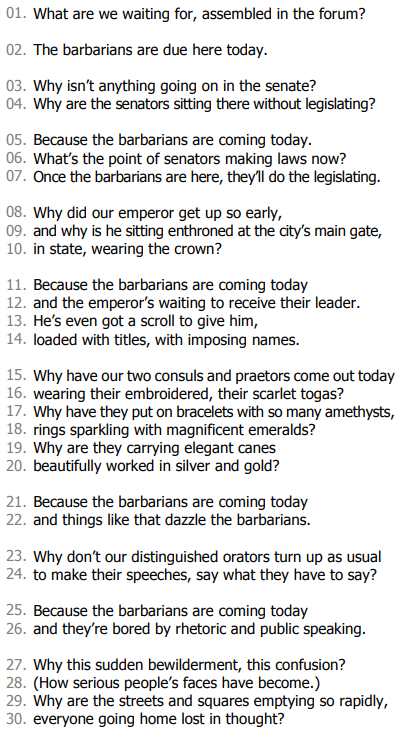
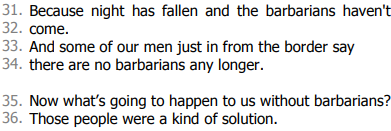
Question refer to the text
below.
“Waiting for the Barbarians” by C.P. Cavafy
What CANNOT be implied from the poem?
Q4348446
Inglês
Complete the following sentence: In Translation and
Language Teaching, Malmkjær (1998) discusses how
translation in education has undergone a paradigm
shift, according to which translation
Q4348445
Inglês
The following are reading strategies:
a. ___________ creates anticipation and gets students thinking about previous experiences they may have had about the topic before they read about it. b. It is important that readers be able to get the main idea of a text, and ___________ can help as the reader restates the meaning in his or her own words. c. The main idea of a paragraph is sometimes stated in the ___________ of a paragraph. d. ___________ are words and phrases that join parts of a text together just like the bands in a watch strap. e. ___________ is to look rapidly for specific information. f. ___________ — for gist or overview.
(Adapted from: FARRELL, T. S. C. Teaching reading to English language learners: a reflective guide. Thousand Oaks: Corwin Press, 2009)
Identify the correct sequence of the missing words in the text from top to bottom.
a. ___________ creates anticipation and gets students thinking about previous experiences they may have had about the topic before they read about it. b. It is important that readers be able to get the main idea of a text, and ___________ can help as the reader restates the meaning in his or her own words. c. The main idea of a paragraph is sometimes stated in the ___________ of a paragraph. d. ___________ are words and phrases that join parts of a text together just like the bands in a watch strap. e. ___________ is to look rapidly for specific information. f. ___________ — for gist or overview.
(Adapted from: FARRELL, T. S. C. Teaching reading to English language learners: a reflective guide. Thousand Oaks: Corwin Press, 2009)
Identify the correct sequence of the missing words in the text from top to bottom.
Q4348442
Inglês
Considering the theoretical intersections among Critical
Literacy, English as a Lingua Franca (ELF), and Additional
Language (AL) acquisition, analyze the following
propositions.
I - The concept of ELF problematizes the notion of language “ownership”—historically attributed to the native speaker—and decenters Anglo-American standards. From the perspective of Critical Literacy, this entails the teacher problematizing the very erasure of non-hegemonic varieties.
II - Understanding English as an AL implies recognizing that the new language integrates into the student’s plurilingual repertoire in an additive, rather than subtractive, manner. However, for Critical Literacy to occur, pedagogical practice must go beyond the affirmation of identity, equipping the student to unveil how mastery of a global language reproduces or challenges geopolitical and class-based asymmetries.
III - Critical pedagogy applied to ELT presupposes the adoption of a “didactics of tolerance,” in which an exclusive focus on mutual intelligibility suspends the need to reflect on local linguistic norms, thereby legitimizing any discursive output based on the argument of cultural hybridization.
IV - Within the framework of Critical Literacy, pedagogical practice adopting ELF must abandon the teaching of the standard norm or prestige varieties. This is because the focus on social emancipation demands the rejection of any hegemonic linguistic conventions, which are viewed purely as instruments of oppression and linguistic colonization.
V - The connection between AL and Critical Literacy presupposes that the process of meaning-making in a new language is a space of agency and contestation. Thus, classroom language practices must equip the student to “rewrite” and subvert hegemonic discourses, using English not as a code to be imitated, but as a resource for social performativity and the creation of new meanings.
The correct statements are
I - The concept of ELF problematizes the notion of language “ownership”—historically attributed to the native speaker—and decenters Anglo-American standards. From the perspective of Critical Literacy, this entails the teacher problematizing the very erasure of non-hegemonic varieties.
II - Understanding English as an AL implies recognizing that the new language integrates into the student’s plurilingual repertoire in an additive, rather than subtractive, manner. However, for Critical Literacy to occur, pedagogical practice must go beyond the affirmation of identity, equipping the student to unveil how mastery of a global language reproduces or challenges geopolitical and class-based asymmetries.
III - Critical pedagogy applied to ELT presupposes the adoption of a “didactics of tolerance,” in which an exclusive focus on mutual intelligibility suspends the need to reflect on local linguistic norms, thereby legitimizing any discursive output based on the argument of cultural hybridization.
IV - Within the framework of Critical Literacy, pedagogical practice adopting ELF must abandon the teaching of the standard norm or prestige varieties. This is because the focus on social emancipation demands the rejection of any hegemonic linguistic conventions, which are viewed purely as instruments of oppression and linguistic colonization.
V - The connection between AL and Critical Literacy presupposes that the process of meaning-making in a new language is a space of agency and contestation. Thus, classroom language practices must equip the student to “rewrite” and subvert hegemonic discourses, using English not as a code to be imitated, but as a resource for social performativity and the creation of new meanings.
The correct statements are
Ano: 2026
Banca:
AMEOSC
Órgão:
Prefeitura de Mondaí - SC
Prova:
AMEOSC - 2026 - Prefeitura de Mondaí - SC - Professor Licenciado - Área: Professor de Inglês (Habilitado e Não Habilitado) - Edital nº 43 |
Q4347984
Inglês
A student writes the following sentence in an academic
assignment:
"The researchers made attention to several inconsistencies and later looked into their possible causes.
The teacher wants to correct the lexical problem without changing the intended meaning.
Which revision is appropriate?
"The researchers made attention to several inconsistencies and later looked into their possible causes.
The teacher wants to correct the lexical problem without changing the intended meaning.
Which revision is appropriate?
Ano: 2026
Banca:
AMEOSC
Órgão:
Prefeitura de Mondaí - SC
Prova:
AMEOSC - 2026 - Prefeitura de Mondaí - SC - Professor Licenciado - Área: Professor de Inglês (Habilitado e Não Habilitado) - Edital nº 43 |
Q4347983
Inglês
A school introduced a language laboratory two years
ago. Teachers did not receive training at the time, and
they are still having difficulty using the laboratory
effectively.
Which sentence correctly expresses a past unreal condition with a present result?
Which sentence correctly expresses a past unreal condition with a present result?
Ano: 2026
Banca:
AMEOSC
Órgão:
Prefeitura de Mondaí - SC
Prova:
AMEOSC - 2026 - Prefeitura de Mondaí - SC - Professor Licenciado - Área: Professor de Inglês (Habilitado e Não Habilitado) - Edital nº 43 |
Q4347977
Inglês
On Monday, a teacher said:
"I may send the revised material tomorrow, but I haven't finished checking it yet."
On Wednesday, another teacher reports what was said.
Which sentence accurately reports the original statement from the later temporal perspective?
"I may send the revised material tomorrow, but I haven't finished checking it yet."
On Wednesday, another teacher reports what was said.
Which sentence accurately reports the original statement from the later temporal perspective?
Ano: 2026
Banca:
AMEOSC
Órgão:
Prefeitura de Mondaí - SC
Prova:
AMEOSC - 2026 - Prefeitura de Mondaí - SC - Professor Licenciado - Área: Professor de Inglês (Habilitado e Não Habilitado) - Edital nº 43 |
Q4347976
Inglês
Read the excerpt:
The new platform has undoubtedly made information easier to distribute. Whether it has made students better informed is a different matter. Faster circulation may increase exposure to information, but exposure should not be mistaken for careful evaluation.
Which inference best represents the writer's position?
The new platform has undoubtedly made information easier to distribute. Whether it has made students better informed is a different matter. Faster circulation may increase exposure to information, but exposure should not be mistaken for careful evaluation.
Which inference best represents the writer's position?
Ano: 2026
Banca:
AMEOSC
Órgão:
Prefeitura de Mondaí - SC
Prova:
AMEOSC - 2026 - Prefeitura de Mondaí - SC - Professor Licenciado - Área: Professor de Inglês (Habilitado e Não Habilitado) - Edital nº 43 |
Q4347975
Inglês
A student writes:
"Online courses offer greater scheduling flexibility. This flexibility can benefit students who work. They also require considerable autonomy. This can become difficult when learners have limited experience managing their own study routines."
Although the paragraph is understandable, the teacher wants to improve its referential precision and thematic progression.
Which revision achieves this purpose most effectively?
"Online courses offer greater scheduling flexibility. This flexibility can benefit students who work. They also require considerable autonomy. This can become difficult when learners have limited experience managing their own study routines."
Although the paragraph is understandable, the teacher wants to improve its referential precision and thematic progression.
Which revision achieves this purpose most effectively?
Ano: 2026
Banca:
AMEOSC
Órgão:
Prefeitura de Mondaí - SC
Prova:
AMEOSC - 2026 - Prefeitura de Mondaí - SC - Professor Licenciado - Área: Professor de Inglês (Habilitado e Não Habilitado) - Edital nº 43 |
Q4347974
Inglês
Match the interactional strategies in Column I with the
examples in Column II.
COLUMN I
1.Clarification request.
2.Confirmation check.
3.Circumlocution.
4.Self-repair.
COLUMN II
(__)Do you mean that the deadline has been moved to Friday?
(__)It is the tool you use to... well, to attach the pages together.
(__)Sorry, when you say "draft," what exactly do you mean here?
(__)She arrived on Thursday — sorry, I mean Tuesday.
The correct sequence, from top to bottom, is:
COLUMN I
1.Clarification request.
2.Confirmation check.
3.Circumlocution.
4.Self-repair.
COLUMN II
(__)Do you mean that the deadline has been moved to Friday?
(__)It is the tool you use to... well, to attach the pages together.
(__)Sorry, when you say "draft," what exactly do you mean here?
(__)She arrived on Thursday — sorry, I mean Tuesday.
The correct sequence, from top to bottom, is:
Ano: 2026
Banca:
AMEOSC
Órgão:
Prefeitura de Mondaí - SC
Prova:
AMEOSC - 2026 - Prefeitura de Mondaí - SC - Professor Licenciado - Área: Professor de Inglês (Habilitado e Não Habilitado) - Edital nº 43 |
Q4347972
Inglês
Regarding English pronunciation and stress, mark T for
true and F for false.
(__)In standard descriptions of English, the noun record and the verb record may be distinguished by a shift in primary stress.
(__)Unstressed grammatical words may undergo vowel reduction in connected speech, which helps explain pronunciations involving schwa.
(__)Words with similar spelling necessarily preserve the same stressed syllable when derivational suffixes are added.
(__)English spelling provides useful information about pronunciation, but grapheme-to-sound relationships are not consistently one-to-one.
The correct sequence, from top to bottom, is:
(__)In standard descriptions of English, the noun record and the verb record may be distinguished by a shift in primary stress.
(__)Unstressed grammatical words may undergo vowel reduction in connected speech, which helps explain pronunciations involving schwa.
(__)Words with similar spelling necessarily preserve the same stressed syllable when derivational suffixes are added.
(__)English spelling provides useful information about pronunciation, but grapheme-to-sound relationships are not consistently one-to-one.
The correct sequence, from top to bottom, is:
Ano: 2026
Banca:
FSADU
Órgão:
Prefeitura de Buriticupu - MA
Prova:
FSADU - 2026 - Prefeitura de Buriticupu - MA - Professor Ensino Fundamental Nível – II - Anos Finais – 6º ao 9º Ano - Língua Inglesa |
Q4345135
Inglês
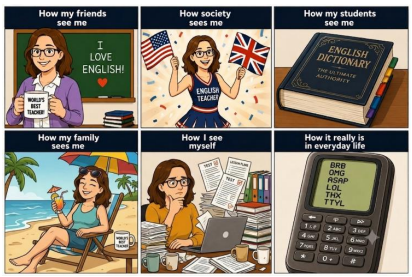
(Adapted from https://br.pinterest.com/pin/48132289740225210/ using AI)
Considering the multimodal construction of this meme, which of the following statements best explains the central critical message conveyed by the image labelled “How it really is in everyday life” in relation to the other five images?
Ano: 2026
Banca:
FSADU
Órgão:
Prefeitura de Buriticupu - MA
Prova:
FSADU - 2026 - Prefeitura de Buriticupu - MA - Professor Ensino Fundamental Nível – II - Anos Finais – 6º ao 9º Ano - Língua Inglesa |
Q4345134
Inglês
Texto associado
Read text below and answer question accordingly.
English Language Teaching in Brazil: A Gap in Policy,
Problems in Practice
Only three percent of Brazilians are estimated to speak
English despite the status of this language as a
mandatory subject. This fact relates to a gap in foreign
language teaching policy documents: the National
Education Guidelines and Framework Law (LDB), and
the National Curriculum Parameters (PCN). These
documents for many years did not prescribe the
necessary conditions for English Language Teaching
(ELT) to take place effectively, often focusing on
reading due to a lack of resources or large classes.
LDB mandated the teaching of a foreign language
chosen locally from grades 5 to 12. A recent reform in
2017 has added that English will be the foreign
language taught in secondary school (from grade 6 up)
throughout the country. Previous versions of LDB,
however, did not mandate the teaching of English,
leading to the perception that only in private language
centers could students learn the language.
The effectiveness of ELT in basic education remains
low because policies impact the quality of teacher
education, the availability of pedagogical resources,
and the number of students in the classroom. Most
schools are equipped with basic materials like
blackboards and chairs, but few have audiovisual
equipment installed in every classroom. This reality
shows why many teachers stick to the textbook most of
the time.
Many English teachers in Brazil do not speak the
language fluently because most undergraduate
programs offer a dual major (English and Portuguese).
Often, aspiring teachers enroll because they actually
want to teach Portuguese. Consequently, these
teachers reproduce in their classrooms the approaches
in which they were taught as students, focusing on
grammar-translation rather than modern communicative
methods.
Misconceptions about the language also contribute to a
lack of motivation. Some believe English is only from
England or the USA. To correct this, BNCC (National
Common Curriculum Base) suggests an intercultural
approach to make the study of a foreign language more
socially and culturally relevant. BNCC aims to raise
awareness of the global web in which English is
involved, and it is treating it as a tool for citizenship.
(Adapted from: BATISTA, F. C. A. English Language Teaching in Brazil: A Gap
in Policy, Problems in Practice. English Language Teaching, v. 13, n. 8, p. 135-
145, 2020. Disponível em: https://doi.org/10.5539/elt.v13n8p135. Acesso em:
30 maio 2026.)
In the sentence “The effectiveness of ELT in basic
education remains low because policies impact the
quality of teacher education”, the word ‘effectiveness’
is
Ano: 2026
Banca:
FSADU
Órgão:
Prefeitura de Buriticupu - MA
Prova:
FSADU - 2026 - Prefeitura de Buriticupu - MA - Professor Ensino Fundamental Nível – II - Anos Finais – 6º ao 9º Ano - Língua Inglesa |
Q4345133
Inglês
Texto associado
Read text below and answer question accordingly.
English Language Teaching in Brazil: A Gap in Policy,
Problems in Practice
Only three percent of Brazilians are estimated to speak
English despite the status of this language as a
mandatory subject. This fact relates to a gap in foreign
language teaching policy documents: the National
Education Guidelines and Framework Law (LDB), and
the National Curriculum Parameters (PCN). These
documents for many years did not prescribe the
necessary conditions for English Language Teaching
(ELT) to take place effectively, often focusing on
reading due to a lack of resources or large classes.
LDB mandated the teaching of a foreign language
chosen locally from grades 5 to 12. A recent reform in
2017 has added that English will be the foreign
language taught in secondary school (from grade 6 up)
throughout the country. Previous versions of LDB,
however, did not mandate the teaching of English,
leading to the perception that only in private language
centers could students learn the language.
The effectiveness of ELT in basic education remains
low because policies impact the quality of teacher
education, the availability of pedagogical resources,
and the number of students in the classroom. Most
schools are equipped with basic materials like
blackboards and chairs, but few have audiovisual
equipment installed in every classroom. This reality
shows why many teachers stick to the textbook most of
the time.
Many English teachers in Brazil do not speak the
language fluently because most undergraduate
programs offer a dual major (English and Portuguese).
Often, aspiring teachers enroll because they actually
want to teach Portuguese. Consequently, these
teachers reproduce in their classrooms the approaches
in which they were taught as students, focusing on
grammar-translation rather than modern communicative
methods.
Misconceptions about the language also contribute to a
lack of motivation. Some believe English is only from
England or the USA. To correct this, BNCC (National
Common Curriculum Base) suggests an intercultural
approach to make the study of a foreign language more
socially and culturally relevant. BNCC aims to raise
awareness of the global web in which English is
involved, and it is treating it as a tool for citizenship.
(Adapted from: BATISTA, F. C. A. English Language Teaching in Brazil: A Gap
in Policy, Problems in Practice. English Language Teaching, v. 13, n. 8, p. 135-
145, 2020. Disponível em: https://doi.org/10.5539/elt.v13n8p135. Acesso em:
30 maio 2026.)
Number the following Verb Tenses (in Column B)
according to the sentences (in Column A). Choose the
option that corresponds to the correct sequence.
Column A
( 1 ) This fact relates to a gap in foreign language teaching policy documents.
( 2 ) […] and it is treating it as a tool for citizenship.
( 3 ) A recent reform in 2017 has added that English […]
( 4 ) Previous versions of LDB, however, did not mandate the teaching of English […]
Column B
( ) Present Perfect
( ) Present Continuous
( ) Present Simple
( ) Past Simple
Column A
( 1 ) This fact relates to a gap in foreign language teaching policy documents.
( 2 ) […] and it is treating it as a tool for citizenship.
( 3 ) A recent reform in 2017 has added that English […]
( 4 ) Previous versions of LDB, however, did not mandate the teaching of English […]
Column B
( ) Present Perfect
( ) Present Continuous
( ) Present Simple
( ) Past Simple
Ano: 2026
Banca:
FSADU
Órgão:
Prefeitura de Buriticupu - MA
Prova:
FSADU - 2026 - Prefeitura de Buriticupu - MA - Professor Ensino Fundamental Nível – II - Anos Finais – 6º ao 9º Ano - Língua Inglesa |
Q4345132
Inglês
Texto associado
Read text below and answer question accordingly.
English Language Teaching in Brazil: A Gap in Policy,
Problems in Practice
Only three percent of Brazilians are estimated to speak
English despite the status of this language as a
mandatory subject. This fact relates to a gap in foreign
language teaching policy documents: the National
Education Guidelines and Framework Law (LDB), and
the National Curriculum Parameters (PCN). These
documents for many years did not prescribe the
necessary conditions for English Language Teaching
(ELT) to take place effectively, often focusing on
reading due to a lack of resources or large classes.
LDB mandated the teaching of a foreign language
chosen locally from grades 5 to 12. A recent reform in
2017 has added that English will be the foreign
language taught in secondary school (from grade 6 up)
throughout the country. Previous versions of LDB,
however, did not mandate the teaching of English,
leading to the perception that only in private language
centers could students learn the language.
The effectiveness of ELT in basic education remains
low because policies impact the quality of teacher
education, the availability of pedagogical resources,
and the number of students in the classroom. Most
schools are equipped with basic materials like
blackboards and chairs, but few have audiovisual
equipment installed in every classroom. This reality
shows why many teachers stick to the textbook most of
the time.
Many English teachers in Brazil do not speak the
language fluently because most undergraduate
programs offer a dual major (English and Portuguese).
Often, aspiring teachers enroll because they actually
want to teach Portuguese. Consequently, these
teachers reproduce in their classrooms the approaches
in which they were taught as students, focusing on
grammar-translation rather than modern communicative
methods.
Misconceptions about the language also contribute to a
lack of motivation. Some believe English is only from
England or the USA. To correct this, BNCC (National
Common Curriculum Base) suggests an intercultural
approach to make the study of a foreign language more
socially and culturally relevant. BNCC aims to raise
awareness of the global web in which English is
involved, and it is treating it as a tool for citizenship.
(Adapted from: BATISTA, F. C. A. English Language Teaching in Brazil: A Gap
in Policy, Problems in Practice. English Language Teaching, v. 13, n. 8, p. 135-
145, 2020. Disponível em: https://doi.org/10.5539/elt.v13n8p135. Acesso em:
30 maio 2026.)
Mark the following statements as True (T) or False (F)
based on text. Choose the option that corresponds to
the correct sequence.
( ) The LDB made foreign languages mandatory for all high school students.
( ) Most Brazilian schools have high-tech audiovisual equipment preinstalled in every classroom.
( ) The perception that English is only learned in private centers is linked to limited results of past educational laws.
( ) The intercultural approach aims to make English lessons more socially relevant.
( ) The LDB made foreign languages mandatory for all high school students.
( ) Most Brazilian schools have high-tech audiovisual equipment preinstalled in every classroom.
( ) The perception that English is only learned in private centers is linked to limited results of past educational laws.
( ) The intercultural approach aims to make English lessons more socially relevant.
Ano: 2026
Banca:
FSADU
Órgão:
Prefeitura de Buriticupu - MA
Prova:
FSADU - 2026 - Prefeitura de Buriticupu - MA - Professor Ensino Fundamental Nível – II - Anos Finais – 6º ao 9º Ano - Língua Inglesa |
Q4345131
Inglês
Texto associado
Read text below and answer question accordingly.
English Language Teaching in Brazil: A Gap in Policy,
Problems in Practice
Only three percent of Brazilians are estimated to speak
English despite the status of this language as a
mandatory subject. This fact relates to a gap in foreign
language teaching policy documents: the National
Education Guidelines and Framework Law (LDB), and
the National Curriculum Parameters (PCN). These
documents for many years did not prescribe the
necessary conditions for English Language Teaching
(ELT) to take place effectively, often focusing on
reading due to a lack of resources or large classes.
LDB mandated the teaching of a foreign language
chosen locally from grades 5 to 12. A recent reform in
2017 has added that English will be the foreign
language taught in secondary school (from grade 6 up)
throughout the country. Previous versions of LDB,
however, did not mandate the teaching of English,
leading to the perception that only in private language
centers could students learn the language.
The effectiveness of ELT in basic education remains
low because policies impact the quality of teacher
education, the availability of pedagogical resources,
and the number of students in the classroom. Most
schools are equipped with basic materials like
blackboards and chairs, but few have audiovisual
equipment installed in every classroom. This reality
shows why many teachers stick to the textbook most of
the time.
Many English teachers in Brazil do not speak the
language fluently because most undergraduate
programs offer a dual major (English and Portuguese).
Often, aspiring teachers enroll because they actually
want to teach Portuguese. Consequently, these
teachers reproduce in their classrooms the approaches
in which they were taught as students, focusing on
grammar-translation rather than modern communicative
methods.
Misconceptions about the language also contribute to a
lack of motivation. Some believe English is only from
England or the USA. To correct this, BNCC (National
Common Curriculum Base) suggests an intercultural
approach to make the study of a foreign language more
socially and culturally relevant. BNCC aims to raise
awareness of the global web in which English is
involved, and it is treating it as a tool for citizenship.
(Adapted from: BATISTA, F. C. A. English Language Teaching in Brazil: A Gap
in Policy, Problems in Practice. English Language Teaching, v. 13, n. 8, p. 135-
145, 2020. Disponível em: https://doi.org/10.5539/elt.v13n8p135. Acesso em:
30 maio 2026.)
According to text and BNCC principles, the
"intercultural approach" is recommended in order to
Ano: 2026
Banca:
FSADU
Órgão:
Prefeitura de Buriticupu - MA
Prova:
FSADU - 2026 - Prefeitura de Buriticupu - MA - Professor Ensino Fundamental Nível – II - Anos Finais – 6º ao 9º Ano - Língua Inglesa |
Q4345130
Inglês
Texto associado
Read text below and answer question accordingly.
English Language Teaching in Brazil: A Gap in Policy,
Problems in Practice
Only three percent of Brazilians are estimated to speak
English despite the status of this language as a
mandatory subject. This fact relates to a gap in foreign
language teaching policy documents: the National
Education Guidelines and Framework Law (LDB), and
the National Curriculum Parameters (PCN). These
documents for many years did not prescribe the
necessary conditions for English Language Teaching
(ELT) to take place effectively, often focusing on
reading due to a lack of resources or large classes.
LDB mandated the teaching of a foreign language
chosen locally from grades 5 to 12. A recent reform in
2017 has added that English will be the foreign
language taught in secondary school (from grade 6 up)
throughout the country. Previous versions of LDB,
however, did not mandate the teaching of English,
leading to the perception that only in private language
centers could students learn the language.
The effectiveness of ELT in basic education remains
low because policies impact the quality of teacher
education, the availability of pedagogical resources,
and the number of students in the classroom. Most
schools are equipped with basic materials like
blackboards and chairs, but few have audiovisual
equipment installed in every classroom. This reality
shows why many teachers stick to the textbook most of
the time.
Many English teachers in Brazil do not speak the
language fluently because most undergraduate
programs offer a dual major (English and Portuguese).
Often, aspiring teachers enroll because they actually
want to teach Portuguese. Consequently, these
teachers reproduce in their classrooms the approaches
in which they were taught as students, focusing on
grammar-translation rather than modern communicative
methods.
Misconceptions about the language also contribute to a
lack of motivation. Some believe English is only from
England or the USA. To correct this, BNCC (National
Common Curriculum Base) suggests an intercultural
approach to make the study of a foreign language more
socially and culturally relevant. BNCC aims to raise
awareness of the global web in which English is
involved, and it is treating it as a tool for citizenship.
(Adapted from: BATISTA, F. C. A. English Language Teaching in Brazil: A Gap
in Policy, Problems in Practice. English Language Teaching, v. 13, n. 8, p. 135-
145, 2020. Disponível em: https://doi.org/10.5539/elt.v13n8p135. Acesso em:
30 maio 2026.)
According to text, the low percentage of English
speakers in Brazil is primarily attributed to
Ano: 2026
Banca:
FSADU
Órgão:
Prefeitura de Buriticupu - MA
Prova:
FSADU - 2026 - Prefeitura de Buriticupu - MA - Professor Ensino Fundamental Nível – II - Anos Finais – 6º ao 9º Ano - Língua Inglesa |
Q4345129
Inglês
Texto associado
Read text below and answer questionão accordingly.
The Future of Language Education: Teachers’
Perceptions About the Surge of Large Language
Models like ChatGPT
(1) Large Language Models (LLMs) like ChatGPT have
been described as a disruptive technology — an
innovation that significantly alters or even revolutionises
an existing industry, often introducing new approaches,
challenging established methodologies, or interpreting
older methods as obsolete.
(2) LLMs are computational models that have the
capability to understand and generate human language.
This capacity to generate human language has the
potential to transform language teaching and learning.
(3) Teachers can use LLM tools to personalise learning,
plan lessons, create quizzes or other learning activities,
and to provide feedback. In second language (L2)
classes, teachers could use these models to explain
grammar, propose improvements in grammar and style,
and facilitate conversational practice. These
affordances are an advantage to instructors, saving
them time and providing personalised instructional
support, and many educators are excited to try working
with LLMs.
(4) But, as it is common with any new technology, many
others are fearful of LLMs’ potential to disturb the way
that students approach classroom learning. Fear of new
technologies is not uncommon because they require
educators to adapt, which can be intimidating;
educators may question their pedagogical effectiveness
or the loss of human interaction.
(5) The results of a survey conducted with 65 language
instructors showed mixed feelings: ranging from
excitement for the pedagogical potential of ChatGPT to
fear of potential academic dishonesty and job security.
(6) Importantly, those who had previously engaged with
the tool expressed greater enthusiasm for its wider
application compared to their counterparts with no such
experience. This suggests that familiarity may mitigate
apprehension and foster a more optimistic outlook on
the potential of ChatGPT in educational settings.
Whether language instructors are in admiration or fear
of ChatGPT, Artificial Intelligence (AI) tools are here to
stay — rather than ignore them, we must quickly learn
to use them, understand the challenges and benefits,
and develop both instructional approaches and policies.
(Adapted from: ZIMOTTI, G.; FRANCES, C.; WHITAKER, L. Technology in
Language Teaching & Learning. Technology in Language Teaching & Learning,
v. 6, n. 2, p. 1-24, 2024. Disponível em: https://doi.org/10.29140/tltl.v6n2.1136.
Acesso em: 30 maio 2026.)
In paragraph 6, the sentence “[…] we must quickly
learn to use them […]” could be correctly transformed
into a question without changing its meaning in the
option:
Ano: 2026
Banca:
FSADU
Órgão:
Prefeitura de Buriticupu - MA
Prova:
FSADU - 2026 - Prefeitura de Buriticupu - MA - Professor Ensino Fundamental Nível – II - Anos Finais – 6º ao 9º Ano - Língua Inglesa |
Q4345128
Inglês
Texto associado
Read text below and answer questionão accordingly.
The Future of Language Education: Teachers’
Perceptions About the Surge of Large Language
Models like ChatGPT
(1) Large Language Models (LLMs) like ChatGPT have
been described as a disruptive technology — an
innovation that significantly alters or even revolutionises
an existing industry, often introducing new approaches,
challenging established methodologies, or interpreting
older methods as obsolete.
(2) LLMs are computational models that have the
capability to understand and generate human language.
This capacity to generate human language has the
potential to transform language teaching and learning.
(3) Teachers can use LLM tools to personalise learning,
plan lessons, create quizzes or other learning activities,
and to provide feedback. In second language (L2)
classes, teachers could use these models to explain
grammar, propose improvements in grammar and style,
and facilitate conversational practice. These
affordances are an advantage to instructors, saving
them time and providing personalised instructional
support, and many educators are excited to try working
with LLMs.
(4) But, as it is common with any new technology, many
others are fearful of LLMs’ potential to disturb the way
that students approach classroom learning. Fear of new
technologies is not uncommon because they require
educators to adapt, which can be intimidating;
educators may question their pedagogical effectiveness
or the loss of human interaction.
(5) The results of a survey conducted with 65 language
instructors showed mixed feelings: ranging from
excitement for the pedagogical potential of ChatGPT to
fear of potential academic dishonesty and job security.
(6) Importantly, those who had previously engaged with
the tool expressed greater enthusiasm for its wider
application compared to their counterparts with no such
experience. This suggests that familiarity may mitigate
apprehension and foster a more optimistic outlook on
the potential of ChatGPT in educational settings.
Whether language instructors are in admiration or fear
of ChatGPT, Artificial Intelligence (AI) tools are here to
stay — rather than ignore them, we must quickly learn
to use them, understand the challenges and benefits,
and develop both instructional approaches and policies.
(Adapted from: ZIMOTTI, G.; FRANCES, C.; WHITAKER, L. Technology in
Language Teaching & Learning. Technology in Language Teaching & Learning,
v. 6, n. 2, p. 1-24, 2024. Disponível em: https://doi.org/10.29140/tltl.v6n2.1136.
Acesso em: 30 maio 2026.)
In the sentence “But, as it is common with any new
technology, many others are fearful of LLMs’ potential
to disturb the way that students approach classroom
learning”, the word ‘fearful’
Ano: 2026
Banca:
FSADU
Órgão:
Prefeitura de Buriticupu - MA
Prova:
FSADU - 2026 - Prefeitura de Buriticupu - MA - Professor Ensino Fundamental Nível – II - Anos Finais – 6º ao 9º Ano - Língua Inglesa |
Q4345127
Inglês
Texto associado
Read text below and answer questionão accordingly.
The Future of Language Education: Teachers’
Perceptions About the Surge of Large Language
Models like ChatGPT
(1) Large Language Models (LLMs) like ChatGPT have
been described as a disruptive technology — an
innovation that significantly alters or even revolutionises
an existing industry, often introducing new approaches,
challenging established methodologies, or interpreting
older methods as obsolete.
(2) LLMs are computational models that have the
capability to understand and generate human language.
This capacity to generate human language has the
potential to transform language teaching and learning.
(3) Teachers can use LLM tools to personalise learning,
plan lessons, create quizzes or other learning activities,
and to provide feedback. In second language (L2)
classes, teachers could use these models to explain
grammar, propose improvements in grammar and style,
and facilitate conversational practice. These
affordances are an advantage to instructors, saving
them time and providing personalised instructional
support, and many educators are excited to try working
with LLMs.
(4) But, as it is common with any new technology, many
others are fearful of LLMs’ potential to disturb the way
that students approach classroom learning. Fear of new
technologies is not uncommon because they require
educators to adapt, which can be intimidating;
educators may question their pedagogical effectiveness
or the loss of human interaction.
(5) The results of a survey conducted with 65 language
instructors showed mixed feelings: ranging from
excitement for the pedagogical potential of ChatGPT to
fear of potential academic dishonesty and job security.
(6) Importantly, those who had previously engaged with
the tool expressed greater enthusiasm for its wider
application compared to their counterparts with no such
experience. This suggests that familiarity may mitigate
apprehension and foster a more optimistic outlook on
the potential of ChatGPT in educational settings.
Whether language instructors are in admiration or fear
of ChatGPT, Artificial Intelligence (AI) tools are here to
stay — rather than ignore them, we must quickly learn
to use them, understand the challenges and benefits,
and develop both instructional approaches and policies.
(Adapted from: ZIMOTTI, G.; FRANCES, C.; WHITAKER, L. Technology in
Language Teaching & Learning. Technology in Language Teaching & Learning,
v. 6, n. 2, p. 1-24, 2024. Disponível em: https://doi.org/10.29140/tltl.v6n2.1136.
Acesso em: 30 maio 2026.)
Which statement best describes the difference
between professionals who had had previous
experience with ChatGPT and those who had not, as
presented by the authors?

 Conheça nossos planos