Questões de Concurso Sobre inglês
Foram encontradas 25.994 questões


Ano: 2026
Banca:
AMEOSC
Órgão:
Prefeitura de Mondaí - SC
Prova:
AMEOSC - 2026 - Prefeitura de Mondaí - SC - Professor Licenciado – Área III / Disciplina: Inglês - Edital nº 39 |
Q4349665
Inglês
Texto associado
Level 1 Autism Spectrum Disorder (formerly known
as Asperger's Syndrome)
Since the mid-2000's, there has been a steady increase
in the number of students with Autism Spectrum Disorder
(ASD) registered at the Paul Menton Centre, consistent
with the finding that Ottawa has the second-highest
concentration of such students in Ontario
(Alcorn-MacKay, 2010).
While still in use, the term Asperger's Syndrome does not
appear in the most recent version of the Diagnostic and
Statistical Manual of Mental Disorders (DSM; American
Psychiatric Association, 2013), and is now subsumed
under the broad category of Autism Spectrum Disorder
(ASD). Those diagnosed in the past with Asperger's
would now be identified as having Level 1 ASD (requiring
minimal supports). A neurodevelopmental disorder
usually identified in childhood, ASD is diagnosed and
described based on two symptom dimensions: (1)
Deficits in social communication/social interaction, and
(2) Restricted, repetitive patterns of behaviour, interests
or activities.
Carleton students with ASD typically have many
strengths. They are usually highly articulate, in speech
and in writing. They tend to be attentive to detail, with
strengths in rote memory and a systematic, logical
approach to problem solving. They may have intense
interests around a general theme (for example,
mechanics or history) with more specific, related interests
having varied since childhood (Stoddart, Burke and King,
2012), which can be highly motivating if they are in a
related program. They are also likely to be
straightforward, loyal and honest (McMahon-Coleman,
2016).
In addition to the two DSM-V symptom dimensions,
students with ASD may experience excessive anxiety
associated with everyday events.
Many are
hypersensitive to environmental stimuli, such as noise,
harsh lighting and crowds. They may exhibit rigid,
inflexible, rule-bound behaviour, and can experience
profound anxiety in response to unfamiliar settings,
unclear expectations, and (seemingly minor) changes
(e.g. last-minute changes to course syllabus). Other
observed areas of difficulty include time management
and organization, concentration, fine motor skills (messy,
effortful handwriting) and processing speed.
Many students with ASD struggle to participate in class
discussions, presentations and group work. Grades may
suffer because they do not intuitively grasp "the hidden
curriculum" like their peers. To illustrate, some may lack
awareness of the various types of postsecondary settings
− like lectures, labs, and discussion groups − with distinct
formats for teaching and learning and expectations for
behaviour. They may generalize from the familiar,
predominately reproductive learning culture of high school (memorise this and give it back) and be
unprepared when required to analyse, critique, or apply
knowledge. They may need to be taught explicitly that
different academic fields apply different writing
conventions, which vary further across assignment types
(book report versus persuasive essay, for example), and
benefit from access to models, scaffolded assignments
(McMahon-Coleman, 2016) and clear written instructions.
Symptoms and characteristics of ASD may lead to false
impressions; as a result, many students struggle to
establish and maintain friendships. Some speak in a
relatively monotone voice with limited eye contact and
avoid social interactions. Such individuals may be
perceived as aloof, uninterested "loners". Others speak
too loudly and out of context, with intense eye contact
and a propensity to talk extensively about their own
interests, giving the impression that they are insensitive
and self-centered. They may be unaware of "unwritten"
social rules (e.g. personal space), or interpret language in
a highly literal fashion (cannot detect sarcasm or "read
between the lines"). Most can't "do small talk"; nor do
they readily interpret and express non-verbal social cues
(facial expressions, tone of voice, gestures).
Typical Academic Accommodations
• Extra time and a smaller location for
tests and exams
• Access to a word processor for written tests
and exams
• Recording software or recording pen for
lectures
• Access to volunteer notetaking services
• Consideration for group work, presentations
or participation.
In some cases, a PMC Coordinator will encourage
students with ASD to send their instructors a
personalised Letter of Introduction explaining the impact
of their disability and related strengths and challenges.
Resources
Gobbo, K. and Shmulsky, S. (2014) Faculty Experience
With College Students With Autism Spectrum Disorders:
A Qualitative Study of Challenges and Solutions. Focus
on Autism and other Developmental Disabilities, 29(1),
13-22
McKeon, B., Alpern, C. S., & Zager, D. (2013). Promoting
academic engagement for college students with Autism
Spectrum Disorder. Journal of Postsecondary Education
and Disability, 26(4), 353-366.
Burgstahler, S. & Russo-Gleicher, R.J. (2015). Applying
universal design to address the needs of postsecondary
students on the autism spectrum. Journal of
Postsecondary Education and Disability, 29, 199-212.
References
Alcorn Mackay, S. (2010). Identifying Trends and
Supports for Students with Autism Spectrum Disorder Transitioning into Postsecondary. Toronto: Higher
Education Quality Council Ontario.
American Psychiatric Association. (2013). Diagnostic and
statistical manual of mental disorders (5th ed.). Arlington,
VA: American Psychiatric Publishing.
Stoddart, K. P., Burke, L., and King, R. (2012). Asperger
Syndrome in Adulthood: A Comprehensive Guide for
Clinicians. New York: W.W. Norton & Company, Inc.
Baron-Cohen, S., Leslie, A. and Frith, U. (1985). Does
the autistic child have a "theory of mind"? Cognition,
21(1), 37-46
https://carleton.ca/pmc/level-1-autism-spectrum-disorder-formerly-know
n-as-aspergers-syndrome/
Throughout the text, descriptions of students with ASD
repeatedly employ expressions such as "typically,"
"usually," "tend to," "may," "likely," "many," and "most."
What is the principal discourse effect of this pattern?
What is the principal discourse effect of this pattern?
Ano: 2026
Banca:
AMEOSC
Órgão:
Prefeitura de Mondaí - SC
Prova:
AMEOSC - 2026 - Prefeitura de Mondaí - SC - Professor Licenciado – Área III / Disciplina: Inglês - Edital nº 39 |
Q4349664
Inglês
Texto associado
Level 1 Autism Spectrum Disorder (formerly known
as Asperger's Syndrome)
Since the mid-2000's, there has been a steady increase
in the number of students with Autism Spectrum Disorder
(ASD) registered at the Paul Menton Centre, consistent
with the finding that Ottawa has the second-highest
concentration of such students in Ontario
(Alcorn-MacKay, 2010).
While still in use, the term Asperger's Syndrome does not
appear in the most recent version of the Diagnostic and
Statistical Manual of Mental Disorders (DSM; American
Psychiatric Association, 2013), and is now subsumed
under the broad category of Autism Spectrum Disorder
(ASD). Those diagnosed in the past with Asperger's
would now be identified as having Level 1 ASD (requiring
minimal supports). A neurodevelopmental disorder
usually identified in childhood, ASD is diagnosed and
described based on two symptom dimensions: (1)
Deficits in social communication/social interaction, and
(2) Restricted, repetitive patterns of behaviour, interests
or activities.
Carleton students with ASD typically have many
strengths. They are usually highly articulate, in speech
and in writing. They tend to be attentive to detail, with
strengths in rote memory and a systematic, logical
approach to problem solving. They may have intense
interests around a general theme (for example,
mechanics or history) with more specific, related interests
having varied since childhood (Stoddart, Burke and King,
2012), which can be highly motivating if they are in a
related program. They are also likely to be
straightforward, loyal and honest (McMahon-Coleman,
2016).
In addition to the two DSM-V symptom dimensions,
students with ASD may experience excessive anxiety
associated with everyday events.
Many are
hypersensitive to environmental stimuli, such as noise,
harsh lighting and crowds. They may exhibit rigid,
inflexible, rule-bound behaviour, and can experience
profound anxiety in response to unfamiliar settings,
unclear expectations, and (seemingly minor) changes
(e.g. last-minute changes to course syllabus). Other
observed areas of difficulty include time management
and organization, concentration, fine motor skills (messy,
effortful handwriting) and processing speed.
Many students with ASD struggle to participate in class
discussions, presentations and group work. Grades may
suffer because they do not intuitively grasp "the hidden
curriculum" like their peers. To illustrate, some may lack
awareness of the various types of postsecondary settings
− like lectures, labs, and discussion groups − with distinct
formats for teaching and learning and expectations for
behaviour. They may generalize from the familiar,
predominately reproductive learning culture of high school (memorise this and give it back) and be
unprepared when required to analyse, critique, or apply
knowledge. They may need to be taught explicitly that
different academic fields apply different writing
conventions, which vary further across assignment types
(book report versus persuasive essay, for example), and
benefit from access to models, scaffolded assignments
(McMahon-Coleman, 2016) and clear written instructions.
Symptoms and characteristics of ASD may lead to false
impressions; as a result, many students struggle to
establish and maintain friendships. Some speak in a
relatively monotone voice with limited eye contact and
avoid social interactions. Such individuals may be
perceived as aloof, uninterested "loners". Others speak
too loudly and out of context, with intense eye contact
and a propensity to talk extensively about their own
interests, giving the impression that they are insensitive
and self-centered. They may be unaware of "unwritten"
social rules (e.g. personal space), or interpret language in
a highly literal fashion (cannot detect sarcasm or "read
between the lines"). Most can't "do small talk"; nor do
they readily interpret and express non-verbal social cues
(facial expressions, tone of voice, gestures).
Typical Academic Accommodations
• Extra time and a smaller location for
tests and exams
• Access to a word processor for written tests
and exams
• Recording software or recording pen for
lectures
• Access to volunteer notetaking services
• Consideration for group work, presentations
or participation.
In some cases, a PMC Coordinator will encourage
students with ASD to send their instructors a
personalised Letter of Introduction explaining the impact
of their disability and related strengths and challenges.
Resources
Gobbo, K. and Shmulsky, S. (2014) Faculty Experience
With College Students With Autism Spectrum Disorders:
A Qualitative Study of Challenges and Solutions. Focus
on Autism and other Developmental Disabilities, 29(1),
13-22
McKeon, B., Alpern, C. S., & Zager, D. (2013). Promoting
academic engagement for college students with Autism
Spectrum Disorder. Journal of Postsecondary Education
and Disability, 26(4), 353-366.
Burgstahler, S. & Russo-Gleicher, R.J. (2015). Applying
universal design to address the needs of postsecondary
students on the autism spectrum. Journal of
Postsecondary Education and Disability, 29, 199-212.
References
Alcorn Mackay, S. (2010). Identifying Trends and
Supports for Students with Autism Spectrum Disorder Transitioning into Postsecondary. Toronto: Higher
Education Quality Council Ontario.
American Psychiatric Association. (2013). Diagnostic and
statistical manual of mental disorders (5th ed.). Arlington,
VA: American Psychiatric Publishing.
Stoddart, K. P., Burke, L., and King, R. (2012). Asperger
Syndrome in Adulthood: A Comprehensive Guide for
Clinicians. New York: W.W. Norton & Company, Inc.
Baron-Cohen, S., Leslie, A. and Frith, U. (1985). Does
the autistic child have a "theory of mind"? Cognition,
21(1), 37-46
https://carleton.ca/pmc/level-1-autism-spectrum-disorder-formerly-know
n-as-aspergers-syndrome/
The text refers to a "predominately reproductive learning
culture" in high school and later recommends "scaffolded
assignments."
Which interpretation preserves the specialized educational meanings of both expressions?
Which interpretation preserves the specialized educational meanings of both expressions?
Ano: 2026
Banca:
AMEOSC
Órgão:
Prefeitura de Mondaí - SC
Prova:
AMEOSC - 2026 - Prefeitura de Mondaí - SC - Professor Licenciado – Área III / Disciplina: Inglês - Edital nº 39 |
Q4349663
Inglês
Texto associado
Level 1 Autism Spectrum Disorder (formerly known
as Asperger's Syndrome)
Since the mid-2000's, there has been a steady increase
in the number of students with Autism Spectrum Disorder
(ASD) registered at the Paul Menton Centre, consistent
with the finding that Ottawa has the second-highest
concentration of such students in Ontario
(Alcorn-MacKay, 2010).
While still in use, the term Asperger's Syndrome does not
appear in the most recent version of the Diagnostic and
Statistical Manual of Mental Disorders (DSM; American
Psychiatric Association, 2013), and is now subsumed
under the broad category of Autism Spectrum Disorder
(ASD). Those diagnosed in the past with Asperger's
would now be identified as having Level 1 ASD (requiring
minimal supports). A neurodevelopmental disorder
usually identified in childhood, ASD is diagnosed and
described based on two symptom dimensions: (1)
Deficits in social communication/social interaction, and
(2) Restricted, repetitive patterns of behaviour, interests
or activities.
Carleton students with ASD typically have many
strengths. They are usually highly articulate, in speech
and in writing. They tend to be attentive to detail, with
strengths in rote memory and a systematic, logical
approach to problem solving. They may have intense
interests around a general theme (for example,
mechanics or history) with more specific, related interests
having varied since childhood (Stoddart, Burke and King,
2012), which can be highly motivating if they are in a
related program. They are also likely to be
straightforward, loyal and honest (McMahon-Coleman,
2016).
In addition to the two DSM-V symptom dimensions,
students with ASD may experience excessive anxiety
associated with everyday events.
Many are
hypersensitive to environmental stimuli, such as noise,
harsh lighting and crowds. They may exhibit rigid,
inflexible, rule-bound behaviour, and can experience
profound anxiety in response to unfamiliar settings,
unclear expectations, and (seemingly minor) changes
(e.g. last-minute changes to course syllabus). Other
observed areas of difficulty include time management
and organization, concentration, fine motor skills (messy,
effortful handwriting) and processing speed.
Many students with ASD struggle to participate in class
discussions, presentations and group work. Grades may
suffer because they do not intuitively grasp "the hidden
curriculum" like their peers. To illustrate, some may lack
awareness of the various types of postsecondary settings
− like lectures, labs, and discussion groups − with distinct
formats for teaching and learning and expectations for
behaviour. They may generalize from the familiar,
predominately reproductive learning culture of high school (memorise this and give it back) and be
unprepared when required to analyse, critique, or apply
knowledge. They may need to be taught explicitly that
different academic fields apply different writing
conventions, which vary further across assignment types
(book report versus persuasive essay, for example), and
benefit from access to models, scaffolded assignments
(McMahon-Coleman, 2016) and clear written instructions.
Symptoms and characteristics of ASD may lead to false
impressions; as a result, many students struggle to
establish and maintain friendships. Some speak in a
relatively monotone voice with limited eye contact and
avoid social interactions. Such individuals may be
perceived as aloof, uninterested "loners". Others speak
too loudly and out of context, with intense eye contact
and a propensity to talk extensively about their own
interests, giving the impression that they are insensitive
and self-centered. They may be unaware of "unwritten"
social rules (e.g. personal space), or interpret language in
a highly literal fashion (cannot detect sarcasm or "read
between the lines"). Most can't "do small talk"; nor do
they readily interpret and express non-verbal social cues
(facial expressions, tone of voice, gestures).
Typical Academic Accommodations
• Extra time and a smaller location for
tests and exams
• Access to a word processor for written tests
and exams
• Recording software or recording pen for
lectures
• Access to volunteer notetaking services
• Consideration for group work, presentations
or participation.
In some cases, a PMC Coordinator will encourage
students with ASD to send their instructors a
personalised Letter of Introduction explaining the impact
of their disability and related strengths and challenges.
Resources
Gobbo, K. and Shmulsky, S. (2014) Faculty Experience
With College Students With Autism Spectrum Disorders:
A Qualitative Study of Challenges and Solutions. Focus
on Autism and other Developmental Disabilities, 29(1),
13-22
McKeon, B., Alpern, C. S., & Zager, D. (2013). Promoting
academic engagement for college students with Autism
Spectrum Disorder. Journal of Postsecondary Education
and Disability, 26(4), 353-366.
Burgstahler, S. & Russo-Gleicher, R.J. (2015). Applying
universal design to address the needs of postsecondary
students on the autism spectrum. Journal of
Postsecondary Education and Disability, 29, 199-212.
References
Alcorn Mackay, S. (2010). Identifying Trends and
Supports for Students with Autism Spectrum Disorder Transitioning into Postsecondary. Toronto: Higher
Education Quality Council Ontario.
American Psychiatric Association. (2013). Diagnostic and
statistical manual of mental disorders (5th ed.). Arlington,
VA: American Psychiatric Publishing.
Stoddart, K. P., Burke, L., and King, R. (2012). Asperger
Syndrome in Adulthood: A Comprehensive Guide for
Clinicians. New York: W.W. Norton & Company, Inc.
Baron-Cohen, S., Leslie, A. and Frith, U. (1985). Does
the autistic child have a "theory of mind"? Cognition,
21(1), 37-46
https://carleton.ca/pmc/level-1-autism-spectrum-disorder-formerly-know
n-as-aspergers-syndrome/
Based exclusively on the supplied text, mark T for true
and F for false.
(__)The text presents articulation in speech and writing, attention to detail, rote memory, and systematic problem solving among frequently observed strengths.
(__)The text indicates that intense interests may retain a broad thematic continuity even when more specific interests change over time.
(__)Environmental hypersensitivity is presented as one of the two symptom dimensions on which ASD diagnosis is based.
(__)Anxiety and sensory sensitivity are discussed separately from the two diagnostic symptom dimensions identified in the text.
The correct sequence, from top to bottom, is:
(__)The text presents articulation in speech and writing, attention to detail, rote memory, and systematic problem solving among frequently observed strengths.
(__)The text indicates that intense interests may retain a broad thematic continuity even when more specific interests change over time.
(__)Environmental hypersensitivity is presented as one of the two symptom dimensions on which ASD diagnosis is based.
(__)Anxiety and sensory sensitivity are discussed separately from the two diagnostic symptom dimensions identified in the text.
The correct sequence, from top to bottom, is:
Ano: 2026
Banca:
AMEOSC
Órgão:
Prefeitura de Mondaí - SC
Prova:
AMEOSC - 2026 - Prefeitura de Mondaí - SC - Professor Licenciado – Área III / Disciplina: Inglês - Edital nº 39 |
Q4349662
Inglês
Texto associado
Level 1 Autism Spectrum Disorder (formerly known
as Asperger's Syndrome)
Since the mid-2000's, there has been a steady increase
in the number of students with Autism Spectrum Disorder
(ASD) registered at the Paul Menton Centre, consistent
with the finding that Ottawa has the second-highest
concentration of such students in Ontario
(Alcorn-MacKay, 2010).
While still in use, the term Asperger's Syndrome does not
appear in the most recent version of the Diagnostic and
Statistical Manual of Mental Disorders (DSM; American
Psychiatric Association, 2013), and is now subsumed
under the broad category of Autism Spectrum Disorder
(ASD). Those diagnosed in the past with Asperger's
would now be identified as having Level 1 ASD (requiring
minimal supports). A neurodevelopmental disorder
usually identified in childhood, ASD is diagnosed and
described based on two symptom dimensions: (1)
Deficits in social communication/social interaction, and
(2) Restricted, repetitive patterns of behaviour, interests
or activities.
Carleton students with ASD typically have many
strengths. They are usually highly articulate, in speech
and in writing. They tend to be attentive to detail, with
strengths in rote memory and a systematic, logical
approach to problem solving. They may have intense
interests around a general theme (for example,
mechanics or history) with more specific, related interests
having varied since childhood (Stoddart, Burke and King,
2012), which can be highly motivating if they are in a
related program. They are also likely to be
straightforward, loyal and honest (McMahon-Coleman,
2016).
In addition to the two DSM-V symptom dimensions,
students with ASD may experience excessive anxiety
associated with everyday events.
Many are
hypersensitive to environmental stimuli, such as noise,
harsh lighting and crowds. They may exhibit rigid,
inflexible, rule-bound behaviour, and can experience
profound anxiety in response to unfamiliar settings,
unclear expectations, and (seemingly minor) changes
(e.g. last-minute changes to course syllabus). Other
observed areas of difficulty include time management
and organization, concentration, fine motor skills (messy,
effortful handwriting) and processing speed.
Many students with ASD struggle to participate in class
discussions, presentations and group work. Grades may
suffer because they do not intuitively grasp "the hidden
curriculum" like their peers. To illustrate, some may lack
awareness of the various types of postsecondary settings
− like lectures, labs, and discussion groups − with distinct
formats for teaching and learning and expectations for
behaviour. They may generalize from the familiar,
predominately reproductive learning culture of high school (memorise this and give it back) and be
unprepared when required to analyse, critique, or apply
knowledge. They may need to be taught explicitly that
different academic fields apply different writing
conventions, which vary further across assignment types
(book report versus persuasive essay, for example), and
benefit from access to models, scaffolded assignments
(McMahon-Coleman, 2016) and clear written instructions.
Symptoms and characteristics of ASD may lead to false
impressions; as a result, many students struggle to
establish and maintain friendships. Some speak in a
relatively monotone voice with limited eye contact and
avoid social interactions. Such individuals may be
perceived as aloof, uninterested "loners". Others speak
too loudly and out of context, with intense eye contact
and a propensity to talk extensively about their own
interests, giving the impression that they are insensitive
and self-centered. They may be unaware of "unwritten"
social rules (e.g. personal space), or interpret language in
a highly literal fashion (cannot detect sarcasm or "read
between the lines"). Most can't "do small talk"; nor do
they readily interpret and express non-verbal social cues
(facial expressions, tone of voice, gestures).
Typical Academic Accommodations
• Extra time and a smaller location for
tests and exams
• Access to a word processor for written tests
and exams
• Recording software or recording pen for
lectures
• Access to volunteer notetaking services
• Consideration for group work, presentations
or participation.
In some cases, a PMC Coordinator will encourage
students with ASD to send their instructors a
personalised Letter of Introduction explaining the impact
of their disability and related strengths and challenges.
Resources
Gobbo, K. and Shmulsky, S. (2014) Faculty Experience
With College Students With Autism Spectrum Disorders:
A Qualitative Study of Challenges and Solutions. Focus
on Autism and other Developmental Disabilities, 29(1),
13-22
McKeon, B., Alpern, C. S., & Zager, D. (2013). Promoting
academic engagement for college students with Autism
Spectrum Disorder. Journal of Postsecondary Education
and Disability, 26(4), 353-366.
Burgstahler, S. & Russo-Gleicher, R.J. (2015). Applying
universal design to address the needs of postsecondary
students on the autism spectrum. Journal of
Postsecondary Education and Disability, 29, 199-212.
References
Alcorn Mackay, S. (2010). Identifying Trends and
Supports for Students with Autism Spectrum Disorder Transitioning into Postsecondary. Toronto: Higher
Education Quality Council Ontario.
American Psychiatric Association. (2013). Diagnostic and
statistical manual of mental disorders (5th ed.). Arlington,
VA: American Psychiatric Publishing.
Stoddart, K. P., Burke, L., and King, R. (2012). Asperger
Syndrome in Adulthood: A Comprehensive Guide for
Clinicians. New York: W.W. Norton & Company, Inc.
Baron-Cohen, S., Leslie, A. and Frith, U. (1985). Does
the autistic child have a "theory of mind"? Cognition,
21(1), 37-46
https://carleton.ca/pmc/level-1-autism-spectrum-disorder-formerly-know
n-as-aspergers-syndrome/
Examine the sentence:
"Those diagnosed in the past with Asperger's would now be identified as having Level 1 ASD."
In this context, the construction "would now be identified as having" is accurately interpreted as:
"Those diagnosed in the past with Asperger's would now be identified as having Level 1 ASD."
In this context, the construction "would now be identified as having" is accurately interpreted as:
Ano: 2026
Banca:
AMAUC
Órgão:
Prefeitura de Piratuba - SC
Prova:
AMAUC - 2026 - Prefeitura de Piratuba - SC - Professor Ensino Infantil e Ensino Fundamental - Inglês |
Q4348685
Inglês
During pronunciation activities, a teacher asks students
to notice sound contrasts, plural endings, word stress
and rhythm in spoken English. Considering basic
principles of English phonetics and phonology, mark T for
true and F for false.
(__)The contrast between ship and sheep shows that a change in a vowel sound may distinguish word meaning in English.
(__)The plural ending written as -s may be pronounced differently depending on the final sound of the noun, as in cats, dogs and buses.
(__)Stress placement can contribute to differences in pronunciation between some nouns and verbs, as in certain uses of record.
(__)English rhythm is based on giving approximately equal duration and prominence to every syllable in an utterance.
After analyzing the statements, choose the alternative that presents the correct sequence from top to bottom.
(__)The contrast between ship and sheep shows that a change in a vowel sound may distinguish word meaning in English.
(__)The plural ending written as -s may be pronounced differently depending on the final sound of the noun, as in cats, dogs and buses.
(__)Stress placement can contribute to differences in pronunciation between some nouns and verbs, as in certain uses of record.
(__)English rhythm is based on giving approximately equal duration and prominence to every syllable in an utterance.
After analyzing the statements, choose the alternative that presents the correct sequence from top to bottom.
Ano: 2026
Banca:
AMAUC
Órgão:
Prefeitura de Piratuba - SC
Prova:
AMAUC - 2026 - Prefeitura de Piratuba - SC - Professor Ensino Infantil e Ensino Fundamental - Inglês |
Q4348680
Inglês
Instead of teaching the verb make as an isolated
vocabulary item, a teacher works with expressions found
in authentic texts, such as make a decision, make a
mistake, make progress and make an effort. Students
later classify the combinations and use them in short
dialogues. From a lexical approach perspective, this
practice is appropriate because:
Ano: 2026
Banca:
AMAUC
Órgão:
Prefeitura de Piratuba - SC
Prova:
AMAUC - 2026 - Prefeitura de Piratuba - SC - Professor Ensino Infantil e Ensino Fundamental - Inglês |
Q4348679
Inglês
A teacher in a public school plans a reading lesson using
an English-language public health campaign. Before
reading, students discuss what they already know about
the topic, identify features of the genre and predict the
purpose of the text. During reading, they verify their
predictions and examine how verbal and visual
information work together.
Considering the principles that guide foreign-language teaching in the PCNs, the proposed lesson:
Considering the principles that guide foreign-language teaching in the PCNs, the proposed lesson:
Ano: 2026
Banca:
AMAUC
Órgão:
Prefeitura de Piratuba - SC
Prova:
AMAUC - 2026 - Prefeitura de Piratuba - SC - Professor Ensino Infantil e Ensino Fundamental - Inglês |
Q4348678
Inglês
A teacher provides students with several short messages
containing the forms some and any. Students identify
patterns, discuss when each form occurs, formulate
tentative explanations and then test their hypotheses
against new examples.
Analyze the assertions below.
I. The activity is compatible with a reflective approach because learners are encouraged to observe linguistic evidence and construct hypotheses about language use.
BECAUSE
II. A reflective approach requires grammatical rules to be explicitly presented by the teacher before students encounter the forms in communicative contexts.
Choose the correct alternative.
Analyze the assertions below.
I. The activity is compatible with a reflective approach because learners are encouraged to observe linguistic evidence and construct hypotheses about language use.
BECAUSE
II. A reflective approach requires grammatical rules to be explicitly presented by the teacher before students encounter the forms in communicative contexts.
Choose the correct alternative.
Ano: 2026
Banca:
AMAUC
Órgão:
Prefeitura de Piratuba - SC
Prova:
AMAUC - 2026 - Prefeitura de Piratuba - SC - Professor Ensino Infantil e Ensino Fundamental - Inglês |
Q4348677
Inglês
A teacher presents two notices to students.
Notice 1: Students must wear their identification cards inside the school.
Notice 2: Students do not have to wear uniforms during the cultural fair.
The teacher asks the class to explain the difference between must and do not have to in these contexts.
Which explanation is accurate?
Notice 1: Students must wear their identification cards inside the school.
Notice 2: Students do not have to wear uniforms during the cultural fair.
The teacher asks the class to explain the difference between must and do not have to in these contexts.
Which explanation is accurate?
Q4348470
Inglês
According to Tomitch (2009), effective reading instruction
should be organized into three stages: pre-reading,
while-reading, and post-reading. Which alternative
best reflects the pedagogical purpose of each stage?
Q4348468
Inglês
Within the paradigm of English as a Lingua Franca
(ELF), Jennifer Jenkins (2000) argues that successful
communication relies on mutual intelligibility rather
than conformity to native-speaker norms. Based on this
perspective, which pedagogical practice is the most
appropriate for teaching listening and speaking?
Q4348467
Inglês
Skehan (1998) argues that not every classroom activity
can be considered a task. According to his definition,
which of the following best describes a task in TaskBased Language Teaching (TBLT)?
Q4348463
Inglês
According to Leffa and Irala (2014), the historical
evolution of additional language teaching can be
understood through three major shifts in how language
is conceptualized. Over time, pedagogical practices
have shifted their primary focus, transitioning from
abstract formal structures to communicative purposes,
and ultimately to the socio-political role of discourse in
society.
Associate the three language teaching emphases listed in the first column with their corresponding descriptions or classroom examples in the second column.
(1) Emphasis on the system
(2) Emphasis on the function
(3) Emphasis on ideology
( ) Language is viewed as a list of lexical units and syntactic rules used to form sentences, focusing primarily on translation and decontextualized grammatical structures.
( ) Language is understood as a way of acting upon the world to achieve specific goals, with pedagogical practices focusing on communicative actions and competencies.
( ) Language is seen as an instrument of social action that constitutes the subject, serving either to reproduce inequality or to promote social change and critical reflection.
( ) Classroom activities engage students in memorizing vocabulary lists, conjugating verbs in isolation, and completing fill-in-the-blank exercises.
( ) Classroom activities focus on specific communicative objectives such as introducing oneself, asking for help, or refusing an invitation.
Choose the alternative that presents the correct sequence from top to bottom.
Associate the three language teaching emphases listed in the first column with their corresponding descriptions or classroom examples in the second column.
(1) Emphasis on the system
(2) Emphasis on the function
(3) Emphasis on ideology
( ) Language is viewed as a list of lexical units and syntactic rules used to form sentences, focusing primarily on translation and decontextualized grammatical structures.
( ) Language is understood as a way of acting upon the world to achieve specific goals, with pedagogical practices focusing on communicative actions and competencies.
( ) Language is seen as an instrument of social action that constitutes the subject, serving either to reproduce inequality or to promote social change and critical reflection.
( ) Classroom activities engage students in memorizing vocabulary lists, conjugating verbs in isolation, and completing fill-in-the-blank exercises.
( ) Classroom activities focus on specific communicative objectives such as introducing oneself, asking for help, or refusing an invitation.
Choose the alternative that presents the correct sequence from top to bottom.
Q4348456
Inglês
Texto associado
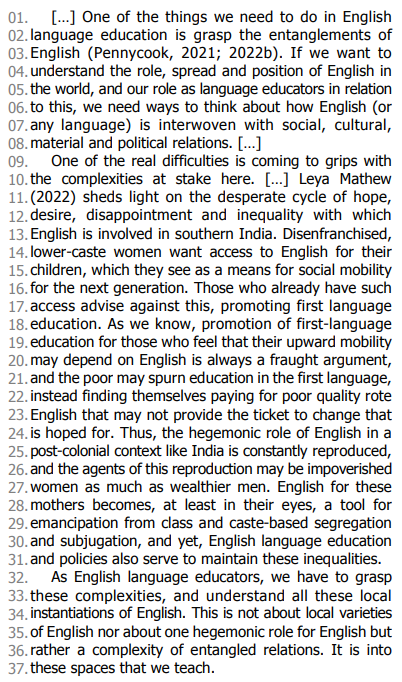
Instruction: Question refer to the
texts below.
(Adapted from: PENNYCOOK, A.; SILVESTRE, V. P. V.; PESSOA, R.
R. Reflections on Critical Applied Linguistics and Decoloniality:
a follow-up conversation with Alastair Pennycook. Calidoscópio, São
Leopoldo, v. 20, n. 2, p. 568–569, 2022. DOI:
10.4013/cld.2022.202.12.)
“These spaces” (l. 37) in “It is into these spaces that
we teach” (l. 36-37) refers to
Q4348455
Inglês
Texto associado
Instruction: Question refer to the
texts below.
(Adapted from: PENNYCOOK, A.; SILVESTRE, V. P. V.; PESSOA, R.
R. Reflections on Critical Applied Linguistics and Decoloniality:
a follow-up conversation with Alastair Pennycook. Calidoscópio, São
Leopoldo, v. 20, n. 2, p. 568–569, 2022. DOI:
10.4013/cld.2022.202.12.)
Pennycook’s description of the entanglements of English
is best explained by which of the following concepts?
Q4348454
Inglês
Texto associado
Instruction: Question refer to the
texts below.
(Adapted from: PENNYCOOK, A.; SILVESTRE, V. P. V.; PESSOA, R.
R. Reflections on Critical Applied Linguistics and Decoloniality:
a follow-up conversation with Alastair Pennycook. Calidoscópio, São
Leopoldo, v. 20, n. 2, p. 568–569, 2022. DOI:
10.4013/cld.2022.202.12.)
In the southern Indian context mentioned by Pennycook,
English is
Q4348453
Inglês
Texto associado
Instruction: Question refer to the
texts below.
(Adapted from: PENNYCOOK, A.; SILVESTRE, V. P. V.; PESSOA, R.
R. Reflections on Critical Applied Linguistics and Decoloniality:
a follow-up conversation with Alastair Pennycook. Calidoscópio, São
Leopoldo, v. 20, n. 2, p. 568–569, 2022. DOI:
10.4013/cld.2022.202.12.)
Pennycook’s main argument is that
Q4348451
Inglês
Read the following statements about Michael Byram’s
(1997) Intercultural Communicative Competence (ICC)
model.
I - Savoirs (knowledge) is primarily defined as deep declarative knowledge regarding the core cultural values and historical traditions specific to the target-language country, disregarding social groups and processes.
II - Savoir comprendre (skills of interpreting and relating) requires a learner to interpret a document or event from another culture, explain it, and relate it to documents or events from their own culture, without relying on real-time interaction with a target-culture interlocutor.
III - Savoir s’engager (critical cultural awareness) posits that language teachers should remain politically neutral and guide students to evaluate cultural practices using purely subjective, personal moral codes.
IV - The primary distinction between savoir comprendre and savoir apprendre/faire is that the former operates on existing knowledge and documents, whereas the latter involves acquiring new cultural knowledge and operating it in real-time constraints of social interaction.
V - According to Byram, a speaker who possesses high linguistic competence (fluency, native-like accent, advanced syntax) automatically fulfills the prerequisites for Intercultural Communicative Competence (ICC).
Which statements are correct?
I - Savoirs (knowledge) is primarily defined as deep declarative knowledge regarding the core cultural values and historical traditions specific to the target-language country, disregarding social groups and processes.
II - Savoir comprendre (skills of interpreting and relating) requires a learner to interpret a document or event from another culture, explain it, and relate it to documents or events from their own culture, without relying on real-time interaction with a target-culture interlocutor.
III - Savoir s’engager (critical cultural awareness) posits that language teachers should remain politically neutral and guide students to evaluate cultural practices using purely subjective, personal moral codes.
IV - The primary distinction between savoir comprendre and savoir apprendre/faire is that the former operates on existing knowledge and documents, whereas the latter involves acquiring new cultural knowledge and operating it in real-time constraints of social interaction.
V - According to Byram, a speaker who possesses high linguistic competence (fluency, native-like accent, advanced syntax) automatically fulfills the prerequisites for Intercultural Communicative Competence (ICC).
Which statements are correct?
Q4348449
Inglês
Texto associado
Question refer to the text below.
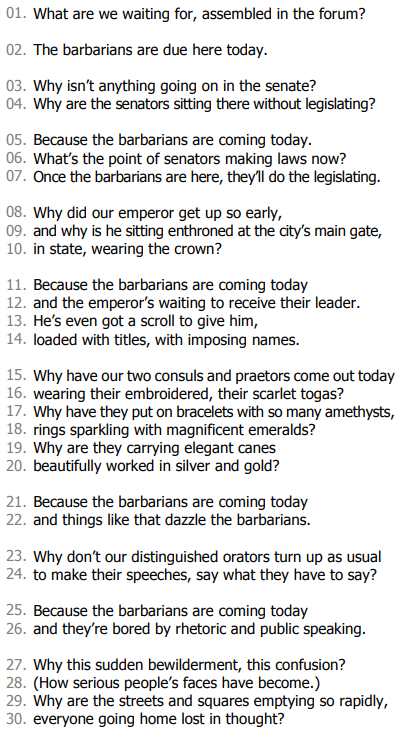
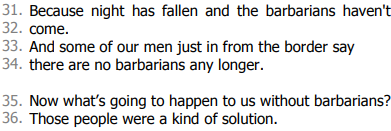
Instruction: Question refer to the texts below.
“Identities can be held together by narratives, in short, without essences: you don’t get to be called ‘English’ because there’s an essence this label follows; you’re English because our rules determine that you are entitled to the label—that you are connected in the right way with a place called England. […] The story of the golden nugget suggests that we can’t help caring about the traditions of ‘the West’ because they are ours: in fact, the opposite is true. They are ours only if we care about them. A culture of liberty, tolerance, and rational inquiry: that would be a good idea. But these values represent choices to make, not tracks laid down by a Western destiny.”
(Adapted from: APPIAH, Kwame Anthony. The lies that bind: rethinking identity. New York: Liveright Publishing Corporation, 2018. p. 151-159)
Which statement is NOT consistent with Appiah’s interpretation of Cavafy’s poem “Waiting for the Barbarians” mentioned above?
“Identities can be held together by narratives, in short, without essences: you don’t get to be called ‘English’ because there’s an essence this label follows; you’re English because our rules determine that you are entitled to the label—that you are connected in the right way with a place called England. […] The story of the golden nugget suggests that we can’t help caring about the traditions of ‘the West’ because they are ours: in fact, the opposite is true. They are ours only if we care about them. A culture of liberty, tolerance, and rational inquiry: that would be a good idea. But these values represent choices to make, not tracks laid down by a Western destiny.”
(Adapted from: APPIAH, Kwame Anthony. The lies that bind: rethinking identity. New York: Liveright Publishing Corporation, 2018. p. 151-159)
Which statement is NOT consistent with Appiah’s interpretation of Cavafy’s poem “Waiting for the Barbarians” mentioned above?
Q4348448
Inglês
Texto associado
Question refer to the text
below.
“Waiting for the Barbarians” by C.P. Cavafy
In English grammar, the words ending in “-ing” have
different uses. Match these functions to a corresponding
example in bold from the poem.
(1) Continuous verbs
(2) Gerunds acting as nouns
(3) Adjectives
( ) “Why are the senators sitting there without legislating?” (l. 4)
( ) “Once the barbarians are here, they’ll do the legislating” (l. 7)
( ) “Why have they put on bracelets with so many amethysts, rings sparkling with magnificent emeralds?” (l. 17-18)
( ) “Now what’s going to happen to us without barbarians?” (l. 35)
( ) “loaded with titles, with imposing names.” (l. 14)
( ) “and they’re bored by rhetoric and public speaking” (l. 26)
Select the alternative with the correct sequence from top to bottom.
(1) Continuous verbs
(2) Gerunds acting as nouns
(3) Adjectives
( ) “Why are the senators sitting there without legislating?” (l. 4)
( ) “Once the barbarians are here, they’ll do the legislating” (l. 7)
( ) “Why have they put on bracelets with so many amethysts, rings sparkling with magnificent emeralds?” (l. 17-18)
( ) “Now what’s going to happen to us without barbarians?” (l. 35)
( ) “loaded with titles, with imposing names.” (l. 14)
( ) “and they’re bored by rhetoric and public speaking” (l. 26)
Select the alternative with the correct sequence from top to bottom.

 Conheça nossos planos