Questões de Concurso
Sobre interpretação de texto | reading comprehension em inglês
Foram encontradas 12.687 questões


Come to Center Parcs
Center Parcs is the perfect family holiday. There are four of them in England and you can do almost anything you want there.
If it’s exercise you want, you can go walking or cycling through the forest. There are also adventure sports like windsurfing. If you are a team player, you can play basketball, tennis, or football. But if you prefer a quieter life, you can do Tai Chi or yoga in the gym, or go swimming in the numerous swimming pools. And if you do not like doing exercise at all, you can learn to paint in the art class or just sit in the coffee shop and relax.
Centers Parcs is not only for adults; children enjoy it as much as their parents. Mothers and fathers can relax in the sauna or play golf, while babies and small children play with their friends in the Time Out clubs. There is something for everyone at Center Parcs.
During the conquest of Asia by Alexander the Great, the Greeks were eventually introduced to the unknown cultures and cosmological schemes of Syria, Babylon, Persia and central Asia. It didn’t take too long after that for the Greeks to overtake cuneiform script as the international language of academic communication and part of this action was the transference of astrology from cuneiform to Greek.
The 4,000 Year History of Horoscopes: How Astrology Has Been Shaped Throughout the Millennia. Internet: <ancient-origins.net> (adapted).
Based on the text above, choose the correct option.
"At the Center for Artificial Intelligence, University of São Paulo, our main goal is to produce machine-intelligence research that has a direct impact on society and industry. One of our five core programmes, for example, examines the influence of climate change, biodiversity and mineral resources on Brazil’s Atlantic coastline and the people who live there. A common problem we face is that some researchers coming from other areas just want a programmer. In my opinion, they need to be more willing to share their knowledge and problems, rather than just adopting a ‘come and help me do programming’ approach. My question for researchers who are hoping to collaborate with AI specialists is: are you hoping to have someone who’s ‘good at computers’ help you to do some data analysis, or do you actually need to ask much deeper questions, which AI might be able to help you answer?"
Jack Leeming. Internet: <nature.com> (adapted). The text above informs its readers that
The text above informs its readers that
Like A Rolling Stone
Once upon a time you dressed so fine
You threw the bums a dime in your prime, didn’t you?
People’d call, say, “Beware doll, you're bound to fall”
You thought they were all kidding you
You used to laugh about
Everybody that was hanging out
Now you don’t talk so loud
Now you don’t seem so proud
About having to be scrounging for your next meal
How does it feel?
How does it feel
To be without a home
Like a complete unknown
Like a rolling stone?
Bob Dylan. 1965.
Text 15A3
Life for researchers whose first language is not English may get quite hard. Many academics assume that their research students come to them fully formed, but every student has to learn the culture of their discipline. For those who don’t speak English as a first language, the challenge is especially daunting.
Mentors need to spend more time helping students to understand the conventions of scientific writing and the expectations of various journals. There’s an art to turning a PhD thesis into a journal article. Without guidance, a student will not be able to do it properly.
Institutions need to do a lot more to support and prepare international students. It’s not enough to hire a specialist in academic writing. Such specialists often have backgrounds in the humanities or social science, and students also need assistance from scientists who can help them to write for their specific disciplines.
I sympathize with students who are trying to learn English on top of everything else because I started out in life speaking another language. My family and I were refugees who fled Hungary during the revolution of 1956.
English speakers have become the gatekeepers of science. By keeping those gates closed, we’re missing out on a lot of perspectives and a lot of good research.
Chris Woolston and Joana Osório. When English is not your mother tongue. Internet: <www.nature.com> (adapted).
Text 15A3
Life for researchers whose first language is not English may get quite hard. Many academics assume that their research students come to them fully formed, but every student has to learn the culture of their discipline. For those who don’t speak English as a first language, the challenge is especially daunting.
Mentors need to spend more time helping students to understand the conventions of scientific writing and the expectations of various journals. There’s an art to turning a PhD thesis into a journal article. Without guidance, a student will not be able to do it properly.
Institutions need to do a lot more to support and prepare international students. It’s not enough to hire a specialist in academic writing. Such specialists often have backgrounds in the humanities or social science, and students also need assistance from scientists who can help them to write for their specific disciplines.
I sympathize with students who are trying to learn English on top of everything else because I started out in life speaking another language. My family and I were refugees who fled Hungary during the revolution of 1956.
English speakers have become the gatekeepers of science. By keeping those gates closed, we’re missing out on a lot of perspectives and a lot of good research.
Chris Woolston and Joana Osório. When English is not your mother tongue. Internet: <www.nature.com> (adapted).
Text 15A3
Life for researchers whose first language is not English may get quite hard. Many academics assume that their research students come to them fully formed, but every student has to learn the culture of their discipline. For those who don’t speak English as a first language, the challenge is especially daunting.
Mentors need to spend more time helping students to understand the conventions of scientific writing and the expectations of various journals. There’s an art to turning a PhD thesis into a journal article. Without guidance, a student will not be able to do it properly.
Institutions need to do a lot more to support and prepare international students. It’s not enough to hire a specialist in academic writing. Such specialists often have backgrounds in the humanities or social science, and students also need assistance from scientists who can help them to write for their specific disciplines.
I sympathize with students who are trying to learn English on top of everything else because I started out in life speaking another language. My family and I were refugees who fled Hungary during the revolution of 1956.
English speakers have become the gatekeepers of science. By keeping those gates closed, we’re missing out on a lot of perspectives and a lot of good research.
Chris Woolston and Joana Osório. When English is not your mother tongue. Internet: <www.nature.com> (adapted).
I. A cidade está sem água potável porque somente uma estação de tratamento atende a sua demanda.
II. O governo está distribuindo somente água potável, em garrafas, aos cidadãos.
III. O governo reconhece que a estação de tratamento afetada não tinha infraestrutura adequada.
IV. O governo reconhece que as inundações em Jackson, MI, são consequências das mudanças climáticas.
Assinale a alternativa correta.
I. Ele contou outra história sobre sua ida para a Grã-Bretanha.
II. Ele foi forçado a trabalho análogo a escravo durante sua infância.
III. Ele foi para a Grã-Bretanha sem nenhum contato de seus parentes.
IV. Ele decidiu contar sua real história graças à condecoração que ganhou da rainha Elizabeth.
Assinale a alternativa correta.
I. Em “We fought him hard”, o termo grifado pode ser substituído, sem alteração de sentido, por “difficulty”.
II. No verso “Chasing the redskins back to their holes”, os termos grifados são usados no sentido depreciativo.
III. Em “Oh, will we ever be set free?”, a pergunta indica uma reflexão do eu-lírico sobre sua condição.
IV. No verso “Selling them whiskey and taking their gold”, os verbos grifados expressam atitudes desonestas.
Assinale a alternativa correta.
I. A canção faz uma crítica ao comportamento de um grupo.
II. A canção traz perspectivas diferentes para uma mesma história.
III. Na canção, há um diálogo entre grupos que procuram entrar em consenso.
IV. A canção sugere que a fuga, como meio de evitar o confronto, é a solução dos covardes.
Assinale a alternativa correta.
TEXT 3
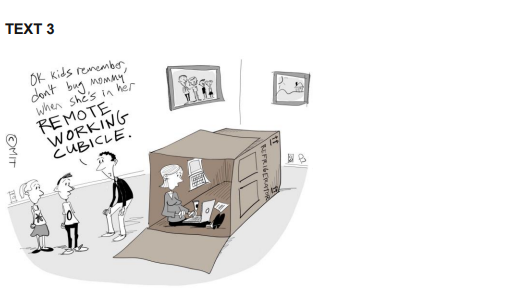
Taken from: https://medium.com/the-coffeelicious/when-working-at-home-dont-forget-the-cubicle-cartooncb6a405f6ce3
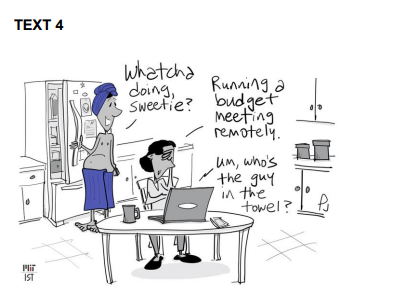
Taken from: https://chumworth.medium.com/remote-working-great-until-its-not-a559b489589d
TEXT 3
Taken from: https://medium.com/the-coffeelicious/when-working-at-home-dont-forget-the-cubicle-cartooncb6a405f6ce3
Taken from: https://chumworth.medium.com/remote-working-great-until-its-not-a559b489589d
TEXT 3
Taken from: https://medium.com/the-coffeelicious/when-working-at-home-dont-forget-the-cubicle-cartooncb6a405f6ce3
Taken from: https://chumworth.medium.com/remote-working-great-until-its-not-a559b489589d
TEXT 2
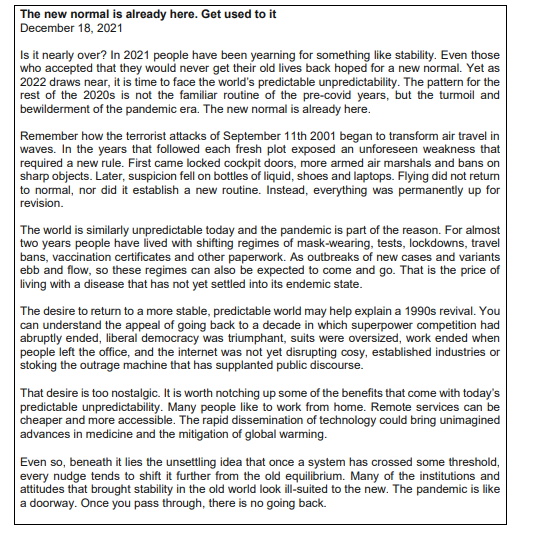

TEXT 2
TEXT 2

 Conheça nossos planos