Foram encontradas 301.582 questões
Resolva questões gratuitamente!
Junte-se a mais de 4 milhões de concurseiros!


Para responder à questão, leia o texto abaixo.
How Will You Get from How Things Are to How Things "Should" Be?
A lot of people get fixated on things that they think "should" happen, but fail to address substantial obstacles in the way. I may even agree with them about what I think "should" happen. But that doesn't mean that it's going to happen. If you're thinking that there is also a danger in being overly cautious or waiting to work out the perfect plan, you're right. That can become a form of procrastination. Acting on an imperfect plan is usually better than waiting until you've worked out every last detail. But at least have some kind of plan that doesn't require a miracle to happen.
The plan that works will also probably not be the plan you started with. You will have to update the plan as you proceed and the situation evolves.
A good model for this process is John Boyd's OODA decision making loop. OODA stands for Observe, Orient, Decide, Act. Actions produce responses that provide new information. New information requires reorientation and new decisions will have to be made that lead to new actions, and the loop repeats.
No big changes happened because a bunch of people sat around complaining about how things "should be."
That's like saying "l should be a millionaire." You could be, but you're going to need some kind of plan to get there that realistically acknowledges the obstacles in your way.
Many of the problems we face today took years to create.
We have inherited a big mess. A lot of things happened that "should not" have happened. Mistakes were made.
But that's life. It's going to throw all kinds of things at you that are sub-optimal. Things you didn't "deserve" or ask for. Cleaning up messes you didn't create is as normal as dealing with bad weather.
Some messes only require a dustpan.
But if you want to clean up a really big mess, you're going to need a plan.
Fonte: https://mrjackdonovan.substack.com/p/the-flow-chart
Analyze the sentence below:
If you _______ to become a millionaire, you _________ to develop a plan that accounts for realíty, rather than just comp/aining.
Choose the alternative that CORRECTLY completes the logic of the millionaire analogy.
Para responder à questão, leia o texto abaixo.
How Will You Get from How Things Are to How Things "Should" Be?
A lot of people get fixated on things that they think "should" happen, but fail to address substantial obstacles in the way. I may even agree with them about what I think "should" happen. But that doesn't mean that it's going to happen. If you're thinking that there is also a danger in being overly cautious or waiting to work out the perfect plan, you're right. That can become a form of procrastination. Acting on an imperfect plan is usually better than waiting until you've worked out every last detail. But at least have some kind of plan that doesn't require a miracle to happen.
The plan that works will also probably not be the plan you started with. You will have to update the plan as you proceed and the situation evolves.
A good model for this process is John Boyd's OODA decision making loop. OODA stands for Observe, Orient, Decide, Act. Actions produce responses that provide new information. New information requires reorientation and new decisions will have to be made that lead to new actions, and the loop repeats.
No big changes happened because a bunch of people sat around complaining about how things "should be."
That's like saying "l should be a millionaire." You could be, but you're going to need some kind of plan to get there that realistically acknowledges the obstacles in your way.
Many of the problems we face today took years to create.
We have inherited a big mess. A lot of things happened that "should not" have happened. Mistakes were made.
But that's life. It's going to throw all kinds of things at you that are sub-optimal. Things you didn't "deserve" or ask for. Cleaning up messes you didn't create is as normal as dealing with bad weather.
Some messes only require a dustpan.
But if you want to clean up a really big mess, you're going to need a plan.
Fonte: https://mrjackdonovan.substack.com/p/the-flow-chart
Reconstruct the following segments into a logically and grammatically sound sentence that aligns with the author's argument:
a / realistic / you / if / want,/ success / need / plan / that / acknowledges / obstacles
Regarding this, mark the alternative that presents the CORRECT sentence structure.
Para responder à questão, leia o texto abaixo.
How Will You Get from How Things Are to How Things "Should" Be?
A lot of people get fixated on things that they think "should" happen, but fail to address substantial obstacles in the way. I may even agree with them about what I think "should" happen. But that doesn't mean that it's going to happen. If you're thinking that there is also a danger in being overly cautious or waiting to work out the perfect plan, you're right. That can become a form of procrastination. Acting on an imperfect plan is usually better than waiting until you've worked out every last detail. But at least have some kind of plan that doesn't require a miracle to happen.
The plan that works will also probably not be the plan you started with. You will have to update the plan as you proceed and the situation evolves.
A good model for this process is John Boyd's OODA decision making loop. OODA stands for Observe, Orient, Decide, Act. Actions produce responses that provide new information. New information requires reorientation and new decisions will have to be made that lead to new actions, and the loop repeats.
No big changes happened because a bunch of people sat around complaining about how things "should be."
That's like saying "l should be a millionaire." You could be, but you're going to need some kind of plan to get there that realistically acknowledges the obstacles in your way.
Many of the problems we face today took years to create.
We have inherited a big mess. A lot of things happened that "should not" have happened. Mistakes were made.
But that's life. It's going to throw all kinds of things at you that are sub-optimal. Things you didn't "deserve" or ask for. Cleaning up messes you didn't create is as normal as dealing with bad weather.
Some messes only require a dustpan.
But if you want to clean up a really big mess, you're going to need a plan.
Fonte: https://mrjackdonovan.substack.com/p/the-flow-chart
Based on a rigorous critical appraisal of the text's argumentative framework and logical progression, analyze the assertions below:
I. The OODA decision-making loop functions as a permanent, static mechanism where a single isolated action definitively concludes the operational cycle.
II. The author draws a direct analogy to assert that clearing away messes for which one bears no direct responsibility is a routine, inescapable reality of existence.
III. The author warns that prioritizing extreme caution while waiting to craft a flawless blueprint can deteriorate into counterproductive procrastination.
Which of the following statements islare CORRECT?
Para responder à questão, leia o texto abaixo.
How Will You Get from How Things Are to How Things "Should" Be?
A lot of people get fixated on things that they think "should" happen, but fail to address substantial obstacles in the way. I may even agree with them about what I think "should" happen. But that doesn't mean that it's going to happen. If you're thinking that there is also a danger in being overly cautious or waiting to work out the perfect plan, you're right. That can become a form of procrastination. Acting on an imperfect plan is usually better than waiting until you've worked out every last detail. But at least have some kind of plan that doesn't require a miracle to happen.
The plan that works will also probably not be the plan you started with. You will have to update the plan as you proceed and the situation evolves.
A good model for this process is John Boyd's OODA decision making loop. OODA stands for Observe, Orient, Decide, Act. Actions produce responses that provide new information. New information requires reorientation and new decisions will have to be made that lead to new actions, and the loop repeats.
No big changes happened because a bunch of people sat around complaining about how things "should be."
That's like saying "l should be a millionaire." You could be, but you're going to need some kind of plan to get there that realistically acknowledges the obstacles in your way.
Many of the problems we face today took years to create.
We have inherited a big mess. A lot of things happened that "should not" have happened. Mistakes were made.
But that's life. It's going to throw all kinds of things at you that are sub-optimal. Things you didn't "deserve" or ask for. Cleaning up messes you didn't create is as normal as dealing with bad weather.
Some messes only require a dustpan.
But if you want to clean up a really big mess, you're going to need a plan.
Fonte: https://mrjackdonovan.substack.com/p/the-flow-chart
I. O ofício é utilizado para comunicação formal entre órgãos ou autoridades administrativas.
II. O memorando é utilizado para comunicação interna entre setores de uma mesma instituição.
III. A ata é utilizada exclusivamente para comunicação externa entre órgãos públicos.
IV. A declaração é utilizada para atestar a veracidade de determinado fato ou informação.
Assinale a alternativa correta.
( ) Em “A proposta ainda está em fase de avaliação. Integrantes da equipe econômica defendem cautela antes de qualquer decisão definitiva.” (2º par.), nota-se a presença de dois períodos simples os quais são desprovidos de uso da vírgula, pois suas respectivas elaborações se encontram na ordem direta.
( ) Em “O rombo financeiro acumulado elevou o nível de preocupação dentro do governo e ampliou a discussão sobre possíveis formas de socorro.” (3º par.), poder-se-ia acrescentar uma vírgula após o vocábulo “governo” haja vista a presença de um Sujeito diferente para a segunda oração.
( ) Em “No fim do ano passado, a estatal buscou reforçar o caixa por meio da contratação de empréstimos com garantia pública.” (5º par.), a pontuação evidencia um Adjunto adverbial de tempo deslocado na oração.
( ) Em “Entre as medidas previstas estão cortes de custos, revisão de contratos e mudanças na estrutura de funcionamento.” (6º par.), nota-se um descuido gramatical quanto à ausência de uma vírgula para isolar um Adjunto adverbial deslocado no contexto.
( ) Em “A empresa também passou a estudar novas frentes de atuação” (6º par.), poder-se-ia usar uma crase no trecho em destaque, uma vez que se nota a presença de uma preposição obrigatória pela regência do verbo “passou”.
Considerando-se V para as afirmativas verdadeiras e F para as falsas, tem-se pela ordem a seguinte sequência.
I. Em “A ideia é observar se o plano de ajuste, iniciado recentemente, será suficiente para melhorar o desempenho” (4º par.) – a conjunção integrante destacada inicia uma oração subordinada substantiva subjetiva.
II. Em “um pacote de reestruturação administrativa e operacional” (5º par.), nota-se a presença de um Substantivo formado por derivação prefixal e sufixal e que é modificado por dois vocábulos de natureza adjetiva.
III. Em “A empresa também passou a estudar novas frentes de atuação para ampliar receitas e reduzir a dependência das atividades tradicionais.” (6º par.), nota-se em destaque a presença de dois vocábulos homônimos perfeitos de mesma classe gramatical.
IV. Em “Os valores desses ativos variam de acordo com a localização e tamanho.” (8º par.), o elemento coesivo destacado poderia ser corretamente substituído por “consoante” sem necessidade de ajustes no contexto.
Pode-se dizer que está correto o que se afirmou apenas em
( ) Em “para reforçar o caixa dos Correios.” (1º par.), o vocábulo destacado determina o aspecto semântico do substantivo “caixa”, o qual seria alterado diante da presença do feminino.
( ) Em “...dar sustentação ao plano de recuperação financeira da estatal.” (1º par.), nota-se uma manutenção da semântica empregada e da classe morfológica da palavra em destaque, se tal passagem fosse reescrita da seguinte forma: “da empresa estatal”.
( ) Em “para reorganizar as contas” (2º par.), o vocábulo em destaque foi formado por derivação prefixal.
( ) Em “O rombo financeiro acumulado elevou o nível de preocupação dentro do governo e ampliou a discussão sobre possíveis formas de socorro.” (3º par.), os vocábulos destacados foram acentuados por possuírem tonicidade silábica distinta.
( ) Em “em diferentes regiões do país” (7º par.), a palavra destacada tem como justificativa de acentuação o fato de ser uma oxítona.
Considerando-se V para as afirmativas verdadeiras e F para as falsas, tem-se pela ordem a seguinte sequência.
A palavra destacada no pensamento acima é sinônima de:
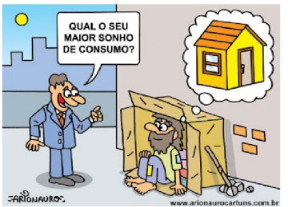
ARIONAURO. Moradia. Disponível em <http://www.arionaurocartuns.com.br/2026/01/chargemoradia.html>.
Na fala do personagem na charge acima, a expressão “de consumo" tem função:

 Conheça nossos planos