Foram encontradas 334 questões

Resolva questões gratuitamente!

Junte-se a mais de 4 milhões de concurseiros!

Q4197928 Inglês

Advantages of wireless technology


Wireless communications offer several cost and connectivity benefits for organizations. The rapid rise of remote work – fuelled in part by the pandemic that began in 2020 – has created an environment where employees demand high-performance access to network resources regardless of where they might be.

Wireless networks can be less expensive to build and maintain since they require fewer switches and other components required by wired infrastructures. New wireless standards – especially among them multiuser, multiple input and multiple output – enable physical Access Points (APs) to serve a greater number of users, further reducing costs.

Wireless technologies also support novel services, among them location tracking, Internet of Things (IoT) deployments and remote diagnostics. Finally, advances in wireless performance enable organizations to stress mobility as a primary benefit, thus helping them redefine how they design their offices and workgroups.

(www.techtarget.com/searchmobilecomputing/definition/wireless. Adaptado)

No trecho do terceiro parágrafo “thus helping them redefine how they design their offices and workgroups”, o termo destacado em negrito equivale, em português, a
Alternativas
Q4197927 Inglês

Advantages of wireless technology


Wireless communications offer several cost and connectivity benefits for organizations. The rapid rise of remote work – fuelled in part by the pandemic that began in 2020 – has created an environment where employees demand high-performance access to network resources regardless of where they might be.

Wireless networks can be less expensive to build and maintain since they require fewer switches and other components required by wired infrastructures. New wireless standards – especially among them multiuser, multiple input and multiple output – enable physical Access Points (APs) to serve a greater number of users, further reducing costs.

Wireless technologies also support novel services, among them location tracking, Internet of Things (IoT) deployments and remote diagnostics. Finally, advances in wireless performance enable organizations to stress mobility as a primary benefit, thus helping them redefine how they design their offices and workgroups.

(www.techtarget.com/searchmobilecomputing/definition/wireless. Adaptado)

No trecho do segundo parágrafo “Wireless networks can be less expensive to build and maintain since they require fewer switches and other components”, o termo destacado em negrito introduz
Alternativas
Q4197926 Inglês

Advantages of wireless technology


Wireless communications offer several cost and connectivity benefits for organizations. The rapid rise of remote work – fuelled in part by the pandemic that began in 2020 – has created an environment where employees demand high-performance access to network resources regardless of where they might be.

Wireless networks can be less expensive to build and maintain since they require fewer switches and other components required by wired infrastructures. New wireless standards – especially among them multiuser, multiple input and multiple output – enable physical Access Points (APs) to serve a greater number of users, further reducing costs.

Wireless technologies also support novel services, among them location tracking, Internet of Things (IoT) deployments and remote diagnostics. Finally, advances in wireless performance enable organizations to stress mobility as a primary benefit, thus helping them redefine how they design their offices and workgroups.

(www.techtarget.com/searchmobilecomputing/definition/wireless. Adaptado)

No trecho do primeiro parágrafo “ where they might be”, o termo destacado em negrito pode ser substituído, sem alteração de sentido, por
Alternativas
Q4197925 Inglês

Advantages of wireless technology


Wireless communications offer several cost and connectivity benefits for organizations. The rapid rise of remote work – fuelled in part by the pandemic that began in 2020 – has created an environment where employees demand high-performance access to network resources regardless of where they might be.

Wireless networks can be less expensive to build and maintain since they require fewer switches and other components required by wired infrastructures. New wireless standards – especially among them multiuser, multiple input and multiple output – enable physical Access Points (APs) to serve a greater number of users, further reducing costs.

Wireless technologies also support novel services, among them location tracking, Internet of Things (IoT) deployments and remote diagnostics. Finally, advances in wireless performance enable organizations to stress mobility as a primary benefit, thus helping them redefine how they design their offices and workgroups.

(www.techtarget.com/searchmobilecomputing/definition/wireless. Adaptado)

No trecho do primeiro parágrafo “regardless of where they might be”, o termo destacado em negrito refere-se a 
Alternativas
Q4197924 Inglês

Advantages of wireless technology


Wireless communications offer several cost and connectivity benefits for organizations. The rapid rise of remote work – fuelled in part by the pandemic that began in 2020 – has created an environment where employees demand high-performance access to network resources regardless of where they might be.

Wireless networks can be less expensive to build and maintain since they require fewer switches and other components required by wired infrastructures. New wireless standards – especially among them multiuser, multiple input and multiple output – enable physical Access Points (APs) to serve a greater number of users, further reducing costs.

Wireless technologies also support novel services, among them location tracking, Internet of Things (IoT) deployments and remote diagnostics. Finally, advances in wireless performance enable organizations to stress mobility as a primary benefit, thus helping them redefine how they design their offices and workgroups.

(www.techtarget.com/searchmobilecomputing/definition/wireless. Adaptado)

De acordo com o texto, uma das vantagens principais da tecnologia wireless é:
Alternativas
Q4197915 Matemática
Um grupo de amigos iria dividir igualmente entre si o valor de R$ 1.440,00 relativo à compra de um presente. Como um desses amigos desistiu de participar do presente, cada um dos amigos restantes no grupo, precisou pagar R$ 20,00 a mais do que pagaria inicialmente. O número de amigos que dividiram o valor desse presente foi
Alternativas
Q4197914 Matemática
A média aritmética dos valores de venda de 5 imóveis é R$ 380.000,00. A média aritmética do valor de venda dos 2 imóveis mais caros supera em R$ 100.000,00 a média aritmética do valor de venda dos outros 3 imóveis. Se a diferença entre o valor de venda dos 2 imóveis mais caros é R$ 20.000,00, o valor do imóvel mais caro é igual a
Alternativas
Q4197913 Matemática
No início de um congresso, a razão do número de palestrantes convidados para o número de inscrições recebidas era 1/40. No decorrer desse congresso, 3 palestrantes convidados não puderam comparecer e ocorreram 60 novas inscrições, de modo que ao final do congresso, a razão do número de palestrantes convidados que compareceram para o número de inscrições totais recebidas passou a ser 3/140 . Para que essa razão de 3/140 tivesse sido de 1/50 , o número de novas inscrições, teria que superar as 60 novas inscrições recebidas, em
Alternativas
Q4197908 Português
Pesquisas comprovam que adolescentes_______ pais fumam são mais propensos ________fumarem. Além disso, nas famílias ________ os pais são fumantes verificou-se maior prejuízo _________saúde dos filhos, mesmo que estes ainda não tenham adquirido esse hábito.
Assinale a alternativa que completa, correta e respectivamente, as lacunas do texto.
Alternativas
Q4197904 Português

Enquanto um mundo novo repleto de oportunidades se abre ao adolescente que vislumbra a fase adulta, é possível que aos seus responsáveis reste uma sensação oposta, de um mundo com menos brilho do que havia antes de os filhos crescerem. E não precisa nem que o tal ninho vazio se concretize — muitas vezes, a dor já começa antes.

A educadora e pesquisadora do comportamento adolescente Carolina Delboni diz que, para muitos pais, a sensação nessa fase da vida é de que perderam os filhos. “E, como os pais não sabem se relacionar com essa ‘perda’, muitas vezes eles acabam se relacionando pela raiva”, afirma. Com isso, a distância em casa só aumenta: adultos num canto, magoados, e os jovens no outro, se sentindo incompreendidos e buscando compreensão lá fora.

Também é papel dos pais, segundo Delboni, quebrar os estereótipos da adolescência — evitar cair na tentação, por exemplo, de acusar os filhos de serem lacônicos, de não saírem do quarto e do celular, ou de dizer que conversar com eles é impossível. “A gente tem o costume de rebater tudo o que vem do universo adolescente, de dizer que é coisa fútil, de chamar a música que eles gostam de ruim, de falar que o lugar que eles escolheram para ir passear não é o melhor etc. Sempre temos algo a dizer que mostra que eles deveriam estar fazendo diferente”, afirma a pesquisadora.

Para ela, este hábito “corta todos os vínculos” com o jovem. “O que isso vai acrescentar às relações? Nada. Não vai melhorar o vínculo, pelo contrário, e ainda não vai tirar ele dali do celular. Por outro lado, você já experimentou perguntar o que ele está vendo? Pode ser que ele não mostre, mas você fez uma pergunta, demonstrou interesse. Nesse cotidiano, estamos sempre querendo tirar o adolescente à força do seu lugar em vez de nos deslocarmos para o canto dele, sem reclamar”.

(Marcella Franco. Estamos sempre querendo tirar o adolescente à força do seu lugar, diz educadora. Folha de S. Paulo, 12.10.2023. Adaptado)

Considere o trecho.
“… acusar os filhos de serem lacônicos…” (3o parágrafo).
Assinale a alternativa que apresenta a palavra que corresponde a um sinônimo do termo destacado e que confere ao trecho um sentido figurado.
Alternativas
Q4197900 Português
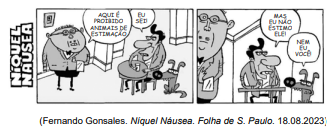
No 1o quadro, a frase “Aqui é proibido animais de estimação” pode ser reescrita, em conformidade com a norma-padrão de concordância, como:
Alternativas
Q4197899 Português
A partir da leitura da tira, é correto afirmar que seu humor deriva do fato de que
Alternativas
Q4197705 Inglês
Leia o texto para responder à questão.

Information Security (InfoSec) defined

Information security, often abbreviated InfoSec, is a set of security procedures and tools that broadly protect sensitive enterprise information from misuse, unauthorized access, disruption, or destruction. InfoSec encompasses physical and environmental security, access control, and cybersecurity. It often includes technologies like cloud access security brokers (CASB), deception tools, endpoint detection and response (EDR), and security testing for DevOps (DevSecOps), among others.

Key elements of information security


InfoSec comprises a range of security tools, solutions, and processes that keep enterprise information secure across devices and locations, helping to protect against cyberattacks or other disruptive events.

•  Application security - Policies, procedures, tools, and best practices enacted to protect applications and their data.w
•  Cloud security - Policies, procedures, tools, and best practices enacted to protect all aspects of the cloud, including systems, data, applications, and infrastructure.
•  Cryptography - An algorithm-based method of securing communication meant to ensure only intended recipients of a specific message can view and decipher it.
•  Disaster recovery - A method to reestablish functional technological systems in the wake of an event like a natural disaster, cyberattack, or another disruptive event.
•  Incident response - An organization’s plan for responding to, remediating, and managing the aftermath of a cyberattack, data breach, or another disruptive event.
•  Infrastructure security - Security that encompasses an organization’s entire technological infrastructure, including both hardware and software systems.
•  Vulnerability management - The process an organization takes to identify, assess, and remediate vulnerabilities in its endpoints, software, and systems.


Three pillars of information security: the CIA triad

Confidentiality, integrity, and availability make up the cornerstones of strong information protection, creating the basis for an enterprise’s security infrastructure. The CIA triad offers these three concepts as guiding principles for implementing an InfoSec plan.


Confidentiality

Privacy is a major component of InfoSec, and organizations should enact measures that allow only authorized users access to information. Data encryption, multi-factor authentication, and data loss prevention are some of the tools enterprises can employ to help ensure data confidentiality.

Integrity

Enterprises must maintain data’s integrity across its entire lifecycle. Enterprises with strong InfoSec will recognize the importance of accurate, reliable data, and permit no unauthorized user to access, alter, or otherwise interfere with it. Tools like file permissions, identity management, and user access controls help ensure data integrity.

Availability

InfoSec involves consistently maintaining physical hardware and regularly completing system upgrades to guarantee that authorized users have dependable, consistent access to data as they need it.


(www.microsoft.com/en-ww/security/business/security-101/ what-is-information-security-infosec#:~:text=Information%20 security%2C%20often%20abbreviated%20(InfoSec,access%2C%20 disruption%2C%20or%20destruction. Adaptado.)

Leia a parte do texto Three pillars of information security: the CIA triad para responder à questão.
De acordo com a parte do texto Three pillars of information security: the CIA triard, é correto afirmar que:
Alternativas
Q4197704 Inglês
Leia o texto para responder à questão.

Information Security (InfoSec) defined

Information security, often abbreviated InfoSec, is a set of security procedures and tools that broadly protect sensitive enterprise information from misuse, unauthorized access, disruption, or destruction. InfoSec encompasses physical and environmental security, access control, and cybersecurity. It often includes technologies like cloud access security brokers (CASB), deception tools, endpoint detection and response (EDR), and security testing for DevOps (DevSecOps), among others.

Key elements of information security


InfoSec comprises a range of security tools, solutions, and processes that keep enterprise information secure across devices and locations, helping to protect against cyberattacks or other disruptive events.

•  Application security - Policies, procedures, tools, and best practices enacted to protect applications and their data.w
•  Cloud security - Policies, procedures, tools, and best practices enacted to protect all aspects of the cloud, including systems, data, applications, and infrastructure.
•  Cryptography - An algorithm-based method of securing communication meant to ensure only intended recipients of a specific message can view and decipher it.
•  Disaster recovery - A method to reestablish functional technological systems in the wake of an event like a natural disaster, cyberattack, or another disruptive event.
•  Incident response - An organization’s plan for responding to, remediating, and managing the aftermath of a cyberattack, data breach, or another disruptive event.
•  Infrastructure security - Security that encompasses an organization’s entire technological infrastructure, including both hardware and software systems.
•  Vulnerability management - The process an organization takes to identify, assess, and remediate vulnerabilities in its endpoints, software, and systems.


Three pillars of information security: the CIA triad

Confidentiality, integrity, and availability make up the cornerstones of strong information protection, creating the basis for an enterprise’s security infrastructure. The CIA triad offers these three concepts as guiding principles for implementing an InfoSec plan.


Confidentiality

Privacy is a major component of InfoSec, and organizations should enact measures that allow only authorized users access to information. Data encryption, multi-factor authentication, and data loss prevention are some of the tools enterprises can employ to help ensure data confidentiality.

Integrity

Enterprises must maintain data’s integrity across its entire lifecycle. Enterprises with strong InfoSec will recognize the importance of accurate, reliable data, and permit no unauthorized user to access, alter, or otherwise interfere with it. Tools like file permissions, identity management, and user access controls help ensure data integrity.

Availability

InfoSec involves consistently maintaining physical hardware and regularly completing system upgrades to guarantee that authorized users have dependable, consistent access to data as they need it.


(www.microsoft.com/en-ww/security/business/security-101/ what-is-information-security-infosec#:~:text=Information%20 security%2C%20often%20abbreviated%20(InfoSec,access%2C%20 disruption%2C%20or%20destruction. Adaptado.)

Leia a parte do texto Three pillars of information security: the CIA triad para responder à questão.
No trecho do item Availability “authorized users have dependable, consistent access to data as they need it”, o termo destacado em negrito pode ser substituído, sem alteração de sentido, po
Alternativas
Q4197703 Inglês
Leia o texto para responder à questão.

Information Security (InfoSec) defined

Information security, often abbreviated InfoSec, is a set of security procedures and tools that broadly protect sensitive enterprise information from misuse, unauthorized access, disruption, or destruction. InfoSec encompasses physical and environmental security, access control, and cybersecurity. It often includes technologies like cloud access security brokers (CASB), deception tools, endpoint detection and response (EDR), and security testing for DevOps (DevSecOps), among others.

Key elements of information security


InfoSec comprises a range of security tools, solutions, and processes that keep enterprise information secure across devices and locations, helping to protect against cyberattacks or other disruptive events.

•  Application security - Policies, procedures, tools, and best practices enacted to protect applications and their data.w
•  Cloud security - Policies, procedures, tools, and best practices enacted to protect all aspects of the cloud, including systems, data, applications, and infrastructure.
•  Cryptography - An algorithm-based method of securing communication meant to ensure only intended recipients of a specific message can view and decipher it.
•  Disaster recovery - A method to reestablish functional technological systems in the wake of an event like a natural disaster, cyberattack, or another disruptive event.
•  Incident response - An organization’s plan for responding to, remediating, and managing the aftermath of a cyberattack, data breach, or another disruptive event.
•  Infrastructure security - Security that encompasses an organization’s entire technological infrastructure, including both hardware and software systems.
•  Vulnerability management - The process an organization takes to identify, assess, and remediate vulnerabilities in its endpoints, software, and systems.


Three pillars of information security: the CIA triad

Confidentiality, integrity, and availability make up the cornerstones of strong information protection, creating the basis for an enterprise’s security infrastructure. The CIA triad offers these three concepts as guiding principles for implementing an InfoSec plan.


Confidentiality

Privacy is a major component of InfoSec, and organizations should enact measures that allow only authorized users access to information. Data encryption, multi-factor authentication, and data loss prevention are some of the tools enterprises can employ to help ensure data confidentiality.

Integrity

Enterprises must maintain data’s integrity across its entire lifecycle. Enterprises with strong InfoSec will recognize the importance of accurate, reliable data, and permit no unauthorized user to access, alter, or otherwise interfere with it. Tools like file permissions, identity management, and user access controls help ensure data integrity.

Availability

InfoSec involves consistently maintaining physical hardware and regularly completing system upgrades to guarantee that authorized users have dependable, consistent access to data as they need it.


(www.microsoft.com/en-ww/security/business/security-101/ what-is-information-security-infosec#:~:text=Information%20 security%2C%20often%20abbreviated%20(InfoSec,access%2C%20 disruption%2C%20or%20destruction. Adaptado.)

Leia a parte do texto Three pillars of information security: the CIA triad para responder à questão.
O(s) item(ns) que destaca(m) a necessidade de permissão de acesso a dados apenas aos usuários autorizados são
Alternativas
Q4197702 Inglês
Leia o texto para responder à questão.

Information Security (InfoSec) defined

Information security, often abbreviated InfoSec, is a set of security procedures and tools that broadly protect sensitive enterprise information from misuse, unauthorized access, disruption, or destruction. InfoSec encompasses physical and environmental security, access control, and cybersecurity. It often includes technologies like cloud access security brokers (CASB), deception tools, endpoint detection and response (EDR), and security testing for DevOps (DevSecOps), among others.

Key elements of information security


InfoSec comprises a range of security tools, solutions, and processes that keep enterprise information secure across devices and locations, helping to protect against cyberattacks or other disruptive events.

•  Application security - Policies, procedures, tools, and best practices enacted to protect applications and their data.w
•  Cloud security - Policies, procedures, tools, and best practices enacted to protect all aspects of the cloud, including systems, data, applications, and infrastructure.
•  Cryptography - An algorithm-based method of securing communication meant to ensure only intended recipients of a specific message can view and decipher it.
•  Disaster recovery - A method to reestablish functional technological systems in the wake of an event like a natural disaster, cyberattack, or another disruptive event.
•  Incident response - An organization’s plan for responding to, remediating, and managing the aftermath of a cyberattack, data breach, or another disruptive event.
•  Infrastructure security - Security that encompasses an organization’s entire technological infrastructure, including both hardware and software systems.
•  Vulnerability management - The process an organization takes to identify, assess, and remediate vulnerabilities in its endpoints, software, and systems.


Three pillars of information security: the CIA triad

Confidentiality, integrity, and availability make up the cornerstones of strong information protection, creating the basis for an enterprise’s security infrastructure. The CIA triad offers these three concepts as guiding principles for implementing an InfoSec plan.


Confidentiality

Privacy is a major component of InfoSec, and organizations should enact measures that allow only authorized users access to information. Data encryption, multi-factor authentication, and data loss prevention are some of the tools enterprises can employ to help ensure data confidentiality.

Integrity

Enterprises must maintain data’s integrity across its entire lifecycle. Enterprises with strong InfoSec will recognize the importance of accurate, reliable data, and permit no unauthorized user to access, alter, or otherwise interfere with it. Tools like file permissions, identity management, and user access controls help ensure data integrity.

Availability

InfoSec involves consistently maintaining physical hardware and regularly completing system upgrades to guarantee that authorized users have dependable, consistent access to data as they need it.


(www.microsoft.com/en-ww/security/business/security-101/ what-is-information-security-infosec#:~:text=Information%20 security%2C%20often%20abbreviated%20(InfoSec,access%2C%20 disruption%2C%20or%20destruction. Adaptado.)

Leia a parte do texto Three pillars of information security: the CIA triad para responder à questão.
No trecho do item Confidentiality “organizations should enact measures”, o termo destacado em negrito pode ser substituído, sem alteração de sentido, por
Alternativas
Q4197701 Inglês
Leia o texto para responder à questão.

Information Security (InfoSec) defined

Information security, often abbreviated InfoSec, is a set of security procedures and tools that broadly protect sensitive enterprise information from misuse, unauthorized access, disruption, or destruction. InfoSec encompasses physical and environmental security, access control, and cybersecurity. It often includes technologies like cloud access security brokers (CASB), deception tools, endpoint detection and response (EDR), and security testing for DevOps (DevSecOps), among others.

Key elements of information security


InfoSec comprises a range of security tools, solutions, and processes that keep enterprise information secure across devices and locations, helping to protect against cyberattacks or other disruptive events.

•  Application security - Policies, procedures, tools, and best practices enacted to protect applications and their data.w
•  Cloud security - Policies, procedures, tools, and best practices enacted to protect all aspects of the cloud, including systems, data, applications, and infrastructure.
•  Cryptography - An algorithm-based method of securing communication meant to ensure only intended recipients of a specific message can view and decipher it.
•  Disaster recovery - A method to reestablish functional technological systems in the wake of an event like a natural disaster, cyberattack, or another disruptive event.
•  Incident response - An organization’s plan for responding to, remediating, and managing the aftermath of a cyberattack, data breach, or another disruptive event.
•  Infrastructure security - Security that encompasses an organization’s entire technological infrastructure, including both hardware and software systems.
•  Vulnerability management - The process an organization takes to identify, assess, and remediate vulnerabilities in its endpoints, software, and systems.


Three pillars of information security: the CIA triad

Confidentiality, integrity, and availability make up the cornerstones of strong information protection, creating the basis for an enterprise’s security infrastructure. The CIA triad offers these three concepts as guiding principles for implementing an InfoSec plan.


Confidentiality

Privacy is a major component of InfoSec, and organizations should enact measures that allow only authorized users access to information. Data encryption, multi-factor authentication, and data loss prevention are some of the tools enterprises can employ to help ensure data confidentiality.

Integrity

Enterprises must maintain data’s integrity across its entire lifecycle. Enterprises with strong InfoSec will recognize the importance of accurate, reliable data, and permit no unauthorized user to access, alter, or otherwise interfere with it. Tools like file permissions, identity management, and user access controls help ensure data integrity.

Availability

InfoSec involves consistently maintaining physical hardware and regularly completing system upgrades to guarantee that authorized users have dependable, consistent access to data as they need it.


(www.microsoft.com/en-ww/security/business/security-101/ what-is-information-security-infosec#:~:text=Information%20 security%2C%20often%20abbreviated%20(InfoSec,access%2C%20 disruption%2C%20or%20destruction. Adaptado.)

Leia a parte do texto Key elements of information security para responder à questão.


No item “Incident response”, o termo “aftermath” equivale, em português, a

Alternativas
Q4197694 Raciocínio Lógico
Uma equipe é formada por 33 ciclistas e 26 corredores, sendo que quem é corredor não é ciclista. Dessa equipe 28 pessoas usam relógio e, entre os corredores, 5 não usam relógio.
O número de ciclistas que não usam relógio é 
Alternativas
Q4197693 Raciocínio Lógico
Considere a sequência 0, 1, 0, 2, 0, 0, 3, 0, 0, 0, 4, 0, 0, 0, 0, 5… Nessa sequência o termo igual a 0 ocorre a primeira vez na 1a posição, a segunda vez na 3a posição e a décima vez na 14a posição.
Nessa sequência, a centésima ocorrência do termo igual a 0 é na
Alternativas
Q4197691 Raciocínio Lógico
Os 234 entrevistados de uma pesquisa responderam à pergunta “Qual ou quais serviços de assinatura de vídeos sob demanda você possui?”. As únicas respostas foram sobre os serviços A, B ou C, sendo que cada entrevistado assina pelo menos um desses serviços. Do total de entrevistados, um terço assina o serviço A e 5 pessoas assinam os três serviços. O número de pessoas que assinam apenas o serviço B é o quádruplo do número de pessoas que assinam apenas os serviços B e C. Ninguém assina apenas os serviços A e B e 92 pessoas assinam o serviço C. São 31 pessoas que assinam apenas os serviços A e C.
O número de entrevistados que assinam apenas o serviço A excede o número de entrevistados que assinam apenas o serviço C em 

Alternativas
Respostas
41: B
42: E
43: A
44: D
45: C
46: B
47: D
48: C
49: D
50: C
51: A
52: E
53: D
54: B
55: E
56: A
57: E
58: D
59: A
60: C