Selecionar segmento
Estude com questões de diferentes segmentos
Atenção: Isso limpará todos os campos já preenchidos no filtro!
Foram encontradas 5.603 questões
Resolva questões gratuitamente!
Junte-se a mais de 4 milhões de concurseiros!


Ano: 2025
Banca:
UNIVALI
Órgão:
Prefeitura de Luiz Alves - SC
Prova:
UNIVALI - 2025 - Prefeitura de Luiz Alves - SC - Zelador - Edital nº 15 |
Q4036073
Segurança e Saúde no Trabalho
Em uma escola municipal ocorreu derramamento de
suco e restos de alimento no corredor durante o
intervalo. O zelador precisa limpar de imediato para
evitar risco de escorregamento e contaminação.
Considerando segurança, higiene e preservação do piso,
assinale a alternativa CORRETA que corresponde a
sequência de procedimentos adequada.
Ano: 2025
Banca:
UNIVALI
Órgão:
Prefeitura de Luiz Alves - SC
Prova:
UNIVALI - 2025 - Prefeitura de Luiz Alves - SC - Zelador - Edital nº 15 |
Q4036072
Atendimento ao Público
O atendimento ao público é uma tarefa crucial para
empresas de todos os setores. Afinal, é determinante
para a manutenção de boas relações. Um cidadão
aborda o zelador para reclamar sobre limpeza do
banheiro, diante disso, julgue as afirmativas abaixo:
I.O servidor deve ouvir o cidadão com atenção e encaminhar a demanda.
II.Ignorar a reclamação é aceitável, pois não é sua função direta.
III.Atender com cordialidade reflete princípios de ética e urbanidade.
IV.Transferir a culpa a outro servidor é prática recomendada.
Está CORRETO o que se afirma em:
I.O servidor deve ouvir o cidadão com atenção e encaminhar a demanda.
II.Ignorar a reclamação é aceitável, pois não é sua função direta.
III.Atender com cordialidade reflete princípios de ética e urbanidade.
IV.Transferir a culpa a outro servidor é prática recomendada.
Está CORRETO o que se afirma em:
Ano: 2025
Banca:
UNIVALI
Órgão:
Prefeitura de Luiz Alves - SC
Prova:
UNIVALI - 2025 - Prefeitura de Luiz Alves - SC - Zelador - Edital nº 15 |
Q4036071
Administração de Recursos Materiais
Um almoxarifado de produtos de limpeza é um local
destinado ao armazenamento organizado de materiais
de higiene e limpeza para garantir segurança, evitar
desperdícios e otimizar o trabalho. O almoxarifado de
uma escola contém detergentes, desinfetantes, panos e
utensílios. O zelador precisa organizar os produtos de
forma segura e eficiente. Julgue as afirmativas abaixo:
I.Produtos químicos devem ser armazenados em prateleiras separadas de utensílios e panos.
II.Panos de limpeza podem ser guardados juntos com desinfetantes, sem risco.
III.Detergentes e desinfetantes devem ter acesso restrito e sinalização visível.
IV.Todos os produtos podem ser empilhados de qualquer forma para economizar espaço.
Está CORRETO o que se afirma em:
I.Produtos químicos devem ser armazenados em prateleiras separadas de utensílios e panos.
II.Panos de limpeza podem ser guardados juntos com desinfetantes, sem risco.
III.Detergentes e desinfetantes devem ter acesso restrito e sinalização visível.
IV.Todos os produtos podem ser empilhados de qualquer forma para economizar espaço.
Está CORRETO o que se afirma em:
Ano: 2025
Banca:
UNIVALI
Órgão:
Prefeitura de Luiz Alves - SC
Prova:
UNIVALI - 2025 - Prefeitura de Luiz Alves - SC - Zelador - Edital nº 15 |
Q4036070
Atendimento ao Público
Um zelador trabalha em um prédio público e interage
diariamente com colegas, professores, alunos e
visitantes. Ele enfrenta situações em que precisa manter
bom relacionamento, resolver conflitos e agir com
empatia e ética.
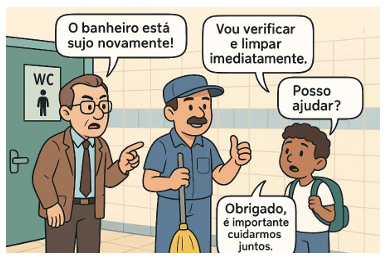
Com base na situação acima, julgue as afirmativas abaixo:
I.Ignorar o comentário do professor seria uma prática aceitável.
II.O zelador demonstrou boa comunicação, atenção e postura colaborativa.
III.Agradecer a colaboração do aluno incentiva comportamento responsável e respeito mútuo.
IV.Repreender o aluno por sugerir ajuda é compatível com ética profissional.
Está CORRETO o que se afirma em:
Com base na situação acima, julgue as afirmativas abaixo:
I.Ignorar o comentário do professor seria uma prática aceitável.
II.O zelador demonstrou boa comunicação, atenção e postura colaborativa.
III.Agradecer a colaboração do aluno incentiva comportamento responsável e respeito mútuo.
IV.Repreender o aluno por sugerir ajuda é compatível com ética profissional.
Está CORRETO o que se afirma em:
Ano: 2025
Banca:
UNIVALI
Órgão:
Prefeitura de Luiz Alves - SC
Prova:
UNIVALI - 2025 - Prefeitura de Luiz Alves - SC - Zelador - Edital nº 15 |
Q4036069
Atendimento ao Público
Ética e comportamento no serviço público é um conjunto
de leis e princípios que guiam a conduta do servidor
público, com o objetivo de garantir que suas ações
priorizem o interesse público e o bem comum. Um
cidadão pede ajuda ao zelador para encontrar o setor de
protocolo, marque verdadeiro (V) ou falso (F) nas
afirmativas abaixo:
(__)O servidor deve prestar informações com cortesia e respeito.
(__)Atender o público com impaciência não interfere na imagem da instituição.
(__)Negar auxílio ao cidadão é compatível com a função administrativa.
(__)O bom atendimento reflete ética, urbanidade e compromisso com o interesse público.
Assinale a alternativa que apresenta a sequência CORRETA de cima para baixo.
(__)O servidor deve prestar informações com cortesia e respeito.
(__)Atender o público com impaciência não interfere na imagem da instituição.
(__)Negar auxílio ao cidadão é compatível com a função administrativa.
(__)O bom atendimento reflete ética, urbanidade e compromisso com o interesse público.
Assinale a alternativa que apresenta a sequência CORRETA de cima para baixo.
Ano: 2025
Banca:
UNIVALI
Órgão:
Prefeitura de Luiz Alves - SC
Prova:
UNIVALI - 2025 - Prefeitura de Luiz Alves - SC - Zelador - Edital nº 15 |
Q4036068
Segurança e Saúde no Trabalho
Equipamento de Proteção Individual (EPI) são
dispositivos usados pelo trabalhador para protegê-lo de
riscos à saúde e segurança no ambiente de trabalho,
como capacetes, luvas e óculos. Durante a limpeza de
um banheiro, o zelador manipula desinfetante
concentrado. Em relação a Segurança no trabalho e
EPIs, marque verdadeiro (V) ou falso (F) nas afirmativas
abaixo:
(__)É obrigatório o uso de luvas, avental impermeável e proteção ocular.
(__)A roupa de algodão comum substitui o avental quando não houver risco químico.
(__)EPIs devem ser higienizados e guardados após o uso.
(__)O uso de calçado aberto é permitido, desde que o piso esteja seco.
Assinale a alternativa que apresenta a sequência CORRETA de cima para baixo.
(__)É obrigatório o uso de luvas, avental impermeável e proteção ocular.
(__)A roupa de algodão comum substitui o avental quando não houver risco químico.
(__)EPIs devem ser higienizados e guardados após o uso.
(__)O uso de calçado aberto é permitido, desde que o piso esteja seco.
Assinale a alternativa que apresenta a sequência CORRETA de cima para baixo.
Ano: 2025
Banca:
UNIVALI
Órgão:
Prefeitura de Luiz Alves - SC
Prova:
UNIVALI - 2025 - Prefeitura de Luiz Alves - SC - Zelador - Edital nº 15 |
Q4036067
Administração de Recursos Materiais
O zelador de um prédio residencial percebe que alguns
equipamentos da área de lazer, como aspiradores e
ferramentas de manutenção, estão sendo retirados pelos
moradores para uso pessoal. Sobre como o zelador deve
proceder diante dessa situação, assinale a alternativa
INCORRETA.
Ano: 2025
Banca:
UNIVALI
Órgão:
Prefeitura de Luiz Alves - SC
Prova:
UNIVALI - 2025 - Prefeitura de Luiz Alves - SC - Zelador - Edital nº 15 |
Q4036066
Segurança e Saúde no Trabalho
Ao receber um produto de limpeza novo, o zelador observa no rótulo um pictograma de crânio com ossos cruzados, conforme figura abaixo:

Assinale a alternativa CORRETA que indica esse pictograma e qual atitude imediata o zelador deve tomar.
Ano: 2025
Banca:
UNIVALI
Órgão:
Prefeitura de Luiz Alves - SC
Prova:
UNIVALI - 2025 - Prefeitura de Luiz Alves - SC - Zelador - Edital nº 15 |
Q4036065
Administração de Recursos Materiais
Um almoxarifado é o local ou setor de uma empresa
onde são recebidos, armazenados e controlados
materiais e produtos para uso interno, como
matérias-primas, insumos e ferramentas, diferente de um
centro de distribuição que armazena produtos acabados
para o cliente final. O almoxarifado do prédio guarda
solventes e produtos inflamáveis junto a materiais de
limpeza gerais. Segundo boas práticas e normas,
assinale a alternativa CORRETA corresponde a medida
prioritária para reduzir risco de incêndio.
Ano: 2025
Banca:
UNIVALI
Órgão:
Prefeitura de Luiz Alves - SC
Prova:
UNIVALI - 2025 - Prefeitura de Luiz Alves - SC - Zelador - Edital nº 15 |
Q4036064
Segurança e Saúde no Trabalho
Em um laboratório de análises clínicas de uma repartição
pública, o zelador é responsável por zelar pela limpeza,
organização e conservação do ambiente, garantindo que
as atividades laboratoriais ocorram de forma segura.
Sobre a limpeza interna do laboratório, é INCORRETO
afirmar que:
Ano: 2025
Banca:
UNIVALI
Órgão:
Prefeitura de Luiz Alves - SC
Prova:
UNIVALI - 2025 - Prefeitura de Luiz Alves - SC - Zelador - Edital nº 15 |
Q4036063
Relações Humanas
O zelador de um prédio público observa que um colega
reutilizou produtos de limpeza do almoxarifado para uso
pessoal. Ele precisa decidir como agir de maneira ética e
responsável. Ética e cidadania no serviço público
referem-se à conduta dos servidores para servir ao bem
comum, agindo com imparcialidade, eficiência e dentro
da lei, além de promover a participação e o controle
social.
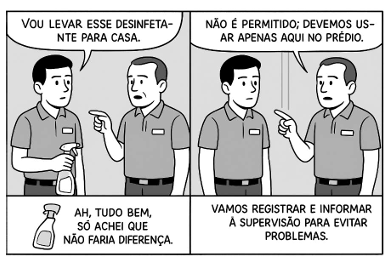
Com base no cenário acima, julgue as afirmativas abaixo:
I.Ignorar a situação, pois não é responsabilidade do zelador.
II.Alertar o colega sobre o uso correto dos materiais e as normas do prédio.
III.Comunicar o supervisor de forma objetiva e respeitosa.
IV.Confrontar o colega de forma agressiva para mostrar autoridade.
Está CORRETO o que se afirma em:
Com base no cenário acima, julgue as afirmativas abaixo:
I.Ignorar a situação, pois não é responsabilidade do zelador.
II.Alertar o colega sobre o uso correto dos materiais e as normas do prédio.
III.Comunicar o supervisor de forma objetiva e respeitosa.
IV.Confrontar o colega de forma agressiva para mostrar autoridade.
Está CORRETO o que se afirma em:
Ano: 2025
Banca:
UNIVALI
Órgão:
Prefeitura de Luiz Alves - SC
Prova:
UNIVALI - 2025 - Prefeitura de Luiz Alves - SC - Zelador - Edital nº 15 |
Q4036062
Segurança e Saúde no Trabalho
Um vaso sanitário é um equipamento de saneamento
básico, também conhecido como bacia sanitária, privado
ou patente, usado para a eliminação de resíduos
humanos por meio da descarga de água. Em prédio
público, o zelador notou manchas de calcário no interior
dos vasos sanitários. Para remover depósitos sem
danificar a louça e garantindo segurança do trabalhador.
Assinale a alternativa CORRETA que corresponde a qual
produto que é adequado para remover depósitos sem
danificar a louça e garantir segurança do trabalhador.
Ano: 2025
Banca:
UNIVALI
Órgão:
Prefeitura de Luiz Alves - SC
Prova:
UNIVALI - 2025 - Prefeitura de Luiz Alves - SC - Enfermeiro - Edital nº 15 |
Q4036051
Enfermagem
O tratamento farmacológico do DM2 deve ser
individualizado, considerando o risco cardiovascular, a
função renal e o perfil do paciente. A combinação de
fármacos com diferentes mecanismos de ação é
fundamental para alcançar o controle glicêmico e
prevenir complicações crônicas. Acerca do assunto,
registre V, para as afirmativas verdadeiras, e F, para as
falsas:
(__)A metformina é considerado o medicamento de primeira escolha para a maioria dos pacientes com DM2, salvo contraindicações, podendo ser associada precocemente a outros agentes para melhor controle glicêmico.
(__)Pacientes com DM2 e doença cardiovascular aterosclerótica estabelecida devem priorizar o uso de agonistas do receptor de GLP-1 ou inibidores de SGLT2, que apresentam benefícios cardiovasculares comprovados.
(__)O uso de iSGLT2 é contraindicado em pacientes com insuficiência cardíaca, uma vez que pode aumentar o risco de descompensação hemodinâmica devido à diurese osmótica.
(__)A intensificação do tratamento, com adição de novas classes terapêuticas, deve ser considerada quando a meta glicêmica não for alcançada em três meses de acompanhamento, mesmo com adesão adequada à terapia e mudanças no estilo de vida.
Após análise, assinale a alternativa que apresenta a sequência correta dos itens acima, de cima para baixo:
(__)A metformina é considerado o medicamento de primeira escolha para a maioria dos pacientes com DM2, salvo contraindicações, podendo ser associada precocemente a outros agentes para melhor controle glicêmico.
(__)Pacientes com DM2 e doença cardiovascular aterosclerótica estabelecida devem priorizar o uso de agonistas do receptor de GLP-1 ou inibidores de SGLT2, que apresentam benefícios cardiovasculares comprovados.
(__)O uso de iSGLT2 é contraindicado em pacientes com insuficiência cardíaca, uma vez que pode aumentar o risco de descompensação hemodinâmica devido à diurese osmótica.
(__)A intensificação do tratamento, com adição de novas classes terapêuticas, deve ser considerada quando a meta glicêmica não for alcançada em três meses de acompanhamento, mesmo com adesão adequada à terapia e mudanças no estilo de vida.
Após análise, assinale a alternativa que apresenta a sequência correta dos itens acima, de cima para baixo:
Ano: 2025
Banca:
UNIVALI
Órgão:
Prefeitura de Luiz Alves - SC
Prova:
UNIVALI - 2025 - Prefeitura de Luiz Alves - SC - Enfermeiro - Edital nº 15 |
Q4036050
Saúde Pública
Durante uma reunião de planejamento em uma Unidade
Básica de Saúde de uma comunidade rural, a equipe de
enfermagem observou baixa adesão da população às
ações educativas e às atividades de controle de doenças
crônicas. Diante disso, a enfermeira propôs uma
estratégia de mobilização social, envolvendo lideranças
locais, associações comunitárias e grupos religiosos, a
fim de fortalecer o vínculo entre os serviços de saúde e
os moradores. Considerando o papel da organização
social e comunitária na efetivação das ações de saúde
coletiva, assinale a alternativa correta.
Ano: 2025
Banca:
UNIVALI
Órgão:
Prefeitura de Luiz Alves - SC
Prova:
UNIVALI - 2025 - Prefeitura de Luiz Alves - SC - Enfermeiro - Edital nº 15 |
Q4036049
Saúde Pública
A Vigilância em Saúde constitui um conjunto de ações
integradas destinadas a promover, proteger e prevenir
agravos à saúde da população, articulando diferentes
áreas e políticas públicas. Acerca do assunto, registre V,
para as afirmativas verdadeiras, e F, para as falsas:
(__)A Vigilância em Saúde atua exclusivamente no monitoramento de doenças transmissíveis, sendo sua principal função identificar surtos e epidemias para intervenção imediata.
(__)A Vigilância Ambiental em Saúde compreende o monitoramento de fatores físicos, químicos e biológicos do meio ambiente que possam interferir na saúde humana.
(__)A Vigilância Epidemiológica e a Vigilância Sanitária são instâncias independentes, sem interface técnica ou administrativa no âmbito do SUS.
(__)A Vigilância em Saúde deve ser desenvolvida de forma integrada às demais ações de atenção e promoção da saúde, considerando o território e o perfil epidemiológico da população.
Após análise, assinale a alternativa que apresenta a sequência correta dos itens acima, de cima para baixo:
(__)A Vigilância em Saúde atua exclusivamente no monitoramento de doenças transmissíveis, sendo sua principal função identificar surtos e epidemias para intervenção imediata.
(__)A Vigilância Ambiental em Saúde compreende o monitoramento de fatores físicos, químicos e biológicos do meio ambiente que possam interferir na saúde humana.
(__)A Vigilância Epidemiológica e a Vigilância Sanitária são instâncias independentes, sem interface técnica ou administrativa no âmbito do SUS.
(__)A Vigilância em Saúde deve ser desenvolvida de forma integrada às demais ações de atenção e promoção da saúde, considerando o território e o perfil epidemiológico da população.
Após análise, assinale a alternativa que apresenta a sequência correta dos itens acima, de cima para baixo:
Ano: 2025
Banca:
UNIVALI
Órgão:
Prefeitura de Luiz Alves - SC
Prova:
UNIVALI - 2025 - Prefeitura de Luiz Alves - SC - Enfermeiro - Edital nº 15 |
Q4036048
Enfermagem
Os distúrbios hidroeletrolíticos e metabólicos, como as
alterações de sódio, potássio e glicose sérica, exigem da
equipe de enfermagem avaliação clínica imediata,
monitorização contínua e intervenções seguras que
previnam complicações neurológicas e cardiovasculares.
Acerca do assunto, registre V, para as afirmativas
verdadeiras, e F, para as falsas:
(__)Na hiponatremia grave com sintomas neurológicos, a correção do sódio deve ser rápida, visando normalizar os valores séricos nas primeiras 6 horas, para prevenir o risco de edema cerebral.
(__)A hipercalemia pode causar arritmias cardíacas fatais; a administração intravenosa de gluconato de cálcio é uma das medidas de emergência para estabilizar a membrana miocárdica.
(__)Na hipoglicemia grave, quando não há acesso venoso disponível, a administração de glicose a 50% por via oral é indicada, desde que o paciente esteja consciente e consiga deglutir.
(__)Na cetoacidose diabética, a reposição de insulina deve ser iniciada somente após a normalização completa do potássio sérico, independentemente de sua concentração inicial.
Após análise, assinale a alternativa que apresenta a sequência correta dos itens acima, de cima para baixo:
(__)Na hiponatremia grave com sintomas neurológicos, a correção do sódio deve ser rápida, visando normalizar os valores séricos nas primeiras 6 horas, para prevenir o risco de edema cerebral.
(__)A hipercalemia pode causar arritmias cardíacas fatais; a administração intravenosa de gluconato de cálcio é uma das medidas de emergência para estabilizar a membrana miocárdica.
(__)Na hipoglicemia grave, quando não há acesso venoso disponível, a administração de glicose a 50% por via oral é indicada, desde que o paciente esteja consciente e consiga deglutir.
(__)Na cetoacidose diabética, a reposição de insulina deve ser iniciada somente após a normalização completa do potássio sérico, independentemente de sua concentração inicial.
Após análise, assinale a alternativa que apresenta a sequência correta dos itens acima, de cima para baixo:
Ano: 2025
Banca:
UNIVALI
Órgão:
Prefeitura de Luiz Alves - SC
Prova:
UNIVALI - 2025 - Prefeitura de Luiz Alves - SC - Enfermeiro - Edital nº 15 |
Q4036047
Enfermagem
Os fundamentos da enfermagem envolvem princípios
teóricos que orientam a prática profissional, a tomada de
decisão clínica e o cuidado centrado no paciente. A
compreensão do metaparadigma e das teorias de
enfermagem é essencial para aplicar o conhecimento
científico na assistência e fortalecer a identidade da
profissão. Sobre os fundamentos de enfermagem,
analise as alternativas abaixo e assinale a correta.
Ano: 2025
Banca:
UNIVALI
Órgão:
Prefeitura de Luiz Alves - SC
Prova:
UNIVALI - 2025 - Prefeitura de Luiz Alves - SC - Enfermeiro - Edital nº 15 |
Q4036046
Enfermagem
Um agricultor de 42 anos chega à unidade básica de
saúde relatando dor e inchaço progressivo na perna
direita após pisar em um animal rastejante durante o
trabalho. Observa-se edema, equimose e presença de
duas marcas puntiformes no terço inferior da perna. O
paciente não apresenta sinais de choque, mas refere
parestesia local. O enfermeiro realiza o acolhimento e
prepara o atendimento inicial, com vistas à identificação
do acidente e à administração de soroterapia, conforme
a suspeita clínica. Considerando as condutas de
enfermagem frente aos acidentes por animais
peçonhentos e a profilaxia por meio de soros e vacinas,
assinale a alternativa correta.
Ano: 2025
Banca:
UNIVALI
Órgão:
Prefeitura de Luiz Alves - SC
Prova:
UNIVALI - 2025 - Prefeitura de Luiz Alves - SC - Enfermeiro - Edital nº 15 |
Q4036045
Enfermagem
A atenção de enfermagem em urgências ginecológicas e
obstétricas exige avaliação rápida, estabilização (ABCs), triagem obstétrica, comunicação imediata com a equipe
multiprofissional e execução de intervenções prioritárias
protocolizadas para reduzir morbimortalidade materna e
perinatal. Acerca do assunto, registre V, para as
afirmativas verdadeiras, e F, para as falsas:
(__)Na hemorragia pós-parto grave, as intervenções imediatas de enfermagem incluem: massagem uterina ativa, solicitação de ajuda, garantia de acesso venoso calibroso para reposição volêmica, monitorização hemodinâmica contínua e preparo para administração de uterotônicos conforme protocolo.
(__)Em caso de suspeita de placenta prévia com sangramento ativo, é recomendado realizar toque vaginal imediato para localizar a fonte do sangramento e avaliar dilatação cervical antes de qualquer transferência.
(__)Em casos de pré-eclâmpsia grave ou eclâmpsia, o sulfato de magnésio é o anticonvulsivante de escolha. Durante sua administração, a equipe de enfermagem deve realizar monitorização rigorosa da função respiratória, dos reflexos tendíneos profundos e da diurese.
(__)Diante de suspeita de gravidez ectópica em paciente hemodinamicamente estável, a conduta de enfermagem inclui monitorização de sinais vitais, preparo para exames (US transvaginal, beta-hCG), avaliação rápida para sinais de instabilidade e organização do fluxo para tratamento médico (p. ex., metotrexato) ou cirúrgico conforme decisão médica.
Após análise, assinale a alternativa que apresenta a sequência correta dos itens acima, de cima para baixo:
(__)Na hemorragia pós-parto grave, as intervenções imediatas de enfermagem incluem: massagem uterina ativa, solicitação de ajuda, garantia de acesso venoso calibroso para reposição volêmica, monitorização hemodinâmica contínua e preparo para administração de uterotônicos conforme protocolo.
(__)Em caso de suspeita de placenta prévia com sangramento ativo, é recomendado realizar toque vaginal imediato para localizar a fonte do sangramento e avaliar dilatação cervical antes de qualquer transferência.
(__)Em casos de pré-eclâmpsia grave ou eclâmpsia, o sulfato de magnésio é o anticonvulsivante de escolha. Durante sua administração, a equipe de enfermagem deve realizar monitorização rigorosa da função respiratória, dos reflexos tendíneos profundos e da diurese.
(__)Diante de suspeita de gravidez ectópica em paciente hemodinamicamente estável, a conduta de enfermagem inclui monitorização de sinais vitais, preparo para exames (US transvaginal, beta-hCG), avaliação rápida para sinais de instabilidade e organização do fluxo para tratamento médico (p. ex., metotrexato) ou cirúrgico conforme decisão médica.
Após análise, assinale a alternativa que apresenta a sequência correta dos itens acima, de cima para baixo:
Ano: 2025
Banca:
UNIVALI
Órgão:
Prefeitura de Luiz Alves - SC
Prova:
UNIVALI - 2025 - Prefeitura de Luiz Alves - SC - Enfermeiro - Edital nº 15 |
Q4036044
Enfermagem
A Atenção Domiciliar integra a Rede de Atenção à
Saúde, ampliando o cuidado prestado pela Atenção
Primária e favorecendo a continuidade do tratamento, a
humanização e a desospitalização segura dos usuários.
Acerca do assunto, registre V, para as afirmativas
verdadeiras, e F, para as falsas:
(__)O atendimento domiciliar substitui o acompanhamento regular realizado na unidade básica de saúde, sendo indicado para todos os usuários com doenças crônicas que apresentam limitação funcional.
(__)A Atenção Domiciliar no âmbito do SUS é estruturada em diferentes modalidades (AD1, AD2 e AD3), definidas conforme a complexidade do cuidado e a necessidade de recursos humanos e tecnológicos para a assistência.
(__)A visita domiciliar é uma ferramenta estratégica para o cuidado longitudinal, permitindo à equipe da ESF avaliar o ambiente familiar, as condições de autocuidado, adesão terapêutica e fatores de vulnerabilidade social.
(__)A equipe multiprofissional do Serviço de Atenção Domiciliar (SAD) deve atuar de forma articulada com a ESF e demais pontos da Rede de Atenção à Saúde, garantindo integralidade e continuidade do cuidado.
Após análise, assinale a alternativa que apresenta a sequência correta dos itens acima, de cima para baixo:
(__)O atendimento domiciliar substitui o acompanhamento regular realizado na unidade básica de saúde, sendo indicado para todos os usuários com doenças crônicas que apresentam limitação funcional.
(__)A Atenção Domiciliar no âmbito do SUS é estruturada em diferentes modalidades (AD1, AD2 e AD3), definidas conforme a complexidade do cuidado e a necessidade de recursos humanos e tecnológicos para a assistência.
(__)A visita domiciliar é uma ferramenta estratégica para o cuidado longitudinal, permitindo à equipe da ESF avaliar o ambiente familiar, as condições de autocuidado, adesão terapêutica e fatores de vulnerabilidade social.
(__)A equipe multiprofissional do Serviço de Atenção Domiciliar (SAD) deve atuar de forma articulada com a ESF e demais pontos da Rede de Atenção à Saúde, garantindo integralidade e continuidade do cuidado.
Após análise, assinale a alternativa que apresenta a sequência correta dos itens acima, de cima para baixo:

 Conheça nossos planos