Selecionar segmento
Estude com questões de diferentes segmentos
Atenção: Isso limpará todos os campos já preenchidos no filtro!
Foram encontradas 3.283 questões
Resolva questões gratuitamente!
Junte-se a mais de 4 milhões de concurseiros!


Ano: 2026
Banca:
COPERVE - UFSC
Órgão:
UFSC
Prova:
COPERVE - UFSC - 2026 - UFSC - Técnico de Tecnologia da Informação |
Q4042701
Segurança da Informação
Analise as afirmativas sobre conceitos e técnicas de backup e assinale a alternativa correta.
I. Um backup diferencial dispensa a existência de um backup completo como base.
II. A retenção dos backups pode ser imposta por regras de conformidade legais.
III. A estabilidade do tamanho do backup pode ser considerada uma garantia de integridade.
I. Um backup diferencial dispensa a existência de um backup completo como base.
II. A retenção dos backups pode ser imposta por regras de conformidade legais.
III. A estabilidade do tamanho do backup pode ser considerada uma garantia de integridade.
Ano: 2026
Banca:
COPERVE - UFSC
Órgão:
UFSC
Prova:
COPERVE - UFSC - 2026 - UFSC - Técnico de Tecnologia da Informação |
Q4042700
Segurança da Informação
Analise as afirmativas sobre as funcionalidade das funções de Hash e assinale a alternativa
correta.
I. Permitem a verificação da integridade de um arquivo.
II. Possibilitam a prova de conhecimento sem a prévia revelação do dado.
III. Servem para codificar e decodificar dados.
I. Permitem a verificação da integridade de um arquivo.
II. Possibilitam a prova de conhecimento sem a prévia revelação do dado.
III. Servem para codificar e decodificar dados.
Ano: 2026
Banca:
COPERVE - UFSC
Órgão:
UFSC
Prova:
COPERVE - UFSC - 2026 - UFSC - Técnico de Tecnologia da Informação |
Q4042699
Segurança da Informação
Analise as afirmativas sobre o conceito de intrusões e técnicas de prevenção e assinale a alternativa correta.
I. Intrusão em computadores é o acesso não autorizado a sistemas e redes com o objetivo de obter informações, causar danos, utilizar recursos e/ou interromper serviços.
II. Hackers utilizam somente técnicas computacionais, como exploração de vulnerabilidades e força bruta, para realizar invasões em sistemas.
III. Conscientização dos usuários é um método de prevenção de intrusão.
Ano: 2026
Banca:
COPERVE - UFSC
Órgão:
UFSC
Prova:
COPERVE - UFSC - 2026 - UFSC - Técnico de Tecnologia da Informação |
Q4042698
Redes de Computadores
Analise as afirmativas sobre cabeamento, fibras e módulos de conexão e assinale a alternativa
correta.
I. A diferença entre conectores de fibra UPC e APC é o tipo de polimento de sua ponta.
II. Módulos SFP alcançam até 300M enquanto SFP+ podem chegar até 10KM.
III. A blindagem dos cabos UTP serve para evitar interferências eletromagnéticas externas.
I. A diferença entre conectores de fibra UPC e APC é o tipo de polimento de sua ponta.
II. Módulos SFP alcançam até 300M enquanto SFP+ podem chegar até 10KM.
III. A blindagem dos cabos UTP serve para evitar interferências eletromagnéticas externas.
Ano: 2026
Banca:
COPERVE - UFSC
Órgão:
UFSC
Prova:
COPERVE - UFSC - 2026 - UFSC - Técnico de Tecnologia da Informação |
Q4042697
Redes de Computadores
Analise as afirmativas sobre os protocolos e serviços de rede e internet e assinale a alternativa
correta.
I. O protocolo HTTPS possibilita autenticar tanto o servidor quanto o cliente.
II. O protocolo HTTP não obriga a necessidade de um serviço de DNS.
III. O serviço DHCP pode informar ao cliente o servidor de tempo (NTP).
I. O protocolo HTTPS possibilita autenticar tanto o servidor quanto o cliente.
II. O protocolo HTTP não obriga a necessidade de um serviço de DNS.
III. O serviço DHCP pode informar ao cliente o servidor de tempo (NTP).
Ano: 2026
Banca:
COPERVE - UFSC
Órgão:
UFSC
Prova:
COPERVE - UFSC - 2026 - UFSC - Técnico de Tecnologia da Informação |
Q4042696
Redes de Computadores
Analise as afirmativas sobre o serviço de acesso remoto SSH e assinale a alternativa correta.
I. Possibilita transferir arquivos via comando SCP.
II. Garante o não comprometimento da senha do usuário.
III. Utiliza, opcionalmente, senha como método de autenticação.
I. Possibilita transferir arquivos via comando SCP.
II. Garante o não comprometimento da senha do usuário.
III. Utiliza, opcionalmente, senha como método de autenticação.
Ano: 2026
Banca:
COPERVE - UFSC
Órgão:
UFSC
Provas:
COPERVE - UFSC - 2026 - UFSC - Assistente em Administração
|
COPERVE - UFSC - 2026 - UFSC - Técnico de Laboratório/Física |
COPERVE - UFSC - 2026 - UFSC - Técnico de Tecnologia da Informação |
COPERVE - UFSC - 2026 - UFSC - Técnico em Enfermagem |
Q4037971
Direito Administrativo
Assinale a alternativa correta referente ao Regime Jurídico dos Servidores Públicos Civis da
União, das Autarquias e das Fundações Públicas Federais, de acordo com a Lei nº 8.112/1990.
Ano: 2026
Banca:
COPERVE - UFSC
Órgão:
UFSC
Provas:
COPERVE - UFSC - 2026 - UFSC - Assistente em Administração
|
COPERVE - UFSC - 2026 - UFSC - Técnico de Laboratório/Física |
COPERVE - UFSC - 2026 - UFSC - Técnico de Tecnologia da Informação |
COPERVE - UFSC - 2026 - UFSC - Técnico em Enfermagem |
Q4037969
Legislação Estadual
Assinale a alternativa correta em relação ao Regimento e ao Estatuto da Universidade Federal de
Santa Catarina (UFSC).
Ano: 2026
Banca:
COPERVE - UFSC
Órgão:
UFSC
Provas:
COPERVE - UFSC - 2026 - UFSC - Assistente em Administração
|
COPERVE - UFSC - 2026 - UFSC - Técnico de Laboratório/Física |
COPERVE - UFSC - 2026 - UFSC - Técnico de Tecnologia da Informação |
COPERVE - UFSC - 2026 - UFSC - Técnico em Enfermagem |
Q4037968
Segurança da Informação
Analise as afirmativas sobre segurança e prevenção na web e assinale a alternativa correta.
I. O acesso não autorizado a sistemas e redes com o objetivo de obter informações, causar danos, utilizar recursos e/ou interromper serviços é considerado uma intrusão.
II. Hackers não utilizam somente técnicas computacionais para realizar invasões. Eles também usam técnicas de engenharia social para obter informações.
III. Conscientização dos usuários é um método de prevenção de intrusão.
I. O acesso não autorizado a sistemas e redes com o objetivo de obter informações, causar danos, utilizar recursos e/ou interromper serviços é considerado uma intrusão.
II. Hackers não utilizam somente técnicas computacionais para realizar invasões. Eles também usam técnicas de engenharia social para obter informações.
III. Conscientização dos usuários é um método de prevenção de intrusão.
Ano: 2026
Banca:
COPERVE - UFSC
Órgão:
UFSC
Provas:
COPERVE - UFSC - 2026 - UFSC - Assistente em Administração
|
COPERVE - UFSC - 2026 - UFSC - Técnico de Laboratório/Física |
COPERVE - UFSC - 2026 - UFSC - Técnico de Tecnologia da Informação |
COPERVE - UFSC - 2026 - UFSC - Técnico em Enfermagem |
Q4037967
Noções de Informática
Assinale a alternativa correta sobre os aplicativos Firefox e o Thunderbird:
Ano: 2026
Banca:
COPERVE - UFSC
Órgão:
UFSC
Provas:
COPERVE - UFSC - 2026 - UFSC - Assistente em Administração
|
COPERVE - UFSC - 2026 - UFSC - Técnico de Laboratório/Física |
COPERVE - UFSC - 2026 - UFSC - Técnico de Tecnologia da Informação |
COPERVE - UFSC - 2026 - UFSC - Técnico em Enfermagem |
Q4037966
Noções de Informática
No Microsoft Word, qual das seguintes opções é usada para inserir uma quebra de página
manual?
Ano: 2026
Banca:
COPERVE - UFSC
Órgão:
UFSC
Provas:
COPERVE - UFSC - 2026 - UFSC - Assistente em Administração
|
COPERVE - UFSC - 2026 - UFSC - Técnico de Laboratório/Física |
COPERVE - UFSC - 2026 - UFSC - Técnico de Tecnologia da Informação |
COPERVE - UFSC - 2026 - UFSC - Técnico em Enfermagem |
Q4037964
Administração de Recursos Materiais
A Universidade Federal de Santa Catarina (UFSC), por meio de seu Plano de Logística Sustentável
(PLS) 2025-2029, reafirma seu compromisso com a gestão eficiente de recursos e a redução de
impactos ambientais, alinhando-se à Política Nacional de Resíduos Sólidos (PNRS). Com base
nas diretrizes de gerenciamento de resíduos sólidos estabelecidas tanto no âmbito institucional da
UFSC quanto na legislação nacional, assinale a alternativa correta.
Ano: 2026
Banca:
COPERVE - UFSC
Órgão:
UFSC
Provas:
COPERVE - UFSC - 2026 - UFSC - Assistente em Administração
|
COPERVE - UFSC - 2026 - UFSC - Técnico de Laboratório/Física |
COPERVE - UFSC - 2026 - UFSC - Técnico de Tecnologia da Informação |
COPERVE - UFSC - 2026 - UFSC - Técnico em Enfermagem |
Q4037962
Direito Ambiental
A poluição e contaminação por resíduos sólidos é um dos maiores problemas ambientais da
atualidade. A dispersão dos plásticos nos oceanos, a disseminação de doenças causadas por
vetores e a emissão de gases de efeito estufa são alguns dos pontos mais recorrentes nos
noticiários e mídias. Para atuar na redução de tais impactos, o Brasil conta com a Política Nacional
de Resíduos Sólidos (PNRS – Lei nº 12.305/2010). Sobre a gestão de resíduos sólidos, assinale a
alternativa correta.
Ano: 2026
Banca:
COPERVE - UFSC
Órgão:
UFSC
Provas:
COPERVE - UFSC - 2026 - UFSC - Assistente em Administração
|
COPERVE - UFSC - 2026 - UFSC - Técnico de Laboratório/Física |
COPERVE - UFSC - 2026 - UFSC - Técnico de Tecnologia da Informação |
COPERVE - UFSC - 2026 - UFSC - Técnico em Enfermagem |
Q4037961
Português
Texto associado
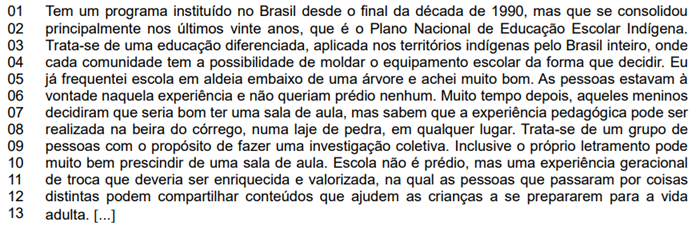
Leia o texto 8 para responder à questão.
Texto 8
O coração no ritmo da terra
KRENAK, Ailton. Futuro Ancestral. 1.ed. São Paulo: Companhia das Letras, 2022. p. 113-114.
Com base no texto 8 e na variedade padrão da língua escrita, assinale a alternativa correta.
Ano: 2026
Banca:
COPERVE - UFSC
Órgão:
UFSC
Provas:
COPERVE - UFSC - 2026 - UFSC - Assistente em Administração
|
COPERVE - UFSC - 2026 - UFSC - Técnico de Laboratório/Física |
COPERVE - UFSC - 2026 - UFSC - Técnico de Tecnologia da Informação |
COPERVE - UFSC - 2026 - UFSC - Técnico em Enfermagem |
Q4037956
Português
Texto associado
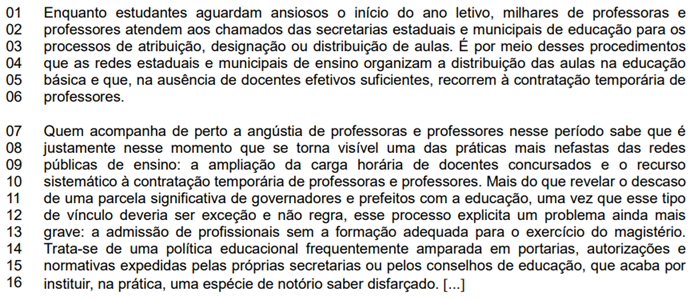
Leia o texto 5 para responder à questão.
Texto 5
‘Notório saber’ e a sala de aula como laboratório do improviso
Por: Thiago Esteves – Carta Capital 02/02/2026
Disponível em: https://www.cartacapital.com.br/opiniao/notorio-saber-e-a-sala-de-aula-como-laboratorio-do-improviso.
Com base no texto 5 e na variedade padrão da língua escrita, assinale a alternativa correta.
Ano: 2026
Banca:
COPERVE - UFSC
Órgão:
UFSC
Provas:
COPERVE - UFSC - 2026 - UFSC - Assistente em Administração
|
COPERVE - UFSC - 2026 - UFSC - Técnico de Laboratório/Física |
COPERVE - UFSC - 2026 - UFSC - Técnico de Tecnologia da Informação |
COPERVE - UFSC - 2026 - UFSC - Técnico em Enfermagem |
Q4037954
Português
Numere a ordem dos períodos, de modo que assegure coesão e coerência ao parágrafo. Em
seguida, assinale a alternativa com a sequência numérica correta de cima para baixo.
( ) No entanto, não digo que a descobri e que, por isso, quero possuí-la. Assim como não digo que descobri o céu, ou os animais de caça! Sempre estiveram aí, desde antes de eu nascer.
( ) Mas esse é um pensamento cheio de esquecimento! Omama nos criou, com o céu e a floresta, lá onde nossos ancestrais têm vivido desde sempre.
( ) Contam os brancos que um português disse ter descoberto o Brasil há muito tempo. Pensam mesmo, até hoje, que foi ele o primeiro a ver nossa terra.
( ) Contento-me em olhar para o céu e caçar os animais da floresta. E só. E é esse o único pensamento direito.
( ) Nossas palavras estão presentes nesta terra desde o primeiro tempo, do mesmo modo que as montanhas onde moram os xapiri. Nasci na floresta e sempre vivi nela.
Davi Kopenawa. A queda do céu: palavras de um xamã yanomami [2010]. São Paulo: Companhia das Letras, 2015.
( ) No entanto, não digo que a descobri e que, por isso, quero possuí-la. Assim como não digo que descobri o céu, ou os animais de caça! Sempre estiveram aí, desde antes de eu nascer.
( ) Mas esse é um pensamento cheio de esquecimento! Omama nos criou, com o céu e a floresta, lá onde nossos ancestrais têm vivido desde sempre.
( ) Contam os brancos que um português disse ter descoberto o Brasil há muito tempo. Pensam mesmo, até hoje, que foi ele o primeiro a ver nossa terra.
( ) Contento-me em olhar para o céu e caçar os animais da floresta. E só. E é esse o único pensamento direito.
( ) Nossas palavras estão presentes nesta terra desde o primeiro tempo, do mesmo modo que as montanhas onde moram os xapiri. Nasci na floresta e sempre vivi nela.
Davi Kopenawa. A queda do céu: palavras de um xamã yanomami [2010]. São Paulo: Companhia das Letras, 2015.
Ano: 2026
Banca:
COPERVE - UFSC
Órgão:
UFSC
Provas:
COPERVE - UFSC - 2026 - UFSC - Assistente em Administração
|
COPERVE - UFSC - 2026 - UFSC - Técnico de Laboratório/Física |
COPERVE - UFSC - 2026 - UFSC - Técnico de Tecnologia da Informação |
COPERVE - UFSC - 2026 - UFSC - Técnico em Enfermagem |
Q4037948
Português
Texto associado
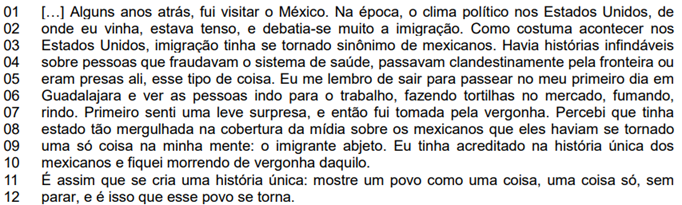
Leia o texto 1 para responder à questão.
Texto 1
ADICHIE, Chimamanda Ngozi. O perigo de uma história única. Tradução de Júlia Romeu. São Paulo: Companhia das Letras, 2019. p. 21-22.
Com base no texto 1 e na variedade padrão da língua escrita, assinale a alternativa correta.
Ano: 2026
Banca:
CONSULPAM
Órgão:
Prefeitura de Eusébio - CE
Prova:
CONSULPAM - 2026 - Prefeitura de Eusébio - CE - Técnico em Tecnologia da Informação |
Q3917582
Gerência de Projetos
Uma fundação pública está conduzindo um projeto de
modernização de sistemas com cronograma crítico e
múltiplas integrações. Na fase de planejamento, foi
exigido ao Técnico de TI o desenvolvimento de um
processo formal para identificar ameaças à execução
do projeto, qualificar o impacto e a probabilidade
dessas ameaças, bem como definir respostas. O
projeto segue práticas do PMBOK. Nesse contexto a
área de conhecimento do PMBOK, envolvida nesta
atividade, é denominada como:
Ano: 2026
Banca:
CONSULPAM
Órgão:
Prefeitura de Eusébio - CE
Prova:
CONSULPAM - 2026 - Prefeitura de Eusébio - CE - Técnico em Tecnologia da Informação |
Q3917581
Modelagem de Processos de Negócio (BPM)
Uma universidade pretende reduzir o tempo de
tramitação de solicitações internas, tais como diárias
e passagens, que atualmente dependem de aprovações
sequenciais, documentos anexos e registros em
diferentes sistemas. Foi solicitado ao Técnico de TI o
mapeamento do fluxo, a padronização das etapas, a
proposta de indicadores e a automação de tarefas
repetitivas com encaminhamentos e validações,
garantindo rastreabilidade do processo. De acordo
com o enunciado, assinale a alternativa que indica o
nome da disciplina e abordagem associadas ao
objetivo descrito nesse cenário.
Ano: 2026
Banca:
CONSULPAM
Órgão:
Prefeitura de Eusébio - CE
Prova:
CONSULPAM - 2026 - Prefeitura de Eusébio - CE - Técnico em Tecnologia da Informação |
Q3917580
Banco de Dados
Uma secretaria municipal implantou um Data
Warehouse para consolidar dados de atendimento de
vários sistemas legados. Em reuniões com a área de
negócio, foi solicitado ao Técnico de TI que os
relatórios permitam analisar “quantidade de
atendimentos” e “tempo médio de atendimento” por
tempo, unidade e tipo de serviço, com boa
performance para agregações e filtros. Para isso, o
Técnico de TI e sua equipe de dados adotaram a
modelagem dimensional. Diante do exposto, assinale
a alternativa que apresenta CORRETAMENTE o
papel da tabela fato nesse cenário.

 Conheça nossos planos