Questões de Concurso
Sobre inglês
Foram encontradas 25.501 questões
Resolva questões gratuitamente!
Junte-se a mais de 4 milhões de concurseiros!


Considering the goal of the activity planned, the directions that the teacher should give to the students after they watch the video is
Available at: https://journals.sagepub.com/. Accessed on: August 27, 2024 (adapted).
According to the text, it is correct to state that
KUMARAVADIVELU, B. Understanding language teaching: from method to postmethod. New Jersey: Lawrence Erlbaum Associates, 2006 (adapted).
Considering the ideas contained in the text, a successful lesson plan should include activities that
Resumos relacionados
Advérbios e conjunções em inglês para concursos públicos
O estudo de advérbios e conjunções na língua inglesa é fundamental para quem deseja se destacar em provas de concursos públicos. Esses elementos desempenham papéis essenciais na construção de frases, influenciando diretamente o sentido e a coesão textual, habilidades bastante exigidas nas questões de interpretação e compreensão de textos em inglês.
Artigos (Articles) em inglês: uso em concursos públicos
Artigos (Articles) são palavras essenciais na gramática da língua inglesa, usadas para indicar se um substantivo está sendo mencionado de forma específica ou geral. Eles desempenham papel fundamental em provas de concursos, pois ajudam na compreensão e interpretação dos textos, além de serem frequentemente cobrados em questões envolvendo uso correto de estruturas gramaticais.
In this context, the language concept that supported this lesson is
 Available at: https://www.instagram.com/.
Accessed on: June 17, 2024
Available at: https://www.instagram.com/.
Accessed on: June 17, 2024
Last week, when an English teacher got into her High School class, one of her students was showing the poem above to her friends. She said she had found it online and was curious about it because its structure was different from the ones she was used to reading. The teacher was pleased to hear that, and thought this would be an excellent opportunity to introduce her class into this non-canonical literature. She started presenting the author, Rupi Kaur, a contemporary Indian poet. Then, she read it aloud and asked them to work in pairs to figure out its main idea.
Considering the students’ ages, their school level and their critical thinking ability, the teacher anticipated they should be able to understand that
After the students have repeated the dialogue several times, the teacher gives them a chance to adopt the role of Bill while she says Sally’s lines. Before the class actually says each line, the teacher models it. In effect, the class is experiencing a repetition drill where the students have to listen carefully and attempt to mimic the teacher’s model as accurately as possible.
LARSEN-FREEMAN, D.; ANDERSON, M. Techniques & principles in language teaching. Oxford: OUP, 2011 (adapted).
TEXT 2
The teacher greets the class and distributes a handout. There is writing on both sides. On one side is a copy of a sports column from a recent newspaper. The reporter is discussing the last World Cup competition. The teacher asks the students to read it and then to underline the predictions the reporter makes about the next World Cup. He gives them these directions in the target language. Then, he and the students discuss which predictions the reporter feels more certain about and which predictions he feels less certain about.
LARSEN-FREEMAN, D.; ANDERSON, M. Techniques & principles in language teaching. Oxford: OUP, 2011 (adapted).
Considering the concept of language learning methods and their characteristics, we can state about text 1 and text 2, respectively, that
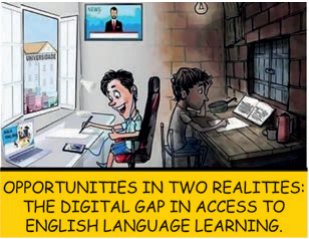 Available at: https://saladerecursos.com.br/. Accessed on: April 8, 2024 (adapted).
TEXT 2
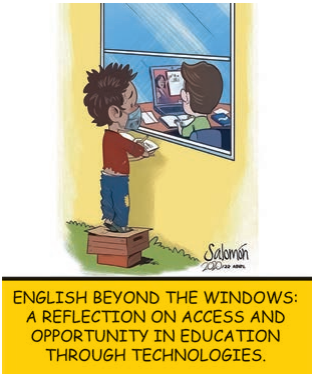 Available at: https://petletras.paginas.ufsc.br/.
Accessed on: April 8, 2024 (adapted).
Available at: https://petletras.paginas.ufsc.br/.
Accessed on: April 8, 2024 (adapted).
From the analysis of the images above, nowadays, the use of digital technologies in English learning
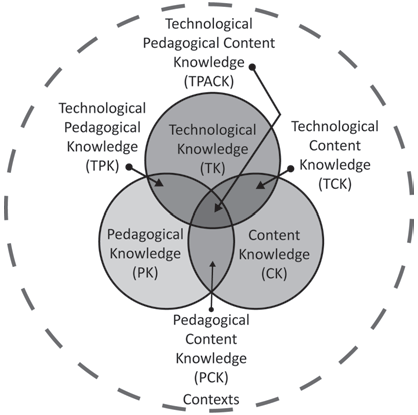 SILVA, J. B.; BILESSIMO, S. M. S.; MACHADO, L. R. Integration of technology in education:
proposal for a teacher training model inspired by TPACK.
Educação em revista, v. 27, 2021 (adapted).
SILVA, J. B.; BILESSIMO, S. M. S.; MACHADO, L. R. Integration of technology in education:
proposal for a teacher training model inspired by TPACK.
Educação em revista, v. 27, 2021 (adapted).
After a two-week workshop on TPACK, a High School teacher prepared a class to be taught in a computer lab in which he had to focus on a coursebook unit entitled Fashion & English, and on the Base Nacional Comum Curricular (BNCC) skill EM13LP17, which covers the phenomenon of regional language variation in its pragmatic-discursive dimension and seeks to promote a students’ broader understanding of the living and dynamic nature of the English language.
Based on these informations, which of the following class ideas can he develop in order to meet the elements presented above?
ERVIN, J. Critically reading the canon: culturally sustaining approaches to a prescribed literary curriculum. Journal of adolescent & adult literacy, v. 65, n. 4, 2022 (adapted).
The abstract excerpt above points to a challenge faced by literature teachers in finding classroom procedures that ensure more culturally sustaining teaching considering limitations imposed by a prescribed curriculum.
In this context, which of the following examples of classes conducted in the scope of literary analysis would align with the approach advocated in the abstract?
 AMOS, E.; CONDI, R. (Orgs.). Peacemakers: 6º Ano. 2 ed. São Paulo: Richmond, 2022.
Due to the spread of English in the 21st century to countries where it is neither a first nor an official language, its use is evident in various contexts, as illustrated in the textbook pictures above. A teacher could use this material to
Considering this scenario, to foster an inclusive learning environment, the teacher should address the linguistic diversity and geopolitical aspects of English by
TEXT 1
News is irrelevant. Out of the approximately 10,000 news stories you have read in the last 12 months, name one that – because you consumed it – allowed you to make a better decision about a serious matter affecting your life, your career or your business. The point is: the consumption of news is irrelevant to you. But people find it very difficult to recognise what’s relevant. It’s much easier to recognise what’s new. The relevant versus the new is the fundamental battle of the current age. In reality, news consumption is a competitive disadvantage. The less news you consume, the bigger the advantage you have.
Available at: https://www.theguardian.com/. Accessed on: June 06, 2024 (adapted).
TEXT 2
What students are saying about how social media affects their body image?
By The Learning Network – March 31, 2022
As we regularly do when The Times writes about an issue that touches the lives of young people, we used our daily Student Opinion forum to ask teenagers to share their perspectives on social media and body image. Let’s see what students from Hanover Horton High School think about it:
Student: LB, Hoggard High School, Wilmington NC
“When I was in fifth grade, I got Instagram and, at first, I was obsessed… It was all so new, but eventually I realized there was “no harm”. I regret thinking that. I would follow all the celebrities my friends did [...]. I started to feel inadequate about the way I dressed and looked… Eventually, I couldn’t stand the unhappiness of it all and I deleted the app. At first it felt weird. I would turn my phone to check it and nothing was there, in the end I forgot about it and I am better because of it. Social media makes you feel like you are less than you are.”
Student: Alexis, Hanover Horton High School “I find that I encounter more body positive content than negative. The reason for this though depends who you follow and surround yourself with, and I make sure to surround myself and follow those who encourage me instead of putting me down. When I see body positive content on social media I find that it just makes me feel normal for the body I have. Positive content can show people that your body doesn’t define you.”
Available at: https://www.nytimes.com/. Accessed on: August 9, 2024 (adapted). *R1001202422* LETRAS - INGLÊS 23
TEXT 3
Available at: https://inglesnoteclado.com.br/. Accessed on: August 9, 2024.
The Base Nacional Comum Curricular (BNCC) objective that could be covered in such a teaching proposal is
Over 2 billion people speak English as a first or second language, which means one out of 4 people can speak English! It makes English the largest language by the number of speakers, and the third largest language by the number of native speakers. With 300 million native speakers, the United States of America is the largest English-speaking country. And by the way, the US doesn’t have an official language. Additionally, there are 60 million native speakers in the United Kingdom, 29 million in Canada, 25.1 million in Australia, 4.7 million in the Republic of Ireland, and 4.9 million in New Zealand.It is an official language of 67 countries as well as 27 non-sovereign entities such as Hong Kong or Puerto Rico. From the website: https://englishwithnab.com/25-facts-about-the-english-language/
According to the text, which position English as a language holds among the most spoken languages of the world?
A: I have the perfect son. B: Does he smoke? A: No, he doesn't. B: Does he drink whiskey? A: No, he doesn't. B: Does he ever come home late? A: No, he doesn't. B: I guess you really do have the perfect son. How old is he? A: He will be six months old next Wednesday.
From the website: http://iteslj.org/c/jokes-short.html
Why does the son not smoke, drink whiskey or come home late?
I. not soft enough
II. not long enough
III. not new enough
IV. not cheap enough

 Conheça nossos planos