Questões de Concurso
Sobre concepções de educação infantil em pedagogia
Foram encontradas 2.431 questões


Ano: 2026
Banca:
VUNESP
Órgão:
Prefeitura de Jundiaí - SP
Prova:
VUNESP - 2026 - Prefeitura de Jundiaí - SP - Professor I (Educação Infantil/Ensino Fundamental – Anos Iniciais/Educação de Jovens e Adultos) |
Q4394931
Pedagogia
De acordo com Oliveira (2018), o currículo por campos
de experiência defende a necessidade de conduzir o trabalho pedagógico na Educação Infantil por meio da organização de
Ano: 2026
Banca:
VUNESP
Órgão:
Prefeitura de Jundiaí - SP
Prova:
VUNESP - 2026 - Prefeitura de Jundiaí - SP - Professor I (Educação Infantil/Ensino Fundamental – Anos Iniciais/Educação de Jovens e Adultos) |
Q4394926
Pedagogia
Assinale a alternativa que apresenta corretamente o
que Focchi (2018) entende como “o grande propósito” da
estratégia da Documentação Pedagógica.
Ano: 2026
Banca:
VUNESP
Órgão:
Prefeitura de Jundiaí - SP
Prova:
VUNESP - 2026 - Prefeitura de Jundiaí - SP - Professor I (Educação Infantil/Ensino Fundamental – Anos Iniciais/Educação de Jovens e Adultos) |
Q4394923
Pedagogia
Augusto (2013) discute os muitos sentidos que podem
ser atribuídos à experiência.
No contexto da Educação Infantil, a autora especifica que a experiência deve ter como sua mais importante característica
No contexto da Educação Infantil, a autora especifica que a experiência deve ter como sua mais importante característica
Ano: 2026
Banca:
VUNESP
Órgão:
Prefeitura de Jundiaí - SP
Prova:
VUNESP - 2026 - Prefeitura de Jundiaí - SP - Professor I (Educação Infantil/Ensino Fundamental – Anos Iniciais/Educação de Jovens e Adultos) |
Q4394918
Pedagogia
Como deve ser uma instituição de educação infantil de
qualidade? A partir de questionamentos como esse, o
documento Indicadores da Qualidade na Educação Infantil
(Brasil, 2009) apresenta-se como um instrumento de auxílio para que escolas e suas comunidades possam avaliar
a qualidade da educação que oferecem às crianças.
Entre os pressupostos que sustentam o documento, está o entendimento de que os espaços escolares destinados à educação infantil devem
Entre os pressupostos que sustentam o documento, está o entendimento de que os espaços escolares destinados à educação infantil devem
Ano: 2026
Banca:
AMEOSC
Órgão:
Prefeitura de Barra Bonita - SC
Prova:
AMEOSC - 2026 - Prefeitura de Barra Bonita - SC - Auxiliar de Creche e Pré-Escola |
Q4393305
Pedagogia
No berçário de uma creche municipal, uma auxiliar de
creche e pré-escola organizou as trocas de fralda em
série, para ganhar tempo antes do horário do almoço.
Ela retira e recoloca as fraldas em sequência, sem dirigir
a palavra aos bebês, sem esperar qualquer reação deles
e sem interromper a conversa que mantém com a colega ao lado. Ao observar a cena, a coordenação pedagógica
retoma com a equipe a concepção que sustenta o
trabalho na etapa.
Com base no caso apresentado, assinale a alternativa correta:
Com base no caso apresentado, assinale a alternativa correta:
Ano: 2026
Banca:
Quadrix
Órgão:
Prefeitura de Cristalina - GO
Prova:
Quadrix - 2026 - Prefeitura de Cristalina - GO - Professor PII – Pedagogia |
Q4392596
Pedagogia
Em uma proposta de educação infantil, a professora
apresentou situações envolvendo objetos colocados na
água. As crianças formularam hipóteses, testaram‑nas,
confrontaram resultados e identificaram relações que
passaram a utilizar para interpretar situações novas.
A professora interveio modificando as condições das
situações e sistematizando as relações construídas.
Com base nessa situação hipotética e na concepção de ensino e aprendizagem discutida por Libâneo (2004), segundo a qual “não se trata do ‘aprender fazendo’” (p. 20), assinale a opção correta.
Com base nessa situação hipotética e na concepção de ensino e aprendizagem discutida por Libâneo (2004), segundo a qual “não se trata do ‘aprender fazendo’” (p. 20), assinale a opção correta.
Ano: 2026
Banca:
Quadrix
Órgão:
Prefeitura de Cristalina - GO
Prova:
Quadrix - 2026 - Prefeitura de Cristalina - GO - Professor PII – Pedagogia |
Q4392587
Pedagogia
Uma rede municipal decidiu adequar o currículo da
educação infantil à BNCC e adotou apostilas semanais com
atividades previamente organizadas para a pré‑escola.
A medida gerou debates sobre suas implicações para o
currículo e para o trabalho pedagógico.
Com base nessa situação hipotética, nos fundamentos da educação infantil e nas orientações curriculares vigentes, assinale a opção correta.
Com base nessa situação hipotética, nos fundamentos da educação infantil e nas orientações curriculares vigentes, assinale a opção correta.
Ano: 2026
Banca:
Quadrix
Órgão:
Prefeitura de Cristalina - GO
Prova:
Quadrix - 2026 - Prefeitura de Cristalina - GO - Agente de Apoio Educacional |
Q4392476
Pedagogia
Na educação infantil, o acompanhamento do
desenvolvimento das crianças integra o trabalho
pedagógico e fornece elementos para a organização das
práticas educativas. Considerando essa informação e as
concepções estabelecidas para essa etapa da educação
básica, é correto afirmar que esse acompanhamento deve
Ano: 2026
Banca:
Quadrix
Órgão:
Prefeitura de Cristalina - GO
Prova:
Quadrix - 2026 - Prefeitura de Cristalina - GO - Agente de Apoio Educacional |
Q4392475
Pedagogia
Em uma instituição de educação infantil, uma criança de
quatro anos de idade apresentava diferenças em relação
ao ritmo de desenvolvimento de outras crianças do
mesmo grupo, especialmente quanto à linguagem oral
e à participação em algumas atividades coletivas. Diante
da situação, parte da equipe defendia que a criança fosse
submetida a uma sequência de atividades específicas
para acelerar as habilidades consideradas abaixo do
esperado para sua idade. Outra parte propunha observar
as diferentes formas pelas quais a criança participava das
experiências cotidianas, considerando as suas interações,
os seus interesses, as suas formas de expressão e as suas
condições concretas de aprendizagem.
Considerando essa situação hipotética e os fundamentos das Diretrizes Curriculares Nacionais para a Educação Infantil e da Base Nacional Comum Curricular (BNCC), é correto afirmar que a segunda perspectiva é a adequada para esse caso, porque
Considerando essa situação hipotética e os fundamentos das Diretrizes Curriculares Nacionais para a Educação Infantil e da Base Nacional Comum Curricular (BNCC), é correto afirmar que a segunda perspectiva é a adequada para esse caso, porque
Ano: 2026
Banca:
IGEDUC
Órgão:
Prefeitura de Custódia - PE
Prova:
IGEDUC - 2026 - Prefeitura de Custódia - PE - Psicopedagogo |
Q4391655
Pedagogia
Acompanhando crianças da Educação Infantil, o
psicopedagogo identifica diferenças nos processos de
aquisição de habilidades motoras, resolução de problemas e participação nas interações coletivas.
Considerando os fundamentos do desenvolvimento
infantil e as relações entre os domínios cognitivo, motor e
socioemocional, assinale a alternativa CORRETA.
Ano: 2026
Banca:
FEPESE
Órgão:
Prefeitura de São José - SC
Prova:
FEPESE - 2026 - Prefeitura de São José - SC - Professor - Educação Infantil |
Q4389713
Pedagogia
Assinale a alternativa correta segundo o Currículo
Base da Educação Josefense (2026).
Ano: 2026
Banca:
FEPESE
Órgão:
Prefeitura de São José - SC
Prova:
FEPESE - 2026 - Prefeitura de São José - SC - Professor - Educação Infantil |
Q4389709
Pedagogia
De acordo com o Currículo Base da Educação
Josefense (2026), uma Pedagogia da Infância deve:
Ano: 2026
Banca:
FEPESE
Órgão:
Prefeitura de São José - SC
Prova:
FEPESE - 2026 - Prefeitura de São José - SC - Professor - Educação Infantil |
Q4389702
Pedagogia
Segundo o documento Política Nacional de Educação Infantil: pelo direito das crianças de 0 a 6 anos à
educação (MEC, 2006), a Educação Infantil deve:
Ano: 2026
Banca:
FEPESE
Órgão:
Prefeitura de Concórdia - SC
Prova:
FEPESE - 2026 - Prefeitura de Concórdia - SC - Auxiliar Educacional - Edital nº 5 |
Q4389301
Pedagogia
A Base Nacional Comum Curricular (BNCC) organiza a Educação Infantil reconhecendo a criança como
sujeito ativo, que aprende e se desenvolve nas interações, nas brincadeiras e nas diferentes experiências
vivenciadas no cotidiano.
Assinale a alternativa correta considerando a organização curricular da Educação Infantil estabelecida pela BNCC.
Assinale a alternativa correta considerando a organização curricular da Educação Infantil estabelecida pela BNCC.
Ano: 2026
Banca:
FEPESE
Órgão:
Prefeitura de Concórdia - SC
Prova:
FEPESE - 2026 - Prefeitura de Concórdia - SC - Auxiliar Educacional - Edital nº 5 |
Q4389300
Pedagogia
O desenvolvimento infantil envolve transformações físicas, cognitivas, afetivas, sociais e psicomotoras
que se manifestam de diferentes formas nas experiências vivenciadas pelas crianças na Educação Infantil.
Assinale a alternativa correta considerando a compreensão do desenvolvimento infantil em suas diferentes dimensões.
Assinale a alternativa correta considerando a compreensão do desenvolvimento infantil em suas diferentes dimensões.
Ano: 2026
Banca:
FEPESE
Órgão:
Prefeitura de Concórdia - SC
Prova:
FEPESE - 2026 - Prefeitura de Concórdia - SC - Auxiliar Educacional - Edital nº 5 |
Q4389298
Pedagogia
Durante a troca de fraldas de uma criança de dois
anos, a profissional percebe que ela procura participar
desse momento: levanta as pernas quando solicitada,
aponta para os materiais e tenta puxar a própria roupa.
Como a rotina do grupo está atrasada, outra profissional sugere realizar todo o procedimento rapidamente
para recuperar o horário previsto.
Considerando a indissociabilidade entre cuidar e educar, o desenvolvimento infantil e a construção progressiva da autonomia, assinale a alternativa que apresenta a conduta correta diante da situação descrita.
Considerando a indissociabilidade entre cuidar e educar, o desenvolvimento infantil e a construção progressiva da autonomia, assinale a alternativa que apresenta a conduta correta diante da situação descrita.
Ano: 2026
Banca:
FEPESE
Órgão:
Prefeitura de São José - SC
Prova:
FEPESE - 2026 - Prefeitura de São José - SC - Professor - Educação Física - Ed. Infantil/Ens. Fundamental e Atividades Complementares |
Q4389286
Pedagogia
“O campo da Educação Infantil vive um intenso
processo de revisão de concepções sobre educação
de crianças” (Diretrizes Curriculares Nacionais para a
Educação Infantil, 2010).
De acordo com o documento citado, as práticas pedagógicas que compõem a proposta curricular da Educação Infantil devem ter quais eixos norteadores?
De acordo com o documento citado, as práticas pedagógicas que compõem a proposta curricular da Educação Infantil devem ter quais eixos norteadores?
Ano: 2026
Banca:
FEPESE
Órgão:
Prefeitura de São José - SC
Prova:
FEPESE - 2026 - Prefeitura de São José - SC - Auxiliar de Sala - Educação Infantil |
Q4388516
Pedagogia
Em uma turma de crianças pequenas, a professora percebe que um grupo frequentemente reúne
cadeiras, tecidos e caixas para construir “casas”. Durante
essas brincadeiras, as crianças distribuem papéis, simulam refeições, cuidam de bonecas, discutem quem
pode entrar e transformam os objetos de acordo com
as necessidades da narrativa. A professora considera
interromper essas brincadeiras para ampliar o tempo
destinado a atividades previamente produzidas em
folhas impressas. Antes de modificar a rotina, decide
analisar pedagogicamente o que está acontecendo.
Considerando a brincadeira como uma forma de expressão, interação e produção das culturas infantis, assinale a alternativa que apresenta a conduta pedagógica mais adequada diante da situação descrita.
Considerando a brincadeira como uma forma de expressão, interação e produção das culturas infantis, assinale a alternativa que apresenta a conduta pedagógica mais adequada diante da situação descrita.
Ano: 2026
Banca:
FEPESE
Órgão:
Prefeitura de São José - SC
Prova:
FEPESE - 2026 - Prefeitura de São José - SC - Auxiliar de Sala - Educação Infantil |
Q4388515
Pedagogia
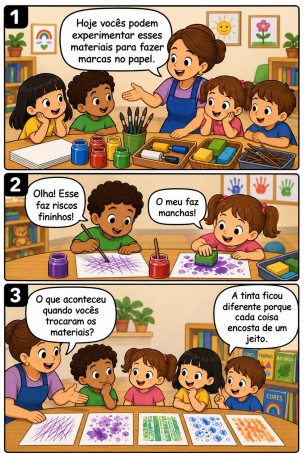
Leia a situação representada nas tirinhas.
Ano: 2026
Banca:
FEPESE
Órgão:
Prefeitura de São José - SC
Prova:
FEPESE - 2026 - Prefeitura de São José - SC - Auxiliar de Sala - Educação Infantil |
Q4388511
Pedagogia
A documentação pedagógica pode contribuir
para que o professor compreenda os processos vivenciados pelas crianças e qualifique seu planejamento.
Identifique abaixo as afirmativas verdadeiras ( V ) e falsas ( F ) em relação ao tema.
( ) Registros escritos, fotografias, produções infantis e transcrições de falas podem fornecer indícios sobre interesses, hipóteses, relações e aprendizagens das crianças.
( ) A documentação pedagógica deve priorizar a organização e o arquivamento dos registros produzidos, evitando interpretações do professor que possam interferir na objetividade das informações.
( ) A avaliação na Educação Infantil tem como função principal estabelecer níveis de desempenho para organizar a progressão das crianças entre os grupos.
( ) O planejamento pode ser revisto a partir da análise das experiências vividas, das manifestações das crianças e das situações observadas pelo professor.
Assinale a alternativa que indica a sequência correta, de cima para baixo.
Identifique abaixo as afirmativas verdadeiras ( V ) e falsas ( F ) em relação ao tema.
( ) Registros escritos, fotografias, produções infantis e transcrições de falas podem fornecer indícios sobre interesses, hipóteses, relações e aprendizagens das crianças.
( ) A documentação pedagógica deve priorizar a organização e o arquivamento dos registros produzidos, evitando interpretações do professor que possam interferir na objetividade das informações.
( ) A avaliação na Educação Infantil tem como função principal estabelecer níveis de desempenho para organizar a progressão das crianças entre os grupos.
( ) O planejamento pode ser revisto a partir da análise das experiências vividas, das manifestações das crianças e das situações observadas pelo professor.
Assinale a alternativa que indica a sequência correta, de cima para baixo.

 Conheça nossos planos